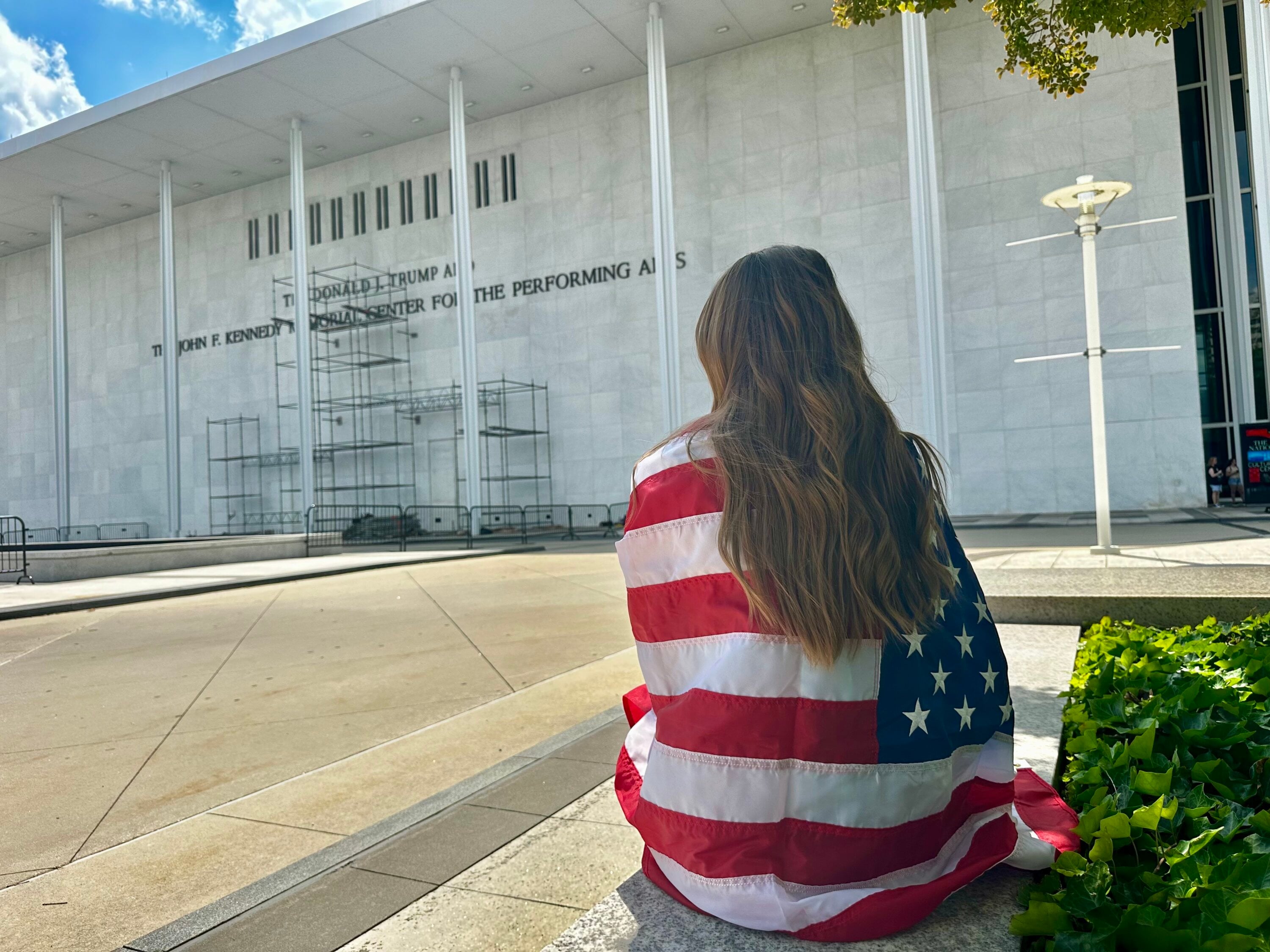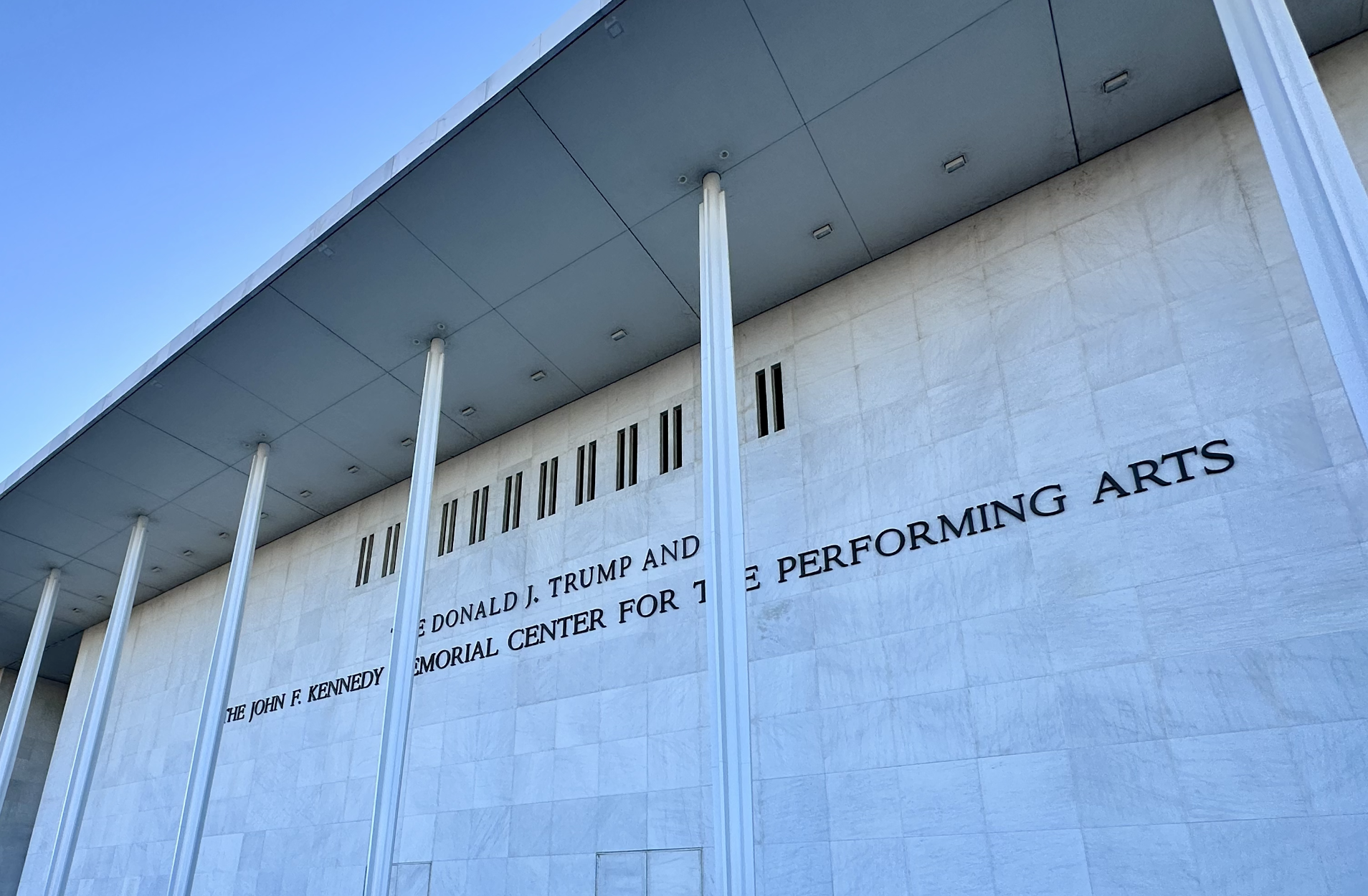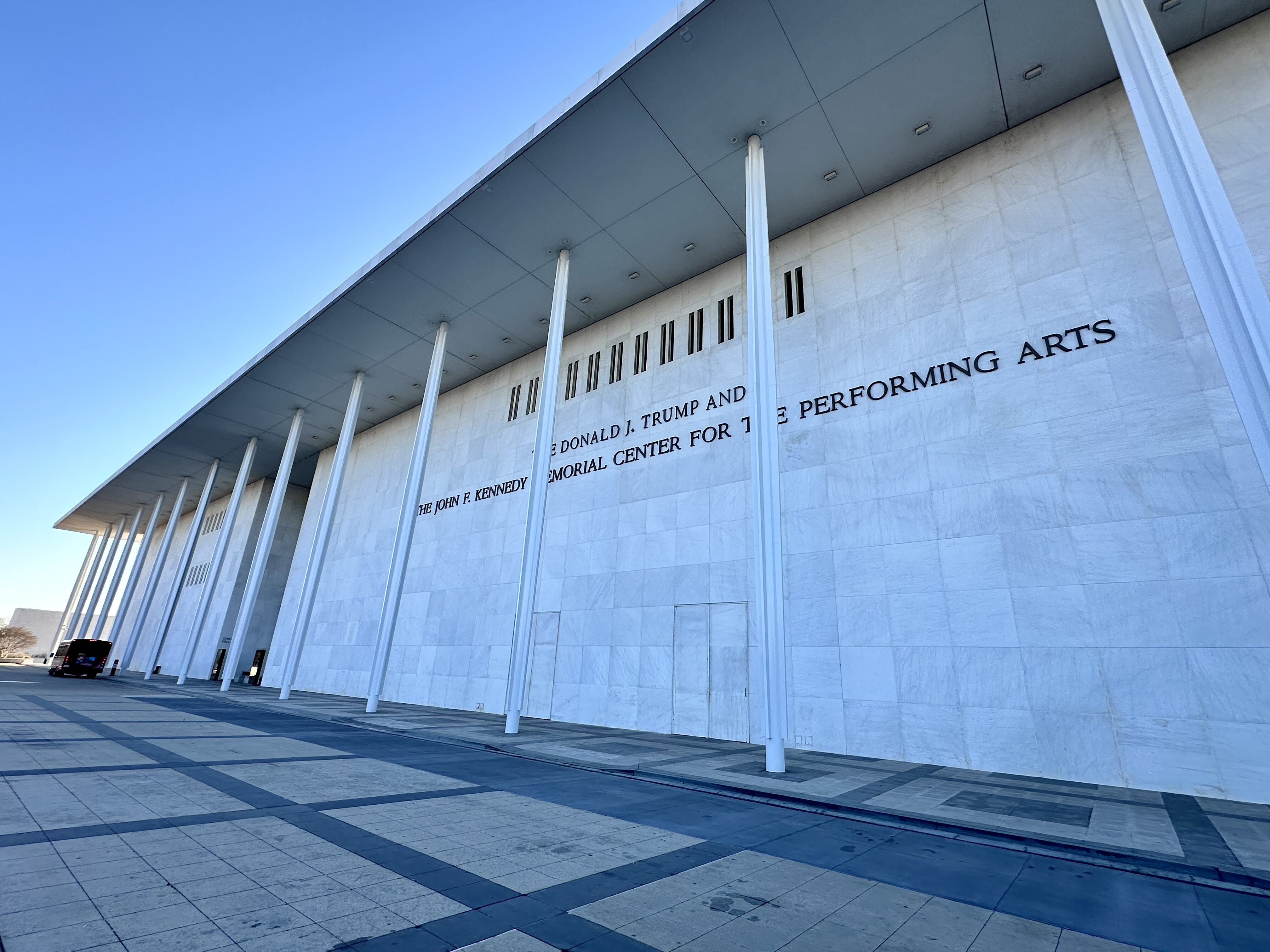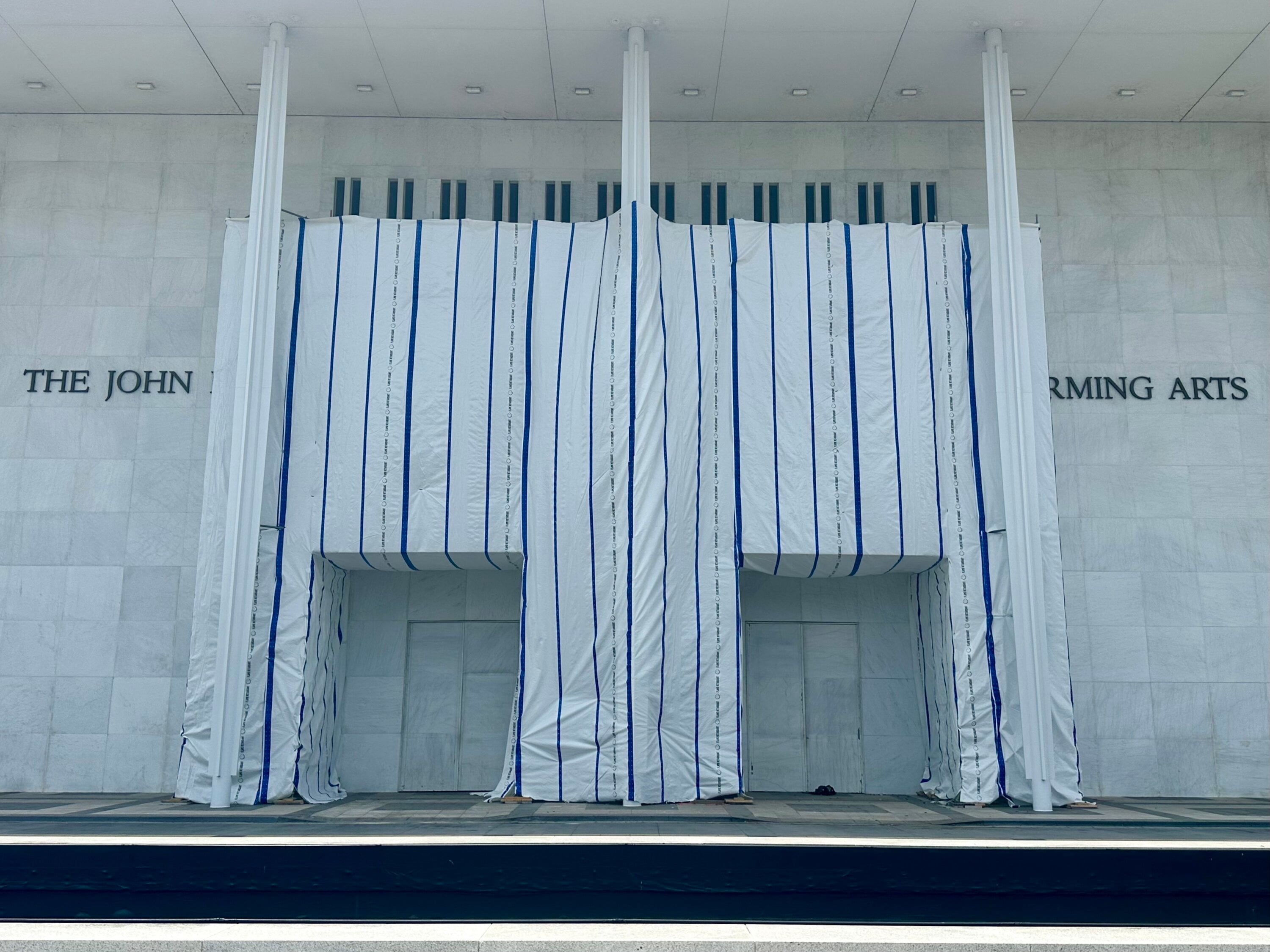
In the early hours of Saturday morning, neon-vested workmen pulled the “Donald J. Trump” lettering from the facade of the Kennedy Center. But even before the sign came down, the Trump administration had asked a court to allow them to put it back up. In the meantime, the Kennedy Center has covered the facade with a tarp.
So is the Trump sign gone for good? And can anything be done about the tarp? What about that bizarre court filing that the Trump administration submitted on Friday? Perhaps you never imagined that you’d have burning questions about such a drab topic as “the stay pending appeal related to the Kennedy Center signage,” or that anything could be revelatory about a “Department of Justice signature block,” but here we are. Below are answers to all your questions—and to questions you didn’t even know you had—about the current status of the legal battle over the Kennedy Center.
In brief, how did we get where we are?
Recall that in May, in response to a lawsuit brought by Ohio Congresswoman Joyce Beatty, US District Judge Christopher Cooper ordered the Kennedy Center to remove Trump’s name from the building’s facade. (If you do not recall this, you can read our previous explainer here.) The Kennedy Center seemed to be complying—until the evening before Cooper’s deadline, when the board voted to appeal the ruling. A flurry of court filings ensued, resulting in some will-they-won’t-they drama about whether the big “Donald J. Trump” sign would actually come down. Early in the morning on Saturday, it did—although the public can’t see it, because the facade is now obscured by a tarp.
If the sign came down, isn’t the lawsuit over?
It sure isn’t. Cooper ruled that renaming the Kennedy Center after Trump was illegal, but the Trump administration has filed an appeal, asking the DC Circuit to overturn Cooper’s ruling. Simultaneously, the administration is asking for a stay pending appeal. That means, in essence, that they want the DC Circuit to allow them to put the Trump sign back up until the underlying appeal is decided.
How does the tarp fit into the ongoing litigation?
Basically, it doesn’t. There is currently nothing before the court related to the tarp, but Beatty’s legal team has asked for information about it, such as why it’s there and when it might come down. “It certainly seems like an attempt to hide embarrassment on Donald Trump’s part,” says Nathaniel Zelinsky, an attorney representing Congresswoman Beatty. The Kennedy Center did not respond to a request for comment, but a spokesperson told the Washington Post that the tarp and scaffolding will remain “while crews evaluate how to repair the exterior marble” and also inspect “slabs on the underside of the overhanging roof.” The spokesperson did not give a timeframe for that work.
Can Beatty’s lawyers do something about the tarp?
“I’m not sure anything can be done about the tarp,” says Sean Marotta, an appellate lawyer who closely follows the DC Circuit. “Quite frankly, I’m not sure there’s a legal right to have them take it down.” The Kennedy Center’s founding statute has lots of language about what can’t be added to various public areas in the building, but it didn’t seem to occur to Congress to dictate what must be there, including the Kennedy name on the building.
One might argue that to obscure the Kennedy name is a breach of the board’s fiduciary duty—the name would seem to be an integral part of the memorial, which the board is legally obligated to maintain—but that would probably be tough to litigate. Zelinsky says that his team is “evaluating what the appropriate next steps might be.” He adds that, “At best, this is a kind of malicious compliance that’s an attempt to evade the spirit of the court’s decision. It’s vintage Donald Trump: hiding a national memorial because he can’t get his way.”
When will the court rule about whether the Trump sign can be reinstalled?
The stay pending appeal, which concerns whether the signage can be reinstalled while the underlying appeal moves through the court, should be resolved fairly quickly. The court asked for a briefing from both sides by June 29, and it can rule anytime thereafter.
But the underlying appeal is likely to move more slowly. If it’s not expedited, the oral arguments would probably be heard next year. If expedited, it could be decided in six-ish months.
Is the Trump administration likely to win that appeal?
Anything is possible, but so far, team Trump has not done much winning on the Kennedy Center in court. Furthermore, the text of the appeal that the Trump administration filed is…idiosyncratic.
Oh. What’s up with the text of the appeal?
Well, the first six pages—three full pages of which include zero paragraph breaks—have an eccentric prose styling reminiscent of the President’s internet screeds. It describes how renaming the Kennedy Center for Donald Trump has enabled it to “function as a financially sound and physically beautiful enterprise, as opposed to a bankrupt eyesore that, for years, will [sic] look like nothing more than an abandoned hulk.” There are jabs at his enemies (Beatty, the plaintiff in the suit, was a “troublemaking appointment, from the beginning of her tenure!”), and odd digressions (tons of verbiage about the renovation of the Kennedy Center when that portion of the ruling is not even being appealed).
“What’s so unusual about that filing is you have this introduction that sounds like a Truth Social post,” explains Marotta, “and then you have the rest of the filing that sounds like a completely normal Department of Justice brief.” It “comes off like a rant,” he adds—the kind “you might imagine from a litigant who is representing himself.”
That’s the President’s style. Is it possible that he wrote it himself?
Yes, it’s possible, and there’s been lots of speculation to that effect. “It’s not how lawyers write,” Marotta says of the first part of that filing. “And if you want to see how lawyers write, all you have to do is read the rest of the brief.” He reminds us, though, that we do not know who authored that part of the appeal. “Is there someone at the Department of Justice who is trying to train themselves to sound like a Donald Trump Truth Social post?” he asks. “Is it that they sent the draft to somebody in the White House who has trained themselves to write like a Truth Social post? Did they give it to the President, and he dictated it?” All we know for sure, he points out, “is that there are people at the Department of Justice who are willing to file a brief that has an introduction that sounds like that.”
Right, an actual attorney filed this document. Who was it?
The sole signatory on this appeal is Assistant Attorney General Brett Shumate.
And what should we glean from that?
According to Marotta, a lot. On a filing in a high-profile case like this one, you might expect to see a half dozen signatures. The fact that there’s only a single signature—and it’s a political appointee, rather than a career attorney—sends a message that the filing might be problematic. This requires a little background to understand.
The Department of Justice is staffed with rank-and-file, nonpartisan lawyers called “line attorneys.” Ideally, multiple line attorneys would draft and sign such a filing. But during the first Trump administration, a lot of filings ended up in the docket with just a single political appointee on the signature block, so at the beginning of Trump’s second term, Attorney General Pam Bondi issued a memo essentially telling the department to fall in line. She wrote that “any attorney who because of their personal political views or judgments declines to sign a brief…will be subject to discipline and potentially termination, consistent with applicable law.” Despite this threat, not a single line attorney signed this Kennedy Center appeal.
“What I take from that,” Marotta says, “is that the line attorneys saw the introduction and said, ‘I’m not putting my name on that.’” Generally speaking, line attorneys—who might spend a few decades at DOJ, under very different flavors of White House—understand that “within a range of normal positions, you just shift with the tide.” But in this case, Marotta thinks that either the political appointees knew the text was too odd to ask their people to sign, or that the line attorneys were asked to sign it and refused. (Shumate, the sole signatory, did not respond to a request for comment.)
There’s a particularly bizarre part of this appeal that pertains to fundraising. What is that?
Essentially, the appeal suggests that there is a fundraising entity (The Trump Kennedy Center for the Performing Arts Foundation) whose bylaws state that if Trump’s name ever comes off of any part of the Kennedy Center (website, facade, letterhead, etc.), then the Kennedy Center is legally obligated to return all money raised by the foundation and will never receive money from them again in the future. The filing claims that hundreds of millions of dollars either have been or will be raised via this foundation, and that this fundraising is only possible if the Trump name is affiliated with the Kennedy Center, because donors appreciate “the concept of two Great Presidents, one Republican, one Democrat, working together as one — In many ways, a bipartisan relationship!”
And what is the Trump Kennedy Center for the Performing Arts Foundation, exactly?
“We have no idea,” says Zelinsky. “This is the first time this has come up at all in the litigation.” Neither the Kennedy Center nor the attorney who signed the filing responded to our requests for clarification.
Zelinsky says that this foundation might be “totally made up,” but if it’s real—and the clawback clause in its bylaws really does exist—then the President is essentially using it to threaten the Kennedy Center financially. Zelinksy describes it as tantamount to telling the court “‘if you don’t give me what I want and allow me to violate the law, then I’ll cripple the institution I’m charged to protect.” He says his team is trying to get to the bottom of it, “but it’s incumbent on the government to explain itself.”
Will the strange content and offbeat writing style of this appeal affect how the judge sees it?
Almost definitely. For one, Marotta says, it tends to irritate judges when litigants make emotional appeals, rather than rational arguments grounded in the law. And second, he says, there’s a reputational risk to appearing to agree with something so eccentric. “I’m not saying they wouldn’t grant a stay if one were warranted,” he says of the judges involved, “but you have to imagine it makes them think again, because the headlines are going to be ‘appellate court grants stay in response to crazy Trumpian rant.’ ” He added that, “Judges read the newspaper, too.”
What can we expect to see next?
Sometime after June 29, the stay pending appeal will go to a three-judge panel from the DC Circuit. In the meantime, we’ll see whether the tarp comes down.
Simultaneously, in the District Court, there’s ongoing litigation about whether the Kennedy Center will stay open. Judge Cooper ruled that the Kennedy Center could not close for renovations, at least for the time being. But Beatty’s legal team remains concerned that the board will effectively proceed with the closure by failing to schedule any programming. On Tuesday, in response to a motion from Beatty’s team, Cooper ordered the Kennedy Center explain how they’re complying with the court order, “including plans for public access and ongoing programming, activities, and operations after July 5, 2026.” He set a deadline of June 19.
Wait, but I’m ready to return to the Kennedy Center now that the sign has come down—are you telling me that there’s nothing there for me to see?
Essentially, yes. Isn’t that ironic? You can read more about it here.
This article has been updated to reflect a Tuesday afternoon court order related to the Kennedy Center’s planned closure, and to include a statement about the tarp that was given to the Washington Post.