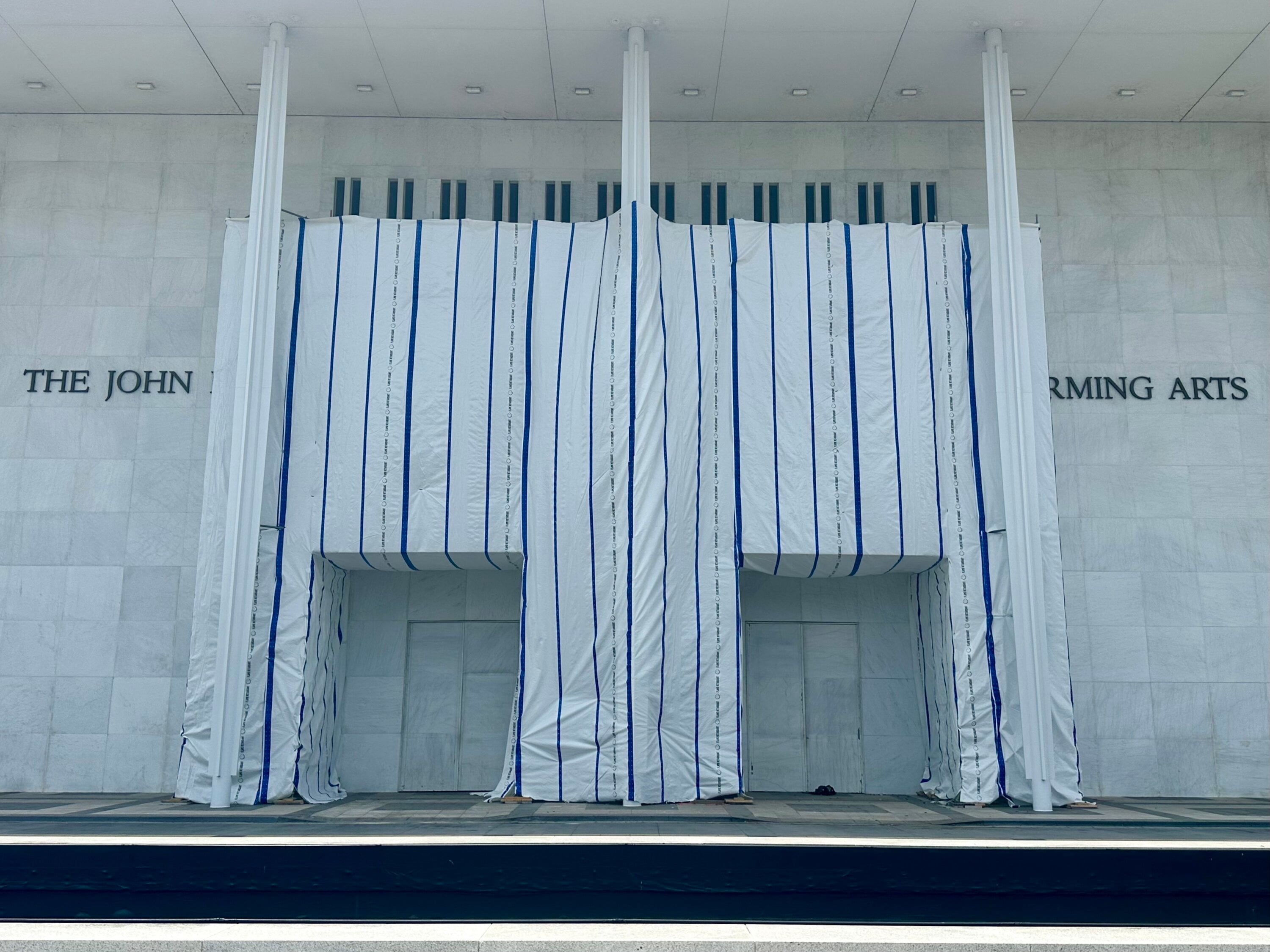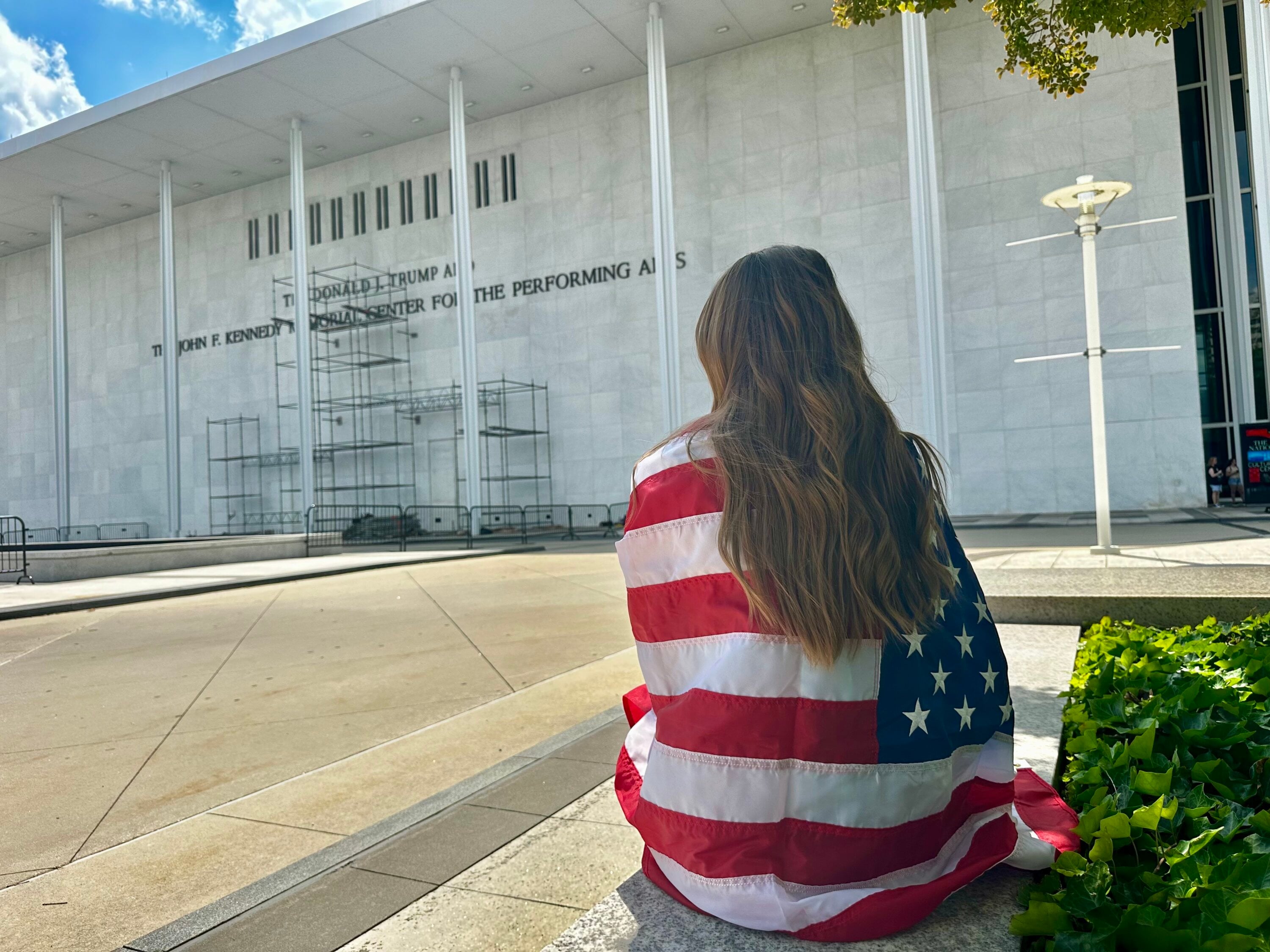
Yesterday evening, I walked past throngs of revelers keeping vigil outside the Kennedy Center, who were waiting for the President’s name to come down from the building’s facade. A federal judge had ordered the name to be removed by midnight. Scaffolding was going up around the lettering. All around, I saw people clumped together, waving signs and chattering in anticipation. There were chants of “Take. It. Down.” and “Fuck. Donald. Trump.” People snapped pictures, sipped sodas, and sweated in the humidity. Cheers periodically rolled through the crowd.
I love coming to the Kennedy Center. I love feeling small against its towering windows, watching the sun descend over the river, eating the oddly good cookies, and taking in the views from the roof. But most of all, I love sitting in the concert hall and spending a couple of hours hearing music that untethers me from earth. That’s what I’d meant to do last night; I had a ticket to the National Symphony Orchestra. I wanted to spend the evening hearing Copland and Gershwin and Barber. I wanted to not think about Donald Trump at all.
Instead, I found myself reeled into the crowd, into the drama of whether the sign would come down. I skipped the concert, spending hours milling around the plaza, neck craned skyward at the lettering, chatting with other people who’d come. To many of them, the Trump signage is a psychic assault. It’s emblematic of the President’s desecration of American democracy and institutions, not to mention his spiteful and chaotic rampage through DC. And there’s a more elemental thing, too: a desire to see a wrong made right, or even simply to access the building without getting the creeps—without walking beneath the enormous “Donald J. Trump” lettering, past his scowling portrait, and through the newly installed metal detectors, only to sit in a half-empty concert hall that just 18 months ago would have been full.
Affixing Trump’s name to the Kennedy Center was bad. It was illegal, reputationally catastrophic for the institution, eerily authoritarian, and crass. But to be honest, I’ve grown wary of the deafening clamor over the sign. I’m not suggesting that the glee about its removal is misplaced, necessarily, just that focus seems to have snagged on the Kennedy Center’s exterior, while what’s truly alarming is occurring inside. Taking the name down will help, I think. Some number of audience members and performers may return. Some wayward donors may be willing to resume their support. But it’s not going to solve the problem. My biggest concern is that the Kennedy Center will remain nominally open—as in, I’ll be free to walk through the doors and perhaps buy a coffee at the cafe—but there will be few, or even no, performances to see.
At one time, the Kennedy Center’s programming issues were related to its signage—audiences and performers refusing to show up to an institution that was named for Trump—but now the issue is more diffuse. Since the Trump takeover, the Kennedy Center has lost most of its programming staff and seems to be making no efforts to replace them. What’s more, administrators wound down programming in anticipation of the two-year closure, which was slated to begin in July. A federal judge halted that plan, ordering the Kennedy Center to stay open—but its calendar remains bare after July 5. There’s a motion before the court asking the Kennedy Center to submit evidence that they’re actively seeking to book performances. But there’s no apparent movement on that front. The sign can come down, and the sign should come down, but it’s one battle in a much larger war.
What enrages me, specifically, is not the sign itself, but one of many things of which it’s become symbolic: the human toll of Trump’s mismanagement—on the performers and ushers and stagehands and box office workers, on all the carpenters and electricians and arts administrators and cafe workers who have given chunks of their lives to making the Kennedy Center run, to supporting performances that ennoble and delight us. Many of those folks have lost their jobs. Those who remain are watching their passions turn to ash while the Kennedy Center falls apart.
In the crowd, I spoke with Anne Vantine, a retired box office worker who’s now the president of her union’s local. She worked at the Kennedy Center for 27 years before retiring in December so that she could, in her words, “fight from the outside” for her colleagues’ jobs. Currently, many box office workers have been laid off, while the Kennedy Center is considering terminating the rest and outsourcing their work. (It’s a deceptively complex job, Vantine explained to me—each worker must know the sightlines for nine different theaters and be able to sell every genre of performance. By contrast, Lincoln Center has three theaters, each with a box office of its own.) Vantine said she’ll be happy once the sign is gone, and that the name coming down will be “a huge boost for the people working in the building, and that’s great, because hope has been dwindling. But we are really fighting for our careers out here.” For her and her union, removing the Trump sign “doesn’t solve the fear over whether we’re still going to have a job.”
Milling around outside, I also ran into Mary Beth Ray, who runs the organization Save Our Symphonies. She founded it last year to let the public know about the deleterious effect that boycotting the Kennedy Center was having on musicians. Her joy about the sign also seemed tempered. “You want to celebrate because there’s so few victories,” she said. “It’s really good news and I don’t want to lose the moment, but I also want to be measured, because this is just one piece of the puzzle, and there are a lot of very complicated details that have not been worked out yet.”
Right now, the National Symphony Orchestra is in an abyss. Its 96 members—some of the best musicians on earth—literally do not know if they will be performing this fall. Their contract expires this summer, and negotiations with the Kennedy Center have stalled. Perhaps worse, the orchestra—which scrambled to plan an entire season at alternate venues after the Kennedy Center announced, without warning, its pending closure—cannot even officially book that season because the board has failed to approve the budget. This leaves the musicians in the bewildering position of wanting desperately to play music—and wanting to play music at the Kennedy Center, the NSO’s home of 55 years—but not knowing whether they can, despite that the venue has never in its history been more available. In fact, the Kennedy Center has been ordered by a federal judge to maintain a schedule of performances—but it has somehow not booked the NSO, leaving members of the orchestra to wonder about their fate.
Another in-house ensemble, whose plight has received scant public attention, is the Kennedy Center Opera House Orchestra, which plays for opera, ballet, and musicals. Their performances with the Washington National Opera have been relocated, but about 40 percent of their work is playing for the Kennedy Center’s Broadway shows and ballets—none of which are currently on the books. The last time the KCOHO performed at their longtime home was in February, for a run of A Winter’s Tale with the American Ballet Theater. That was supposed to fall in the middle of their season—but one by one, upcoming performances were canceled: The San Francisco and New York City ballets pulled out, the Martha Graham Dance Company said they wouldn’t show. Suddenly there was nothing left besides WNO performances at other venues. These musicians’ careers are now in limbo, and they’re left to scour news articles for clues as to what’s going on.
Inside the Kennedy Center last night, taking notes on a plush bench in the Hall of States while thunder rumbled outside, I was struck by how profound a tragedy it is to wreck this institution simply out of vanity and spite. Someone caused this, and that person is Donald Trump. Twice snubbed by the Kennedy Center Honors, he became fixated on conquering the place. He took over its board, and his destruction of the institution has been a cascade of hamfisted, egomaniacal decisions that were catastrophic for people’s lives. Given that, it makes sense to take some solace in his defeat, as many Kennedy Center workers and musicians do. For a man notoriously obsessed with monuments to himself, with slapping his name on things, the removal of these letters must mean something. One has to imagine that it stings.
But part of my hesitation about over-focusing on the sign boils down to a dynamic from Thursday’s meeting of the Kennedy Center’s board. After the meeting, I spoke with someone who was there, who said that the Trump appointees seemed so consumed by the brouhaha over the signage—by discussing how disrespectful it was to take down the President’s name, and then voting to fight the court ruling that ordered it—that they did not even get around to discussing the fate of the NSO, or the Kennedy Center’s alarming programming void. Walking through the crowd last night as people sang songs about fascism, I wondered about the danger of becoming mirrors of that on the left, of focusing more on superficially wounding the President than addressing the institutional problems that loom. The sign’s removal is a welcome tonic for many, a small vindication after years of struggling with Trump. But nobody should believe that bringing down the sign will mean a resurgence of the arts.
When the NSO concert got out, the musicians spilled onto the plaza, gathering in small flocks to keep watch over the building’s facade. By then, the storms that chased away work crews for much of the evening had passed, and neon-vested men had mounted the scaffolding once more. The crowd swelled. Hundreds gathered on the plaza with selfie sticks and costumes and dogs and wine. Someone set up a speaker. Others led strangers in song.
Before midnight, the masses grew restless. Someone shouted, “Give us one letter and we’ll leave!” Chants of “Take. It. Down.” echoed against the marble, filling the air, making it vibrate, the atmosphere becoming almost tactile against my skin. “Why won’t you do it?” one man screamed, as the workers—who were apparently Kennedy Center stage riggers—preened and waved, glancing back at the admiring crowd. “You’re aiding and abetting a criminal,” one woman shouted at them. Nobody knew what was taking so long, or why the work crew appeared to have paused.
I left before I found out. Apparently, the Kennedy Center’s legal team had filed for a 12 hour extension due to the weather delay. As of this writing, there’s a tarp obscuring the signage, and some news outlets are reporting that the letters have begun to come down. I’m not going back to see.
Past midnight, when I was still killing time at the Kennedy Center, I reflected for a bitter moment on the six or seven straight hours I’d just spent staring at the name “Donald Trump.” Damn, I thought—once again, this man has stolen my time. I won’t dismiss the real gratification some felt to be there, to participate in the collective commiseration over the grief that this man has wrought, but I can’t count myself among them. In the end, I didn’t feel moved by the scene. Instead of hanging out in the plaza, I should have just seen the NSO like I planned. This is their final weekend performing at the Kennedy Center this season, and nobody knows when they’ll be back.
I love the Kennedy Center. I love the stray notes that bounce through the concert hall as the musicians warm up, and the hush that falls when the baton is raised. I’m not sure when I’ll have that experience again, since the Kennedy Center’s board seems bent on shuttering the place. When the sign is gone, I’ll be glad—but it won’t matter so much when the concert halls are vacant and there’s no longer a reason to go.