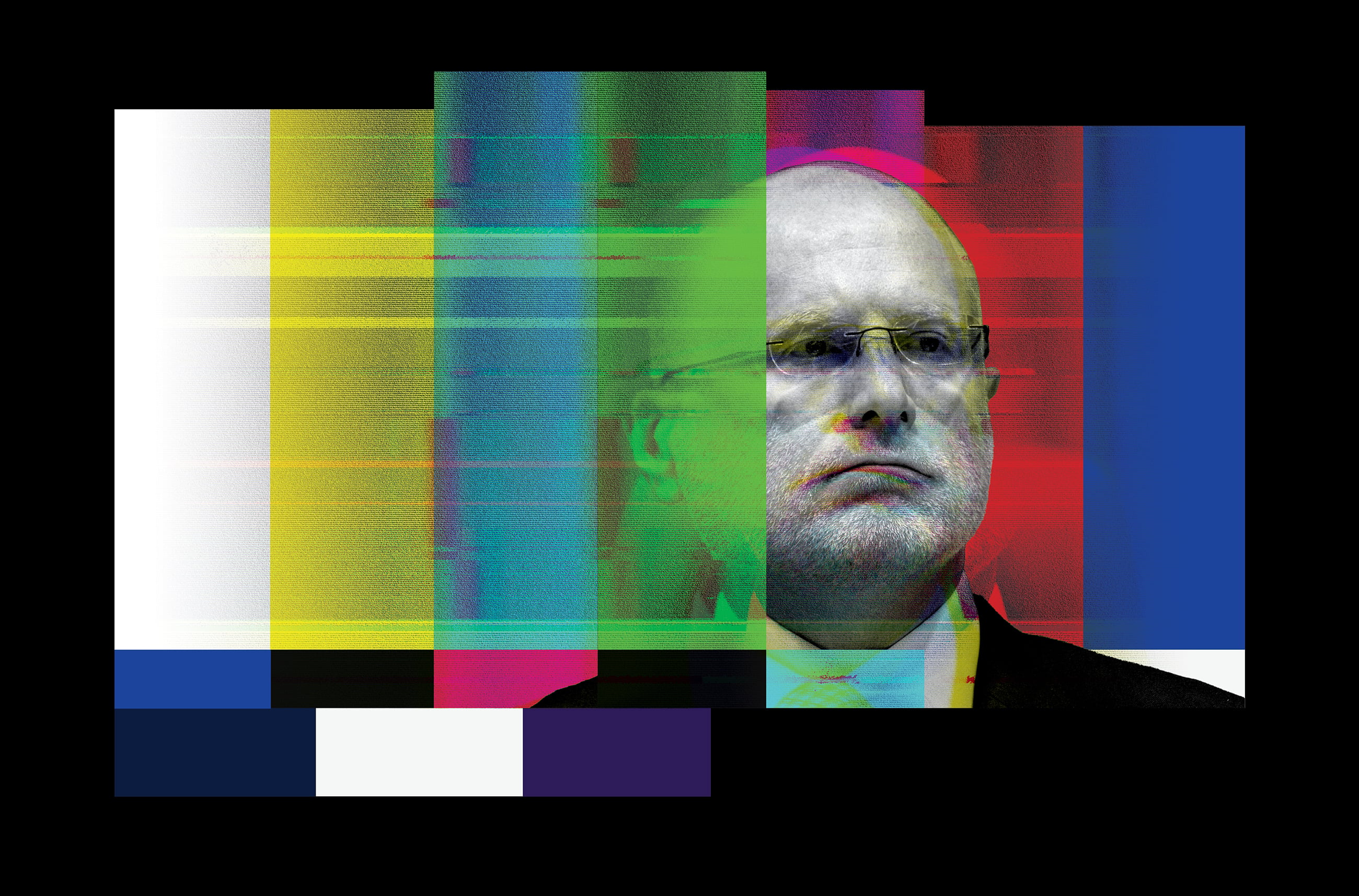

Brendan Carr likes to climb towers.
This began in the spring of 2018, when Carr was a newly minted member of the Federal Communications Commission and looking for a lane. Visiting a South Dakota training center for aspiring “tower dogs,” the technicians who maintain communications towers, Carr clambered up a practice tower out in the parking lot. In a button-down shirt and rimless glasses, his hard-hat askew, Carr was, he later admitted, a little “shaky” on his first try.
A few months later, Ajit Pai, then the agency’s chair, attempted a tower: a 131-footer in Colorado. “Carr took that as a personal challenge,” says Todd Schlekeway, executive director of NATE, a professional association of communications-infrastructure contractors. “There was this ongoing joke between the two of who was going to climb higher, and then Ajit realized that he wasn’t going to be able to keep up with Carr.”
Carr, Schlekeway says, got certified to climb. Trading in his lawyer casual wear for T-shirts, hoodies, and work boots, he scaled towers and utility poles on what he branded #CarrTrips from Alaska to Wisconsin to Florida. One morning this spring, he climbed a 2,000-foot television broadcast tower in eastern North Carolina, marking the occasion with a video that he posted to X.
“President Trump has been delivering for America’s workers,” Carr told viewers. “And we’re going to see firsthand some of the hard work they’re doing.”
As Trump’s handpicked FCC chair, Carr, 47, now heads the federal agency responsible for regulating much of the country’s communications infrastructure, including broadcast media. And from that lofty perch, he’s been working hard to deliver—arguably making our information landscape more friendly to the President and less friendly to his perceived enemies.
When nominating Carr after the 2024 election, Trump called him “a warrior for Free Speech.” Since taking office, however, Carr has launched an investigation of the daytime talk show The View, effectively for being unfair to Republicans. He has been blamed for leaning on CBS to pull a Stephen Colbert interview with a Democratic congressional candidate from Texas. He has pressured carriers to pull ABC late-night host Jimmy Kimmel off the air for jokes and comments many conservatives found offensive. Accusing broadcasters of “hoaxes and distortions,” Carr has threatened to revoke their licenses over their coverage of the administration’s war on Iran.
Carr also has used his power to reshape the media business, approving a Paramount-Skydance merger that critics suggested appeared to be conditioned on CBS reaching a $16 million settlement with Trump over the editing of a 60 Minutes interview with Kamala Harris that the President found objectionable. (Carr has denied that assertion, saying the FCC “ran a standard review process.”) As part of the deal, Skydance installed a Republican campaign donor and Trump ambassadorial nominee as a CBS ombudsman. More recently, Carr has championed a controversial, Trump-supported merger that would place local television operator Nexstar—which was quick to preempt Kimmel’s show after Carr complained—in charge of a broadcast giant reaching 80 percent of the country’s households. (The deal is currently being challenged in court.)
Ted Cruz called Carr’s threats to ABC “dangerous as hell”
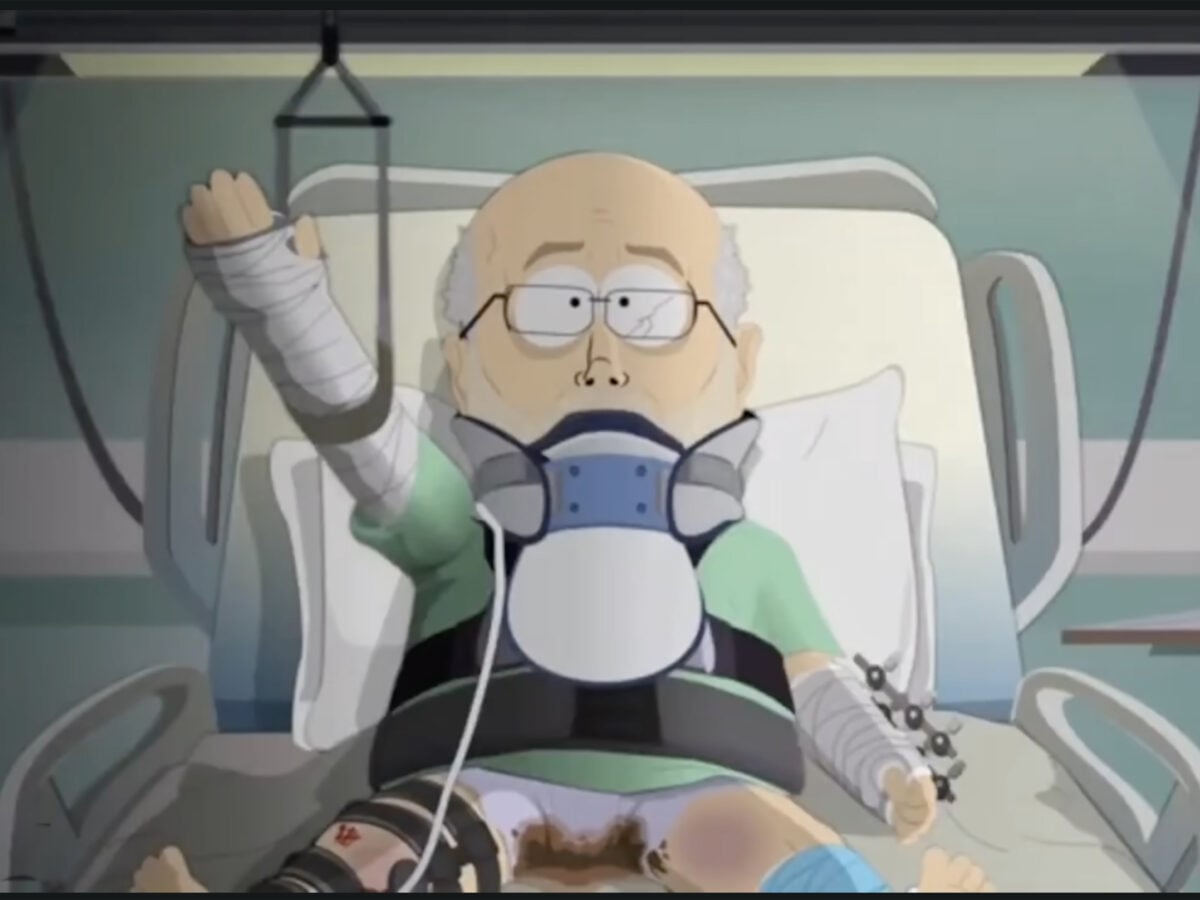
All of this has prompted blowback. Free-speech advocates, Democrats, and even Texas Republican senator Ted Cruz have, respectively, called some of Carr’s actions “outrageous,” “fascist,” and “dangerous as hell.” South Park lampooned Carr as a Trump stooge for nearly an entire episode, at one point giving his cartoon avatar explosive diarrhea. Both were firsts for an FCC chair. Within the insular and influential world of Washington telecom law, where Carr has long been known as a milquetoast wonk, his transformation has prompted puzzlement: How did this guy end up as MAGA’s media watchdog?
For his part, Carr—who did not agree to be interviewed for this story—seems less embarrassed than validated by the backlash, saying last year that he’s “having the time of my life at the FCC.” Perhaps no one in Trump’s Washington has more enthusiastically taken on the President’s grievances or more joyfully targeted his foes. Like a tower dog on the ascent, he is pushing past previous limits on his office and on government control over American speech, using agency powers that Victor Pickard, a professor of media policy and political economy at the University of Pennsylvania, says are “rarely considered, let alone deployed.” Adds Pickard: “I can safely say it’s unprecedented.”
“This Guy Gets It”
For a long time, Carr wasn’t much of a partisan fighter. Born in DC and raised in Northern Virginia, he played soccer at McLean’s private Potomac School and then attended Georgetown University. His main ambition, he later told Bloomberg Businessweek, was to secure a comfortable and lucrative legal gig—likely the kind of white-collar practice that his father, Thomas, had built representing clients such as Richard Nixon.
One of Thomas’s old colleagues, prominent communications lawyer Bob Beizer, reportedly recommended that Carr enroll in Catholic University law school’s highly regarded telecom program. Carr graduated magna cum laude, then joined the Federal Communications Bar Association, a group of some 2,000 lawyers who wield enormous influence on telecom law. Mark Brennan, who co-chaired the FCBA’s young-lawyers group with Carr, remembers him as “an excellent attorney” who was “going to accomplish great things in the field.” While many of their peers were heads-down building practices and thinking about making partner, Brennan says, Carr was “always looking beyond that to where the field might be going in ten or 20 years.”

Carr Wars
During his time at the FCC, Carr has picked a series of public fights on MAGA’s behalf. Here are some of the most memorable.
2026
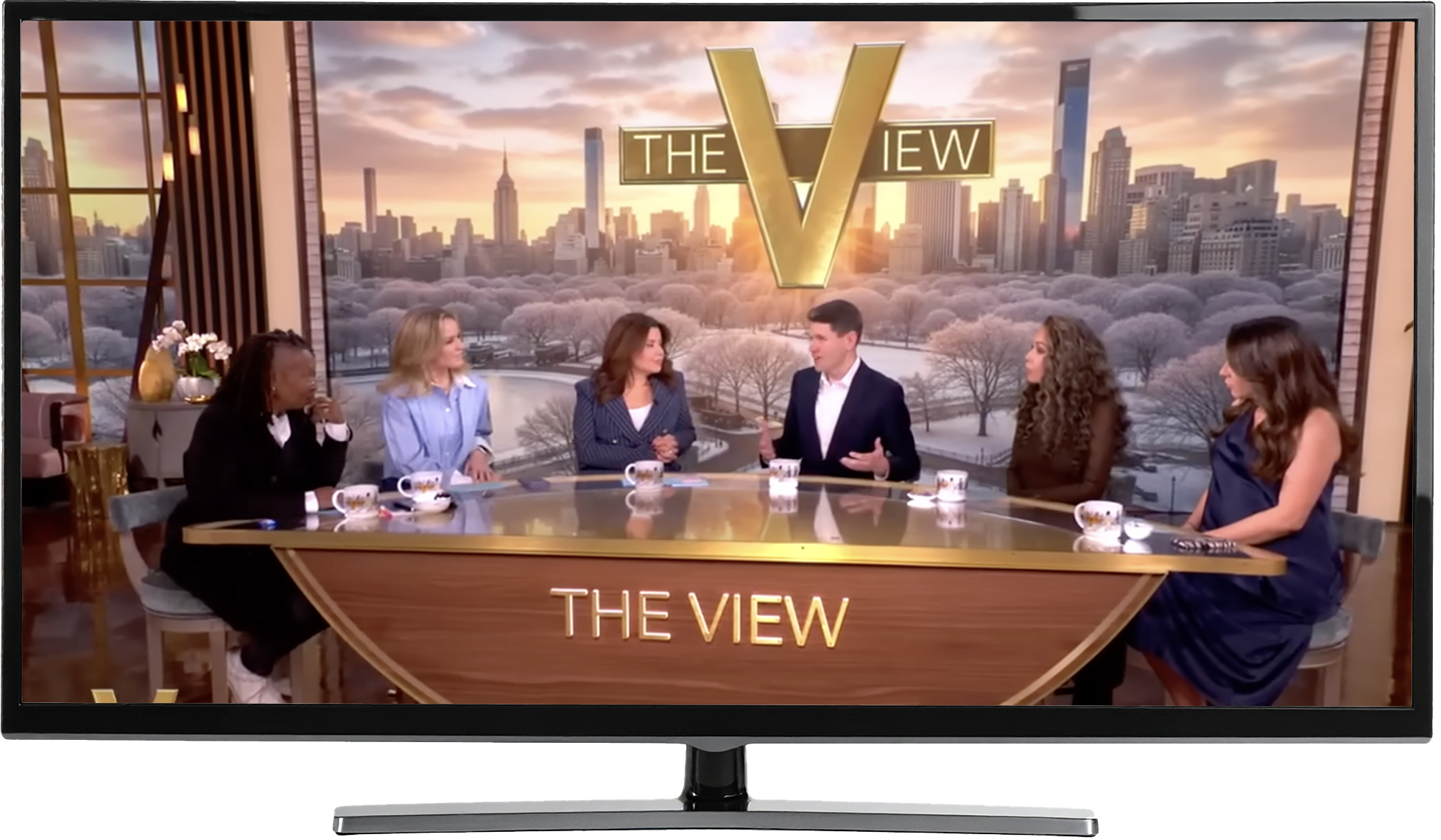
Announced FCC investigation into The View after Texas Democratic Senate candidate James Talarico was a guest.
2026

Warned broadcasters running “fake news” Iran war coverage to “correct course before their license renewals come up.”
2025
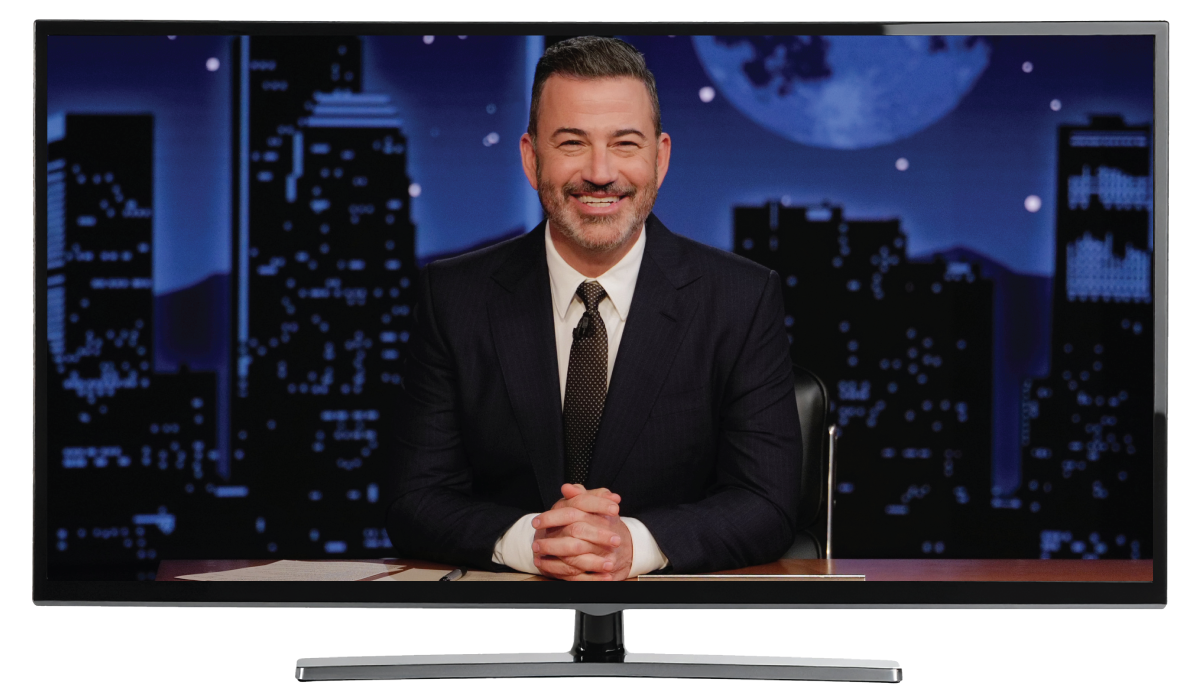
Pressured broadcasters to pull late-night host Jimmy Kimmel off the air for jokes and commentary that conservatives found offensive.
2023
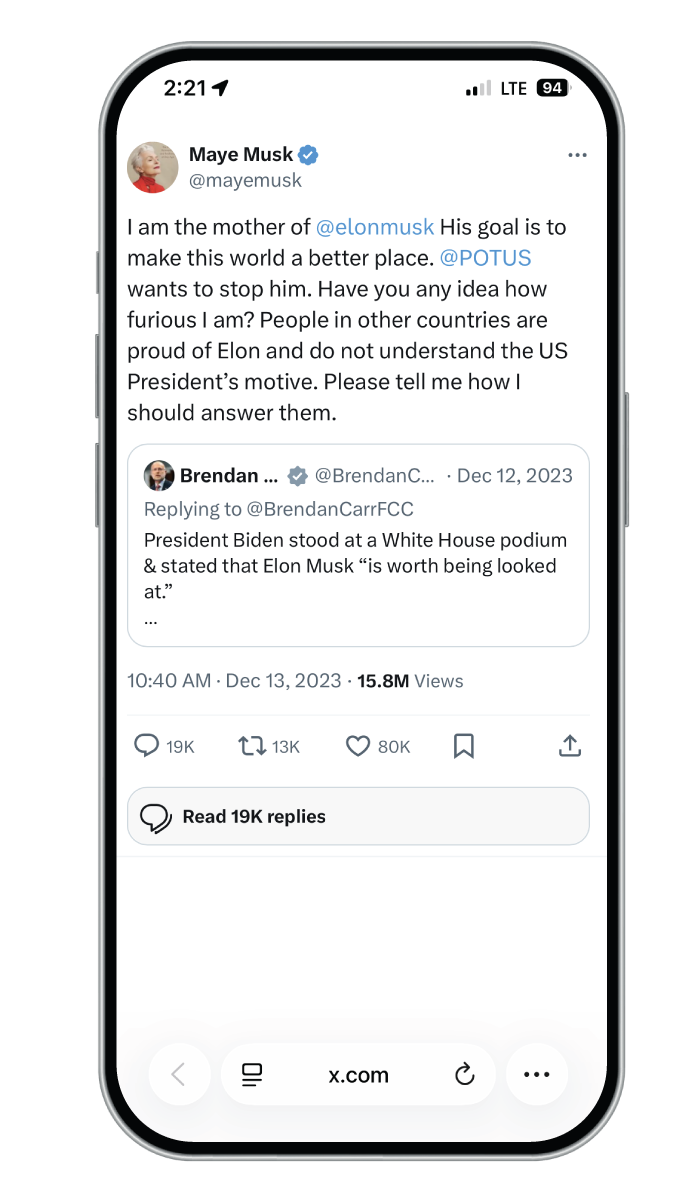
Complained on X that the Biden administration was subjecting Elon Musk to “regulatory harassment.”
2020
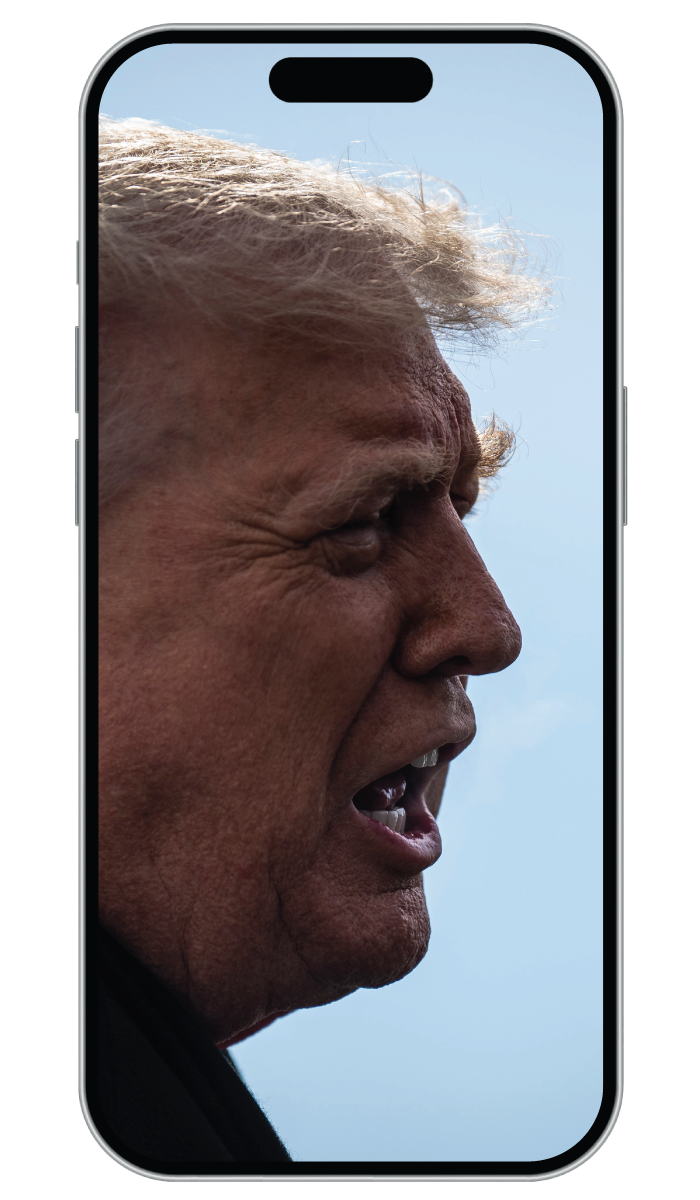
Supported President Trump’s attacks against Twitter for placing fact-check labels on two of his posts making false claims about mail-in ballots.
Photograph of Iran war by Getty Images.
Photograph of Kimmel by Randy Holmes/Disney.
Photograph of Trump by Jabin Botsford/Washington Post via Getty Images.
After stints at the behemoth communications law firm Wiley Rein and a federal clerkship, Carr joined the FCC general counsel’s office. In 2014, he became an adviser to Republican FCC commissioner Pai, mostly working on wireless issues. “He was very much a spectrum nerd,” says Joel Thayer, a former law clerk in Pai’s office, referring to the limited radio frequencies, managed by the federal government, on which many communications networks run.
Seemingly well liked by colleagues, Carr wasn’t seen as especially ideological. That made him a good fit for an agency that has spent most of its nearly 100-year history regulating wonky technical matters affecting the communications industry—such as rural-broadband access—and not the content of broadcasts, which is mostly protected by the First Amendment. Tom Wheeler, the FCC chair under President Obama and a Democrat, was a longtime friend of Carr’s father. After leaving the agency, Wheeler would regularly have lunch with Carr to discuss telecom issues. “He’s a decent guy,” Wheeler says.
Following Trump’s 2016 victory, the FCC found itself in the political spotlight. Under Pai, Trump’s appointed chair, the agency repealed Obama-era rules enforcing so-called net neutrality—the principle that, broadly speaking, all internet traffic should be treated alike. Seen by some as a sop to large internet service providers, the change earned Pai the ire of many on the left—and made the FCC “a punching bag for late-night TV,” recalls Nathan Leamer, then a policy adviser to Pai. Last Week Tonight host John Oliver regularly hammered Leamer’s boss, calling him a “goober.” Pai also drew criticism from some Democrats for spearheading a number of rule changes that seemed to benefit Sinclair, a Maryland telecom company that controls about 40 percent of America’s local television stations and has a reputation for producing and airing conservative news programming. (An FCC investigation found no evidence that Pai gave Sinclair favorable treatment. Sinclair chairman David Smith—whose family foundation reportedly has donated more than $1 million to conservative groups such as Turning Point USA and Moms for Liberty—has dismissed accusations of bias, telling the Guardian that he has “zero tolerance” for “political spin.”)
At the time, Leamer says, many at the FCC struggled to see that their decisions could have broad political and cultural impact. “The world was basically as big as the Portals office building,” he says, referring to what was then the agency’s longtime headquarters on DC’s waterfront. Carr was different. While some in Washington credit his wife, Machalagh—once chief of staff for former Republican House speaker Kevin McCarthy—for sharpening her husband’s political instincts, Leamer says he and Carr bonded over being “political animals.” Carr was deeply interested, Leamer says, in turning an agency largely ignored outside the trade press into a real player in national politics: “He would come into my office and we’d just shoot the shit, and I was like, ‘This guy gets it.’ ”
In the summer of 2017, Carr became an FCC commissioner—one of five presidentially nominated and Senate-confirmed individuals, statutorily a bipartisan mix, who direct the agency. Early in his tenure, he was invited onto Fox News with host Tucker Carlson to push back on Facebook CEO Mark Zuckerberg, who in a Washington Post op-ed had called for greater regulation of social media. Evan Swarztrauber, then Carr’s aide, was a bit nervous about the discussion, because Carlson could go wildly off-topic. But Carr nailed it. “His media talent,” Swarztrauber says, “was not something you would just assume about a telecom lawyer.” Swarztrauber remembers Carr’s reaction in the studio after the session: Yeah, that was fun. Swarztrauber started booking him all over, with minimal preparation: “You literally just say, ‘This is the outlet,’ and it’s like, ‘Okay, I know how to do the interview.’ ”
Carr’s stock rose in Republican circles. He was good on paper, better on TV, and becoming something of an attack dog on social media. He went after Democratic lawmakers Adam Schiff and Elizabeth Warren. He hammered TikTok as a “national-security threat” over its ties to China and called for a total ban—a stance that endeared him to many in the MAGA movement, never mind that, as the company correctly pointed out, Carr’s agency had no actual jurisdiction over the app. When the President blasted Twitter in 2020 for placing fact-checking labels on two of his posts that made false claims about mail-in ballots, Carr backed Trump on Carlson’s show, accusing the company of “political speech against the President.”
Remaining an FCC commissioner following Trump’s 2020 election loss, Carr regularly assailed President Joe Biden. In December 2023, he complained on X that the Democratic administration was subjecting platform owner and future Trump megafunder Elon Musk to “regulatory harassment.” As evidence, Carr cited the FCC’s refusal to include Musk’s internet satellite company, Starlink, in a federal rural-broadband program. One of Carr’s posts got an eye-catching repost: “I am the mother of @elonmusk His goal is to make this world a better place. @POTUS wants to stop him. Have you any idea how furious I am?,” read the repost from the account of Maye Musk. “People in other countries are proud of Elon and do not understand the US President’s motive. Please tell me how I should answer them.”
Viewed nearly 16 million times, the repost boosted Carr’s clout. To some in tech, he was a political insider confirming their growing suspicion that Biden was hostile to them. To Republicans, he was becoming someone who could help win over Silicon Valley. Carr also wrote a chapter for Project 2025, the controversial Heritage Foundation–led blueprint for a GOP restoration. Though what he contributed was fairly pedestrian—yes to stopping social platforms from censoring conservatives, no to foreign tech companies deemed security risks—it further raised Carr’s profile.
Following Trump’s 2024 victory, Musk reportedly advocated for Carr to become FCC chair during transition meetings at Mar-a-Lago. The President-elect soon nominated Carr for the job. At the Turning Point USA Inaugural Eve Ball in DC, conservative activist Charlie Kirk called Carr onstage, where he stood between Donald Trump Jr. and future FBI director Kash Patel. Carr gave the crowd a thumbs-up. The spectrum nerd had arrived.
“The Threat Is All You Need”
Newly atop the FCC, Carr drew on his Project 2025 work, leaning into a then-hot Republican idea that Big Tech was stifling free speech. At a Justice Department event, he expressed a desire to take on what he called the Silicon Valley “censorship cartel,” saying that “whenever you have increase in government control, you necessarily have decrease in free speech, because free speech is the check on government control.”
As it quickly became clear that Trump had no actual appetite for going after the country’s tech juggernauts—many of which had bent the knee through a combination of campaign contributions, boosting conservative content on their platforms, and in-person flattery from their chief executives—Carr changed course. Speech remained a priority, only now it meant broadcast content and whether it fit Trump’s worldview.
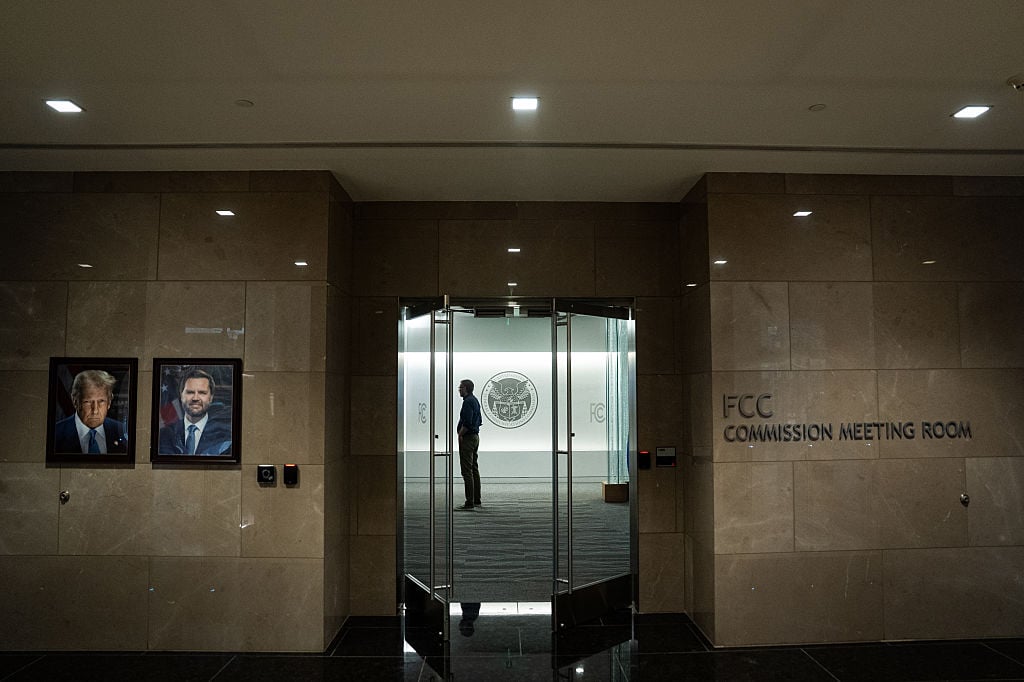
The FCC has two points of leverage over broadcasters: It can block or approve mergers and can grant or revoke broadcast licenses. By law, license holders are required to act “in the public interest.” Historically, Congress has declined to define what that means, and the FCC largely has taken a hands-off approach to broadcast content. Moreover, conservatives have long recoiled at the idea of the federal government effectively telling local stations what they can and cannot say.
Not Carr. Speaking last September on a podcast hosted by conservative influencer Benny Johnson, he expressed displeasure with Kimmel for comments about the murder of Kirk, which had infuriated Trump and other Republicans. Mentioning “remedies” for ABC and “fines or license revocation” for local broadcasters, Carr also made what sounded like a threat: “Look, we can do this the easy way or the hard way. These companies can find ways to change conduct, to take action, frankly, on Kimmel, or, you know, there’s going to be additional work for the FCC ahead.”
Within days, local television operator Nexstar, which had a merger pending with rival Tenga, promptly announced it would preempt Kimmel’s show. ABC followed suit, suspending the show indefinitely. Following significant backlash, Kimmel returned to the air a week later. Carr backpedaled a bit, too, claiming that his podcast comments were referring to local stations’ refusal to air the show—a move some had already announced—and not to FCC action.
Still, a message had been sent. In February, CBS late-night host Colbert announced that network lawyers had blocked him from airing an interview with Texas Democratic Senate candidate James Talarico, citing what’s known as the “equal-time rule,” which requires that those running for office receive equivalent handling by radio and broadcast stations. (The network later said it gave “legal guidance” but did not prohibit the interview from airing.) Talk shows and late-night programs previously were treated as exempt from the rule, but Carr’s FCC had recently announced it would apply to them.
Calling it “the interview Donald Trump didn’t want you to see,” Talarico posted a clip of the conversation on X. Colbert accused the administration—and, by extension, Carr—of censorship. Dismissing those claims and scolding the media for covering them, Carr argued that he was simply applying the law. People close to Carr point out that he never actually picked up the phone and called CBS’s lawyers and that Talarico ultimately benefited from the controversy, raising $2.5 million in a 24-hour period.
Thomas Berry, director of constitutional studies at the Cato Institute, a libertarian think tank, is among those who believe Carr has been overzealous. Calling his handling of Kimmel “appalling,” Berry says that in Talarico’s case, it doesn’t matter that the FCC never took formal action against CBS: “The threat is all you need to change their behavior.”
Berry has a point. In March of last year, Carr said he would block mergers and acquisitions unless the telecoms involved dropped their diversity, equity, and inclusion programs—part of the Trump administration’s broader effort to battle what the President calls “reverse discrimination” against white people and men. Verizon and T-Mobile subsequently sent letters to the FCC announcing the end of their DEI initiatives. Both quickly had pending deals approved. On X, Carr praised T-Mobile’s decision as a “good step forward.”
As for companies who don’t play ball? Days before this year’s White House Correspondents’ Dinner, Kimmel performed a skit in which he pretended to host the event and joked that First Lady Melania Trump had a “glow like an expectant widow”—a reference, Kimmel later said, to the 23-year age gap between the 79-year-old President and the First Lady. After an armed man was charged with attempting to assassinate Trump at the actual dinner, the First Lady accused Kimmel of spreading “hateful and violent rhetoric,” while the President called on ABC and parent company Disney to fire him.
As that was happening, the FCC announced that it would be reviewing the broadcast licenses of eight local stations owned and operated by ABC—years before those licenses had previously been scheduled to be renewed. Citing the public-interest standard, the agency indirectly connected the move to an already underway investigation of Disney’s DEI practices. Three congressional Democrats accused Carr of using the FCC as “a weapon to punish protected speech at the behest of the President,” while Democratic FCC commissioner Anna Gomez posted on X that the agency’s actions were “unprecedented,” “unlawful,” and a “political stunt.”
It’s exceedingly rare for the FCC to revoke or fail to renew a broadcast license: The most recent examples happened decades ago. Either sanction could trigger a lengthy and messy legal battle that, Gomez argues, Disney would be well positioned to win. Yet even the prospect of a full-on confrontation—regardless of outcome—gives the agency leverage. Fighting the federal government is expensive, time-consuming, and risky. Fighting the federal government controlled by Trump means subjecting your brand to a negative onslaught from one of the world’s most aggrieved and prolific posters, a media-obsessed man who commands cult-like fealty from a huge swath of the American public. Under Carr, the FCC arguably has forced some companies to make a choice: Go to war and you’ll pay a price. Go along and you won’t have to.
Public Enmity
While most previous FCC chairs have hardly been household names, Carr’s high-profile tenure has triggered backlash, including mockery on South Park.
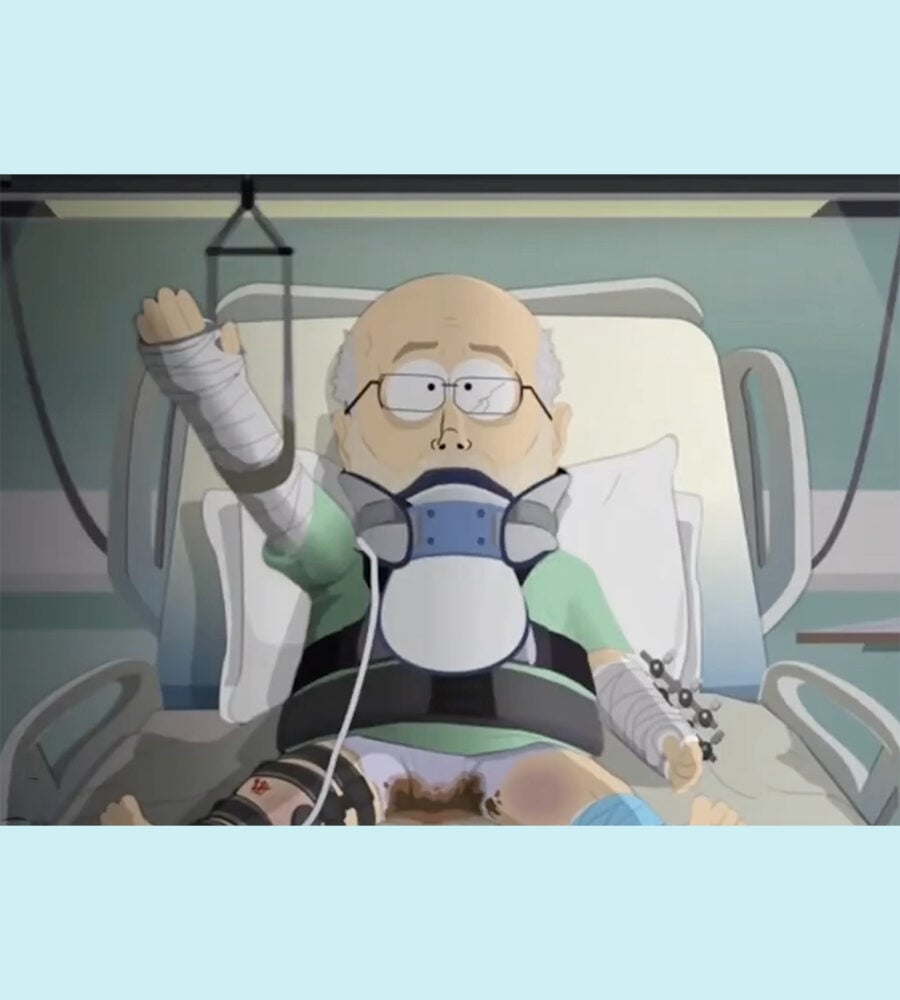 Picture by South Park.
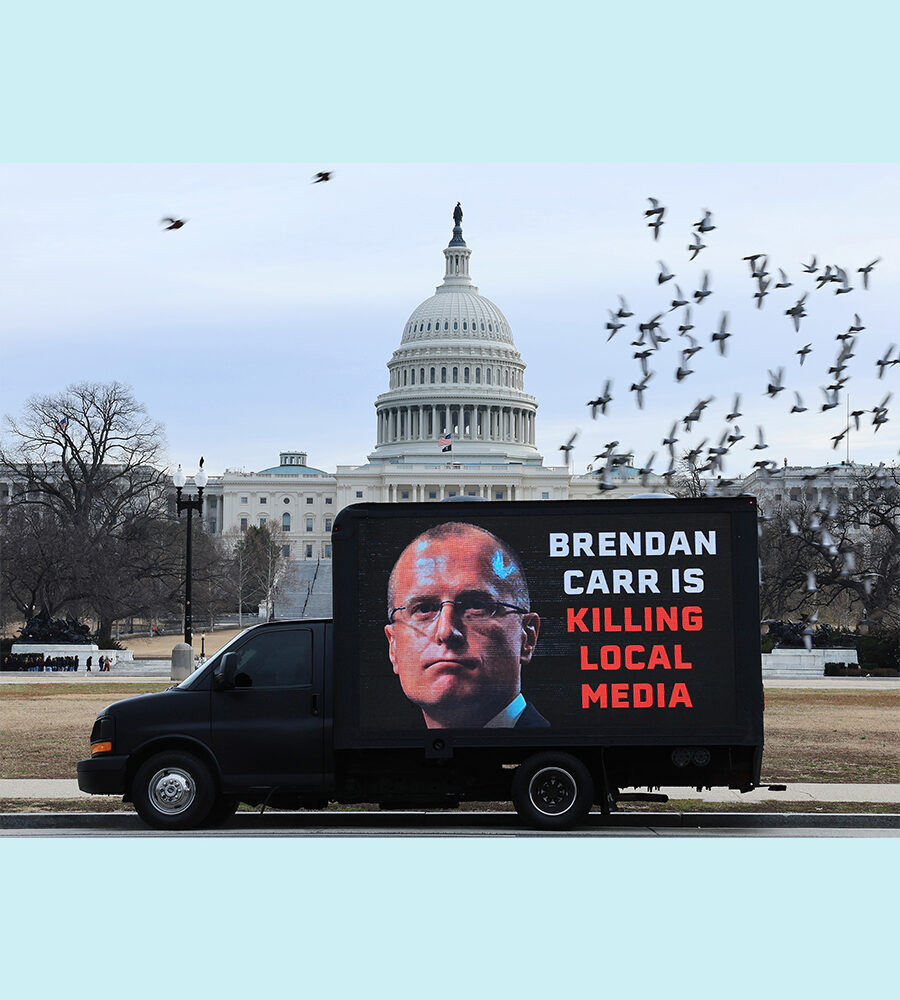
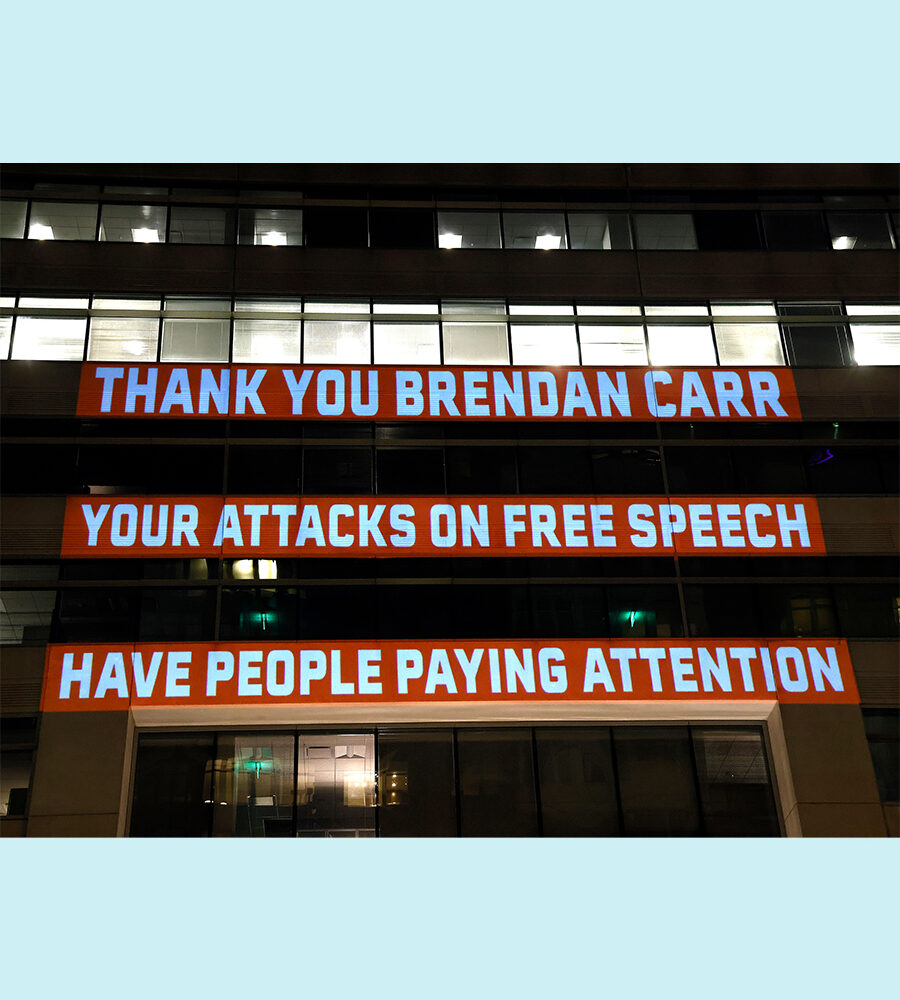
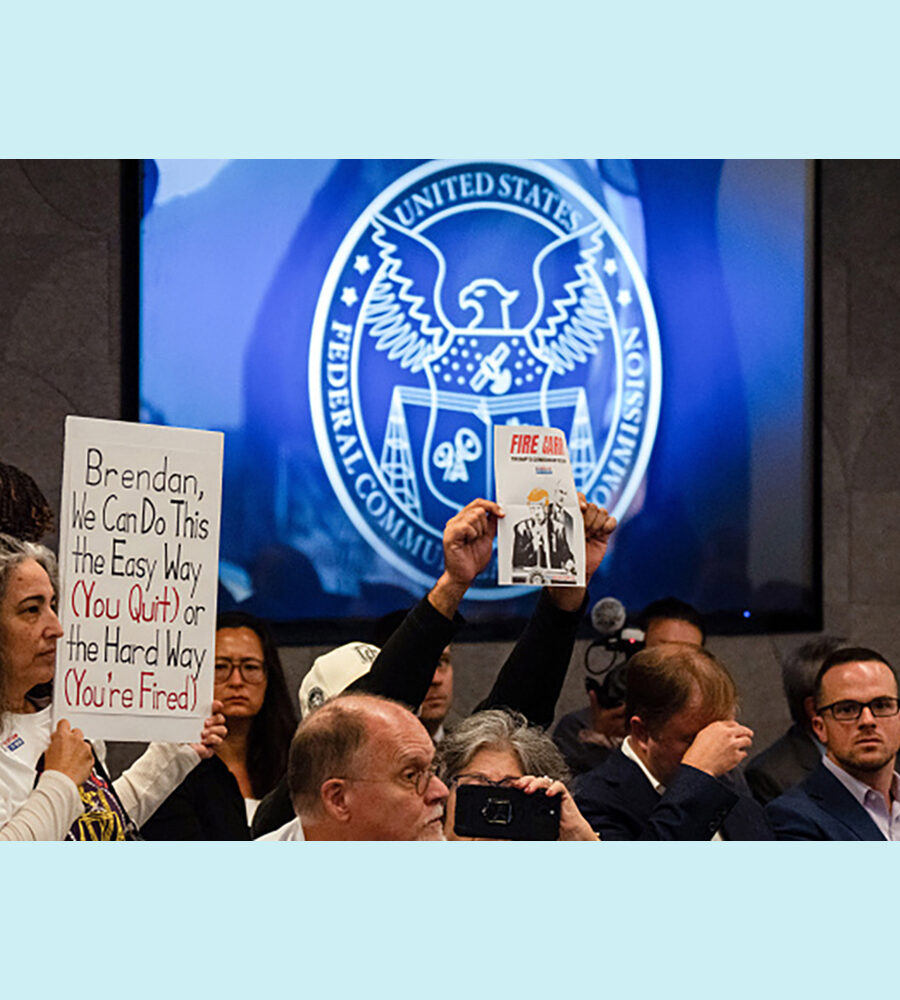
In May, Gomez blasted the Trump administration for “weaponizing” the FCC against the media. “We have not seen anything like what we are seeing today in terms of going after broadcast content in my lifetime,” she said during a public meeting. “This administration does not like any content that criticizes it, and it wants to amplify voices that are friendly to it.” Wheeler, the FCC chair under Obama, worries that the agency’s longtime culture of operating with restraint is being eroded. “What has happened” under Carr, he says, “has been the bastardization of due process in the name of political expediency.”
When Skydance was trying to merge with CBS News parent company Paramount, the deal needed FCC approval—a green light from Carr that came only after the network settled Trump’s 60 Minutes lawsuit and with an agreement to bring what Carr called “more fact-based, objective, unbiased coverage to their newsrooms.” Paramount Skydance CEO David Ellison, son of billionaire Trump supporter Larry Ellison, subsequently tapped Bari Weiss, a right-leaning podcaster and opinion editor with no broadcast experience, to head CBS News. More recently, Carr waived a media-ownership cap set by Congress to approve a Trump-backed merger between rival local broadcasting conglomerates Nexstar and Tegna. If the deal survives court challenges, it will give a single company control over more than 250 stations. Carr ruled without calling for a commission vote, making legal opposition more difficult.
“I respect Brendan’s intelligence,” Wheeler says of Carr. “He’s a lot smarter than I am. I respect his ability to express himself. I respect his strategic thinking. It’s just a tragedy that these gifts are being used in this kind of an abusive manner.” The two men no longer lunch.
“It Will Not Age Well”
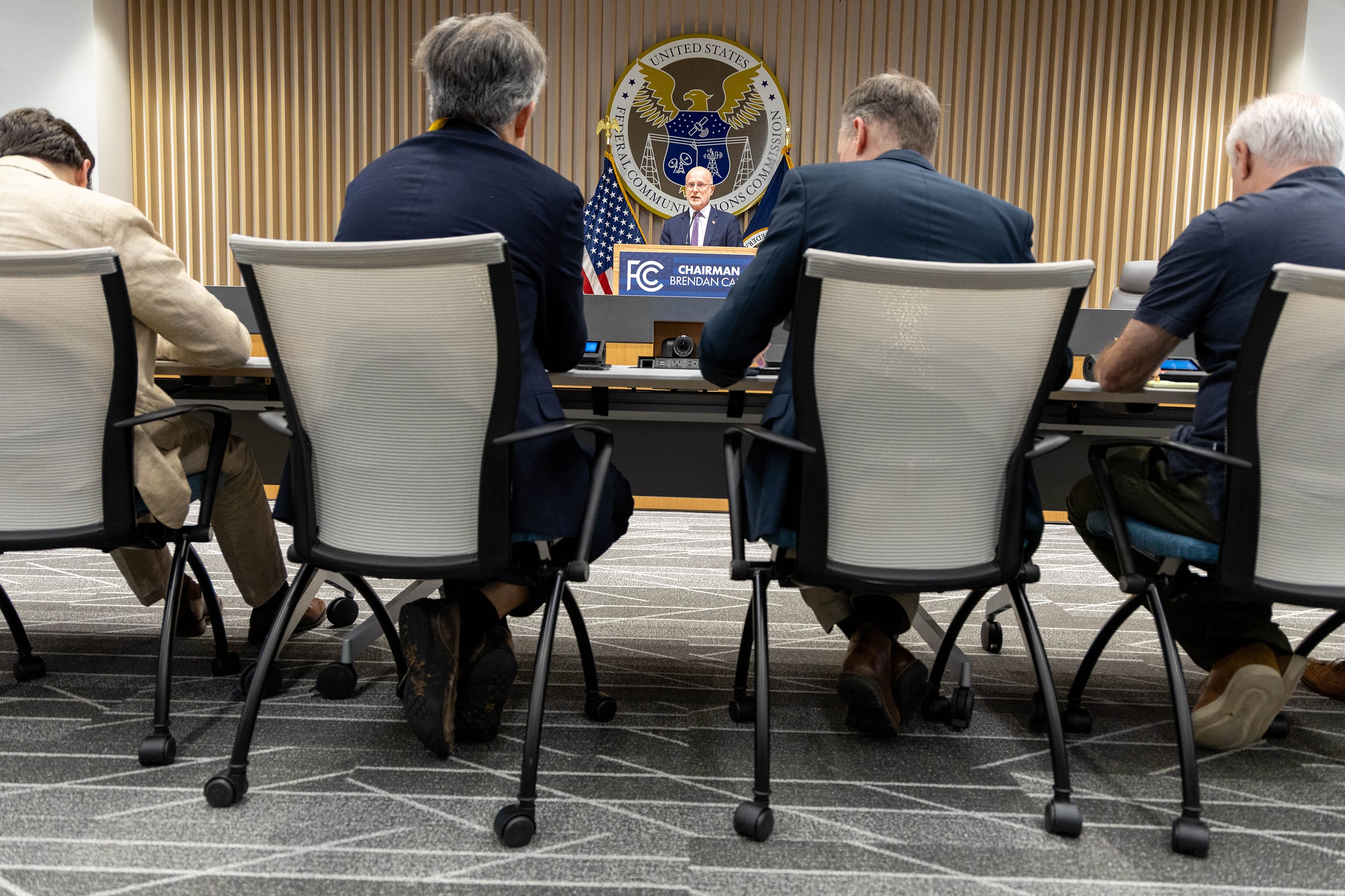
In March, I saw Carr in Washington, presiding over the FCC’s monthly open meeting. A can of Celsius energy drink, a Trumpworld favorite, sat on the dais in front of him. The session, held in a windowless room in the agency’s NoMa headquarters, was routine—discussions of onshoring call centers, robocalls, and the allocation of radio spectrum—until the Q&A, during which I asked Carr about a recent post he made on X.
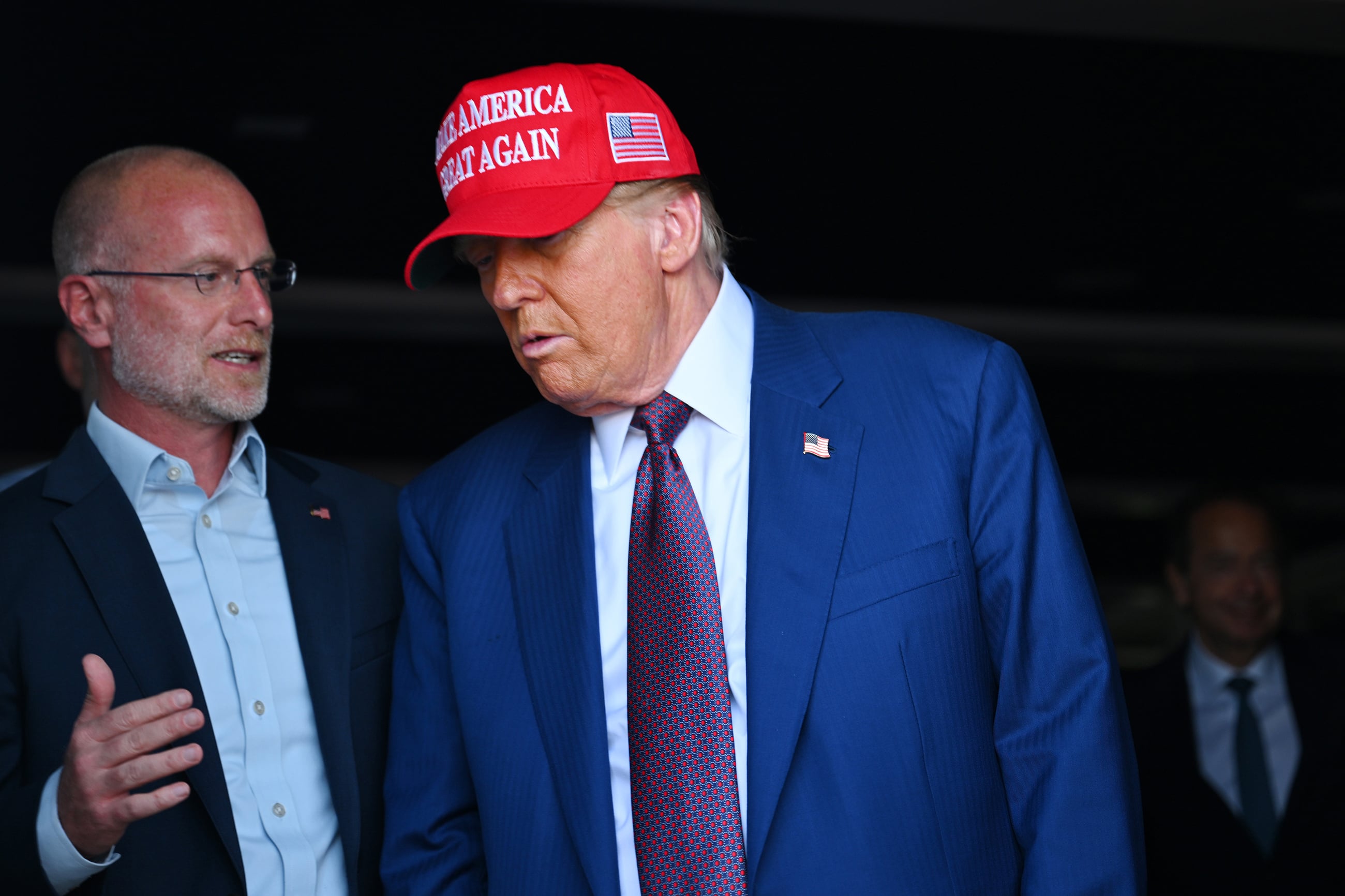
The post featured a screen grab of a long and winding Trump complaint about the “sick and demented” “Fake News Media” misreporting the facts of the Iran war and wanting the administration to lose. Above the President’s rant, Carr posted a mini-essay of his own, calling on broadcasters running “fake news” to “correct course before their license renewals come up.” He also blamed the media for earning the public’s distrust and—in a nod to his boss—stated that “when a political candidate is able to win a landslide election victory after in [sic] the face of hoaxes and distortions, there is something very wrong.”
Critics saw Carr’s post as an “authoritarian” and “unconstitutional” attempt to shape war coverage. I asked Carr about the idea that Trump’s wins, despite negative coverage, proved that “there is something very wrong.” Wrong with what?
“When you have someone running and there’s 97 percent negative coverage,” Carr answered, using a statistic Trump often cites without providing a source, “and that person still wins, clearly there’s a mismatch between the focus in the operations of the legacy media and where the communities all across the country are.”
Among conservatives, this is a common sentiment. Carr, they say, isn’t stacking the media deck in Trump’s favor—he’s simply shuffling cards that are otherwise very unfair to the President and his followers. The Media Research Center, a conservative watchdog group based in Herndon, claims that 92 percent of ABC, NBC, and CBS evening-newscast stories between January and April 2025 discussing Trump and his administration were negative. Daniel Suhr heads the Center for American Rights, a conservative law firm that has sued an Iowa newspaper for publishing a poll showing Harris leading Trump prior to the 2024 election and filed an FCC complaint over Kimmel telling more jokes about Republicans than Democrats. Suhr describes the media landscape with a football metaphor: “For the past several decades, the ball has just been parked on the Democratic Party’s two-yard line. I’m not asking to get the ball to the Republican Party’s two-yard line. I’m just saying let’s get it between the 40s.”
Similarly, Carr’s allies bristle at accusations that his behavior is unprecedented, pointing to the Wheeler-led FCC’s issuing of controversial net-neutrality rules shortly after Obama called on the agency to adopt them. Carr likes to remind people that in 2018 a group of Democratic senators sent the FCC a letter expressing concern that Sinclair’s political content violated the public-interest standard. Recently, he told CNBC that Democrats “massively weaponized” the agency under Biden, claiming “they teed up potentially not renewing a Fox broadcast TV license for content on Fox News Cable.” Carr was referring to a 2023 complaint filed by a liberal advocacy group, which sought to block a Philadelphia Fox station’s license renewal because Fox News knowingly promoted false claims that a voting-machine company had rigged the 2020 election for Biden. That complaint was later dismissed by former agency chair and Democrat Jessica Rosenworcel.
Carr’s allies bristle at accusations that his behavior is unprecedented.
A few years earlier, Rosenworcel wrote an op-ed urging a crackdown on radio and TV ads for e-cigarettes. In response, Carr posted, “Should the government censor speech it doesn’t like? Of course not. The FCC does not have a roving mandate to police speech in the name of the ‘public interest.’ ” Times change. At a recent hearing, Democratic Hawaii senator Brian Schatz told Carr he has enjoyed their interactions over the years, calling him a “solid, knowledgeable person.” He then said Carr’s handling of the media has been “out of character, and it will not age well.”
Around the capital, divining Carr’s motivations has become a guessing game. Matt Wood, vice president of policy and general counsel at the media advocacy group Free Press, has known Carr for years. He thinks the FCC chair, whom he once considered a standard-issue Chamber of Commerce Republican, is largely performing for “an audience of one”: Trump. Why else would Carr call the President the “alpha in every single room, in every single place, all across the world?” Or show up to a Justice Department panel on “Big Tech censorship” wearing a gold lapel pin of Trump’s head?
After Carr recently pushed to ban foreign-made routers, a joke circulated in DC telecom circles—referring to both the administration’s forever feud with the press and Carr’s seemingly mindless willingness to fight it. Do you think Trump told him to “ban Reuters” and he misheard? Those close to Carr, however, insist there’s nothing vacuous about his agenda. “Some of the coverage is ‘What does he think he’s doing? What does he not understand?’ says Leamer, the former Pai adviser. “No, he very much understands.”
Wood isn’t sure whether Carr’s actions as FCC chair reflect his genuine beliefs. “I think it could be opportunism,” he says. “What I would say is, if opportunism is authoritarianism, too, then I don’t really care. He doesn’t get extra points from me if he’s faking it and only doing it to get ahead.” Either way, it’s working. During a White House event in March at which Trump announced an executive order protecting the airing of the Army-Navy football game, the President called Carr “perhaps the most powerful man in this room,” adding, “You are doing some job.” Carr posted the clip to X, writing: “Thank you, Mr. President. More good work ahead.”
Carr’s endgame isn’t clear. Some in Washington believe he’s gunning for a promotion: Secretary of Commerce in the second half of Trump’s term, a cabinet post in a future JD Vance administration, or a top job at Musk’s SpaceX if the White House changes parties in 2028. Others think Carr is trying to appease Trump to protect the FCC, buying it space to work on boring, technocratic, non-media issues and perhaps keeping the administration from appointing a chair with less respect for the agency’s mission.
Last spring, Carr said at an industry event that previous FCC chairs always hungered to have gotten more done. “So from the get-go,” he proclaimed, “I’m starting from a no-regrets perspective.” Regret may arrive anyway. Like the rest of the federal government, much of the agency’s legitimacy stems from being seen as an honest broker. If it instead becomes a tool to harass and silence political opponents while rewarding allies, that perception could be lost. Asked about Carr’s potential legacy, Wheeler sounds a note of caution: “I hope that when the Democrats are back in power, we don’t turn around and do the same thing.”
A basic rule of gravity, political or otherwise, holds that what goes up eventually comes down. Back at the FCC open meeting, I ask Carr about his tower-climbing and if he hopes to go even higher. “Well, fortunately or unfortunately, 2,000 feet is basically the cap for broadcast towers in this country, so we topped out in terms of that,” he says. “But we’ll see.”
Brendan Carr likes to climb towers.
This began in the spring of 2018, when Carr was a newly minted member of the Federal Communications Commission and looking for a lane. Visiting a South Dakota training center for aspiring “tower dogs,” the technicians who maintain communications towers, Carr clambered up a practice tower out in the parking lot. In a button-down shirt and rimless glasses, his hard-hat askew, Carr was, he later admitted, a little “shaky” on his first try.
A few months later, Ajit Pai, then the agency’s chair, attempted a tower: a 131-footer in Colorado. “Carr took that as a personal challenge,” says Todd Schlekeway, executive director of NATE, a professional association of communications-infrastructure contractors. “There was this ongoing joke between the two of who was going to climb higher, and then Ajit realized that he wasn’t going to be able to keep up with Carr.”
Carr, Schlekeway says, got certified to climb. Trading in his lawyer casual wear for T-shirts, hoodies, and work boots, he scaled towers and utility poles on what he branded #CarrTrips from Alaska to Wisconsin to Florida. One morning this spring, he climbed a 2,000-foot television broadcast tower in eastern North Carolina, marking the occasion with a video that he posted to X.
“President Trump has been delivering for America’s workers,” Carr told viewers. “And we’re going to see firsthand some of the hard work they’re doing.”
As Trump’s handpicked FCC chair, Carr, 47, now heads the federal agency responsible for regulating much of the country’s communications infrastructure, including broadcast media. And from that lofty perch, he’s been working hard to deliver—arguably making our information landscape more friendly to the President and less friendly to his perceived enemies.
When nominating Carr after the 2024 election, Trump called him “a warrior for Free Speech.” Since taking office, however, Carr has launched an investigation of the daytime talk show The View, effectively for being unfair to Republicans. He has been blamed for leaning on CBS to pull a Stephen Colbert interview with a Democratic congressional candidate from Texas. He has pressured carriers to pull ABC late-night host Jimmy Kimmel off the air for jokes and comments many conservatives found offensive. Accusing broadcasters of “hoaxes and distortions,” Carr has threatened to revoke their licenses over their coverage of the administration’s war on Iran.
Carr also has used his power to reshape the media business, approving a Paramount-Skydance merger that critics suggested appeared to be conditioned on CBS reaching a $16 million settlement with Trump over the editing of a 60 Minutes interview with Kamala Harris that the President found objectionable. (Carr has denied that assertion, saying the FCC “ran a standard review process.”) As part of the deal, Skydance installed a Republican campaign donor and Trump ambassadorial nominee as a CBS ombudsman. More recently, Carr has championed a controversial, Trump-supported merger that would place local television operator Nexstar—which was quick to preempt Kimmel’s show after Carr complained—in charge of a broadcast giant reaching 80 percent of the country’s households. (The deal is currently being challenged in court.)
Ted Cruz called Carr’s threats to ABC “dangerous as hell”
All of this has prompted blowback. Free-speech advocates, Democrats, and even Texas Republican senator Ted Cruz have, respectively, called some of Carr’s actions “outrageous,” “fascist,” and “dangerous as hell.” South Park lampooned Carr as a Trump stooge for nearly an entire episode, at one point giving his cartoon avatar explosive diarrhea. Both were firsts for an FCC chair. Within the insular and influential world of Washington telecom law, where Carr has long been known as a milquetoast wonk, his transformation has prompted puzzlement: How did this guy end up as MAGA’s media watchdog?
For his part, Carr—who did not agree to be interviewed for this story—seems less embarrassed than validated by the backlash, saying last year that he’s “having the time of my life at the FCC.” Perhaps no one in Trump’s Washington has more enthusiastically taken on the President’s grievances or more joyfully targeted his foes. Like a tower dog on the ascent, he is pushing past previous limits on his office and on government control over American speech, using agency powers that Victor Pickard, a professor of media policy and political economy at the University of Pennsylvania, says are “rarely considered, let alone deployed.” Adds Pickard: “I can safely say it’s unprecedented.”
“This Guy Gets It”
For a long time, Carr wasn’t much of a partisan fighter. Born in DC and raised in Northern Virginia, he played soccer at McLean’s private Potomac School and then attended Georgetown University. His main ambition, he later told Bloomberg Businessweek, was to secure a comfortable and lucrative legal gig—likely the kind of white-collar practice that his father, Thomas, had built representing clients such as Richard Nixon.
One of Thomas’s old colleagues, prominent communications lawyer Bob Beizer, reportedly recommended that Carr enroll in Catholic University law school’s highly regarded telecom program. Carr graduated magna cum laude, then joined the Federal Communications Bar Association, a group of some 2,000 lawyers who wield enormous influence on telecom law. Mark Brennan, who co-chaired the FCBA’s young-lawyers group with Carr, remembers him as “an excellent attorney” who was “going to accomplish great things in the field.” While many of their peers were heads-down building practices and thinking about making partner, Brennan says, Carr was “always looking beyond that to where the field might be going in ten or 20 years.”
Carr Wars
During his time at the FCC, Carr has picked a series of public fights on MAGA’s behalf. Here are some of the most memorable.
2026
Announced FCC investigation into The View after Texas Democratic Senate candidate James Talarico was a guest.
2026
Warned broadcasters running “fake news” Iran war coverage to “correct course before their license renewals come up.”
2025
Pressured broadcasters to pull late-night host Jimmy Kimmel off the air for jokes and commentary that conservatives found offensive.
2023
Complained on X that the Biden administration was subjecting Elon Musk to “regulatory harassment.”
2020
Supported President Trump’s attacks against Twitter for placing fact-check labels on two of his posts making false claims about mail-in ballots.
Photograph of Iran war by Getty Images.
Photograph of Kimmel by Randy Holmes/Disney.
Photograph of Trump by Jabin Botsford/Washington Post via Getty Images.
After stints at the behemoth communications law firm Wiley Rein and a federal clerkship, Carr joined the FCC general counsel’s office. In 2014, he became an adviser to Republican FCC commissioner Pai, mostly working on wireless issues. “He was very much a spectrum nerd,” says Joel Thayer, a former law clerk in Pai’s office, referring to the limited radio frequencies, managed by the federal government, on which many communications networks run.
Seemingly well liked by colleagues, Carr wasn’t seen as especially ideological. That made him a good fit for an agency that has spent most of its nearly 100-year history regulating wonky technical matters affecting the communications industry—such as rural-broadband access—and not the content of broadcasts, which is mostly protected by the First Amendment. Tom Wheeler, the FCC chair under President Obama and a Democrat, was a longtime friend of Carr’s father. After leaving the agency, Wheeler would regularly have lunch with Carr to discuss telecom issues. “He’s a decent guy,” Wheeler says.
Following Trump’s 2016 victory, the FCC found itself in the political spotlight. Under Pai, Trump’s appointed chair, the agency repealed Obama-era rules enforcing so-called net neutrality—the principle that, broadly speaking, all internet traffic should be treated alike. Seen by some as a sop to large internet service providers, the change earned Pai the ire of many on the left—and made the FCC “a punching bag for late-night TV,” recalls Nathan Leamer, then a policy adviser to Pai. Last Week Tonight host John Oliver regularly hammered Leamer’s boss, calling him a “goober.” Pai also drew criticism from some Democrats for spearheading a number of rule changes that seemed to benefit Sinclair, a Maryland telecom company that controls about 40 percent of America’s local television stations and has a reputation for producing and airing conservative news programming. (An FCC investigation found no evidence that Pai gave Sinclair favorable treatment. Sinclair chairman David Smith—whose family foundation reportedly has donated more than $1 million to conservative groups such as Turning Point USA and Moms for Liberty—has dismissed accusations of bias, telling the Guardian that he has “zero tolerance” for “political spin.”)
At the time, Leamer says, many at the FCC struggled to see that their decisions could have broad political and cultural impact. “The world was basically as big as the Portals office building,” he says, referring to what was then the agency’s longtime headquarters on DC’s waterfront. Carr was different. While some in Washington credit his wife, Machalagh—once chief of staff for former Republican House speaker Kevin McCarthy—for sharpening her husband’s political instincts, Leamer says he and Carr bonded over being “political animals.” Carr was deeply interested, Leamer says, in turning an agency largely ignored outside the trade press into a real player in national politics: “He would come into my office and we’d just shoot the shit, and I was like, ‘This guy gets it.’ ”
In the summer of 2017, Carr became an FCC commissioner—one of five presidentially nominated and Senate-confirmed individuals, statutorily a bipartisan mix, who direct the agency. Early in his tenure, he was invited onto Fox News with host Tucker Carlson to push back on Facebook CEO Mark Zuckerberg, who in a Washington Post op-ed had called for greater regulation of social media. Evan Swarztrauber, then Carr’s aide, was a bit nervous about the discussion, because Carlson could go wildly off-topic. But Carr nailed it. “His media talent,” Swarztrauber says, “was not something you would just assume about a telecom lawyer.” Swarztrauber remembers Carr’s reaction in the studio after the session: Yeah, that was fun. Swarztrauber started booking him all over, with minimal preparation: “You literally just say, ‘This is the outlet,’ and it’s like, ‘Okay, I know how to do the interview.’ ”
Carr’s stock rose in Republican circles. He was good on paper, better on TV, and becoming something of an attack dog on social media. He went after Democratic lawmakers Adam Schiff and Elizabeth Warren. He hammered TikTok as a “national-security threat” over its ties to China and called for a total ban—a stance that endeared him to many in the MAGA movement, never mind that, as the company correctly pointed out, Carr’s agency had no actual jurisdiction over the app. When the President blasted Twitter in 2020 for placing fact-checking labels on two of his posts that made false claims about mail-in ballots, Carr backed Trump on Carlson’s show, accusing the company of “political speech against the President.”
Remaining an FCC commissioner following Trump’s 2020 election loss, Carr regularly assailed President Joe Biden. In December 2023, he complained on X that the Democratic administration was subjecting platform owner and future Trump megafunder Elon Musk to “regulatory harassment.” As evidence, Carr cited the FCC’s refusal to include Musk’s internet satellite company, Starlink, in a federal rural-broadband program. One of Carr’s posts got an eye-catching repost: “I am the mother of @elonmusk His goal is to make this world a better place. @POTUS wants to stop him. Have you any idea how furious I am?,” read the repost from the account of Maye Musk. “People in other countries are proud of Elon and do not understand the US President’s motive. Please tell me how I should answer them.”
Viewed nearly 16 million times, the repost boosted Carr’s clout. To some in tech, he was a political insider confirming their growing suspicion that Biden was hostile to them. To Republicans, he was becoming someone who could help win over Silicon Valley. Carr also wrote a chapter for Project 2025, the controversial Heritage Foundation–led blueprint for a GOP restoration. Though what he contributed was fairly pedestrian—yes to stopping social platforms from censoring conservatives, no to foreign tech companies deemed security risks—it further raised Carr’s profile.
Following Trump’s 2024 victory, Musk reportedly advocated for Carr to become FCC chair during transition meetings at Mar-a-Lago. The President-elect soon nominated Carr for the job. At the Turning Point USA Inaugural Eve Ball in DC, conservative activist Charlie Kirk called Carr onstage, where he stood between Donald Trump Jr. and future FBI director Kash Patel. Carr gave the crowd a thumbs-up. The spectrum nerd had arrived.
“The Threat Is All You Need”
Newly atop the FCC, Carr drew on his Project 2025 work, leaning into a then-hot Republican idea that Big Tech was stifling free speech. At a Justice Department event, he expressed a desire to take on what he called the Silicon Valley “censorship cartel,” saying that “whenever you have increase in government control, you necessarily have decrease in free speech, because free speech is the check on government control.”
As it quickly became clear that Trump had no actual appetite for going after the country’s tech juggernauts—many of which had bent the knee through a combination of campaign contributions, boosting conservative content on their platforms, and in-person flattery from their chief executives—Carr changed course. Speech remained a priority, only now it meant broadcast content and whether it fit Trump’s worldview.
The FCC has two points of leverage over broadcasters: It can block or approve mergers and can grant or revoke broadcast licenses. By law, license holders are required to act “in the public interest.” Historically, Congress has declined to define what that means, and the FCC largely has taken a hands-off approach to broadcast content. Moreover, conservatives have long recoiled at the idea of the federal government effectively telling local stations what they can and cannot say.
Not Carr. Speaking last September on a podcast hosted by conservative influencer Benny Johnson, he expressed displeasure with Kimmel for comments about the murder of Kirk, which had infuriated Trump and other Republicans. Mentioning “remedies” for ABC and “fines or license revocation” for local broadcasters, Carr also made what sounded like a threat: “Look, we can do this the easy way or the hard way. These companies can find ways to change conduct, to take action, frankly, on Kimmel, or, you know, there’s going to be additional work for the FCC ahead.”
Within days, local television operator Nexstar, which had a merger pending with rival Tenga, promptly announced it would preempt Kimmel’s show. ABC followed suit, suspending the show indefinitely. Following significant backlash, Kimmel returned to the air a week later. Carr backpedaled a bit, too, claiming that his podcast comments were referring to local stations’ refusal to air the show—a move some had already announced—and not to FCC action.
Still, a message had been sent. In February, CBS late-night host Colbert announced that network lawyers had blocked him from airing an interview with Texas Democratic Senate candidate James Talarico, citing what’s known as the “equal-time rule,” which requires that those running for office receive equivalent handling by radio and broadcast stations. (The network later said it gave “legal guidance” but did not prohibit the interview from airing.) Talk shows and late-night programs previously were treated as exempt from the rule, but Carr’s FCC had recently announced it would apply to them.
Calling it “the interview Donald Trump didn’t want you to see,” Talarico posted a clip of the conversation on X. Colbert accused the administration—and, by extension, Carr—of censorship. Dismissing those claims and scolding the media for covering them, Carr argued that he was simply applying the law. People close to Carr point out that he never actually picked up the phone and called CBS’s lawyers and that Talarico ultimately benefited from the controversy, raising $2.5 million in a 24-hour period.
Thomas Berry, director of constitutional studies at the Cato Institute, a libertarian think tank, is among those who believe Carr has been overzealous. Calling his handling of Kimmel “appalling,” Berry says that in Talarico’s case, it doesn’t matter that the FCC never took formal action against CBS: “The threat is all you need to change their behavior.”
Berry has a point. In March of last year, Carr said he would block mergers and acquisitions unless the telecoms involved dropped their diversity, equity, and inclusion programs—part of the Trump administration’s broader effort to battle what the President calls “reverse discrimination” against white people and men. Verizon and T-Mobile subsequently sent letters to the FCC announcing the end of their DEI initiatives. Both quickly had pending deals approved. On X, Carr praised T-Mobile’s decision as a “good step forward.”
As for companies who don’t play ball? Days before this year’s White House Correspondents’ Dinner, Kimmel performed a skit in which he pretended to host the event and joked that First Lady Melania Trump had a “glow like an expectant widow”—a reference, Kimmel later said, to the 23-year age gap between the 79-year-old President and the First Lady. After an armed man was charged with attempting to assassinate Trump at the actual dinner, the First Lady accused Kimmel of spreading “hateful and violent rhetoric,” while the President called on ABC and parent company Disney to fire him.
As that was happening, the FCC announced that it would be reviewing the broadcast licenses of eight local stations owned and operated by ABC—years before those licenses had previously been scheduled to be renewed. Citing the public-interest standard, the agency indirectly connected the move to an already underway investigation of Disney’s DEI practices. Three congressional Democrats accused Carr of using the FCC as “a weapon to punish protected speech at the behest of the President,” while Democratic FCC commissioner Anna Gomez posted on X that the agency’s actions were “unprecedented,” “unlawful,” and a “political stunt.”
It’s exceedingly rare for the FCC to revoke or fail to renew a broadcast license: The most recent examples happened decades ago. Either sanction could trigger a lengthy and messy legal battle that, Gomez argues, Disney would be well positioned to win. Yet even the prospect of a full-on confrontation—regardless of outcome—gives the agency leverage. Fighting the federal government is expensive, time-consuming, and risky. Fighting the federal government controlled by Trump means subjecting your brand to a negative onslaught from one of the world’s most aggrieved and prolific posters, a media-obsessed man who commands cult-like fealty from a huge swath of the American public. Under Carr, the FCC arguably has forced some companies to make a choice: Go to war and you’ll pay a price. Go along and you won’t have to.
Public Enmity
While most previous FCC chairs have hardly been household names, Carr’s high-profile tenure has triggered backlash, including mockery on South Park.
 Picture by South Park.
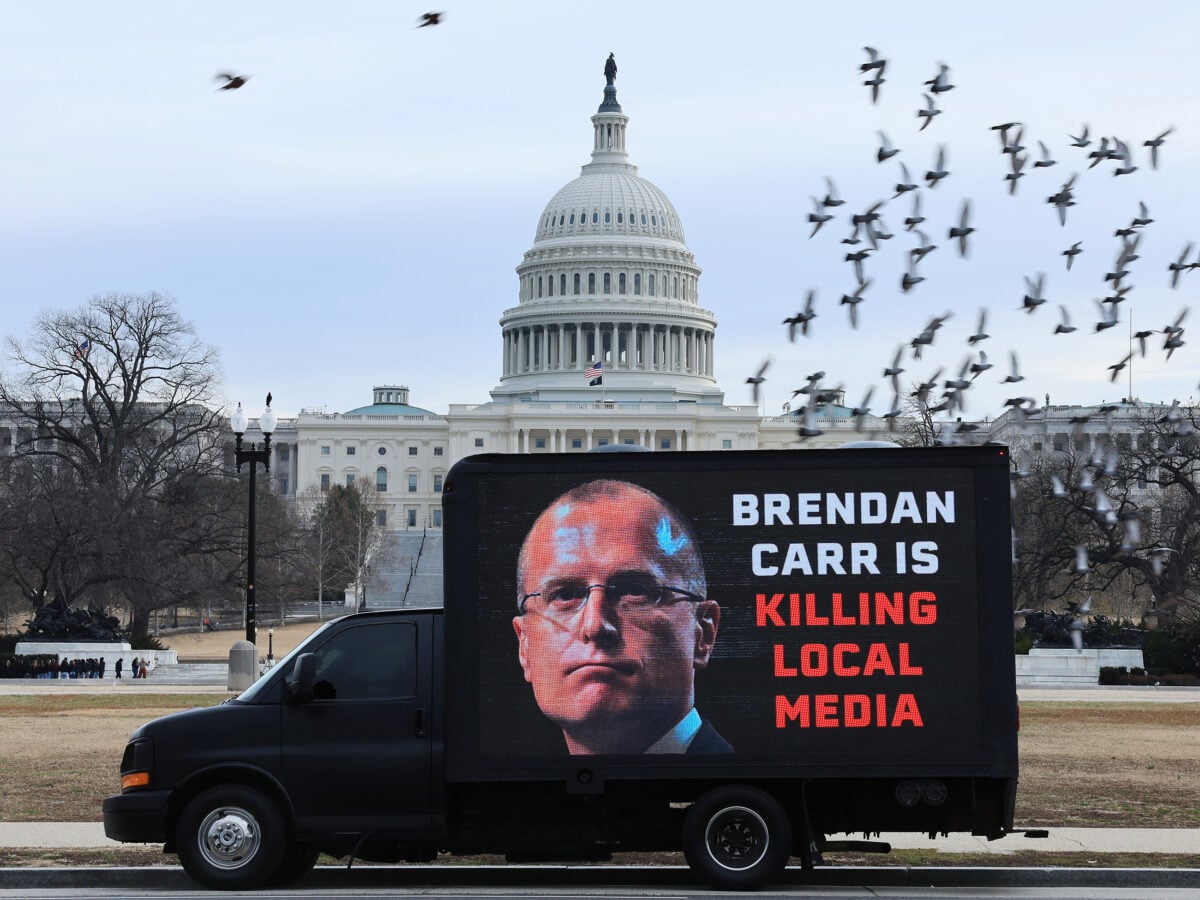
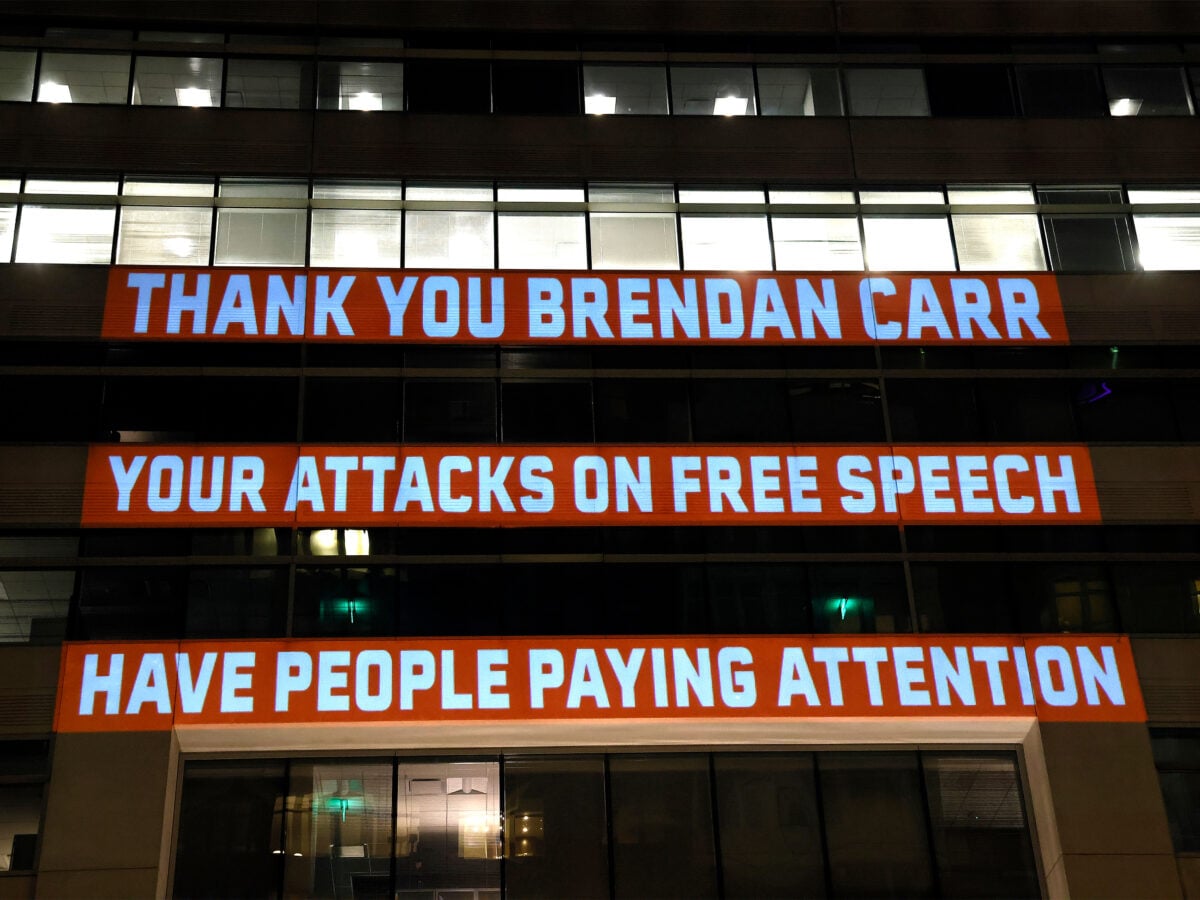
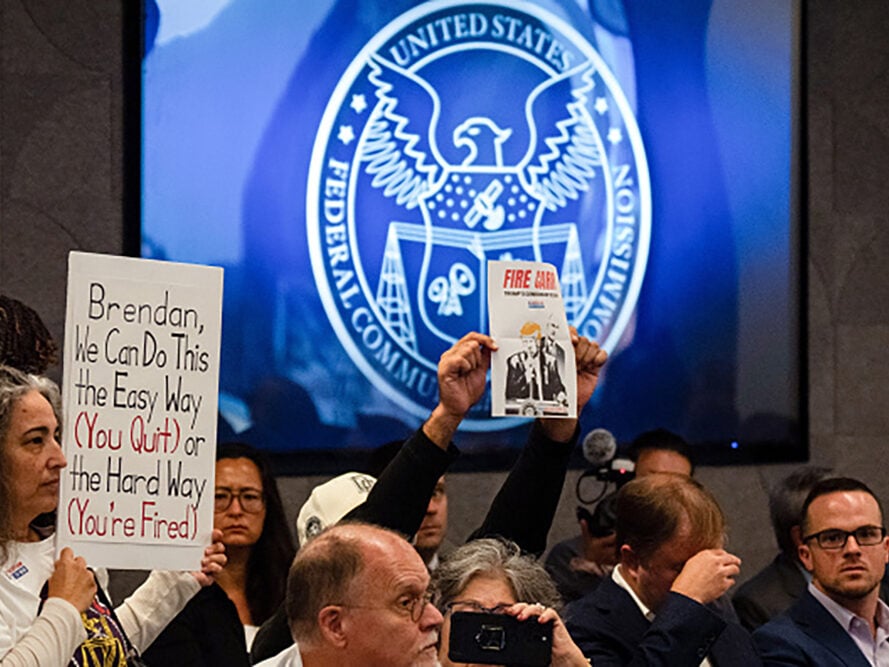
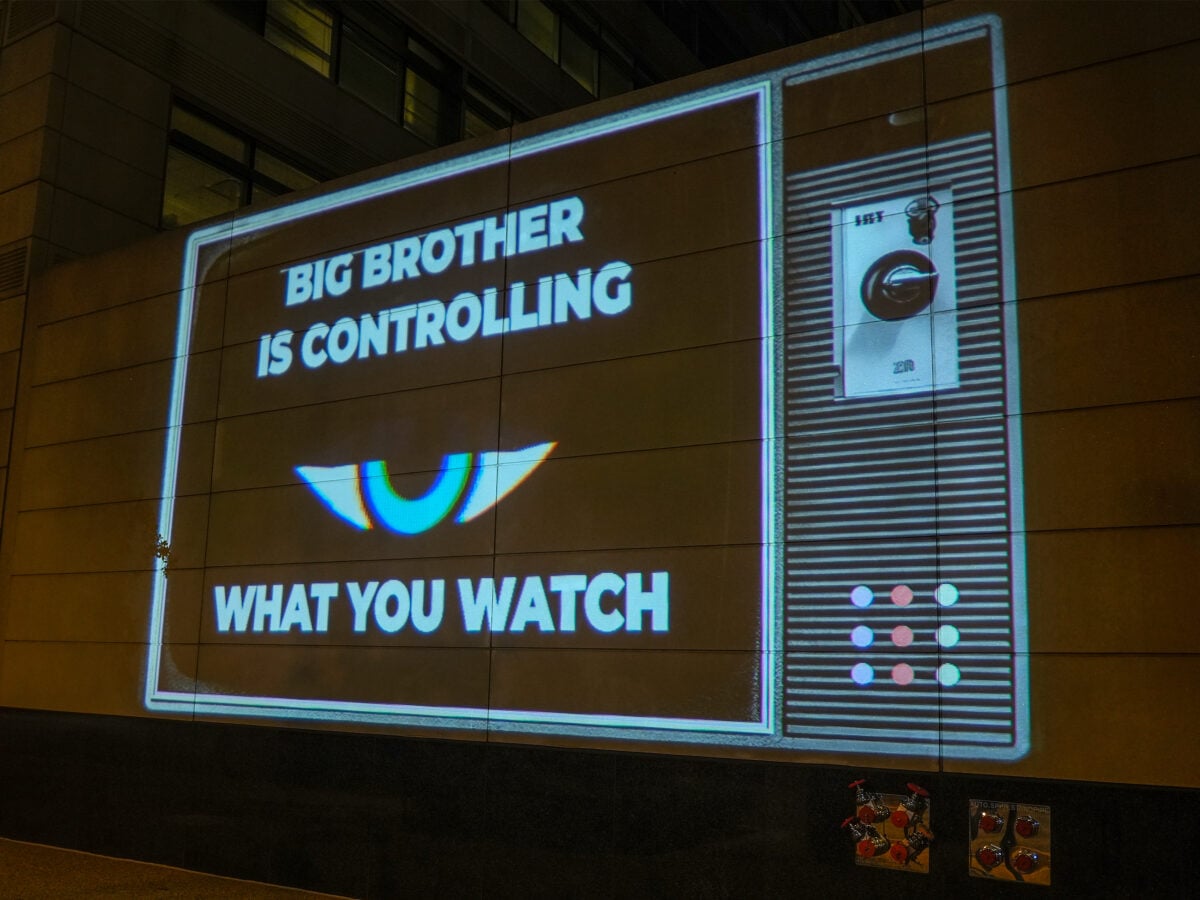
In May, Gomez blasted the Trump administration for “weaponizing” the FCC against the media. “We have not seen anything like what we are seeing today in terms of going after broadcast content in my lifetime,” she said during a public meeting. “This administration does not like any content that criticizes it, and it wants to amplify voices that are friendly to it.” Wheeler, the FCC chair under Obama, worries that the agency’s longtime culture of operating with restraint is being eroded. “What has happened” under Carr, he says, “has been the bastardization of due process in the name of political expediency.”
When Skydance was trying to merge with CBS News parent company Paramount, the deal needed FCC approval—a green light from Carr that came only after the network settled Trump’s 60 Minutes lawsuit and with an agreement to bring what Carr called “more fact-based, objective, unbiased coverage to their newsrooms.” Paramount Skydance CEO David Ellison, son of billionaire Trump supporter Larry Ellison, subsequently tapped Bari Weiss, a right-leaning podcaster and opinion editor with no broadcast experience, to head CBS News. More recently, Carr waived a media-ownership cap set by Congress to approve a Trump-backed merger between rival local broadcasting conglomerates Nexstar and Tegna. If the deal survives court challenges, it will give a single company control over more than 250 stations. Carr ruled without calling for a commission vote, making legal opposition more difficult.
“I respect Brendan’s intelligence,” Wheeler says of Carr. “He’s a lot smarter than I am. I respect his ability to express himself. I respect his strategic thinking. It’s just a tragedy that these gifts are being used in this kind of an abusive manner.” The two men no longer lunch.
“It Will Not Age Well”
In March, I saw Carr in Washington, presiding over the FCC’s monthly open meeting. A can of Celsius energy drink, a Trumpworld favorite, sat on the dais in front of him. The session, held in a windowless room in the agency’s NoMa headquarters, was routine—discussions of onshoring call centers, robocalls, and the allocation of radio spectrum—until the Q&A, during which I asked Carr about a recent post he made on X.
The post featured a screen grab of a long and winding Trump complaint about the “sick and demented” “Fake News Media” misreporting the facts of the Iran war and wanting the administration to lose. Above the President’s rant, Carr posted a mini-essay of his own, calling on broadcasters running “fake news” to “correct course before their license renewals come up.” He also blamed the media for earning the public’s distrust and—in a nod to his boss—stated that “when a political candidate is able to win a landslide election victory after in [sic] the face of hoaxes and distortions, there is something very wrong.”
Critics saw Carr’s post as an “authoritarian” and “unconstitutional” attempt to shape war coverage. I asked Carr about the idea that Trump’s wins, despite negative coverage, proved that “there is something very wrong.” Wrong with what?
“When you have someone running and there’s 97 percent negative coverage,” Carr answered, using a statistic Trump often cites without providing a source, “and that person still wins, clearly there’s a mismatch between the focus in the operations of the legacy media and where the communities all across the country are.”
Among conservatives, this is a common sentiment. Carr, they say, isn’t stacking the media deck in Trump’s favor—he’s simply shuffling cards that are otherwise very unfair to the President and his followers. The Media Research Center, a conservative watchdog group based in Herndon, claims that 92 percent of ABC, NBC, and CBS evening-newscast stories between January and April 2025 discussing Trump and his administration were negative. Daniel Suhr heads the Center for American Rights, a conservative law firm that has sued an Iowa newspaper for publishing a poll showing Harris leading Trump prior to the 2024 election and filed an FCC complaint over Kimmel telling more jokes about Republicans than Democrats. Suhr describes the media landscape with a football metaphor: “For the past several decades, the ball has just been parked on the Democratic Party’s two-yard line. I’m not asking to get the ball to the Republican Party’s two-yard line. I’m just saying let’s get it between the 40s.”
Similarly, Carr’s allies bristle at accusations that his behavior is unprecedented, pointing to the Wheeler-led FCC’s issuing of controversial net-neutrality rules shortly after Obama called on the agency to adopt them. Carr likes to remind people that in 2018 a group of Democratic senators sent the FCC a letter expressing concern that Sinclair’s political content violated the public-interest standard. Recently, he told CNBC that Democrats “massively weaponized” the agency under Biden, claiming “they teed up potentially not renewing a Fox broadcast TV license for content on Fox News Cable.” Carr was referring to a 2023 complaint filed by a liberal advocacy group, which sought to block a Philadelphia Fox station’s license renewal because Fox News knowingly promoted false claims that a voting-machine company had rigged the 2020 election for Biden. That complaint was later dismissed by former agency chair and Democrat Jessica Rosenworcel.
Carr’s allies bristle at accusations that his behavior is unprecedented.
A few years earlier, Rosenworcel wrote an op-ed urging a crackdown on radio and TV ads for e-cigarettes. In response, Carr posted, “Should the government censor speech it doesn’t like? Of course not. The FCC does not have a roving mandate to police speech in the name of the ‘public interest.’ ” Times change. At a recent hearing, Democratic Hawaii senator Brian Schatz told Carr he has enjoyed their interactions over the years, calling him a “solid, knowledgeable person.” He then said Carr’s handling of the media has been “out of character, and it will not age well.”
Around the capital, divining Carr’s motivations has become a guessing game. Matt Wood, vice president of policy and general counsel at the media advocacy group Free Press, has known Carr for years. He thinks the FCC chair, whom he once considered a standard-issue Chamber of Commerce Republican, is largely performing for “an audience of one”: Trump. Why else would Carr call the President the “alpha in every single room, in every single place, all across the world?” Or show up to a Justice Department panel on “Big Tech censorship” wearing a gold lapel pin of Trump’s head?
After Carr recently pushed to ban foreign-made routers, a joke circulated in DC telecom circles—referring to both the administration’s forever feud with the press and Carr’s seemingly mindless willingness to fight it. Do you think Trump told him to “ban Reuters” and he misheard? Those close to Carr, however, insist there’s nothing vacuous about his agenda. “Some of the coverage is ‘What does he think he’s doing? What does he not understand?’ says Leamer, the former Pai adviser. “No, he very much understands.”
Wood isn’t sure whether Carr’s actions as FCC chair reflect his genuine beliefs. “I think it could be opportunism,” he says. “What I would say is, if opportunism is authoritarianism, too, then I don’t really care. He doesn’t get extra points from me if he’s faking it and only doing it to get ahead.” Either way, it’s working. During a White House event in March at which Trump announced an executive order protecting the airing of the Army-Navy football game, the President called Carr “perhaps the most powerful man in this room,” adding, “You are doing some job.” Carr posted the clip to X, writing: “Thank you, Mr. President. More good work ahead.”
Carr’s endgame isn’t clear. Some in Washington believe he’s gunning for a promotion: Secretary of Commerce in the second half of Trump’s term, a cabinet post in a future JD Vance administration, or a top job at Musk’s SpaceX if the White House changes parties in 2028. Others think Carr is trying to appease Trump to protect the FCC, buying it space to work on boring, technocratic, non-media issues and perhaps keeping the administration from appointing a chair with less respect for the agency’s mission.
Last spring, Carr said at an industry event that previous FCC chairs always hungered to have gotten more done. “So from the get-go,” he proclaimed, “I’m starting from a no-regrets perspective.” Regret may arrive anyway. Like the rest of the federal government, much of the agency’s legitimacy stems from being seen as an honest broker. If it instead becomes a tool to harass and silence political opponents while rewarding allies, that perception could be lost. Asked about Carr’s potential legacy, Wheeler sounds a note of caution: “I hope that when the Democrats are back in power, we don’t turn around and do the same thing.”
A basic rule of gravity, political or otherwise, holds that what goes up eventually comes down. Back at the FCC open meeting, I ask Carr about his tower-climbing and if he hopes to go even higher. “Well, fortunately or unfortunately, 2,000 feet is basically the cap for broadcast towers in this country, so we topped out in terms of that,” he says. “But we’ll see.”
This article appears in the July 2026 issue of Washingtonian.