It’s Alexandra Reeve Givens’s job to think deeply about how technology and civil rights can intersect. The president and CEO of the nonpartisan Center for Democracy & Technology came to her job via a background in human-rights law and a stint with the Senate Judiciary Committee, where she worked on issues including voting rights and consumer protection. She says she realized early in her career that “the fight for civil rights in the 21st century is a technology fight.” Her organization is devoted to protecting people’s rights in the digital age.
Recently, that has meant grappling with the implications of the artificial-intelligence tools that companies are deploying, sometimes without much forethought about how they might be used—or misused. The Pew Research Center found that most Americans are deeply concerned about AI’s impact on their lives, and for good reason: Beyond teenagers using ChatGPT to do their homework, scammers have employed AI tools to create deepfake porn videos of public and private figures, ICE has used the tech to scan people’s faces and social-media accounts, and the President of the United States has shared an AI-generated video to depict a fantasy about dousing protesters with poop.
Givens also serves on the board of the Christopher & Dana Reeve Foundation—named for her late father, the actor who played Superman in the ’70s and ’80s, and her stepmother—which is working toward a cure for spinal-cord injuries.
A lot of what you do involves advocating for regulation. How has your approach changed under the Trump administration?
One big change is that the federal agencies designed to protect consumers, workers, and families are under sustained attack. We spend a lot of time raising awareness about the importance of these agencies and making the case that protecting consumers and workers’ basic rights shouldn’t be political. It’s not woke; it’s how you actually make the economy work for everyone.
The fact that you have to say that regulation isn’t “woke” makes this task seem quite daunting.
Regardless of how engaged or not disengaged the federal government is on these questions, we still are actively working with companies, making the case that responsible protections for their users are good business for them. It helps boost consumer trust. And then [we are] working actively in red and blue states that are very focused on how technology is impacting consumers and families, and are looking for technical advice and assistance on the ways to craft appropriate regulation and legislation.
Many tech companies have found a receptive ear in the White House while also, for example, contributing funds to help the President build a ballroom. How do you convince them that they should embrace some rules of the road?
Yeah, it’s an interesting question. Because for a long time, tech regulation was one of the few remaining issues in Washington where it didn’t matter what side of the divide you were on—you were interested in how these issues are impacting people. We are working really hard to keep that bipartisan energy and to collapse this false distinction that you have innovation on the one hand or regulation on the other. The mantra that I always come back to is that the key to AI success is going to be its adoption. And adoption is contingent on people trusting these tools and knowing that they can work well.
As people start relying on AI assistance or engaging more with AI chatbots, AI companies will know an extraordinary amount of information about our lives, even far more personal than internet browsers today. So what privacy safeguards are in place? What happens when AI companies begin using this information to target people with ads?
And it’s not just ads, is it? This administration has been eager to use AI to aid surveillance.
There’s surveillance issues to talk about, yes, and then there’s an entirely different bucket, which is AI being used in consequential decisions about people’s lives. So whether you’re hired for a job, whether you’re approved for a loan, whether you receive public benefits and how much—all of those tools are now AI-integrated, with very little transparency into how those tools are being used.
Oh my gosh, I hadn’t even thought about that.
Yes, that is widespread and has been for a number of years, and nobody’s talking about it. And so our work there is to say: Of course there are ways that AI tools can make those processes more efficient, but you have to have transparency and rigorous testing to ensure that the AI tools are fit for purpose and not causing discrimination or harm.
Do you aim to teach those people about best practices?
We are in the best-practice game. We have an AI-governance lab that is led by technologists who know how to build these tools responsibly and well and what questions people should be asking. And so we will advocate directly to the AI companies about what best practices should look like. We then support AI adopters or deployers to say, “How do you become a smart user of this tool?”
And then, separately, when law-makers say, “Hey, we want to regulate in this space,” we’ll give advice on their legislative solutions as well to make sure that they actually work and don’t either stop all use of technology whatsoever by accident or have loopholes so big you can drive a truck through it.
Unintended consequences seem inevitable in the rush to inject this tech into every aspect of life.
That’s exactly right. Time and again, we’re seeing tools that are being adopted too quickly or are being deployed without thinking about how they’re going to be used. There are examples of employers using an automated video screening tool for interviewing candidates, and testers have completed the entire interview in a foreign language and still been scored at 80 percent because it turns out that the algorithm was testing their tone of voice and their perceived attitude rather than the content of what they were saying.
In some ways, it’s startling that we’re at this level of basic education being needed as to how things can go wrong and how to make sure that people are smart, informed users of this technology—not just buying the pipe dream but really testing Hey, is this going to work? And putting in those appropriate safeguards so that they can use it confidently.
There are and will be real benefits for this technology. But they have to be grounded in expertise and evidence rather than just the marketing promises of any one particular company. I think that there has been a real rush toward integrating this stuff without a lot of thought about how it’s going to be used. And one of the concerns that I have the most is ensuring that actual subject-matter experts retain or gain their seat at the table. So when you’re thinking about deploying AI in a particular sector, where is the expertise of the people that have led that work for many years? They are the ones who can help identify where AI might be a supplement or not. And we have to make sure that those voices stay empowered.
It sounds like you’re somewhat optimistic about a future in which this technology is deployed–if it’s deployed responsibly.
Yeah, I think there are specific ways in which AI will significantly advance science or boost productivity. I’m an advocate for thinking on a use-case-by-use-case basis rather than the high-level banner claims of a one-single-shot solution for all the world’s ills.
I have to admit that over the last decade I’ve found myself growing a lot more pessimistic about the idea that technology can be a force for good.
You are far from alone. The survey results are stunning when you look at the level of skepticism in the US, in particular around AI. People are not happy with how content is moderated on most of the major services. And the internet, which had so much promise to connect people—still has so much promise to connect people and empower people—came with all of these additional issues that we’re still working through 30 years later. So one big part of my mission is: How do we take those lessons from the past and try to break the cycle this time?
I’ve had zero luck trying to get companies to stop shoving AI tools I don’t want down my throat.
I think one of the issues is them understanding how much this matters to consumers. And for that to work, consumers need to keep making the case. So a lot of this work does end up being public education. People lead really busy lives. They continue to use web browsers that are more privacy-invasive, even though they should use other ones that are more privacy-protective. It’s hard having consumer choice be the only protection.
We’ve talked a lot about AI, but are there other aspects of tech now that interest you?
There are a lot of rapid developments happening right now that warrant far greater attention than they’re receiving. One that’s worth noting is just the significant efforts under this administration to access and consolidate information about people for new purposes, including for immigration enforcement. So there’s a significant ramp-up in the capabilities that are happening at the exact same time as we’re seeing privacy and civil-liberties officers and inspectors general in the federal government being fired, reducing the traditional checks and balances on the use of any of this tech.
Listening to you, I feel like I’m in the Outer Banks waiting helplessly for the sea to take my house. How do you stay optimistic?
I continue to be deeply passionate about the potential for technology to change people’s lives. It has made us more informed, more connected, more able to express ourselves and find community than ever before. The question is: How do you make sure that people really get the benefits and are protected from invasive uses or exploitation?
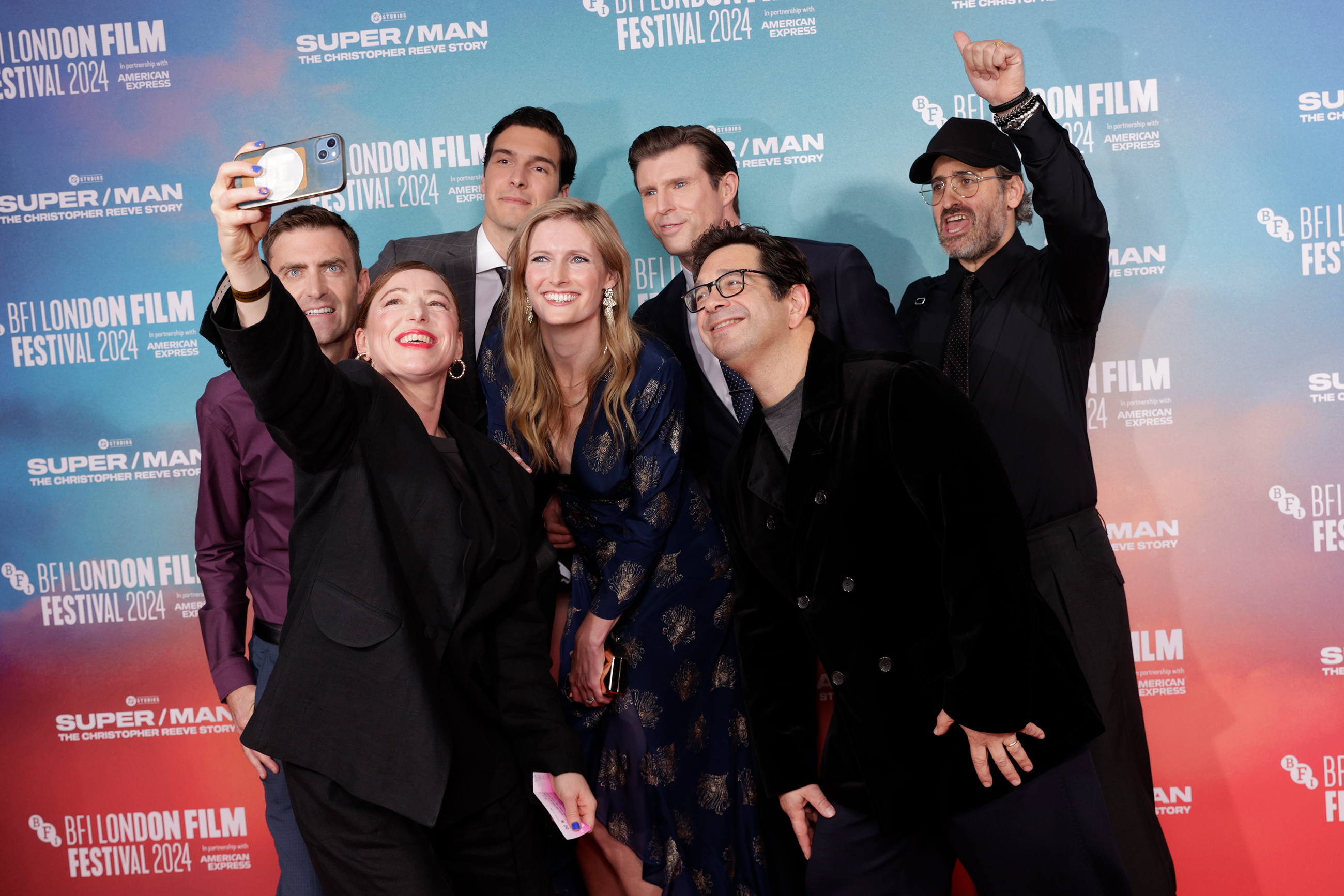
You’re on the board of your dad’s foundation–do you have any good news to report about research into spinal-cord injuries?
The Christopher & Dana Reeve Foundation is going from strength to strength with really important new breakthroughs in the field of spinal-cord injury. The most important one has been the use of AI, in fact, to help power neurostimulation, which is devices that are implanted on the spinal cord to stimulate the nerves. And with this, for the first time, we are now seeing people take steps and regain more independent movement and control over their bodies.
I was thinking about you the other night when I saw Lynda Carter introduce Kara Swisher and Scott Galloway at a live taping of their podcast. Do you know Lynda Carter? Is there a secret club among actors who play superheroes?
I got to sit next to her at the Met Gala in 2008. And it was very cool to meet her. I had a law-school final the next day, so I was probably less interesting than I could have been. But no, sadly, the superheroes, or at least the spawn of the superheroes, don’t get to hang out that much.
This article appears in the February 2026 issue of Washingtonian.

Andrew Beaujon joined Washingtonian in late 2014. He was previously with the Poynter Institute, TBD.com, and Washington City Paper. He lives in Del Ray.