For the past year, Danila Galperovich has worked at the Trader Joe’s in Clarendon, stacking shelves and manning the register. Trader Joe’s refers to its employees as crew members, mates, and captains, and for Galperovich it triggers a twinge of nostalgia, because he once served in the Soviet navy.
More recently, Galperovich was a top journalist at Voice of America, and he sometimes encounters his old VOA colleagues while ringing up groceries. In the beginning, he sensed pity in their attitude toward him. But over time, he’s felt more and more as if he’s in the better position. “In the first months after I started at Trader Joe’s, they looked at me like I’m ill,” he says. “After six or seven months, they looked at me like, Do you have any positions here? ”
Galperovich spent 30 years as a journalist, interviewing Alexei Navalny, Jimmy Carter, and many Russian and American officials and diplomats. But in March 2025, he was abruptly fired along with hundreds of other VOA journalists, part of a Trump-administration purge that has led to three lawsuits by its former journalists and thrown the future of this 84-year-old institution into doubt.
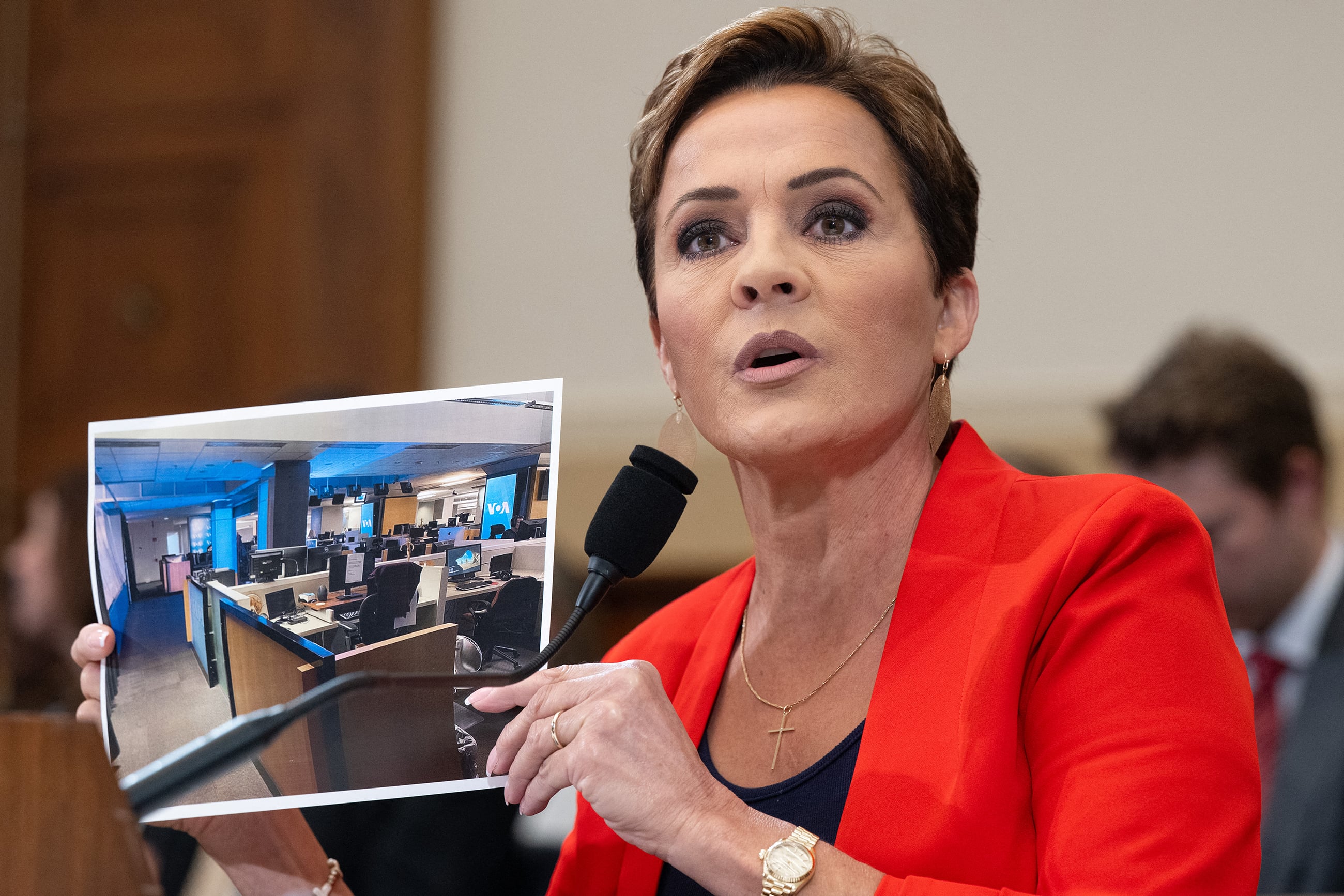
Now, in the crumbling New Deal–era Wilbur Cohen Building on Independence Avenue that has long been VOA’s home, just a few lights are on. When 2025 began, the broadcaster employed nearly 2,000 journalists covering news in 49 languages. There are currently about 200 people at work, and most programming is off the air. The desultory content still being put out in a few languages—Farsi and Chinese among them—is thinly reported and propagandistic.
For Galperovich, the past year has been a period of turmoil and uncertainty. He makes less than half his hourly pay at VOA. But he isn’t eager to return to his old employer in its current state. Last year, VOA reached out to Galperovich with an offer to come back under his previous contract. It was tough for him to imagine. “I asked them, ‘How am I supposed to work if the Russian service no longer exists?’ ” he says. Given no real answer, he told the broadcaster he’d “respectfully decline.”
Galperovich’s reluctance speaks to something that worries many former VOA employees: Even if the lawsuits ultimately restore VOA, the path to returning the broadcaster to its former robust, independent, trusted status will be narrow and difficult. After all the damage done to VOA’s functions and its reputation, it may be impossible.
Voice of America was launched during World War II to broadcast anti-propaganda and music programming to Axis-occupied territories. In the early years of the Cold War, it began to grow dramatically, eventually becoming a behemoth that employed journalists around the world and produced substantive, independent reporting for audiences who wouldn’t otherwise have access to it. More than just relaying news and information about US policies, VOA tried to offer access to American culture. The Voice of America Jazz Hour, which broadcast for decades, had millions of listeners, including many in the Eastern Bloc.
In recent years, the global audience for VOA continued to be substantial. Surveys from 2020 to 2024 show 361 million regular listeners and viewers around the world, including 64.8 million in Indonesia, 37.4 million in Nigeria, 37.1 million in Mexico, 30 million in India, and 12 million in Iran. In Afghanistan and Somalia, more than 60 percent of adults turned to VOA for news. Audiences in these countries say they often trust VOA more than they do their local media.
VOA has historically enjoyed bipartisan support in Congress, but most Americans don’t have a clear idea of what it does. Maybe you fondly remember watching Sesame Street on PBS as a kid or tuning in to Car Talk on NPR. You likely don’t have any such fuzzy feelings about VOA. There’s a reason: For most of the agency’s history, the 1948 Smith-Mundt Act prohibited government-funded international broadcasters from reaching Americans at home. In 2013, as online news took off, Congress loosened that prohibition, but VOA still has no real constituency in America. Like the US Agency for International Development, it’s funded by taxpayers to help advance human rights overseas, but it doesn’t benefit Americans directly.
Partly because of this, many in Trump’s orbit see VOA as a waste of money. They also view it—especially its central DC office—as too liberal. Trump antagonized the broadcaster during his first term, and the White House accused VOA of amplifying Chinese propaganda during the pandemic. Michael Pack, Trump’s pick for head of the US Agency for Global Media (USAGM), VOA’s parent, rescinded a rule that protected his employees from political interference, threatening the firewall that stood for decades between its journalism and the White House. But Pack barely met with editors, and the newsroom largely continued operating as it had before. Pack resigned two hours after Joe Biden took office.
The second time around, Trump officials moved faster. On March 14, 2025, the President signed an executive order decimating USAGM and putting Kari Lake, a loyalist election denier and former TV news anchor, in charge. Lake said the agency was “not salvageable.” Soon, DOGE employees entered the VOA offices. The vast majority of VOA staff got emails saying they were now on administrative leave and were forbidden from reporting or broadcasting. Most of VOA’s newsgathering and broadcasting operations froze. Millions of listeners in Nigeria and Indonesia heard music—or silence—in place of regular programming. The agency even stopped updating its websites. More than a year later, the homepages of most of its news services—including the English-language one—are frozen in place, featuring the news from March 15, 2025.
Less than a week after the layoffs, VOA journalists filed the first of several lawsuits. White House bureau chief Patsy Widakuswara, press-freedom editor Jessica Jerreat, and strategy director Kate Neeper, along with a few unnamed plaintiffs and the nonprofit Reporters Without Borders, sued to stop the layoffs and restore VOA as “a reliable and authoritative source of news,” as mandated by its charter. Furloughed but still receiving pay (unlike contractor colleagues such as Galperovich), they’ve since been running the #SaveVOA campaign as a full-time job. The campaign encourages people to call their representatives about VOA, publicizes the group’s legal battle, and raises money to cover the daily needs and legal help for staff living abroad. “It’s been the most important work I’ve ever done,” Jerreat says.
In the meantime, uncharacteristically propagandistic coverage in a few languages—Chinese, Farsi, Dari, Pashto, Korean, and Kurdish—has restarted, disturbing VOA’s veteran journalists. Another group of reporters and editors sued over editorial content this spring, alleging that VOA is broadcasting Trump propaganda.
On March 17, federal judge Royce Lamberth, who is presiding over two related VOA lawsuits, including one filed by VOA director Michael Abramowitz on behalf of the agency, ruled that the agency had been illegally dismantled and ordered VOA to bring back its employees. But a federal appeals court stayed the return-to-work order two weeks later, and things remain in limbo as the cases progress. In June, an appeals court put the two suits on hold until a case about similar issues—a challenge against Russel Vought’s dismantling of the Consumer Financial Protection Bureau—is resolved.
A spokesperson for USAGM didn’t respond to a request for comment on the concerns of the journalists interviewed for this story. Lake has said publicly that shutting down VOA was necessary because it was wasteful, hired too many foreign workers, and broadcast “Russian, Chinese, and Iranian propaganda,” she claimed. “Some say it’s the Voice of anti-America,” Lake said at a House hearing last summer. In court, USAGM’s lawyers have made a more narrow argument: that personnel decisions should rest with the executive branch and that Judge Lamberth’s ruling was overly broad.
One thing that apparently has now been resolved: Lake’s role. In May, Trump named her ambassador to Jamaica, ending her destructive tenure at USAGM. Her successor, Sarah B. Rogers, a State Department official, is awaiting a Senate confirmation hearing.
VOA journalists say that even if Lamberth’s order ultimately goes into effect and operations are restored to previous levels, things won’t simply return to normal. One senior VOA journalist, who asked to remain anonymous amid the ongoing legal and political battles, got a call in March from Lake’s office asking her to come back to work after Lamberth’s order. When she walked into the Cohen building, she was disturbed by what she saw. Camera gear and hard drives full of significant footage had been haphazardly shoved into storage rooms. Some contained footage from ISIS attacks, refugee camps, and the Syrian civil war. “That’s the stuff you cannot buy again,” the journalist says. “I don’t know where it is.”
The journalist says she was in the office for only a few days before the appeals court stayed Lamberth’s order and nearly all VOA employees were back on leave. But things were in a concerning state. At one time, VOA had taken up three floors of the Cohen building. It now was reduced to half a floor, with most of the old newsroom occupied by IT and maintenance staff, not editorial. The desks were denuded of their computers. The journalist’s office had been given to someone else. (Lake had announced that the downsized VOA would be moving into a NASA building in Southwest DC, though that plan is uncertain.)
The biggest thing that worries me is trust from your audiences. It takes a lifetime to build trust and a reputation, and you can lose it overnight.”
And the logistical puzzle of rehiring VOA’s 1,300 laid-off employees, finding them office space, and tracking down camera gear and footage would only be the first step. Those hurdles are less troubling to the VOA journalists I talked to than the crucial issue of VOA’s reputation. “You don’t need to have a physical office space to get back to work,” Jerreat says. “We’d be able to build something. The biggest thing that worries me is trust from your audiences. It takes a lifetime to build trust and a reputation, and you can lose it overnight.”
VOA’s Farsi service, once an independent source of news for Iranians that was beholden to neither the US government nor the Iranian regime, has ignored news like the deadly bombing of a girls’ school in February. Many stories exclusively quote Trump and his officials. The Mandarin service now runs articles with headlines such as trump combined dealmaking skill with ‘peace through strength’ diplomacy to mitigate eight conflicts around the world in 2025. That one was illustrated with an AI image of Trump superimposed over a waving American flag.
Now, former VOA journalists believe, the planet’s increasingly savvy media consumers will flee. “Our audience around the world is used to state propaganda and used to avoiding state propaganda,” says Widakuswara. “Seeing this from VOA, a source that they used to trust—that’s going to make them leave us.”
At this point, it seems unlikely that either Widakuswara’s lawsuit or the suit over editorial content will restore VOA to its pre-Trump status before the President leaves office. If the VOA journalists I talked to have any hope, it’s that their colleagues’ legal battles will be a tool for rebuilding that trust at some future point. “It’ll give us credibility when we come back,” one told me. “Because they’ll see journalists at VOA fighting for editorial independence.”
Meanwhile, the court fights will drag on; VOA’s reputation will continue to wane. For Steven Herman, VOA’s former White House bureau chief, things seem particularly grim: “The damage, I fear, is permanent.”
A version of this article appears in the July 2026 issue of Washingtonian.

Ike Allen covers politics, food, culture, and transportation in DC and writes the monthly Hidden Eats column for the magazine. He grew up in DC.