Jensen Huang is out as CEO at Nvidia, and the world is reeling. The chip-making giant has lost ten percent of its stock value since news that the former head had left the company, and the scope of the impact on the world’s exploding AI obsession is yet to be determined.
Huang’s ouster comes after the revelation, on October 29, that his paramour, Alice Huang, may have been a Chinese spy. Experts now wonder if Huang—who’s long had President Trump’s ear and favored selling his chips to China—had inadvertently been advancing Beijing’s interest at the behest of his secret lover.
As much as we might think this classic espionage is a thing of the past, says Mark Jacobson, the International Spy Museum’s historian, it’s actually an ongoing practice. But, he adds, “it’s just a matter of what gets uncovered.”
Jacobson says that, technically, Huang’s undoing is more a case of possible covert influence than a traditional romantic or sexual compromise because, classically, blackmail is usually at the end of a romance scheme.
“I think Huang had no issue with anything he’s been doing,” Jacobson explains. His case is “more about compromise, exploiting an individual’s emotional vulnerability.” But it’s possible Huang was undone, at least in part, by sexual spycraft.
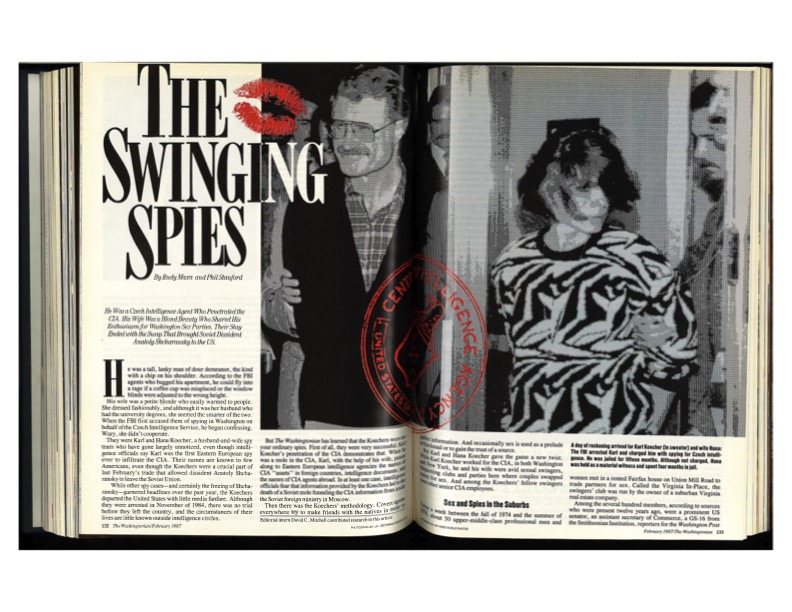
With this in mind, we decided to dip into the archives and share our (at the time) exclusive reporting on a pair of Czech spies who collected information and influence as part of DC’s and New York City’s swinger scenes.
Karl and Hana Koecher did “incalculable damage” as spies for the Soviet Union, says Jacobson, but their story of infiltrating the CIA and swinging with Washington types of all sorts is a doozy. From the February 1987 issue of Washingtonian, we present “The Swinging Spies” by Rudy Maxa and Phil Stanford.
— Tani Levitt
He was a tall, lanky man of dour demeanor, the kind with a chip on his shoulder. According to the FBI agents who bugged his apartment, he could fly into a rage if a coffee cup was misplaced or the window blinds were adjusted to the wrong height.
His wife was a petite blonde who easily warmed to people. She dressed fashionably, and although it was her husband who had the university degrees, she seemed the smarter of the two. When the FBI first accused them of spying in Washington on behalf of the Czech Intelligence Service, he began confessing. Wary, she didn’t cooperate.
They were Karl and Hana Koecher, a husband-and-wife spy team who have gone largely unnoticed, even though intelligence officials say Karl was the first Eastern European spy ever to infiltrate the CIA. Their names are known to few Americans, even though the Koechers were a crucial part of last February’s trade that allowed dissident Anatoly Shcharansky to leave the Soviet Union.
While other spy cases—and certainly the freeing of Shcharansky—garnered headlines over the past year, the Koechers departed the United States with little media fanfare. Although they were arrested in November of 1984, there was no trial before they left the country, and the circumstances of their lives are little known outside intelligence circles.
But The Washingtonian has learned that the Koechers were not your ordinary spies. First of all, they were very successful; Karl Koecher’s penetration of the CIA demonstrates that. When he was a mole in the CIA, Karl, with the help of his wife, passed along to Eastern European intelligence agencies the names of the names of CIA “assets” in foreign countries, intelligence documents. In at least one case, intelligence officials fear that information provided by the Koechers led to the death of a Soviet mole funneling the CIA information from inside the Soviet foreign ministry in Moscow.
Then there was the Koechers’ methodology. Cover agents everywhere try to make friends with the natives in order to gather information. And occasionally sex is used as a prelude to blackmail or gain the trust of a source.
But Karl and Hana Koecher gave the game a new twist. While Koecher worked for the CIA, in both Washington and New York, he and his wife were avid sexual swingers, frequenting clubs and parties here where couples swapped mates for sex. And among the Koechers’ fellow swingers were senior CIA employees.
Sex and Spies in the Suburbs
Twice a week between the fall of 1974 and the summer of 1976, about 50 upper-middle-class professional men and women met in a rented Fairfax house on Union Mill Road to trade partners for sex. Called the Virginia In-Place, the swingers’ club was run by the owner of a suburban Virginia real estate company.
Among the several hundred members, according to sources who were present twelve years ago, were a prominent US senator, an assistant secretary of Commerce, a GS-16 from the Smithsonian Institution, reporters for the Washington Post and the New York Times, and a host of men and women who by day worked in visible jobs. There were also CIA employees and, occasionally, a young Czech couple known as Karl and Hana.
The Fairfax house was a nondescript place maintained by a caretaker who cleaned up after parties. Most important, there were seven bedrooms, though any available space could serve as a romping ground. One large walk-in closet had two double mattresses on the floor. Lying down was not always a requisite for sex; one group activity involved a chain of couples making love while standing up, a sort of sexual “bunny hop,” as one participant remembers it.
Five couples, mostly in their thirties, put up $1,000 each to provide initial capital and to rent the Virginia In- Place’s residential home. Couples “donated” $20 at the door and brought their own liquor; a bartender provided mixers.
“No dope,” recalls one of the club’s organizers. “These were the yuppies of our generation—we were all legitimate businesspeople doing our thing, and we wanted to have no reason to have a knock on the door.”
No police action was taken against the club. But upon their return from a State Department posting in Mexico, the owners of the house heard about the orgies and filed suit against the man who had handled the rental of the property and had helped organize the sex club. The lawsuit also identified some of the people who had attended the sex parties, names obtained as a result of the police surveillance reports of months earlier.
Among those named were one CIA official and others whose Washington jobs required top security clearance. The lawsuit languished for two and a half years until the summer of 1979, when the lawyer for the complainant decided to subpoena many of the partygoers. Within two weeks, the suit was quietly settled out of court.
Three years later, perhaps tipped off by an Eastern Bloc defector, the FBI became interested in Karl Koecher, a Czech émigré, naturalized citizen, and former employee of the CIA. In the course of investigating the Koechers, FBI counterintelligence agents learned of the Koechers’ sex life. Had Karl Koecher used his wife and fellow CIA swingers to secure his CIA job?
Both the FBI and the CIA decline to discuss the Koecher case, but The Washingtonian learned that in 1982 FBI agents began asking police forces in the Washington area for information about a beautiful Czech woman who, they said, was involved in group sex parties. In particular, the FBI wanted details about a sex club. The counterintelligence investigation was so sensitive that the FBI asked area police to search their files in such a way that no record would be kept of the FBI inquiry. What manner of spies, they wanted to know, were these Koechers?
The Mole Burrows
Five years after he joined the Communist party in Prague, Karl Koecher emigrated with his wife to the United States. They arrived in New York in December of 1965 and claimed to be political defectors. Later Karl would tell acquaintances that his departure from Czechoslovakia had been necessitated by the fact that he had secretly worked in his homeland for Radio Free Europe. His first job in the US was as a freelance writer for Radio Free Europe in New York.
But in statements he would later make to the FBI, Karl admitted he had begun working for Czech intelligence in 1962 and that he had been sent to America to infiltrate the US government. He had a doctorate in physics from Charles University in Prague, and it was the academic world to which he turned when he and his wife began building their lives in the US as naturalized citizens.
Between 1969 and 1973, Karl taught philosophy at Wagner College on Staten Island and received a doctorate in philosophy from Columbia University. During a two-year course at Columbia’s Russian Institute, Karl studied under the man who would eventually serve as President Carter’s national-security adviser, Zbigniew Brzezinski.
The FBI describes the Koechers as “sleepers,” agents sent abroad to worm their way into sensitive positions that could produce intelligence for their real bosses. In late 1972, Karl Koecher did that after—he later claimed—he saw a flyer at Columbia announcing job interviews with the CIA. He moved to Washington and, after passing a lie-detector test affirming his loyalty to the US, began working for the CIA in February 1973. His wife stayed in New York, where she worked in Manhattan’s diamond district. She visited her husband on weekends and participated in sex parties in Washington.
At the CIA, Karl worked in what is called the AE Screen unit. He translated “conversations from the Russian and Czech languages . . . that were collected clandestinely by the CIA, ” according to Kenneth Geide, an FBI agent who investigated Karl Koecher. “In addition,” Geide says, “he was responsible for writing assessments on individuals who were speaking in those conversations, providing background and personality observations concerning those individuals. . . . Everything that he produced on his job was classified. The work of other individuals in the AB Screen unit that he had access to was also classified. He also had knowledge of the identities of fellow workers and their assignments abroad which was extremely sensitive information.”
In his work with the AE Screen unit, Karl was assigned to study and assess a Soviet official named Aleksander Dmitrevich Ogorodnik. Ogorodnik was a valuable CIA asset who, according to John Barron’s book KGB Today, was “turned” by the CIA in 1974 when he served in the Soviet Foreign Service in Bogotá, Colombia.
Later, Ogorodnik went to work in the Global Affairs Department of the Ministry of Foreign Affairs in Moscow, an office that receives sensitive political reports from Soviet ambassadors and KGB agents around the world. Information supplied to the CIA by Ogorodnik, says Barron, was circulated to the White House and State Department. Somehow—and the CIA and FBI suspected Koecher of the leak—the Soviets learned there was a mole in their capital, and according to Barron, Ogorodnik was caught photographing sensitive documents in Moscow in 1977.
The information collected by Karl Koecher was sometimes passed in cigarette cases by his wife to Soviet or Eastern European agents in the Washington and New York areas. The Koechers also used “dead drops” around Washington, primarily in the Virginia suburbs.
In August 1975, Karl left the AE Screen unit. He moved back to New York, bought a two-bedroom co-op for $40,000, and, still a contract employee for the CIA, began writing a paper on the decision-making process of Soviet leadership. The CIA will not say what other duties he had in New York before he left the employ of the agency in April 1977.
Apparently at no point during Karl’s CIA years was he or his wife under suspicion, for it wasn’t until 1982 that the FBI began nosing around Washington for information about his earlier activities. In the ensuing years, Koecher made attempts to return to college teaching, but his personality didn’t win him friends and his frustration at not finding a good job grew. He was turned down for full-time jobs at the CIA, Radio Free Europe, and the State University of New York at Old Westbury, though did teach humanities there between September 1979 and August 1980.
There were two things friends of the ochers never failed to notice: Hana’s sexy good looks and Karl’s virulent anti-communism. Once, when Czech tennis star Ivan Lendl wanted to buy a $700,000 apartment in the Koechers’ co-op, it was Karl Koecher who voted against him. (The cost of units in the co-op skyrocketed in the late ’70s, and their fellow residents included actress Anne Bancroft, director Mel Brooks, and Broadway choreographer Tommy Tune.)
The Steamy ’70s
According to a federal law-enforcement official who has spent a career sounding the depths of Washington’s sexual underworld, the 1970s were a particularly busy time for sexual operatives in the nation’s capital. Both American and foreign intelligence agents worked the call-girl rings. Some hung around the gay bars. And others, like the Koechers, entered into the “swinging” clubs that, in the wake of the sexual revolution, were in vogue in Washington.
In 1973, when Karl Koecher moved from New York to the Virginia suburbs, there were at least four clubs in the area catering to couples looking for group sex. In Jessup, there was the Swinging Gate, operating out of a large country house outfitted with wall-to-wall mattresses and black lights, which, according to a regular, “had an amazing effect if you’re looking at someone who has a tan.” Upstairs there was a tent room” with billowing parachutes hung from the ceiling. In the basement were a sauna and some utility rooms for people who did things shunned by society.”
The Gate, as it was called, had a reputation for steamy parties. One woman who attended a couple of affairs there recalls an impromptu floor show that featured a pair of bisexual midgets from Baltimore. According to another visitor, porno movie stars from New York sometimes drove down for the parties. It isn’t known whether the Koechers ever visited the Gate — or a second club in Upper Marlboro. Former patrons of both clubs do not recognize pictures of the Koechers, which is not surprising because the two Maryland clubs were usually known as hangouts for the six-pack crowd. The Koechers, it appears, were targeting more upscale partygoers. The Virginia In-Place in Fairfax County and Capitol Couples in downtown DC suited their purposes better.
The real estate agent who organized the Virginia In-Place—and was sued for using a client’s house for parties—remembers Karl Koecher clearly.
“Of course, you usually knew everyone by just their first names,” he says. “But there was definitely a Karl. A good-looking fellow who spoke English quite well, but with a slight Czech accent.” He identified the accent because his mother-in-law was Czechoslovakian, and he had picked up a few phrases in the language.
“Sometimes,” adds the real estate agent, “I even talked a little Bohunk with him while his wife was partying.”
The real estate agent had begun the Virginia In-Place in 1973 when his marriage went bad. A wealthy Virginian who presents himself to the world as a good ol’ boy, he attended parties with a young woman from his real estate firm. The woman, who went on to work as an administrative assistant in the Carter White House, is now on the staff of a House committee. Before it was disbanded in the summer of 1976—shortly after the owner of the house filed the lawsuit—the Virginia In-Place had a mailing list of more than 200 couples.
The Koechers’ other favorite club was Capitol Couples.
“Ah, yes,” says the man who organized Capitol Couples in 1970. “I remember them quite well. I found them an interesting couple. He was a professor. She was a diamond merchant. Strikingly beautiful. Warm, sweet, ingratiating. Incredibly orgasmic. I went to bed with her several times.
“But I thought Karl Koecher was a bit strange. I thought he took some sort of special drug—he was always naked at the parties. Usually people keep their clothes on at least some of the time, but he was always walking around naked. And he always had an erection. The women he was with said he was a terrible lover, very insensitive. His wife was everything he wasn’t.”
Memories and Mysteries
The club’s organizer, a frail, nervous man in his mid-forties, says the Koechers were “regulars” at Capitol Couples parties for a period of about a year and a half, starting in 1973. At the time, the members of Capitol Couples met every Saturday night at a downtown bar, the Exchange, where the club’s organizer worked. There, members would strike up new friendships and find out where parties were being held later on. Unlike the other swingers’ clubs in the area, Capitol Couples was an “off-premises” operation. In theory, at least, all the action was reserved for the parties, which were held in members’ homes or, on special occasions, in a hotel suite rented by the club. In 1974, when the club’s organizer took a new job at the Class Reunion and then, in 1976, at Marigolds, Capitol Couples moved with him.
He also remembers the time two years ago when FBI agents showed up with photographs of the Koechers for him to identify. He was able to do so without difficulty, although Hana, who had been a blonde, had allowed her hair to return to a darker color. All the FBI agents wanted to know, he recalls, was what parties the Koechers had attended.
“‘They went to the big ones,” he told them, “the ones where they could meet lots of people.”
Another couple, now living in Florida, remembers meeting the Koechers in 1973. At the time, they say, they were “seeing” an Army major and his wife who talked constantly about a beautiful and sophisticated couple they had met. The major and his wife jealously refused to divulge the names of this beautiful couple, but the Florida couple eventually succeeded in meeting the Koechers.
They remember Karl as “the most brilliant man” they had ever met. Karl told the couple that he had three PhDs—two from Czechoslovakia, in philosophy and drama, and another in physics that he had earned after coming to the US. The Koechers also told them they were “freedom fighters” who had come to the US just before the Russian tanks rumbled into Prague. (In fact, the Russians cracked down on Czechoslovakia in 1968, about three years after the Koechers first came to the US.)
The Florida couple called the FBI in November 1984, the moment they heard that the Koechers had been arrested as spies. They were shocked. “We told the FBI that we had known the Koechers for a long time,” says the husband. “The FBI agents we talked to said, ‘We know. We’ve been watching you for a long time.’ ”
Subsequently, the husband and wife were interrogated and given lie-detector tests. According to the wife, one of the FBI agents said they had been on to the Koechers since 1976. At one point, she says, the agent asked her if they and the Koechers had been close.
“No,” she said, “we just got together and f—ed.”
Another couple—the husband is an economist with the Treasury Department—continued swinging with the Koechers after the spies moved back to New York in 1976. Sometimes they would go to Plato’s Retreat, Manhattan’s sexual emporium, and sometimes to a nudist camp on the New Jersey shore. In retrospect, says the economist, there was reason to be suspicious of the Koechers’ activities.
Karl, he says, was always complaining about being out of work. He talked about opening a school or a restaurant and said he couldn’t get a job in academia because the universities were too liberal. Nevertheless, says the economist, although Karl never seemed to have a job, every morning he would leave the house before nine, returning at five or six o’clock. The economist says that in 1982 he offered to help Karl get a job at the Treasury Department, but Karl wasn’t interested.
The Koechers’ financial situation was intriguing. Karl was apparently unemployed, and Hana earned only about $20,000 a year as a clerk at Savion Diamonds, according to her employer. But, as the economist and wife note, the Koechers were able to maintain an expensive lifestyle. On one of their visits to New York in 1984, says the economist, Hana went shopping and returned with a mink coat. When she opened the closet to hang it up, they saw that the closet was filled with other fur coats.
Someone was paying the Koechers well during the eight years they lived in New York. Because the government isn’t willing to talk about it, what they did to earn the money is still a mystery.
The Dead Spook and the Watergate Reporter
Other mysteries lie just beneath the surface of the case of the swinging spies. One of them involves a former CIA agent, John Paisley, who occasionally took dates to swinging clubs.
A badly mutilated body said to be his was found floating in the Chesapeake Bay in October 1978. The cause of death was a gunshot wound to the head. Paisley, an expert on strategic weapons, had retired from the CIA four years earlier but continued to work for the CIA as a contract agent.
When the body was found, CIA spokesmen labeled Paisley’s death a suicide and described him as a low-level analyst. In fact, when Paisley retired from the CIA in 1974 he was deputy director of the Office of Strategic Assessment, with a rank of GS-17. At the time of his disappearance, he was engaged in a top-secret study of Soviet nuclear strength. There is a good deal of testimony from CIA sources, supported by documents obtained through the Freedom of Information Act, that at the time of his disappearance Paisley was also engaged in counterintelligence activities—caught up in the CIA’s frantic forts to find a Soviet mole inside the agency.
Only the CIA knows for certain whether Paisley was ferreting out Soviet moles, but if the timing was right, he could have socialized with the Koechers at the Virginia In-Place and Capitol Couples. Although it now appears that the Koechers left Washington’s swinging scene before Paisley became a participant, the possibility must have occurred to federal investigators that the paths of Paisley and the Koechers might have crossed in a bedroom.
According to a friend of Paisley’s, the ex–CIA agent didn’t discover the swinging scene until about 1977, which would rule out another favorite theory among Watergate conspiracy theorists:
A Washington journalist well known for his Watergate reporting was a frequent participant in local swinging clubs. While Paisley was working full-time at the CIA, he was the agency’s liaison with the White House “Plumbers,” whose dirty tricks caused the Nixon administration so much trouble. Did Paisley and the Watergate reporter get acquainted at a sex club? Was Paisley Deep Throat, providing information about the Plumbers’ skullduggery?
One member of the Virginia In-Place who was a friend of both the spook and the reporter says he doesn’t think the two met. But another member of the group says he recalls two or three parties, in his own home, where both men were present. The reporter has said he never met Paisley. Whatever the truth, Paisley was not the only CIA source the reporter might have developed while frolicking. One of the reporter’s acquaintances in the swinging scene was an assistant to Paisley in the CIA’s Office of Strategic Assessment, a fact that could not have cheered investigators seeking details of the Koechers’ stay in Washington.
Baiting the Trap
By the summer of 1984, the FBI had planted bugs in the Koechers’ New York apartment, their car, their apartment telephone, and the telephone at Hana Koecher’s office. It seems clear that both the CIA and the FBI knew the Koechers were—or had been—spies but did not have enough evidence to allow the Justice Department to prosecute them. Later, when confronted by the FBI, Karl Koecher said he presumed his cover had been blown by an émigré, perhaps from Czechoslovakia. But even if someone had fingered him as a spy, any prosecution would require more evidence than hearsay. And because the FBI had begun investigating the Koechers several years earlier in connection with the swingers’ clubs, one could presume that—as of the bugging in 1984—the FBI had not yet been able to gather that evidence. It must have been disconcerting, then, for the FBI to learn from eavesdropping on the Koechers’ conversations in mid-1984 that the couple intended to move to Austria.
Unable to find a good job, Karl Koecher told friends it was time to leave the country. He said he would use the profit from selling the couple’s co-op—bought a decade earlier for $40,000, it fetched about $280,000 in November of 1984—to invest in a hotel or supermarket in Europe. In the autumn of 1984, as the Koechers made final preparations to leave for Vienna, it was clear to the FBI and the CIA that if they didn’t move against the Koechers in some way, their quarry might elude them.
In meetings between FBI agents and Jerry Brown, the chief of a counterintelligence section in the CIA’s Office of Security, it was decided to take a “friendship approach” with the Koechers. Without enough hard evidence to arrest the couple, the FBI couldn’t compel them to talk; the trick was to persuade them to cooperate.
Twelve days before the Koechers were due to leave the United States, the FBI staked out a bank where, wiretaps had revealed, the Koechers had a 10 am appointment. Fourteen FBI agents were involved in the operation that morning, Thursday, November 15, 1984. Several agents were assigned to follow Karl, several to trail Hana, and several to assist at the Barbizon Plaza Hotel, where the FBI had rented a suite in which to question the Koechers.
When the Koechers left the bank at 10:45, they walked toward 30 West 47th Street, Hana’s office in Manhattan’s diamond district. Several agents followed the couple and waited while the Koechers entered the building. When Karl emerged alone, he was approached by an FBI agent he vaguely knew because they both worked out in the same health club. After an exchange of greetings, the agent introduced him to Kenneth Geide, an FBI agent who had spent several years on the New York counterintelligence squad that tracked Czech agents.
“Karl,” said Geide, “I am aware of your plans for the future, and in view of your past employment with the CIA, I think perhaps we should talk.”
“I think we should,” answered Koecher. “All right.”
Let’s Make a Deal
An unmarked government car pulled up to the curb, and the agents joined Koecher in the back seat. During the ride to the hotel, Geide remembers, Koecher was “calm, composed, relaxed.” An agent in the front seat radioed colleagues waiting at the hotel to say the “male package had been picked up.”
Ten minutes later, the agents and Koecher took the service elevator to Room 2640, a suite with a balcony and a view of Sixth Avenue and Central Park South. In an adjoining bedroom, FBI agents monitored taping equipment; Room 2640 was equipped with a hidden microphone and a camera that videotaped the conversation between Koecher, Geide, and the CIA counterintelligence specialist, Jerry Brown.
“Well, as I briefly told you out there,” began Geide, “we are aware, of course, of your plans and activities.”
During the next two hours, Karl Koecher outlined his recruitment and training by Czech intelligence as well as his assignment to penetrate the US government. Geide and Brown were startled that his cooperation came so quickly.
Their success wasn’t complete, however. Later that day, in a nearby room, FBI agent Richard Dorn Jr. was having no luck convincing Hana Koecher to cooperate. Hana was as distraught as her husband was cool. Dorn brought her into her husband’s suite, where, still very upset, she blurted: “I will, I will cooperate. I am going there. I delivered things. That’s all I can offer because I don’t want to be involved in any business. . . . I’m not by nature a spy. I don’t want to ever be in my whole life.”
When Hana Koecher mentioned prison, Dorn reassured her she wasn’t going to jail. And Brown begged her to calm down, assured her no one meant to harm either her or her husband, and told her that if she cooperated, there would be “very little disruption in your life.”
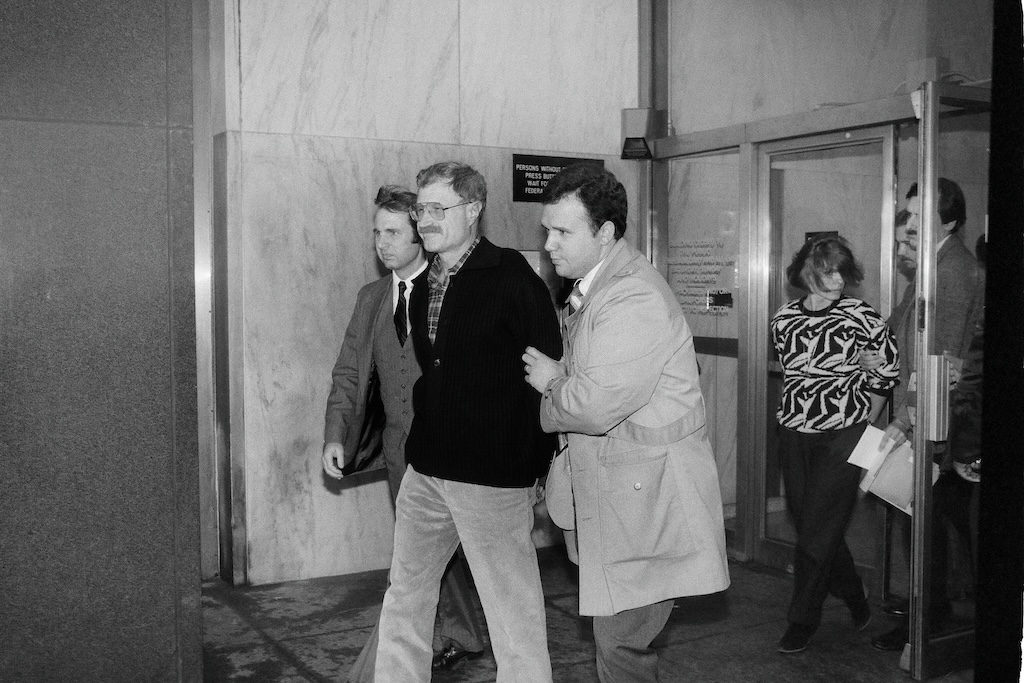
The Koechers went about their plans to leave the United States, and on November 27 the FBI agents volunteered to drive the Koechers to Kennedy International Airport for their flight to Europe. But when the Koechers showed up at the Barbizon Plaza Hotel with their luggage, the FBI arrested Karl Koecher and charged him with providing classified national-security information to the Czechoslovakian Intelligence Service (CIS). Hana was not charged but was held as a material witness.
Karl wouldn’t see the outside of a jail for another fifteen months. After four months in prison, his wife was freed on a $1 million bond posted by friends, several of whom had been sexual partners of the spy couple.
Endgame: The Exchange
A year after the Koechers were arrested, their attorney, Atlanta lawyer Robert Fierer, argued that the Koechers had been sandbagged, that the government agents who questioned Karl had clearly told him if he cooperated everything would be all right.
The government argued during several days of hearings that neither the FBI nor the CIA agents present during the questioning of Karl Koecher had the authority to make any deals, that only the Justice Department can finally decide whether or not to press charges.
As it turned out, a jury or judge never had to determine the Koechers’ guilt or innocence. During trips in early and mid-1985 to Prague, attorney Fierer suggested to a Czech government official that they persuade their Soviet colleagues to trade dissident Anatoly Shcharansky for the Koechers.
Wolfgang Vogel, a debonair East Berlin millionaire who had represented the East on numerous exchanges, got the green light from Moscow to negotiate the release of Shcharansky. He represented the Soviet Union, Poland, and Czechoslovakia and met during the last half of 1985 with the American ambassador to East Germany, Francis J. Meehan, and an aide to the American ambassador to West Germany, Richard Burt. Meeting secretly at an Austrian ski resort in December 1985, the group nailed down the list of prisoners available for trading.
A possible snag: Would the Koechers, now US citizens, agree to be expelled from the country that had adopted them? Vogel flew to the US, and, to no one’s surprise, the Koechers were more than happy to return to their homeland.
In a secret court proceeding, Karl Koecher pleaded no contest, which is tantamount to a guilty plea, and was sentenced to time served since his arrest. on the condition he be swapped for Shcharansky.
On February 11, 1986—after about a year of jockeying on the part of Fieter and Vogel, as well as American, West. German, Soviet, and Czech government officials—the trade took place on the drab-green Glienicke Bridge between West and East Germany. Except for Shcharansky, everyone involved in the trade was a suspected, accused, or convicted spy. In addition to Shcharansky, the East released two Germans and a Czech; the West handed over the Koechers and three suspected Eastern Bloc spies who had been in West German prisons.
The CIA may never know exactly what kind of damage Karl Koecher caused. Or if the agency knows, it isn’t saying. And no one knows if the Koechers gathered pillow talk worth sending back to Moscow during their evenings at various Washington swingers’ clubs.
All the world can be sure of about Karl and Hana Koecher’s stay in the United States is that the couple made a very good profit on the sale of their New York apartment.