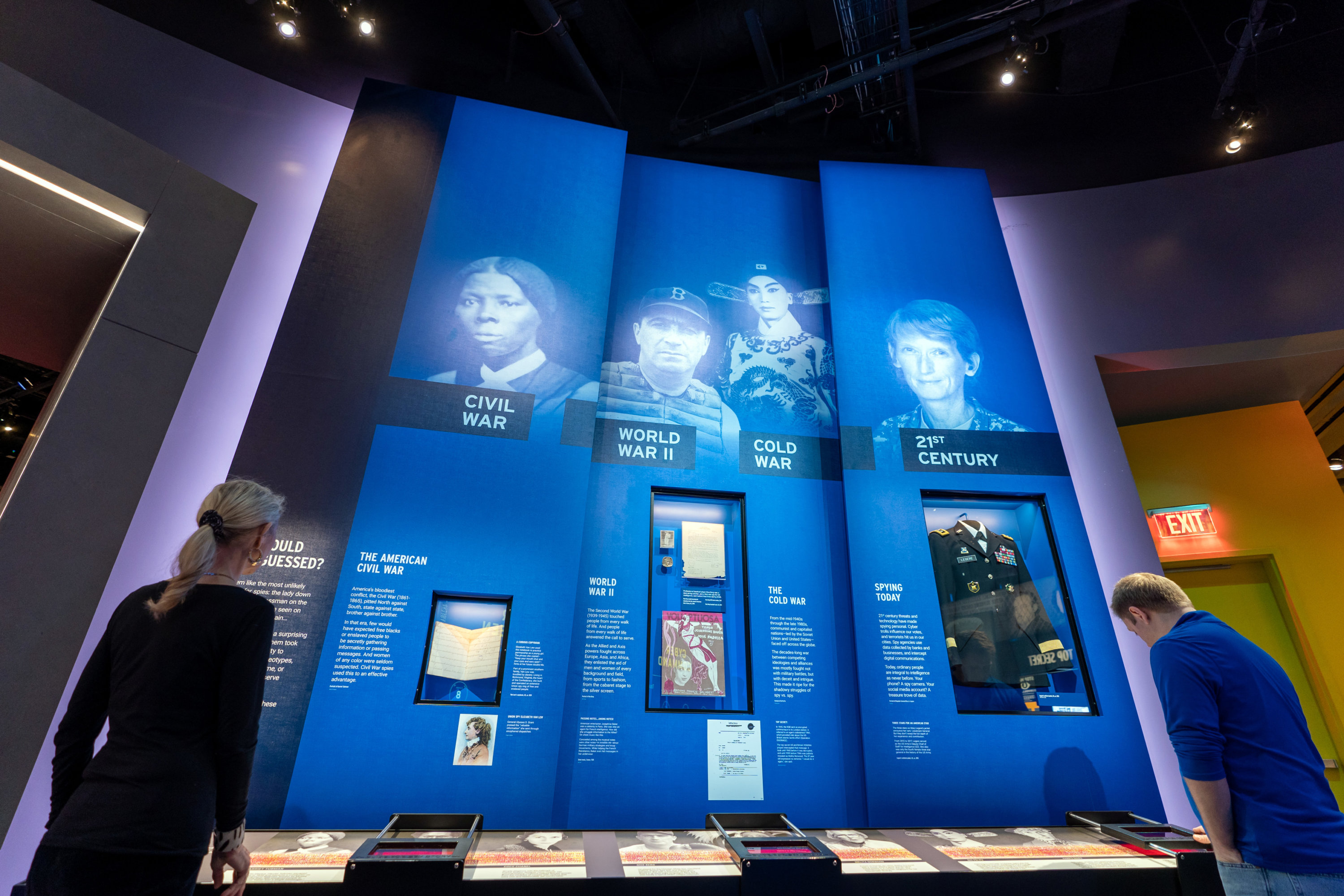
Mark Jacobson is the International Spy Museum’s new historian, a job in which he’ll help ensure the accuracy of exhibits and engage people via programs that teach about situations when a country’s professed values conflict with how it views its security needs at the time. Some historians, he notes, call that phenomenon “reluctant hypocrisy,” and Jacobson’s new employer is a multi-story catalog of tradeoffs Americans have been willing to make in order to feel safe.
Sure, there’s the fun stuff at the DC museum, like a KGB lipstick pistol and James Bond’s car from Goldfinger, but Jacobson hopes visitors will also engage with exhibits that might make them less comfortable, such as one on interrogation. It’s a subject he knows well: The former naval intelligence officer was part of a team that investigated interrogation practices at Guantanamo for the Senate Armed Services Committee. When people leave that exhibit, he says, he hopes they’ll walk away “understanding that when you do something, there are consequences of those choices, and they may not be consequences you thought about.”
Following that stint on the Hill, Jacobson spent two years in Afghanistan as an adviser to generals Stanley McChrystal and David Petraeus and moved on from that work to academia, where he put to work a Ph.D. for which he studied psychological warfare, propaganda, and disinformation by teaching at schools including Georgetown University, Amherst College, and George Washington University.
The closest analog Jacobson sees to today’s wild information environment is the Cold War, when the US began to study how advertising works to fight what some at the time called the “war for men’s minds.” But those efforts, and similar ones by the Soviet Union, targeted sizable groups of people. Now, thanks to how freely people share information about themselves on social media, he says, “you can target down to the individual.”
The historian is careful to avoid politics when he talks about his new gig. He allows that for US politicians, “the norms about speaking truthfully and transparently to the American people have eroded significantly over the last decade.” Conspiracy theories, he says, aren’t necessarily bad: If they “get people interested in finding out what really happened, that’s okay.”
There’s plenty of other stuff for Jacobson to work on. The museum plans an “Analyst Experience” exhibition next year that will teach visitors about the roles people in desk jobs play in the intelligence community, and next month the museum will launch the “Secret History of History,” a free walking tour of spy-history-related sites on the National Mall via its mobile app.
Mostly, Jacobson is fascinated by history’s gray areas. “Black and white’s too easy,” he says, laughing. Questions of how Americans could extract information from detainees during the wars in Afghanistan and Iraq look a lot different two decades later, he says, and history can help unlock questions with such moral and ethical dimensions. The US conducted an incredibly successful operation to interrogate high ranking German POWs at Fort Hunt in Alexandria during World War II, allowing detainees walks and dinners in Old Town to help them relax and open up—all the while bugging their quarters. “If we don’t work through things like this,” he says, “then we doom the next generation.”

Andrew Beaujon joined Washingtonian in late 2014. He was previously with the Poynter Institute, TBD.com, and Washington City Paper. He lives in Del Ray.