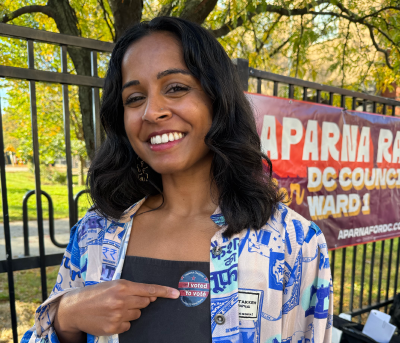
Just past 8 PM on election night, Aparna Raj was working the room at her victory party at a Mexican restaurant in Adams Morgan, bouncing from one group of supporters to the next.
Though the 32-year-old’s win in the race to become Ward 1’s DC Council member was all but assured after she triumphed in June’s primary, the energy at the gathering was high: decked out in bright pink-and-purple campaign pins, attendees watched Democratic candidates nationwide score win after win, ultimately flipping control of Congress and a number of statewide offices.
“It felt like our races where progressives, democratic socialists won on the local level were just part of sort of this bigger movement that we’re seeing at the national level,” Raj said.
A member and former chapter chair of the Metro DC Democratic Socialists of America, Raj became the first non-incumbent candidate elected by Ward 1—the city’s most densely populated ward—in more than three decades. A queer woman of color, she was also perhaps the left-most candidate in the race, with a platform centered on housing and affordability, workers’ rights, corporate overreach, and pushing back against increased federal law enforcement presence in the District.
Here are five things to know about her:
She started as a community organizer
A political science and economics major at Vanderbilt University, Raj was a House intern in 2013 and moved to DC after graduating from college in 2015. Still, she never saw herself running for office—at least, not until Donald Trump became president.
After seeing the impact of the first Trump administration on the immigrant community, Raj began working with small businesses on immigrants’ workplace rights and coordinating “Know Your Rights” trainings across Ward 1. She also joined the DSA, and supported efforts to raise DC’s tipped minimum wage.
During the pandemic, Raj began organizing around housing. She was motivated by her own experience fighting for repairs to a house she was living in—and more broadly, by what she saw as a gap between public health officials advising people to stay home and unsanitary or dangerous living conditions. “That was the moment where I really dug in,” she says.
Raj’s efforts included a case regarding unhealthy conditions at the Marbury Plaza apartment complex in Ward 8—which ended with the landlord being ordered by a judge to pay $41 million to tenants and the city—and fighting against rent hikes for existing residents at the Woodner Apartments in Ward 1.
Raj believes those experiences will help in office. “I think there’s a value to having an organizing lens to governing,” she says. “I think being able to use that power and that platform in a way that actually pushes things outside of the normal legislative process is gonna be really important, because these are not normal times.”
Housing is one of her top priorities
Given that two-thirds of Ward 1 residents are renters, it’s not surprising that Raj has a tenant-friendly legislative to-do list. Among her goals:
- Updating and expanding DC’s rent stabilization laws to expand the number of properties they cover.
- Restoring recently-eliminated provisions in DC housing law that gave tenants stronger eviction protections and the right to buy residential buildings before their landlords can sell them elsewhere.
- Reinstating some of the funding DC has cut from its Emergency Rental Assistance Program, which provides one-time financial aid to low-income residents experiencing an acute housing emergency or in danger of eviction. Since fiscal year 2024, the program’s annual funding has dropped from $60 million to $8.6 million.
- Increasing the yearly budget for DC’s Housing Production Trust Fund—which aims to create and preserve affordable housing—from $100 million to $125 million, and also using some of that money to support residents who want to form co-ops and other forms of new housing.
- Working with incoming mayor Janeese Lewis George to create social housing that would follow a District-owned and tenant-controlled model, drawing on examples in Seattle and Montgomery County.
“Housing is one of the biggest things that affects us because it is one of the biggest expenses anyone has,” Raj says. “It is the foundation of all of our lives.”
She wants to protect immigrants from the Trump administration
Home to the city’s largest Latino population, Ward 1 has seen dozens of immigration-related raids and arrests since the Trump administration began its federal law enforcement takeover last year. Lewis George has vowed to end cooperation between local police and Immigration and Customs Enforcement (ICE) on Day 1 of her term—a move Raj supports.
Raj wants to strengthen a 2020 DC law limiting cooperation between District agencies and federal immigration authorities. She says the Council should conduct more oversight of the Metropolitan Police Department by publicly asking the police chief questions about federal agents’ presence in meetings and how many trips local police and federal agents take together.
Raj also plans to use the “soft power of the office” to go into precincts herself to see whether federal agents are present during MPD’s coordination meetings. In addition, she could see herself working with community groups providing mutual aid for immigrants who are fearful of leaving their houses, and working as an advocate for individuals and families who might need help with different things like getting groceries or going to work or school.
“There can often be a view that, ‘well, the Council can only do so much’ or only looking at the very strict role of the Council, but I think times like this require us to be a little more creative about what our role is,” Raj says.
She’s on the left side of the blue wave
Following in the footsteps of Lewis George and Hilda Mason—who held an at-large seat on the Council from 1977 to 1999 and served as national vice-chair of the Democratic Socialists of America in the 1980s—Raj is just the third avowed democratic socialist to serve on the Council. Her victory can be viewed as a continuation of a modern progressive movement within city politics that began to take shape in 2014 behind Council members Elissa Silverman, Charles Allen, and Brianne Nadeau, Raj’s predecessor.
While Raj views this as a potentially more progressive era for the Council, she cautions that any leftward movement ultimately will be measured by its actions, not its composition. In terms of immediate policy, she hopes to expand DC’s paid family leave program, which was recently trimmed in an effort to plug the city’s budget deficit.
“I will always vote in line with my values,” Raj says, specifically mentioning her focus on affordability for workers, families and immigrants. “It will require some organizing and some working with other council members, but I don’t foresee myself becoming more moderate. I think it’s on me to hold that left, progressive voice.”
She’s something of a food influencer
About a year after moving to DC, Raj and a friend started District Delicious, an Instagram account dedicated to trying different restaurants.
“It wasn’t something that we were trying to do anything [political] with,” Raj said. “Then it ended up growing, and as I started organizing and as the account started growing, I was also thinking about different things that intersect with food.”
Since its debut, District Delicious has garnered 40,000 followers and become a way for Raj to advocate for different policies around food and workers’ rights—such as raising the tipped minimum wage—as well as other issues. Her former role as the communications and marketing manager at DC Greens, a health and food equity nonprofit in the area, also allowed her to see how food intersects with politics.
Ward 1 is home to several restaurants and cuisines that are meaningful for Raj. The Green Zone, a Middle Eastern cocktail bar in Adams Morgan, is where she and her now-husband had their first date (and where they continue to celebrate their anniversary). Citing her Indian heritage, Raj also enjoys both traditional and modern South Asian restaurants across the District, including Tapori and Daru.
Raj says District Delicious proved beneficial on the campaign trail, allowing her to connect with different small businesses and restaurant owners. Early in her campaign, it also gave her a platform to share what running for office looks like—hopefully helping to demystify politics for voters. She wants to continue using the account in office.
“I would love to not just share a lot of the food scene in DC, but try to add more of that relaxed content about what being a councilmember in DC is like,” Raj says.