In August, I had the unprecedented gastronomical experience of eating a dish called “Peaches Filled With Ham Mousse.” If anything, it was worse than it sounds: three whole peaches stuffed with a food-processed mixture of ham, butter, mayonnaise, cayenne, and port. I ate it on the lawn at Wolf Trap, and for the next few hours, a queasiness oozed through my body as I watched the National Symphony Orchestra perform. The offending dish came from the Wolf Trap Picnic Cookbook, a spiral-bound compendium from 1976 that I’d purchased the month before.
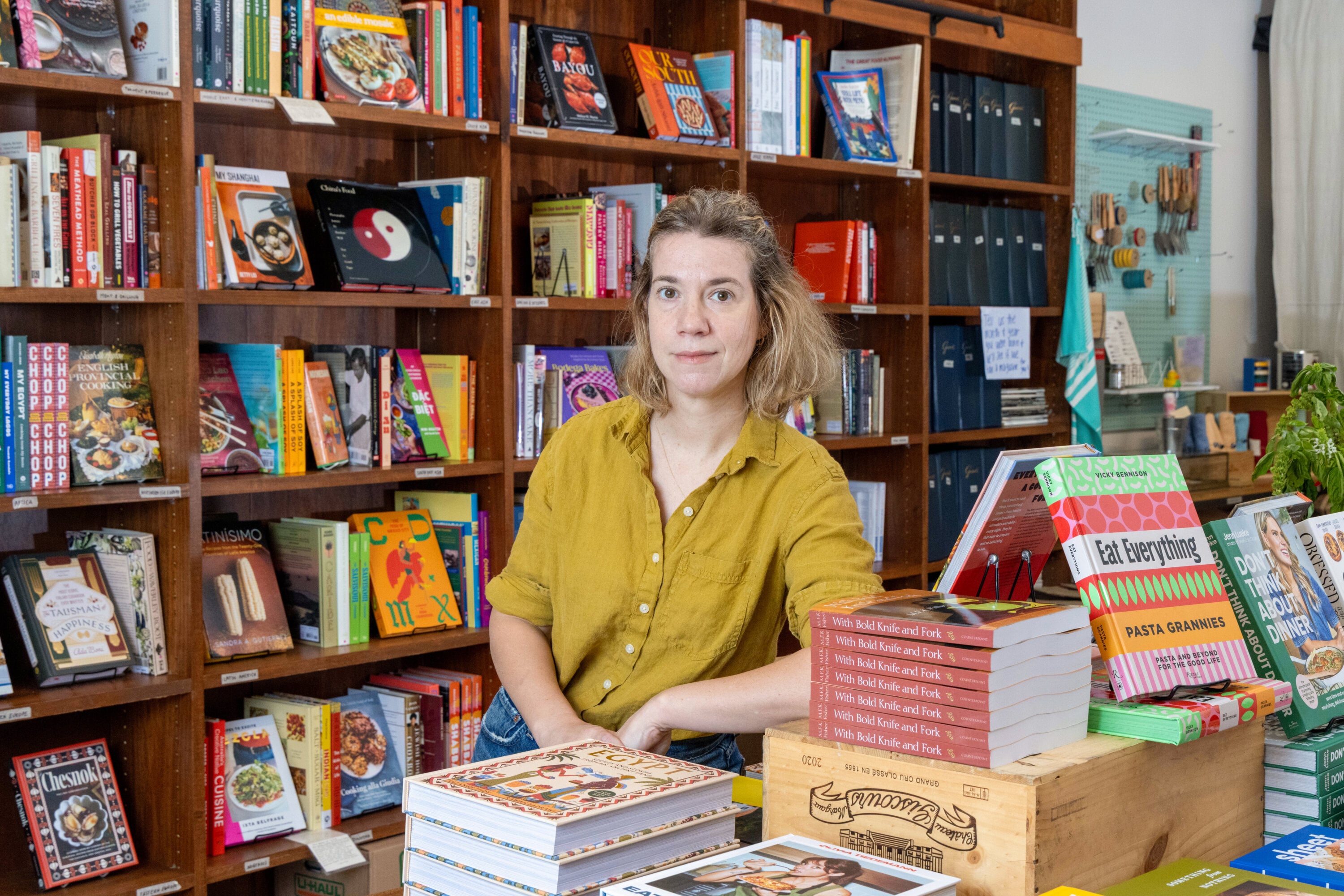
I found it at Bold Fork Books, which was DC’s only standalone cookbook store before it permanently closed in September. This was at the height of summer, when the capital was convulsed with the spectacles of Freedom250 and Bold Fork was doing some counterprogramming. To observe America’s birthday, the staff had rolled out a large array of vintage cookbooks from across the nation, the Wolf Trap book among them.
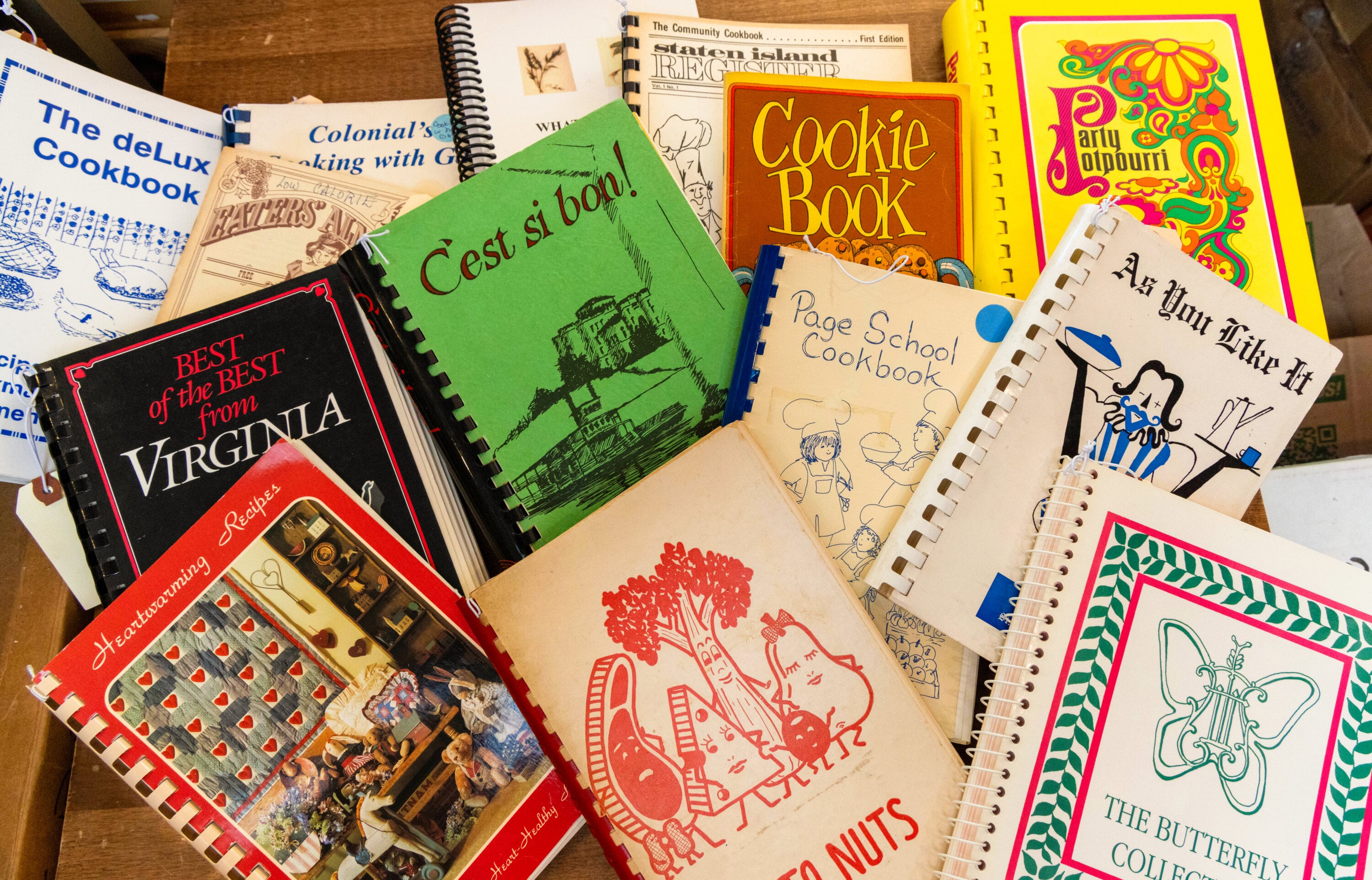
Specifically, these were community cookbooks: self-published recipe collections, assembled to fundraise for local civic organizations like the Junior League, the synagogue, or the elementary-school PTA. Bold Fork had cookbooks from Yakima, Natchitoches, Punxsutawney, and Provincetown, all of them flush with dishes that came directly from home cooks. The recipes have craggy edges and odd ingredients. They don’t all work. But they’re time capsules of midcentury cooking, of how ordinary Americans actually ate.
The Wolf Trap Picnic Cookbook is rife with bizarre ’70s artifacts: a bowl of grated Gruyère doused with a full cup of vinaigrette, a “Chinese Boiled Chicken” simmered with one turnip and the peel of a tangerine. What drew me to this book was not the desire to cook literally anything in it, but that I liked its general spirit. Picnics at Wolf Trap can be elaborate: folding tables laden with chilled wine and sandwiches and fresh cherries and dips. There is something so summery, so luxe, about sitting on the lawn eating pie, waiting for a concert to begin. I wanted that feeling in my home. I did not want “Artichoke Bottoms With Shrimp.”
In general, I cook under the impression that the arc of American cuisine bends toward progress, that the further we move forward in time, the more delicious things get. Nothing in the store’s vintage cookbook array seemed to contradict this belief. Browsing the shelves, I encountered a comical overabundance of gelatin, an epidemic of mayo-whipped meats, and a heavy dependence on canned goods. These cookbooks are exquisite historical objects with gorgeous art. They’re portals into bygone flavors. I was certain that they could not make me a better cook.
Kreesa Lancaster, an attorney who lives in Navy Yard, also bought a vintage cookbook at Bold Fork this summer: Favorite Recipes of America, from 1968. “I wanted the craziest neon-colored Jell-O monstrosities,” she told me. “My goal was to cook things that are not classics for a reason—to really dig into ‘This is heinous. These are crimes.’ I wanted to commit crimes.”
We were standing in the backroom at Bold Fork, beside tables laden with such criminally antiquated dishes as a gelatinous salmon mousse topped with wedges of boiled egg, a congealed peach salad, and an apricot Jell-O mold smothered in bright-orange Cheddar cheese. It was like a 1970s church potluck gone haywire—but actually, it was the store’s monthly cookbook club. Dozens of people had made dishes from community cookbooks. Lancaster brought eight, including a gelatinous pineapple ham loaf and a ham tetrazzini that, she said, required her to do “evil, evil things to pasta.”
I wanted the craziest neon-colored Jell-O monstrosities. My goal was to cook things that are not classics for a reason—to really dig into ‘This is heinous. These are crimes.’ I wanted to commit war crimes.
“You know, the flavor is not disgusting, but the texture is super unsettling,” I told Lancaster as I tasted her ham loaf, which was adorned with canned pineapple rings and studded with whole cloves. “It’s kind of vomity, like half-digested sweetened meat.” Lancaster took a bite. The texture, she conceded, was “horrifying,” but it called for so much ground ham that she didn’t think much could be done. With a crazed gleam in her eye, she sampled a couple of her other creations: a sickly-sweet citrus Jell-O mold topped with candy circus peanuts and a congealed lime salad that looked like the fur of the Grinch.
There was no mandate to cook with gelatin, but that’s what most people did. A local PR executive made a “Dilly Tomato Aspic” from 1985’s Tidewater on the Half Shell because, she said, “aspic is always the butt of every vintage-cookbook joke and I’ve never had the pleasure of eating it.” An employee of Bold Fork considered making a pineapple Jell-O mold from 1957 until she saw that it called for three-quarters of a cup of sugar plus sliced olives and pimiento cheese. “I wanted to be adventurous, but I still had to be willing to eat it,” she explained, opting for a Bing-cherry-and-cream-cheese ring mold instead.
All night, the energy surrounding the aspics was riotous. Everyone crowded together, sampling dishes and discussing what they’d learned—about the difficulties of setting gelatin, or how the US annexation of Hawaii brought canned pineapple to the American middle class. Marveling at these Jell-Os, which glowed ethereally under the lights, I realized something that probably should have been obvious: A three-layer caviar aspic that serves 16 (collected by the Thibodaux Service League in 1982) was not meant to feed your children. It was a quasi-edible centerpiece for gathering neighbors and colleagues and friends.
“Deliciousness-wise, it wasn’t our most successful cookbook club,” Bold Fork’s co-owner Clementine Thomas told me later. “But that wasn’t the point.” Like the midcentury gelatin craze, cookbook club was more about community than about nourishment or taste. She wanted to see all these old recipes brought back to life, to encourage cooks to experiment, to bond people in disgust and delight.
In its previous life, the Wolf Trap Picnic Cookbook belonged to a woman named Lois Noonan, an administrative assistant in the Montgomery County school system who raised her family in Silver Spring. She was a relentless amasser of cookbooks. To find them, she scoured the region’s thrift stores, and she always returned from vacation with volumes that were local to wherever she’d been. Most of Bold Fork’s community cookbooks came from her; Thomas bought a portion of Noonan’s collection in 2023, two years before she died.
Noonan did not see these cookbooks as novelties. She cooked from them all the time. “I think it was an adventure for her,” her daughter, Brigid, recalls. “She found it really interesting when people would put together ingredients that you might not think of putting together.” Sometimes these creations would flop, which Noonan typically took with good humor. But they’d often taste surprisingly good, like the salmon mousse she served each Christmas from a fish-shaped copper mold. Noonan was a skilled and intuitive cook who often modified the recipes—sometimes to an extreme degree—but she used the community cookbooks because she liked them, because they expanded her culinary life.
To many of us, cooking from vintage recipes was a deliberate flirtation with revulsion—but the disasters were actually the exception. Most of the food was passable, and a few things were even superb. The salmon mousse from the 1984 Mount Vernon Cookbook, resplendent on its bed of wilted radish greens, turned out to be herby and creamy and nice. (“Oh my God, it has so much mayo,” the cook told an admiring crowd.) The sweet Jell-O salads were festive and flavor-dense. Even the congealed apricot with cheddar cheese worked. But to me, the “Dilly Tomato Aspic,” gorgeously ribbed from its bundt mold, was the night’s revelation. It was crisp and refreshing and tasted just like a Bloody Mary. If you brought it to a party, you’d be a star.
Noonan adored these oddball gems of dishes. But to her, community cookbooks were also expressions of civic pride, efforts by ordinary people to raise money for institutions they loved: a Special Olympics committee in Hawaii, a hospital in Western Pennsylvania, the Smith Island PTA. She herself was a regular at Wolf Trap, and according to Brigid, she bought the cookbook to support the arts. This was the ’70s, when the American middle class was still robust, when people joined the Elks Lodge and the Junior League and shopped at the regional department store. Resources tended to pool within communities then. It was before faceless conglomerates extracted so much of our money and attention, before the economy enabled such extreme hoarding of wealth.
That was on my mind a week after cookbook club when Bold Fork announced that it was closing. “It just wasn’t sustainable for us,” Thomas told me on the phone. There were the high fixed costs and the creep of the behemoth internet stores—and then came the Trump administration’s attack on the federal bureaucracy last year. “I think in our little microcosm, we felt it particularly strongly,” Thomas said. The Mount Pleasant neighborhood “is especially dense with government employees and people who were directly impacted by these cuts.” Bold Fork was a business, not a civic institution, but it brought strangers together. It hosted fun and rich community events. Small businesses, Thomas said, are “a huge part of the texture of places.” It matters when a community is too weakened for them to survive.
Before Bold Fork closed, I bought a few more community cookbooks. I sometimes flip through them on my coffee table, marveling at what people once ate. In a Pepto-pink cookbook from 1982, I recently encountered a recipe for tomato aspic, which seems close to the spectacular one from cookbook club: jiggly and earthy-red, oddly glamorous, a wistful relic of another time. I think it will be dynamite at Thanksgiving. It’s possible that nobody will eat it, but I no longer think that’s the point.
This article appears in the November 2026 issue of Washingtonian.