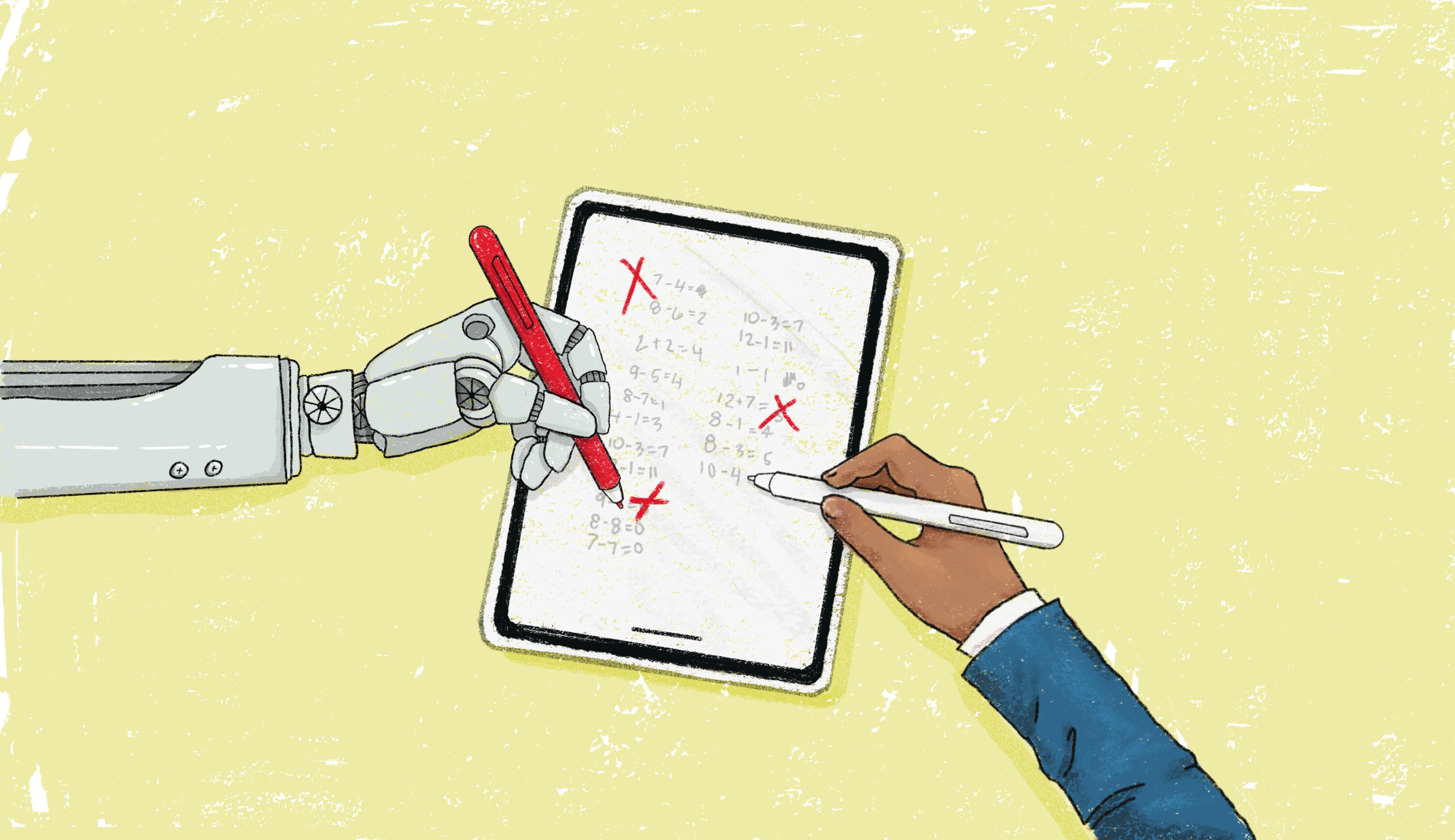
Artificial-intelligence companies are marketing tools directly to schools and school-age kids, and the technology is becoming a regular part of education. For example, Google Classroom, a class-management portal for assignments, grades, and more, comes with Gemini built in, and ChatGPT recently launched a version for teens.
Whether or not academic institutions are ready, AI now has a direct pipeline into many classrooms. For area private schools, that means not just figuring out policies that address AI use but also being ready to respond quickly to the evolving technology.
Jennifer Steele, an education-policy researcher at American University, says that while schools may have an ad hoc approach, it isn’t chaos. Teacher autonomy, or letting individual instructors figure out what works best for their subject and students, is more consistent with what private schools sell than a top-down ban.
For a sense of how that manifests from place to place, just look at the local landscape. Some schools are restrictive: At Georgetown Day School, AI is prohibited by default—a policy embedded in the academic-integrity section of the student-parent handbook. Kids must get permission from their teachers to use “any external source, website, or app,” including generative artificial intelligence. On the other end of the spectrum is the Alpha School, with campuses in Bethesda and Chantilly. Under the supervision of human “guides,” students study core subjects for just two hours a day using adaptive-learning platforms, AI tutors, and personalized lesson plans. They spend the rest of the day in workshops, learning skills such as public speaking and coding.
Other schools encourage students to use the technology as an aid rather than a teacher. Saint James School in Hagerstown has a two-part policy outlining approved uses, which include creating study guides or practicing foreign-language conversation skills. It also outlines how AI use might violate the honor code. In a blog post, associate headmaster Kimberly Kingry wrote that the school created the policy to “embrace this emerging technology and teach students how to be responsible users rather than approach this as . . . something that would always be an infraction.”
At some schools, policies are being formed in partnership with the pupils. Holton-Arms in Bethesda has a student-led AI Innovators Club that holds workshops to mentor peers and teachers on ethical ways to use AI inside and outside of the classroom. They cover tools such as Gemini, MagicSchool, and Wayground, and the school emphasizes that AI should serve as an assistant rather than a crutch.
“Being a member of AI Innovators has given me the opportunity to explore the creative and academic applications of AI in our school community,” says Fiona Mehta, a junior at Holton-Arms. “AI is becoming an increasingly ubiquitous part of how students learn, and understanding how to use it responsibly can help students and teachers to view AI as a tool for learning rather than a replacement for critical thinking.”
Steele says the core concern is that kids will offload learning to AI instead of doing the work themselves if schools aren’t teaching them how to use it responsibly. “Schools need to teach the metacognitive skills of prioritizing the effort of learning and understanding when you’re using AI as a tutor to help you understand hard questions,” she says, “versus when you’re using it so you don’t have to think.”
Even as they grapple with new technology, private schools still do offer smaller class sizes and more personalized attention. “In the age of AI, the premium product is human,” says Steele. Teachers are now tasked with helping students understand whether they’re using AI as a helpful tutor or to outsource their thinking. (It’s a hazier line for those born and raised in the age of AI.) That includes teaching kids to ask themselves, “Could I explain this work?” AI or not, it’s the type of question that drives learning.

Before becoming Research Editor, Damare Baker was an Editorial Fellow and Assistant Editor for Washingtonian. She has previously written for Voice of America and The Hill. She is a graduate of Georgetown University, where she studied international relations, Korean, and journalism.