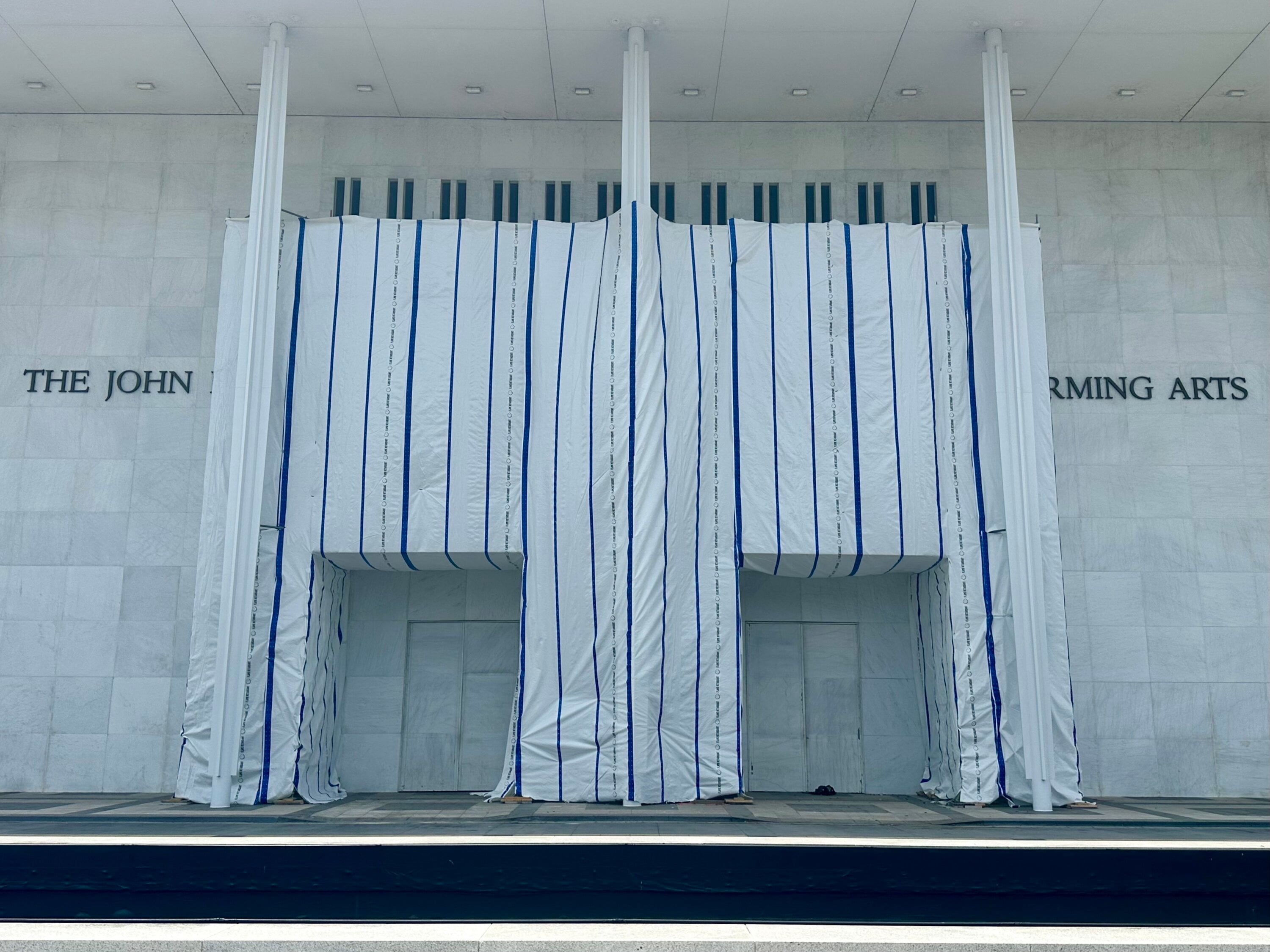
On Tuesday afternoon—shortly after a federal judge ruled that Donald Trump could not put his name back on the Kennedy Center, and after the Kennedy Center board voted to close the building immediately for repairs—the President took to Truth Social to make an announcement: He will not allow the Kennedy Center to be renovated until an appeals court grants his request to put his name back onto the building’s facade.
The President didn’t stop there. In his post, he implied that should the appeals court rule against him, he will take the case to the Supreme Court. And if the nation’s highest court doesn’t allow Trump to have his sign, then the “Reconstruction and Renovation of the Kennedy Center will not take place.” Think about that for a second: The President of the United States, who is also the chairman of the Kennedy Center’s board, is refusing to allow necessary renovations (which Congress has already appropriated the money to undertake) unless the building, which honors a slain president, is amended to bear his own name.
As President, Trump took an oath to uphold the laws of the nation. As chairman of the board, he has a sworn duty to serve the best interests of the Kennedy Center. By explicitly threatening not to renovate the Kennedy Center unless he can put up his illegal sign, Trump appears to be in violation of both of these oaths. The President is holding the Kennedy Center hostage. It is now stuck in a limbo state where it is closed—ostensibly because the need for renovation is so dire that the building is no longer fit for human habitation—but no actual renovations will occur.
This actually isn’t a shocking development. As I reported earlier today, the government has been laying groundwork to walk away from the renovations for some time. The administration’s argument, I wrote, has been that Trump—because he is such a talented and experienced builder—is the only person who could oversee the renovations. And the government has long threatened that if Trump’s efforts aren’t acknowledged by putting up his sign, then he will abandon his oversight of the project, making renovation financially out-of-reach. Regardless of the merits of that argument, the renovation now seems doomed. A Georgetown Law professor parsed the relevant language in the One Big Beautiful Bill Act for me, and he said that Congress seems to have authorized the spending without requiring it, so the board probably can’t be forced to use the appropriated funds.
This is a dismal outcome for the Kennedy Center—among the worst-case scenarios, short of the administration demolishing the building outright. It seems that for at least the foreseeable future, the building will be vacant—not hosting performances, hemorrhaging donors and staff, deteriorating as an institution in every conceivable way—and whenever it reopens, assuming it re-opens at all, it won’t even have been fixed up.