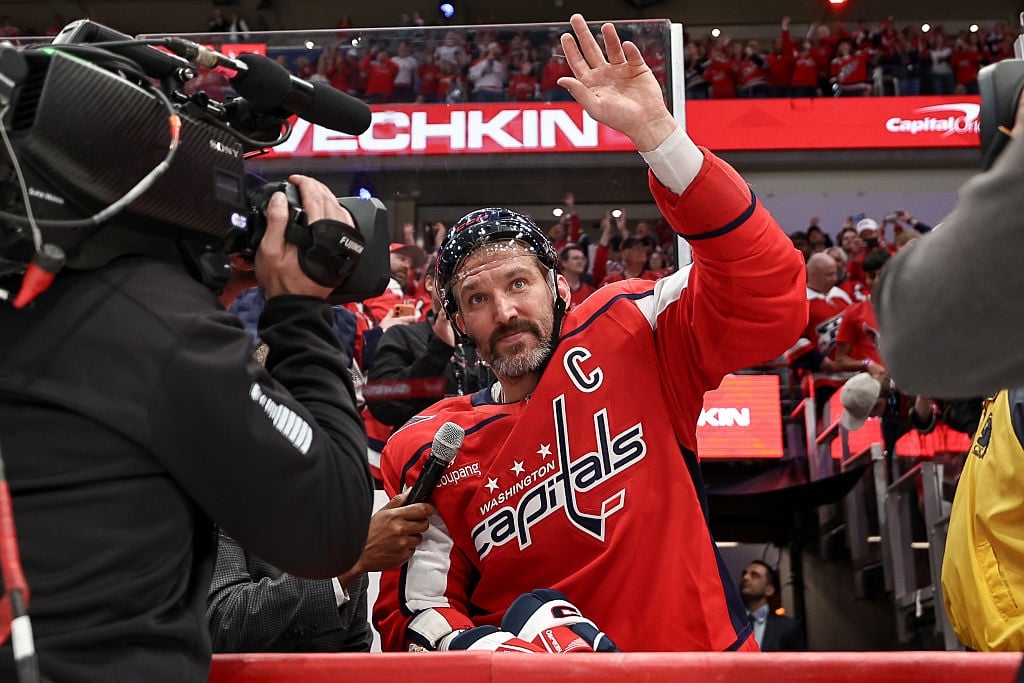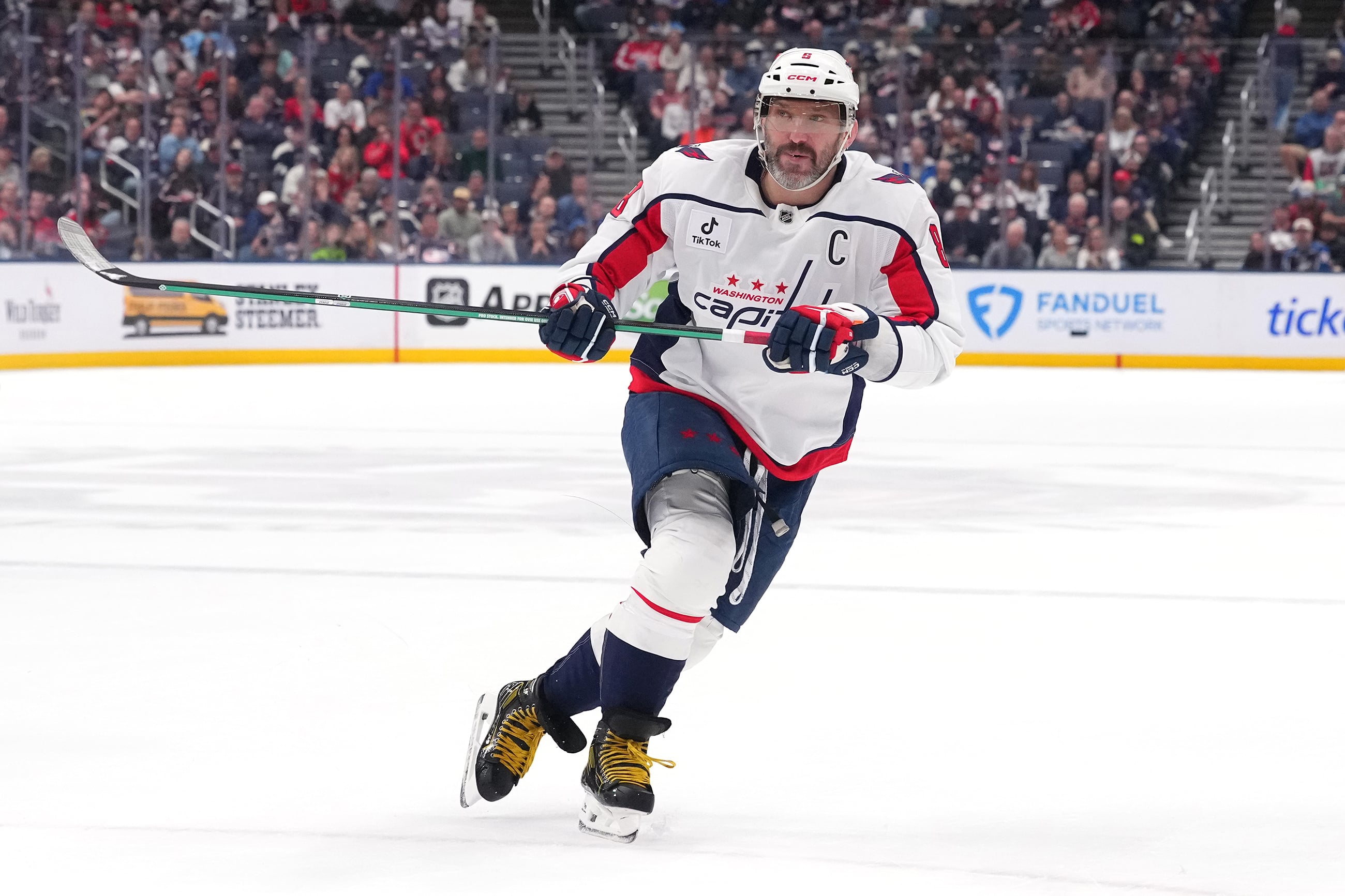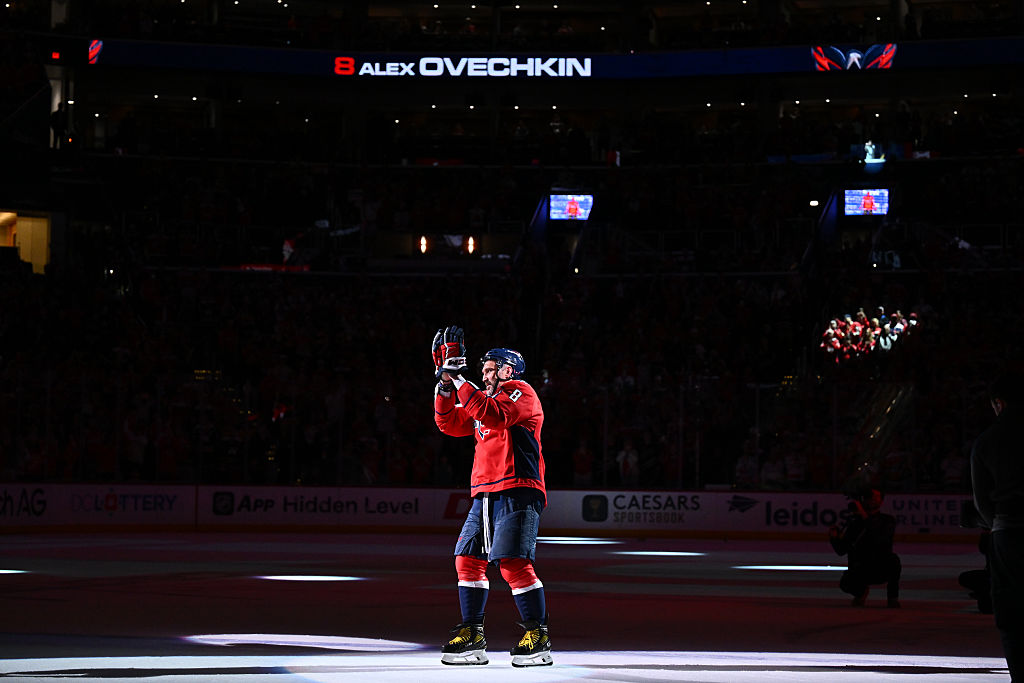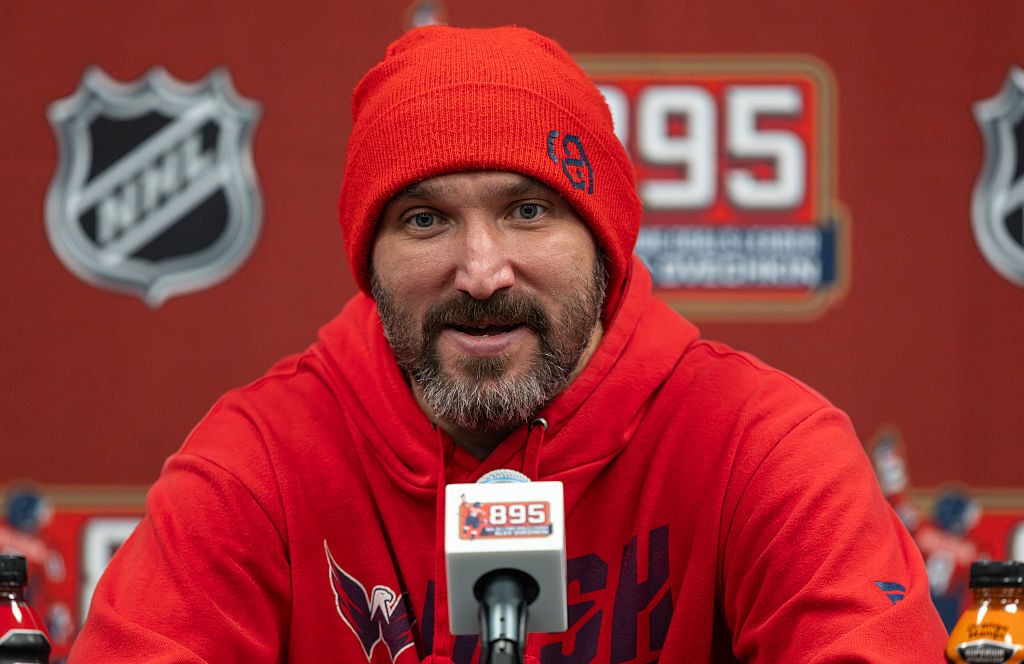
If you’re a Washington Capitals fan, you’re probably still processing the news that longtime team star Alexander Ovechkin, the National Hockey League’s all-time leading goal scorer, will be calling it quits after this season.
Also, you’re probably still scratching your head over his recent appearance in what amounts to a political hype video for Russian President Vladimir Putin.
To quickly recap: in September, Ovechkin, who is Russian, appeared in a campaign ad for the Putin-backed United Russia party, released ahead of that country’s first parliamentary election since its full-scale invasion of Ukraine in 2022. The Capitals forward doesn’t speak in the spot—but he does stand behind Russian Foreign Minister Sergey Lavrov, who warns the country’s enemies to “expect no mercy.”
Unsurprisingly, criticism followed. Latvia banned Ovechkin from entering. South Carolina Republican Representative Joe Wilson sent the NHL a letter calling it “incredibly alarming” that Ovechkin had expressed public support for the party of a “war criminal.”
The Capitals star took a lot of fire on the website formerly known as Twitter, too—including from NHL Hall of Fame goalie Dominik Hašek, who posted that Ovechkin bore “a significant share of responsibility through his public stance” for the dead and injured of the war in Ukraine.
Speaking to the press during Capitals training camp, Ovechkin didn’t exactly apologize for his appearance, explaining, “the thing about the video: I’m Russian.”
Asked later about his reasons for appearing, Ovechkin gave the same explanation: “Well, I would say I’m Russian and I support my country.”
Is it really that simple? Yes and no. To better understand Ovechkin’s actions, it helps to understand the political role of sports in Putin’s Russia. Here’s what to know:
Sports are very important to Putin’s political project …
Putin is no stranger to sports. The 2014 Sochi Olympics were a very big deal to him, and his prodigious goal-scoring touch in a series of exhibition games featuring former NHL players is well-known.
While it would be easy to dismiss the above as mere expressions of dictatorial vanity—eight goals while sharing the ice with Pavel Bure? What’s next, defeating Kim Jong-Il at golf?—the truth is that even since becoming Russia’s president in 2000, Putin has seen sports as essential to the nation’s post-Soviet rebuild.
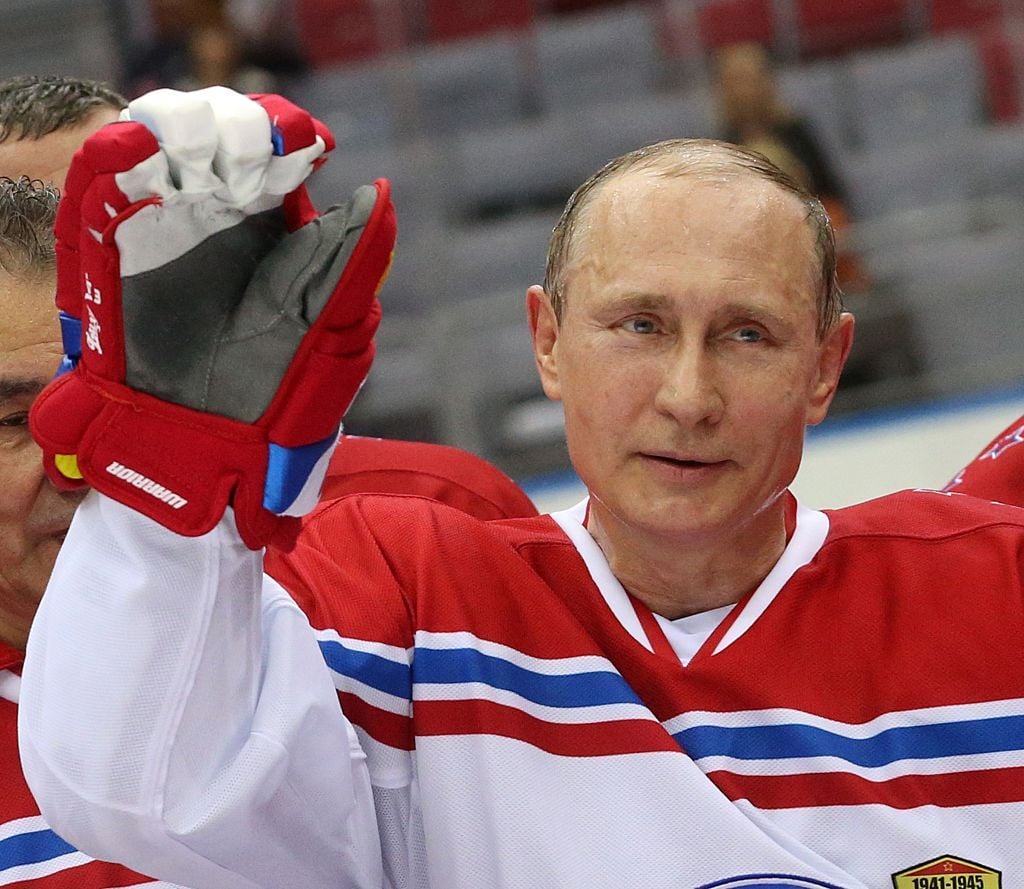
During Putin’s childhood, Soviet athletes brought a dose of pride to the nation by dominating international sports—and upon his political ascent, he was eager for Russians to again see their athletes atop the world’s medal podiums. As he told the country’s national team before the Sydney Olympics, “Victories in sports unite the country more than a hundred political slogans.”
Whenever athletes have brought victories home, Putin has honored them at the Kremlin. And these receptions are a bit different than White House visits by championship teams, in which the president gets gifts and the athletes get a Big Mac banquet.
Russian athletes have received state honors, which carry lifetime benefits in rubles and perks. Olympic champions also have taken home cash bonuses equal to more than $50,000, along with new BMW cars. Indeed, even Russian athletes cleared to compete as “neutrals” at the 2024 and 2026 Olympics received government payouts.
In many cases, sports success has opened the door to Russia’s political power structure. Following this September’s elections, the State Duma now includes 14 Olympians, Paralympians, and former world champions; by contrast, Congress has had only seven former Olympians as members—ever. And in the Russian regions, even more world-class athletes hold offices.
In nearly every case, these athletes-turned-politicians belong to United Russia.
… and Ovechkin is very important to Putin’s sports efforts
Though Putin’s supporters include some of the biggest names in Soviet and Russian sports, Ovechkin could be considered their Most Valuable Player. In 2017, when a PR firm launched “Putin’s Team,” a social media campaign for Putin’s then-upcoming reelection bid, the roster featured famous singers, actors, and international athletes. The initiative was geared to reach a global audience, to show the world that Russians who were popular abroad also supported their president.
Owing to his fame in America—and, in particular, Washington—Ovechkin got the spotlight. He gladly took on the role, announcing the website’s launch on his Instagram. “We value our leader’s trust and respect for people,” he declared in Russian, “his fairness, integrity, and sense of compassion.”
As Russia’s invasion of Ukraine drags on—costing the country blood and treasure and making it more of an international pariah, with no end or victory in sight—the NHL achievements of Ovechkin and his countrymen arguably have taken on greater importance to Putin’s rule. They become Russian achievements, proof of the country’s greatness in the world, despite its international isolation, crumbling infrastructure, and rampant corruption. As political scientist Nina Kramareva says, “Russia has nothing concrete to offer its own people. It has to give them gold medals.”
And Ovechkin’s goals. Here in North America, when Ovechkin broke Wayne Gretzky’s all-time goal scoring record in April of last year by tallying his 895th career goal, it was celebrated as a historic sports event. In Russia, by contrast, it was celebrated as a historical national event. On the ice at UBS Arena in New York City in the ceremony after the goal, Ovechkin finished his thanks with the words, “All of you fans, for whole the world, Russian, we did it, boys. We did it! It’s a history.”
Back home, his off-the-cuff English received a creative translation. On sports sites, social media, and even a giant screen above downtown Moscow, Ovechkin was quoted as declaring: “Russians, we did it!”
“A Team of Like-Minded People”
In the past, Ovechkin has explained his support for Putin by saying he is patriotic, not political. That’s been good enough for many in the hockey world, where the Capitals star—blessed with a gregarious, gap-toothed smile and seen, in hockey-speak, as a down-to-earth “great guy”—is a widely-beloved face of the league.
Over the years, some fans and observers have even suggested that Ovechkin, who plans to live with his family in Russia after his NHL career ends, has been coerced into supporting Putin. During Ovechkin’s September press conference, a reporter seemed to steer in this direction, asking him about “ramifications” if he had said “no” to appearing in the United Russia campaign video.
Ovechkin, however, brushed that idea aside. “They asked me to do that. I say yes,” he said. “It’s simple as that.”
Ovechkin also has claimed that he is “not pro-war.” Hašek, a two-time NHL MVP, takes issue with that. As a young player with Czechoslovakia’s army club, he went AWOL to join students protesting against the country’s communist regime on the streets of Prague. Ovechkin’s appeals to peace and love are thin cover, Hašek has written, for what amounts to an endorsement of Putin’s military decisions.
Ovechkin, Hašek says, “has always been a staunch supporter of Putin, and nothing has changed that. Not the annexation of Crimea, not the war in Ukraine. Absolutely nothing in Ovechkin’s statements suggests he has any interest in changing his stance.”
In the United Russia video campaign—which consists of five different video clips—figures from Russia’s government, media, and the military speak of justice, truth, love, and fairness. Above all, they speak of victory. Lavrov gives a harsh warning to anyone who comes at Russia “with a sword”; another speaker, Vladislav Golovin, led troops in the horrific siege of Mariupol and now heads the Russian military’s youth recruiting operation.
There’s also an appearance from Maria Lvova-Belova, indicted by the International Criminal Court for her role in the abductions of Ukrainian children.
Each speaker is joined by an array of politicians, athletes, journalists, actors, and war veterans. A photograph captured the entire group: “A team of like-minded people,” observed the Russian newspaper Vedomosti. Of the 39 people who appear in the videos, 20 are on multiple sanctions lists related to Russia’s invasion of Ukraine. Ovechkin is one of the few who is not under international sanction.
Unlike in other countries—where affirmation of one’s national identity can be followed by rejection of the nation’s government—Russian culture today, says Russian journalist and sociologist Sergei Medvedev, merges loyalty to nation and state. And understanding that may be key to understanding Ovechkin’s public actions.
“It takes great courage to say, ‘I’m Russian’ and ‘I’m opposed to the war and Putin,’” explains Medvedev, author of The Return of the Russian Leviathan, a 2019 book that examines Russian militarism under Putin. “Ovechkin takes for granted that being Russian means supporting Putin.”

Bruce Berglund is a visiting professor at Charles University’s Institute for International Studies and the author of multiple books, including The Moscow Playbook: How Russia Used, Abused, and Transformed Sports in the Hunt for Power.