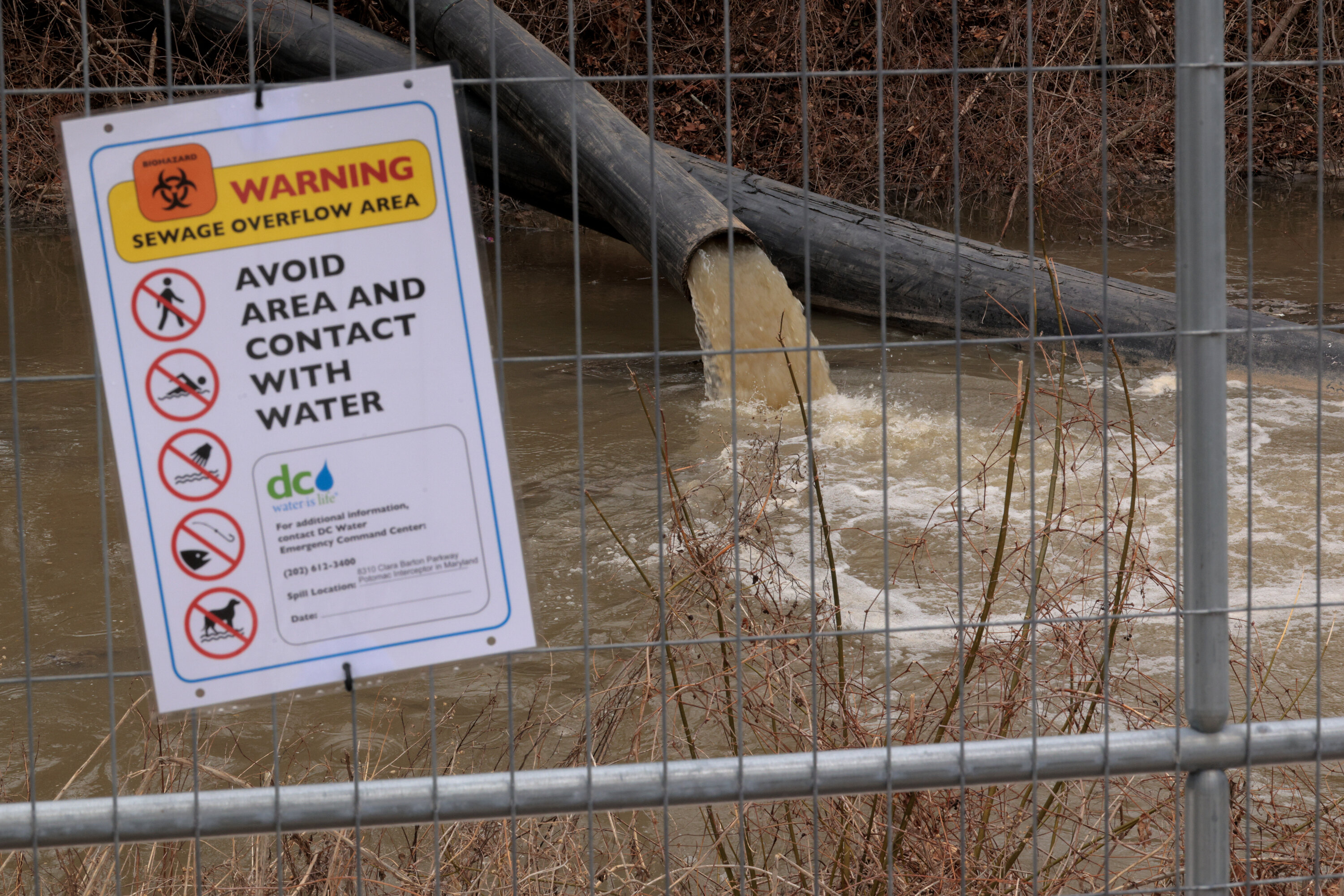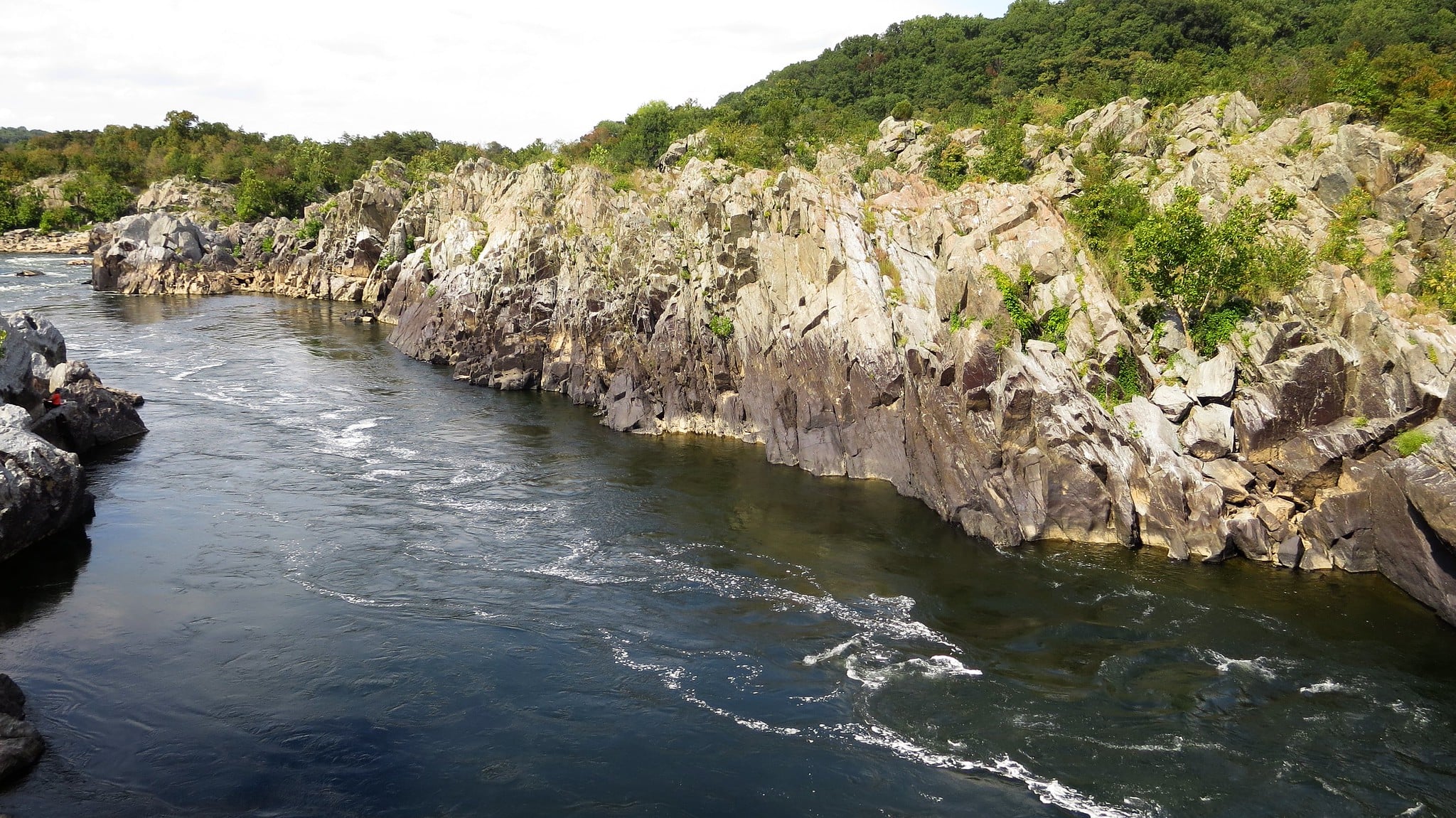
Yesterday, DC Water started emergency repairs on the Potomac Interceptor—another section of the same pipe that collapsed in January and famously spewed raw sewage straight into the Potomac River. That incident took place downstream of the Washington Aqueduct’s intakes near Great Falls, meaning our drinking water was not affected. This upcoming round of construction in the Potomac, however, is located upstream of those intake sites. Had DC Water not identified severe corrosion and exposed rebar on this pipe segment during a recent inspection, a rupture in this area could have been catastrophic for public health. All this commotion around the river, DC’s only water source, is a reminder of the precarious state of our city’s water supply.
DC Water CEO David Gattis, who is now serving in his position on an interim basis after the agency’s board of directors voted to oust him, testified during a May Congressional oversight hearing that the sewage spill prompted more rigorous inspection of the 64-year-old Potomac Interceptor pipe. He said at the time that crews had identified multiple high-priority spots for emergency repair, one of which is the segment where construction began yesterday. DC Water spokesperson Sherri Lewis told Washingtonian that there are two additional priority sections in Dulles—one on airport property and one near Broad Run—and another on the DC-Maryland line by Chain Bridge. “Of course, this is what we want to have happen,” says Betsy Nicholas, the president of the Potomac Riverkeeper Network. “I would have liked it a lot better if it happened eight years ago,” when inspectors initially reported damage to the National Park Service.
While the sewage spill was jarring for many locals, the Potomac Interceptor—which carries wastewater from Northern Virginia to a treatment plant in Southwest DC—is not the only fragile piece of our region’s water situation. While a steady parade of evening thunderstorms might lead you to forget, DC is currently under a drought watch. Current conditions are “some of the most significant the region has experienced in more than 20 years,” according to DC Water, and residents are asked to conserve their water usage with shorter showers and full laundry loads. A more severe drought—or contamination event—could render the Potomac River’s water undrinkable. As things stand, the DC area has no alternate water supply. Last week, regional water companies announced a $25 million study to identify a backup source. “The tiny bit of lemonade that we’re getting from the lemons here of the Potomac Interceptor is finally some focus on this issue that we do not have a backup,” Nicholas says.
In April, the Potomac was named America’s most endangered river by the nonprofit American Rivers. Beyond the poop-water deluge, the ranking is also attributed to rapid data center construction along the river. “It’s not like any of these things are new,” Nicholas says of the factors that threaten our water supply. “Unfortunately, this is often the case—you have to have that disaster that we did, and fortunately, the disaster did not take out our drinking water.”
How data centers affect river health
About 1,200 data centers are currently proposed for the Potomac River watershed; some are already under construction, while others are working to get permits. Many of these facilities are being built speculatively, meaning that they aren’t yet owned by any particular company. “It’s just a development of, ‘If we build it, somebody will want it,’ ” Nicholas says. “Which is usually the worst way for buildings to ever come online, because they don’t even have the corporate entity that might have some sustainability measures that they’re going to require.”
Some data centers have been proposed for the sites of former coal-fired power plants along the river, including the Dickerson Generating Station in Montgomery County and the Morgantown Generation Station in West Virginia. “These are dirty sites, so they’re going to be all the more contaminated,” Nicholas explains. “There’s coal ash buried on them, there’s unregulated landfills on them of coal byproducts.” Not only do data centers use a lot of water simply to keep their computers cool, but they deploy diesel generators as backup energy sources in the event of a power outage. “In my career, I’ve never seen a pipeline or a diesel tank that doesn’t eventually leak—it’s just a matter of time and maintenance—so if you’re looking at putting more and more and more of these things in the same watershed, you’re going to be adding diesel, coal ash, a lot of different things that are getting into our drinking water supply,” Nicholas adds.
Ultimately, it’s difficult for us to know exactly how area data centers are using water. “The industry has probably a lot of data on this, but it’s proprietary data. It’s their secret sauce,” says João Ferreira, the acting director for the University of Virginia’s Center of Economic and Policy Studies. “If a data center has a specific kind of cooling that is more water-dependent or not, that’s the kind of decision they make that we in academia and the general audience are still not very aware about.” Most data centers rely on municipal water companies for their supply, but these utilities are typically bound by nondisclosure agreements that prevent them from releasing information on how much water they’re consuming. Environmental advocates, including Nicholas, condemn this practice as a lack of transparency.
We do have as sense of how much water these facilities are consuming on average; all data centers across Northern Virginia, commonly referred to as “data center alley,” used a collective 2 billion gallons in 2023, with Loudoun County accounting for about 900 million gallons that year alone. But these numbers don’t tell us everything we need to know, according to Ferreira. “There are data centers that don’t use water and others that use a lot of water,” he says. “Averages are useful, but they have limits, especially when we have huge difference between the individuals—in this case, thinking of individuals as the data centers.”
Nicole Riley, the director of Virginia government affairs for the data center industry association Data Center Coalition, tells Washingtonian in an emailed statement that “the data center industry used significantly less water than other essential industries in 2025, including the agriculture, power, food and beverage, and semiconductor sectors,” citing a report published last year by water-sector research firm Bluefield Research.
In Virginia, Riley adds, “83 percent of data centers use the same or less water than an average commercial office building,” per a 2024 report by the commonwealth’s Joint Legislative Audit and Review Commission. The same report, which is based on 2023 data, concludes that water usage among the state’s data centers “is currently sustainable, but use is growing and could be better managed.”
“The data center industry continues to invest in water management and deploy water efficiency practices through air-cooled systems, closed-loop and water-free cooling, and dry cooling technologies,” Riley writes. “DCC member companies are also piloting advanced solutions, including AI-driven cooling optimization and on-site water recycling systems, to further reduce consumption and maximize water efficiency.”
What local environmental groups are doing
“It’s certainly like whack-a-mole out there, but using one of those little toothpick hammers,” says Nicholas of her organization’s advocacy to regulate data center development. “There’s no doubt that more data centers are going to be built. I think the question is how.” The Environmental Protection Agency recently announced that it won’t set national environmental standards for data centers. In Virginia last week, lawmakers introduced a new budget proposal that would nix a rule requiring data centers to comply with a set of environmental standards in order to be exempt from the state’s sales and use taxes. In lieu of these regulations, the spending bill proposes creating a commission to study the statewide impact of data centers—including factors like energy costs, air quality, and water conservation. This plan has bipartisan support, including from Governor Abigail Spanberger.
“I think it would be worth it to implement regulations on this area pretty quickly, because [data centers] are large resource consumers in terms of water [and] energy and they have to be subject to these constraints, as everyone else is,” Ferreira says. Obtaining precise data is pretty much impossible without transparency on the part of the data centers. “If we had the right information and we could know the behavior of each one of the data centers, we could even discuss future impacts, or what kind of planning or regulations that we want to impose on the data center industry so they reduce their local impacts,” he adds.
To survey the health of local waterways, several local organizations—including the Reservoir Center for Water Solutions, the Anacostia Riverkeeper, Anacostia Watershed Society, and the Potomac Riverkeeper Network—last week launched an online dashboard that folks can use to monitor real-time water-quality data concerning the Potomac, Anacostia, and Shenandoah rivers. The tool tracks a number of water-quality measures, such as the rivers’ pH levels, salt contamination, dissolved oxygen, and E.coli.
The dashboard is one effort by environmentalists to keep the public engaged with DC’s water supply issue. “We have aging infrastructure in a city [with] millions of people dependent on that drinking water, and now we’re adding all of these data centers upstream, and we’re just amplifying the risk more and more without a solution or a backup in there at all,” Nicholas says. “Not to say that if we have a backup for our drinking water, that means that the development, the pollution risk, the water withdrawals are acceptable—but we at least are looking at these impacts.”