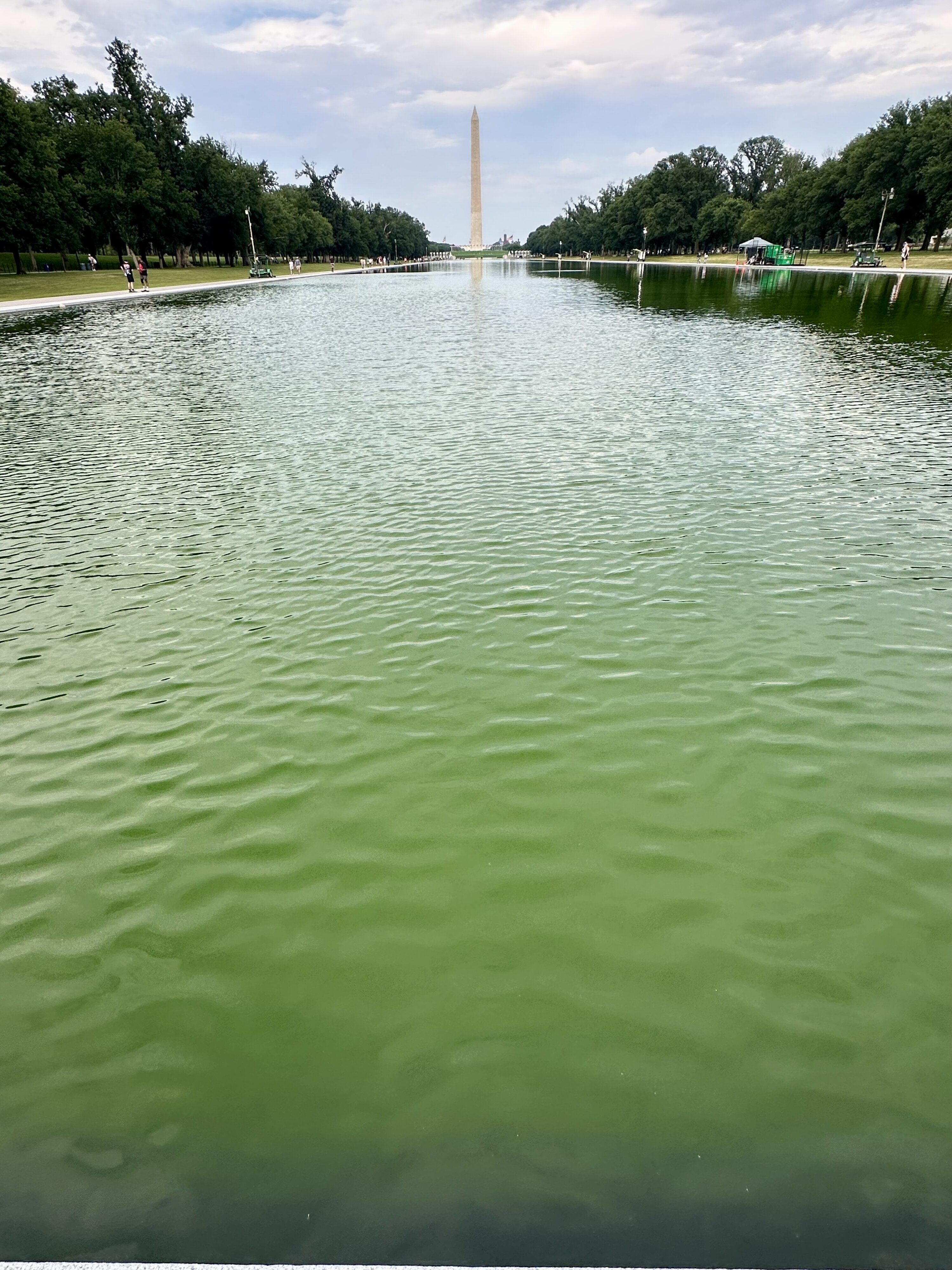
The race to de-greenify the Reflecting Pool continues, as National Park Service workers were seen dumping bottles of hydrogen peroxide into the pool Tuesday morning.
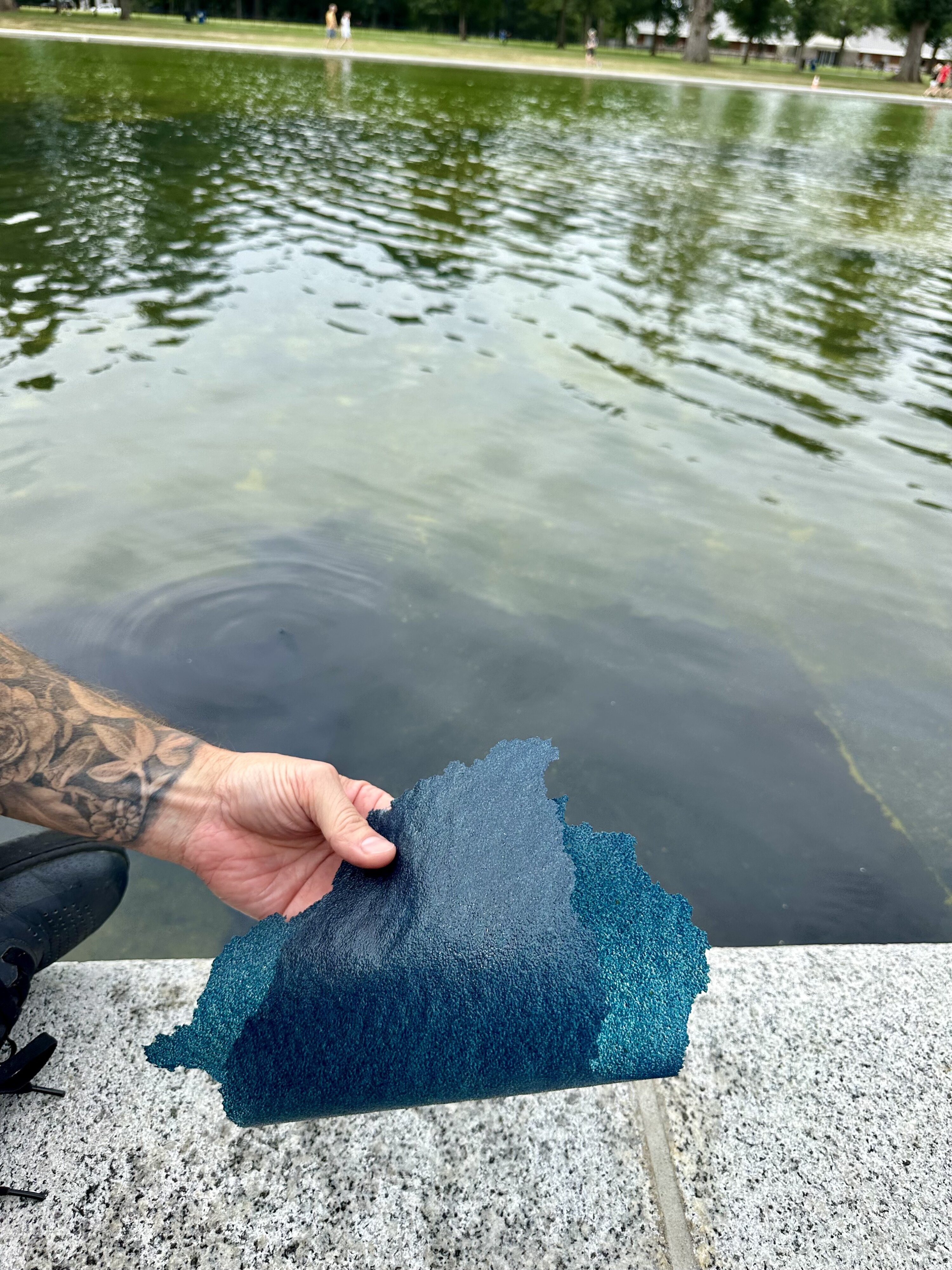
Algae first appeared in the pool last week shortly after its reopening, following weeks of construction directed by President Donald Trump, including a new paint job to transform the pool to “American Flag Blue.” Workers throughout the week have been using nets to clean up the algae, and a Department of the Interior spokesperson told Washingtonian Monday that NPS had used nanobubbler technology—allowing for the injection of gaseous ozone into the pool—and “successfully destroyed” the algae bloom.
“The algae is dead and being vacuumed up as we speak,” the spokesperson said in a statement Monday. “We thank President Trump for fixing the Reflecting Pool for good.”
But on Tuesday, workers seemed to have turned to an additional tactic: dumping jugs of hydrogen peroxide, an oxidizing agent used as a disinfectant, into the water. A DOI spokesperson confirmed Tuesday they were using hydrogen peroxide, which they described as a milder chemical than chlorine, to treat the pool.
“There are no harmful side effects to marine life or to the environment,” the spokesperson said.
Steve Goodale, a Canadian swimming pool specialist known online as “Swimming Pool Steve,” told Washingtonian on Monday that the darker blue of the renovated pool may worsen its long-existing algae problem absent other mitigation efforts, because the darker color will absorb more sunlight and increase the water temperature, making the pool ripe for more algae blooms.
But Goodale said there might be some merit to using hydrogen peroxide. He said a liquid oxidizer could help boost the oxidizing effects of the nanobubbler technology to kill the algae.
“They’re trying to manually supplement the amount of oxidation of the water to try and battle back this algae problem,” Goodale said.
Ozone and hydrogen peroxide are both acting as “oxidizing agents,” or a chemical that accepts electrons from another substance. These products are commonly used to kill algae by stripping them of their electrons and breaking down their cells.
However, Goodale said the hydrogen peroxide still does not address the fact that the Reflecting Pool’s massive size—the more-than-2,000-foot pool holds about 6.75 million gallons of water—presents obstacles for chemical treatment. He said the nanobubbler system may not produce enough ozone to make a meaningful difference in the pool, and while the hydrogen peroxide could “turbocharge” the oxidizing effects, it would still take inordinate amounts of the chemical to kill the amount of algae in the pool.
“The absolute immense size and scale of this body of water makes things like controlling algae through manually adding a liquid oxidizer product a tall order,” Goodale said. “That’s a lot of product you need to add.”
Goodale said the hydrogen peroxide likely does not pose a threat to existing wildlife in the pool, such as the ducks that swim in it, because it will be so diluted by the water. However, high concentrations of the substance can be harmful to fish and other wildlife.
“Hydrogen peroxide is considered one of the safest environmental options for open-air water features,” Goodale said. “It does not leave any toxic residue because it breaks down into simply water and oxygen.”