June 13: This story has been updated since its original posting.
It was 2 PM, and some of the earliest spectators to arrive outside the Kennedy Center were Louise Weiner and Julia LaVilla, who sat under the shade of trees. They had come to see President Donald Trump’s name removed from the building.
“I have friends at the NSO,” LaVilla said. “I’m hoping that they will be able to resume their performances and resume their rehearsals.”
“I hope life comes back,” she added.
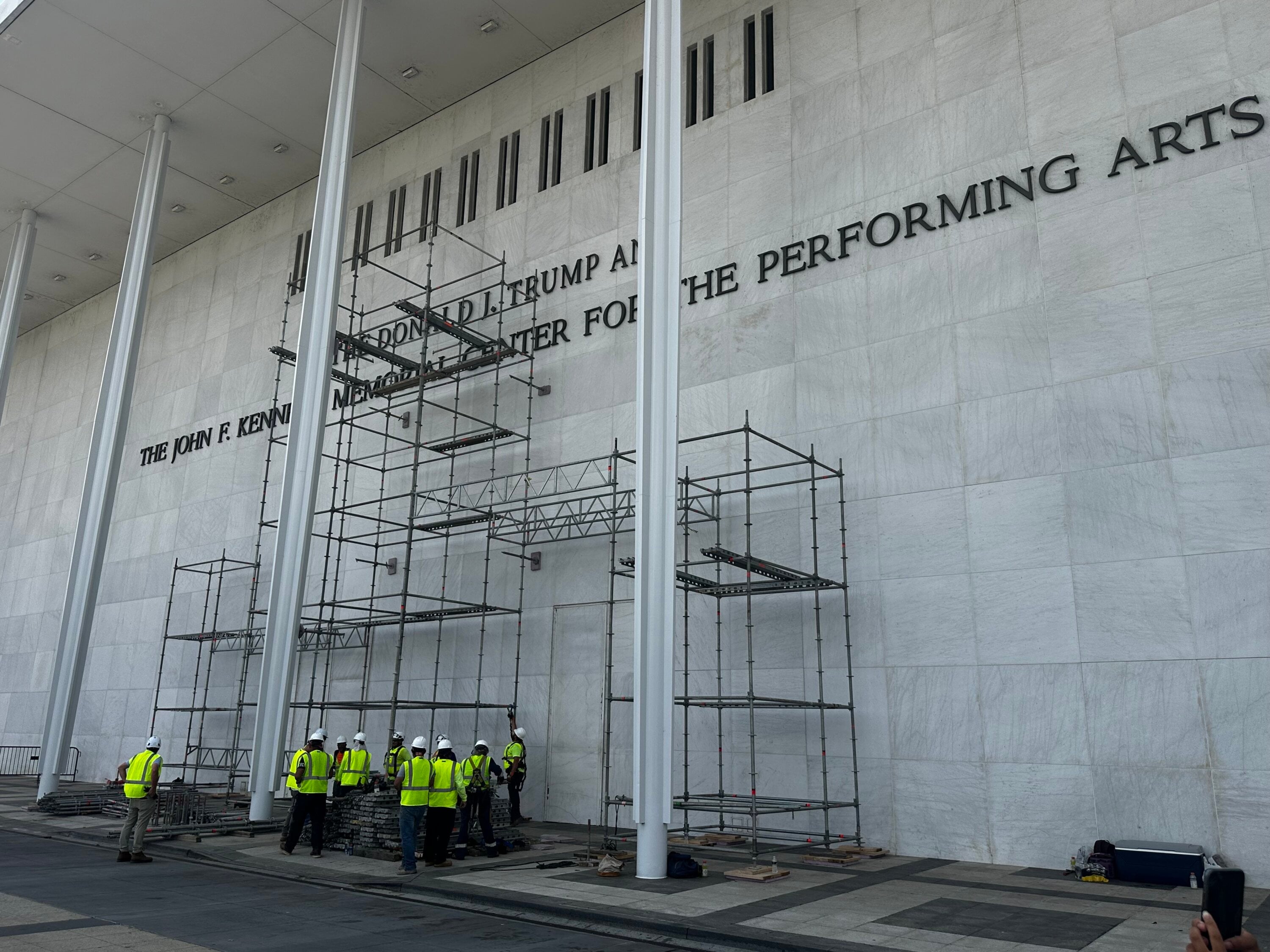
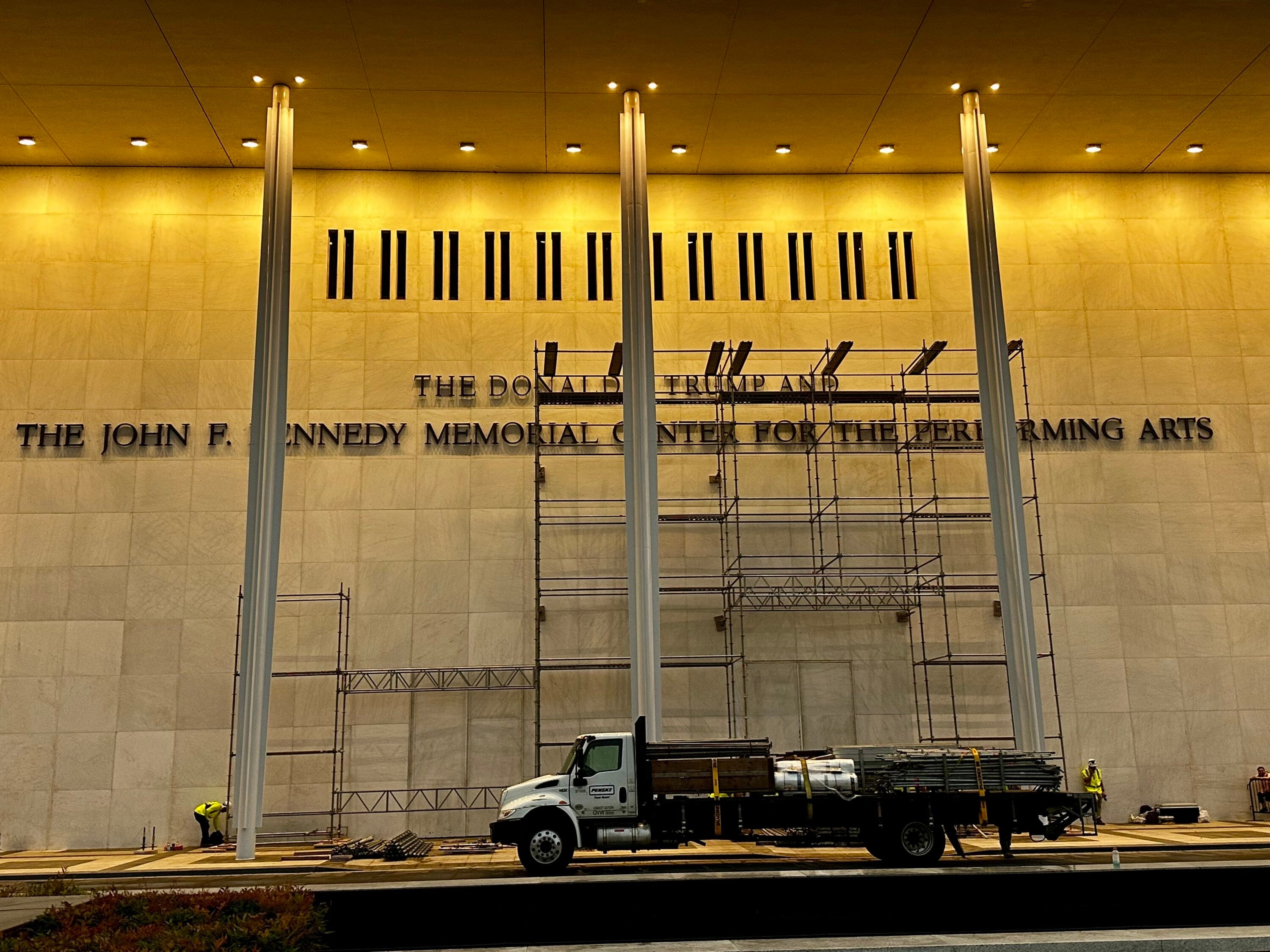
At 1 PM, a judge had rejected the Kennedy Center board’s request to pause the order to remove Trump’s name from the facade by midnight. Even before that decision, in the late morning, scaffolding had started to go up outside the building. With several cameras live-streaming the front of the center, word of the construction spread quickly.
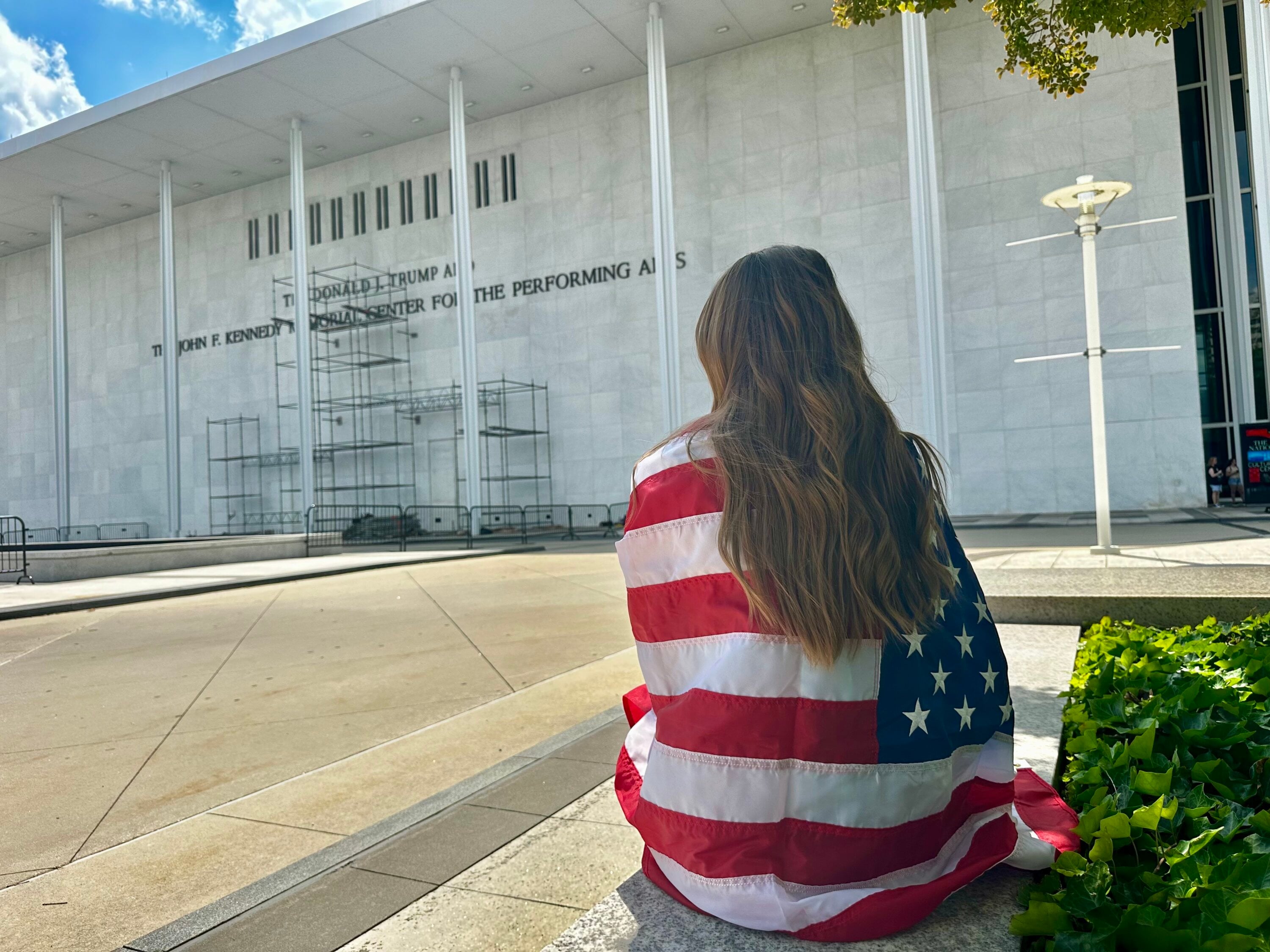
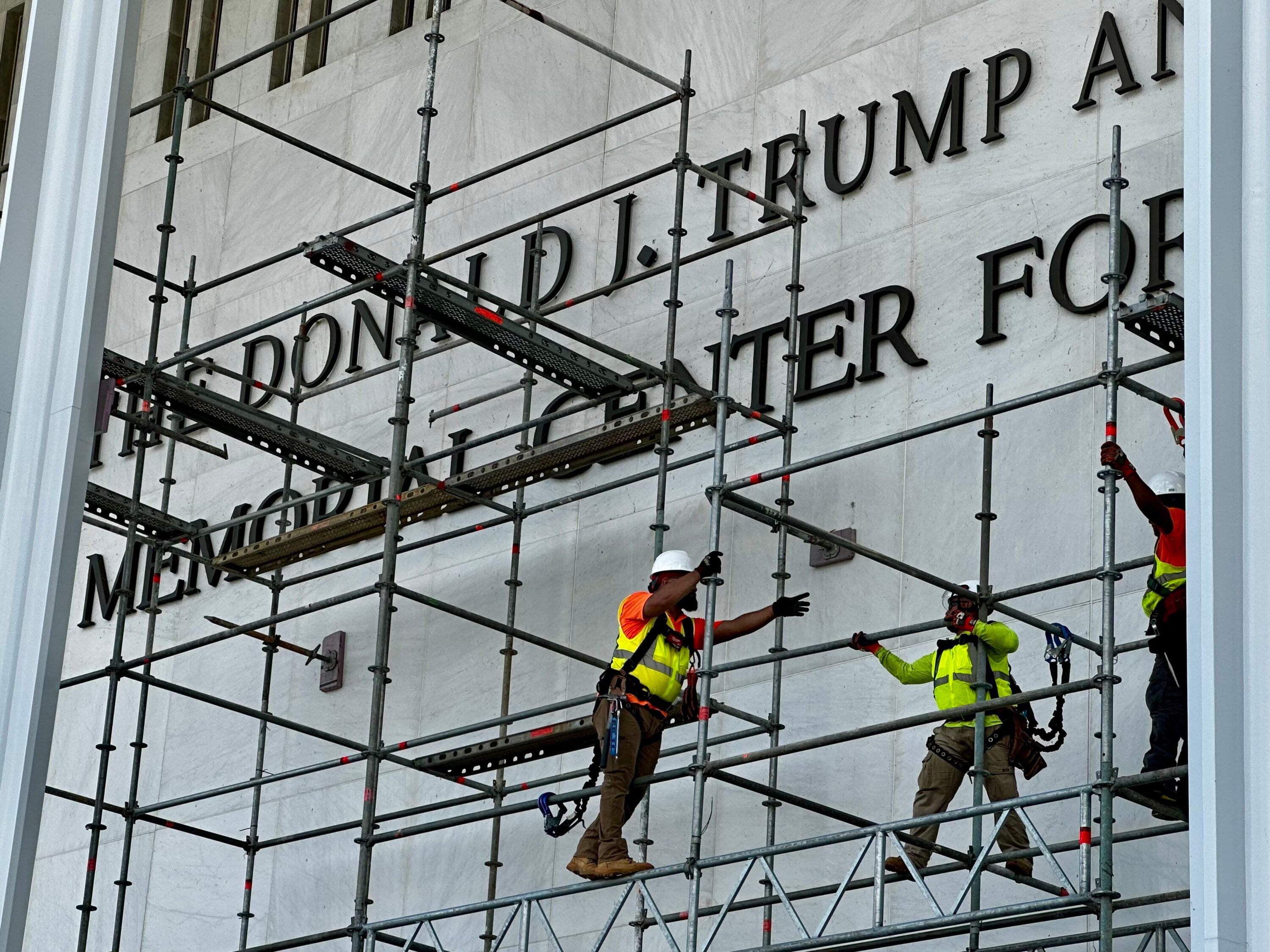
However, Weiner and LaVilla wouldn’t end up seeing Trump’s name removed—in fact, no one would. More than 13 hours of anxious waiting ended in disappointment when crews brought out tarps to cover up a massive scaffolding in front of the building.
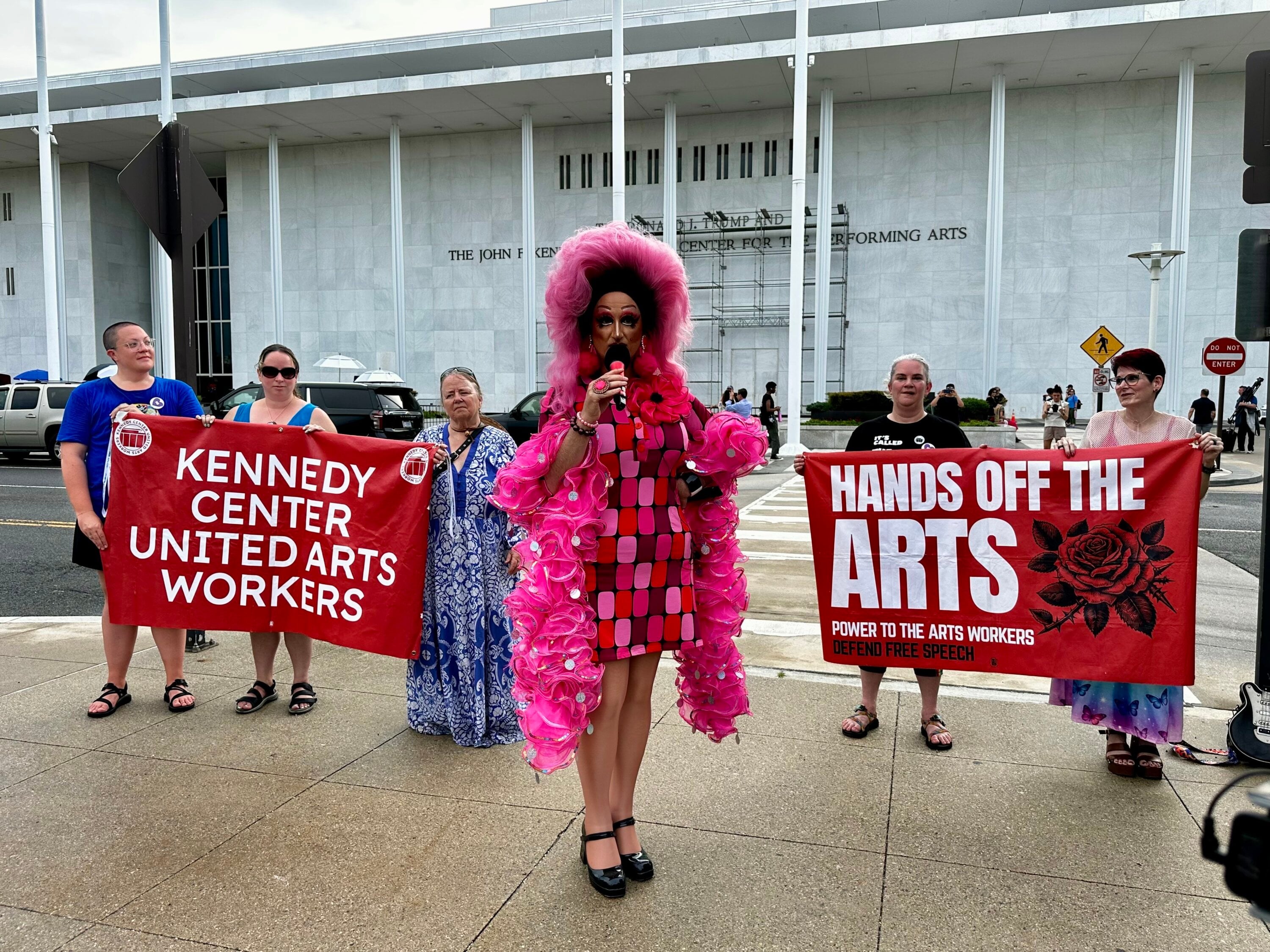
As more spectators gathered, drag queen Tara Hoot paraded around with bubble machines. Hoot had performed at the Kennedy Center before Trump’s takeover, and has been leading protests at the center over the past year. “There is so much that has been decimated inside the Kennedy Center: jobs, careers, programming, development, everything. So it’s time to start the hard work of rebuilding,” Hoot said.
At 2 PM, the crew abandoned the scaffolding and went inside. The crowd largely agreed that it was because of the heat—and many seemed to wish they could also take a cool-down break.
Around 2:30 PM, a group of construction workers re-appeared to chants of “take it down,” with spectators shouting “thank you” as workers appeared poised to finish the scaffolding. The cheers died down and turned to confused murmurs as the workers walked past the site, instead gathering around trucks in the main drop-off lane. When asked where they were going, workers replied, “No comment.”
Max Levy, a digital strategist with Hands Off the Arts, was just as confused as everyone else.
“Is it happening? Is it not happening? We’ve seen the scaffolding go up. We saw construction workers leave. We’ve seen them come back, leave again,” he said. “I think we’re all just waiting to see if and when, and hoping it’s today, as the crowd just keeps growing, that we’ll finally see the name actually come off.”
For the next 30 minutes, all eyes were on the crew gathered around a blue pickup. Rumors were flying—some said they were switching crews, others thought they were done for the day. At that point, it felt like 110 degrees and spectators were visibly sweating.
Sitting on lawn chairs and attempting to find some shade was a group of former Kennedy Center employees. Among them was Liz Goldberg, the former Director of Individual Giving. She started in 2019, but left in May 2025 after her team was “fired out from under [her].” She came from her home over an hour away because she said she needed to watch the letters come down.
To her, the moment was both cathartic and hopeful. As a former fundraiser for the institution, she said that Trump’s name being removed from the building will grow its donations and help the center survive.
“I have heard donors say, ‘When his name is off the building, I will start to consider coming back,’ ” Goldberg said. “I would like to see support rally back around the center and to have it have a chance to rebuild. It has to stay open.”
When asked if she would return to work at the Kennedy Center, she got choked up.
“I have had to move on. I will have to wait and see if the center is able to come back to its mission,” she explained, then paused. “But I would say right now, I would not come back.”
Standing with Goldberg was Jonathan Thomas, who worked at the center until 2019 as the Manager of National and International Advancement. He first came to the Kennedy Center on an eighth grade field trip, and fell in love. He moved to DC in 2012 to intern at the venue, a place he said must be preserved regardless of presidential administration.
“This is an incredible place. It’s a resource for not just our Washington community, but the millions of people that come visit every single year,” Thomas said. “I’ve had friendships and relationships, and this is a place that continues to be a huge part of my life.”
As Goldberg was talking, cheers started up again. The workers started back toward the scaffolding. Once they started suiting up, the crowd gathered around the barricades. “Who knew scaffolding could be so exciting?” one woman exclaimed. Another sighed, “I needed this.”
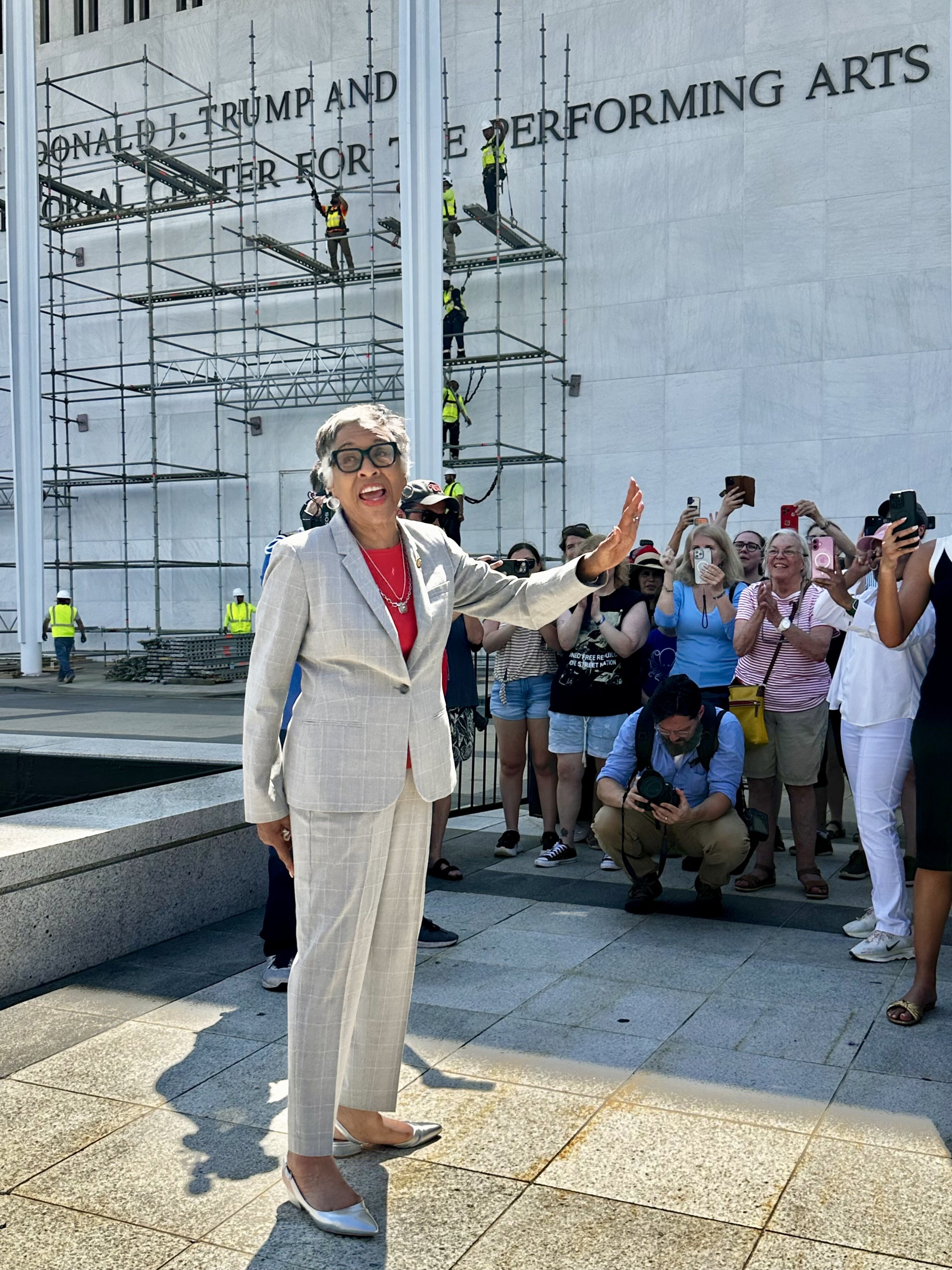
The crowd was still discussing when the letters might actually come down. Someone had heard 6 PM, others thought that they’d wait until midnight. Around 3:30 PM, Rep. Joyce Beatty arrived. The Ohio Congresswoman is a member of the Kennedy Center board, and was muted during the December meeting when the board voted to rename the center. She’s also the plaintiff in the suit that has resulted in the order to remove Trump’s name. She addressed the crowd, telling them that she’d been in close contact with the Kennedy family, and that they were grateful for those protesting to keep the former president’s name the sole one on the center.
“When they tried to silence me, they had to understand that they were going to be in a fight. Because we cannot be silenced no matter who it is, and the law is on our side,” she said to cheers.
At 4 PM, a drizzle began. What seemed like divine intervention for an overheated crowd caused the construction workers to get off the scaffolding, which appeared to be nearly completed.
Around this time, news broke that the Kennedy Center board had filed an emergency motion to stay the order from earlier in the day. The US Court of Appeals for DC had until 7 PM to issue a decision on whether Trump’s name could stay up while they consider the suit.
As the wait dragged on, some spectators decided to head home for an “intermission” to shower and grab dinner. As these longtime viewers departed, the after-work crowd arrived.
At 6:30, Hands Off The Arts hosted a rally, both in-person and on their Kennedy Center livestream. Just as the rally began, a few members of the construction crew walked by to cheers. One worker pumped his fists in response.
Speakers at the rally included Hoot and several members of the Kennedy Center United Arts Workers union, which the center hasn’t recognized. One member, Kathleen O’Malley, talked about how her nine-year-old daughter told her class, “my mom saved the Kennedy Center!”
“You all, we are saving the Kennedy Center, this is a moment in history,” O’Malley said.
Former CNN anchor Jim Acosta also spoke, leading the crowd in a “take it down” chant.
“We’ve seen this assault on the First Amendment in this country. I witnessed that firsthand, they took away my press pass during the first Trump administration. They are now going after the artists,” Acosta said. “When collective action takes place, when the people rise up, anything is possible.”
When 7 PM came and went with no ruling, the crowd anxiously continued the rally. At 7:15, organizer Luke Hall rushed to the megaphone.
“The Court of Appeals denied the request to press pause and, as of right now, that name has to come down,” he said.
The crowd erupted into cheers, and just minutes later ran across the street to watch as an 18-wheeler pulled in with more scaffolding. As if on cue, the first lightning strike hit, and rain poured down. The crowd and the construction crew huddled under an awning. Around 7:45 PM, Beatty reappeared to celebrate the victory.
“If we’re going to fight for the people, if we’re going to fight for our democracy, we have to make sure that we respect the rule of law,” Beatty said.
“You saved us,” one woman replied.
Incredibly, a double rainbow appeared outside the Kennedy Center. Gathered under the awning, demonstrators sang “God Bless America” while looking toward the rainbow.
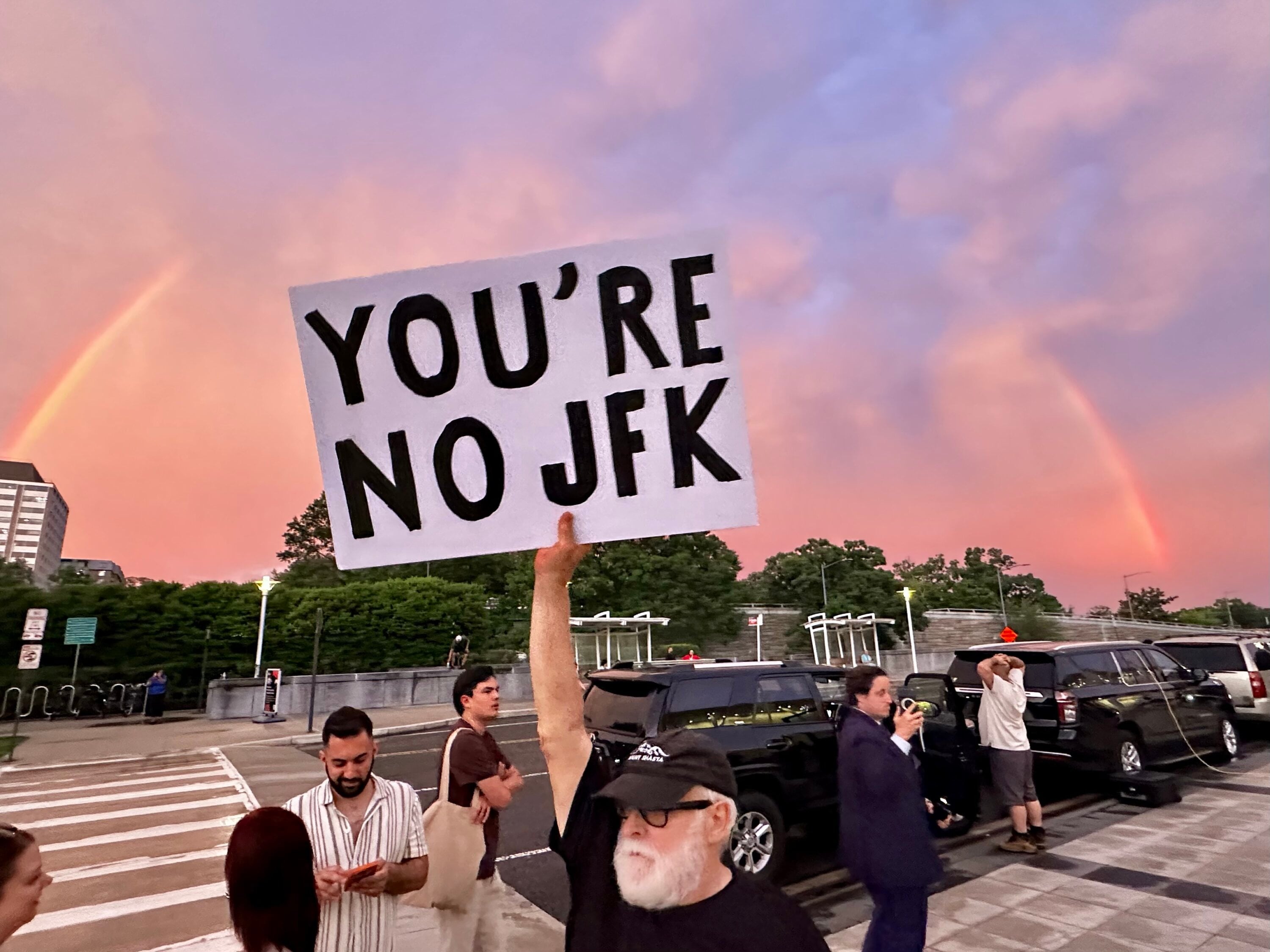
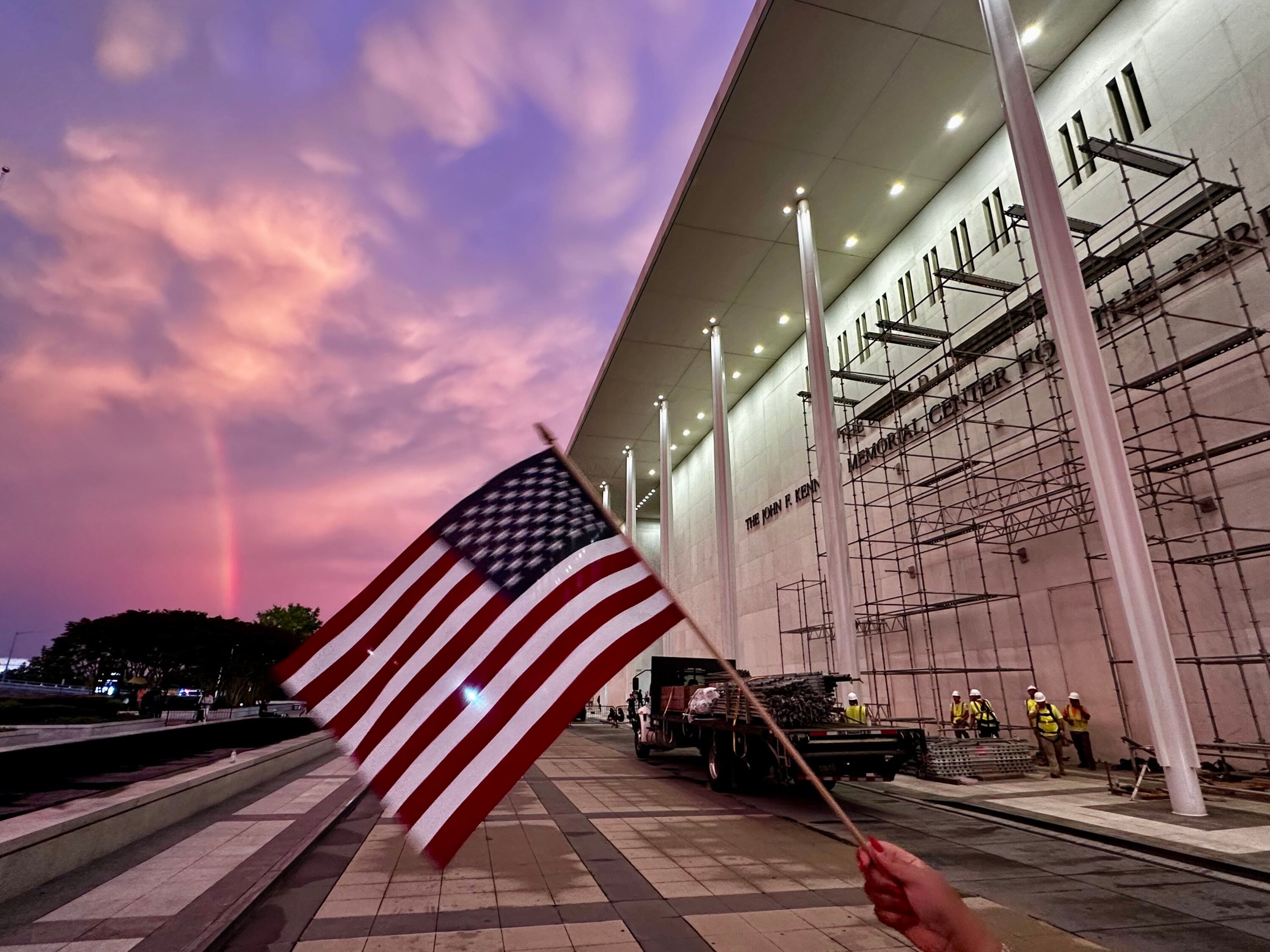
The crowd grew into the hundreds as workers continued to build the scaffolding well past sunset. From the sidewalk, onlookers gave suggestions.
“Start with the T!” one man said. “We’ll all love you for it!”
He asked them to remove the T first at least 10 times.
A small quintet of women launched into “This Land is Your Land” around 9:30 PM. Now, all of the workers have come down from the scaffolding and are gathered around the truck.
With T-minus two hours until the Kennedy Center’s midnight deadline, the construction crew began working on the scaffolding again after an extended break. They were met with cheers from the crowd.
Shockingly, the crowd only grew as the night went on.
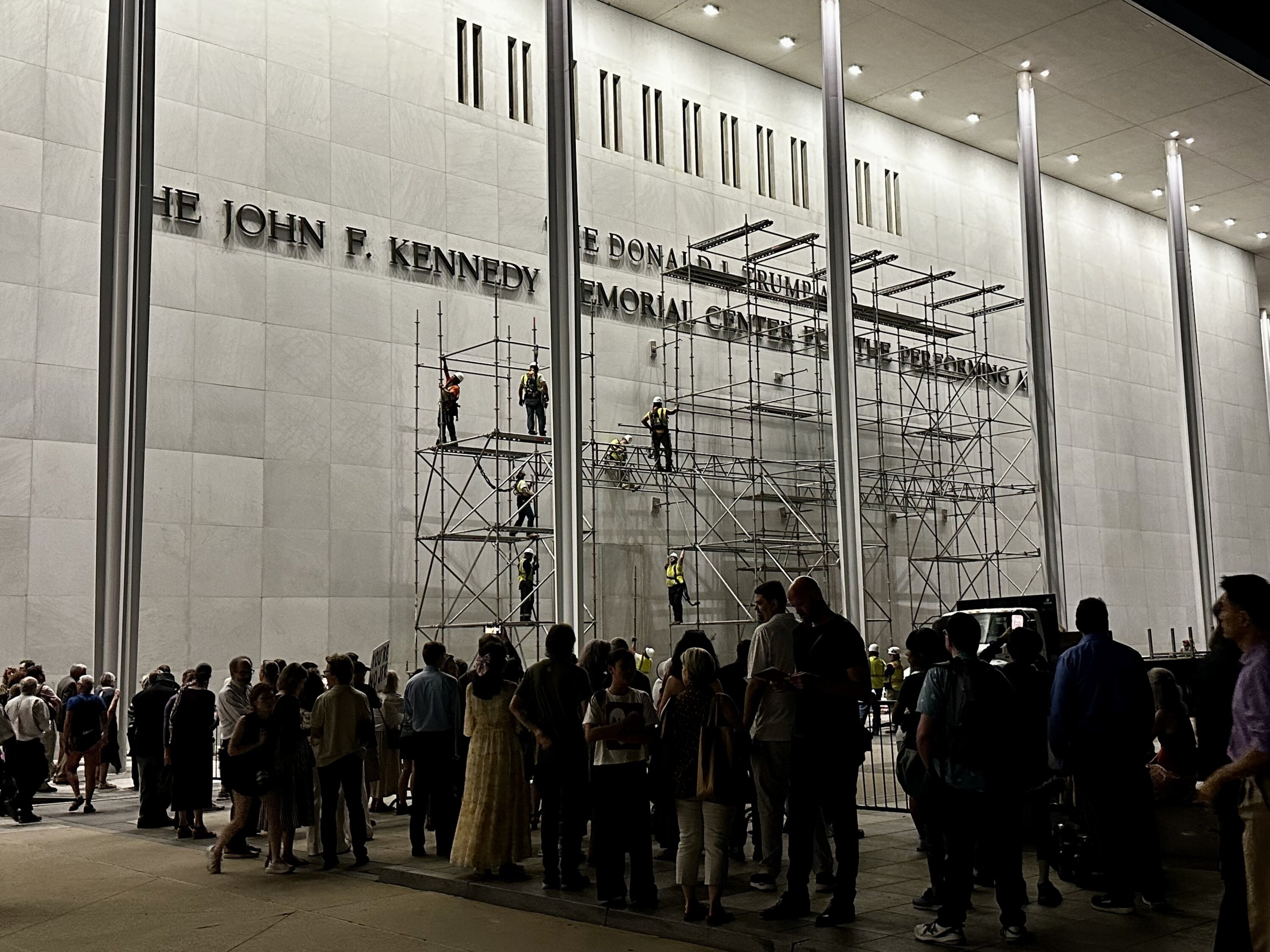
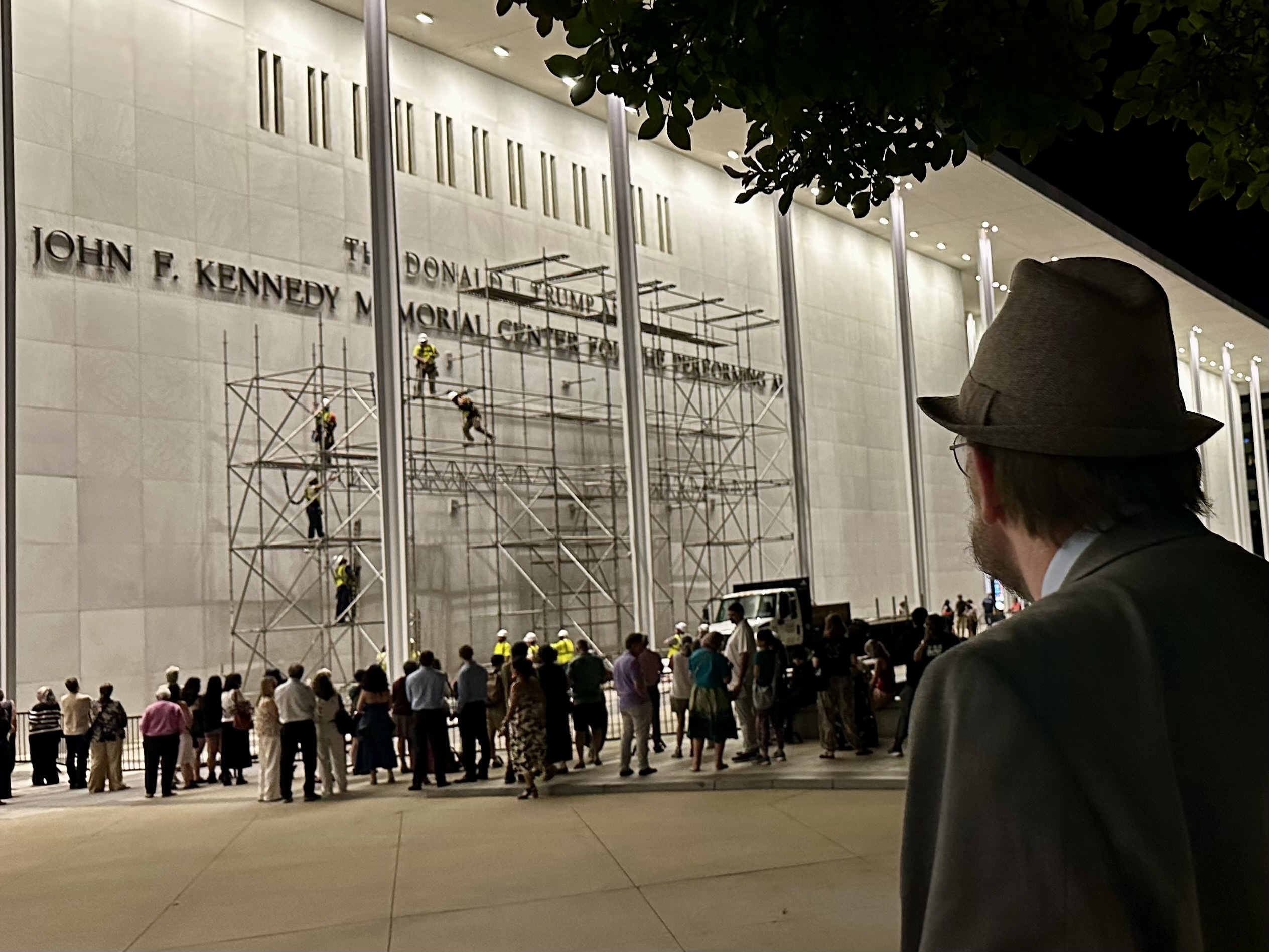
As the one-hour mark approached, workers continued to build what appeared to be the last level of scaffolding. While the crowd had generally quieted, particularly loud noises from the crew drew chants—likely because few audience members actually understood what constituted progress when building scaffolding.
Periodically, passing cars honked at the crowd. It seemed like the people that were already there were in it for the long haul; the crowd was not diminishing, despite construction moving at a snail’s pace.
As it hit 11:11, one spectator remarked, “I know what my wish is.”
Just when the crowd was celebrating what they thought was the final layer, new supports for an even higher level of scaffolding were installed. Meanwhile, four construction workers sat down, leisurely watching the scaffolding like everyone else.
“30 minutes!” an attendee shouted to the workers.
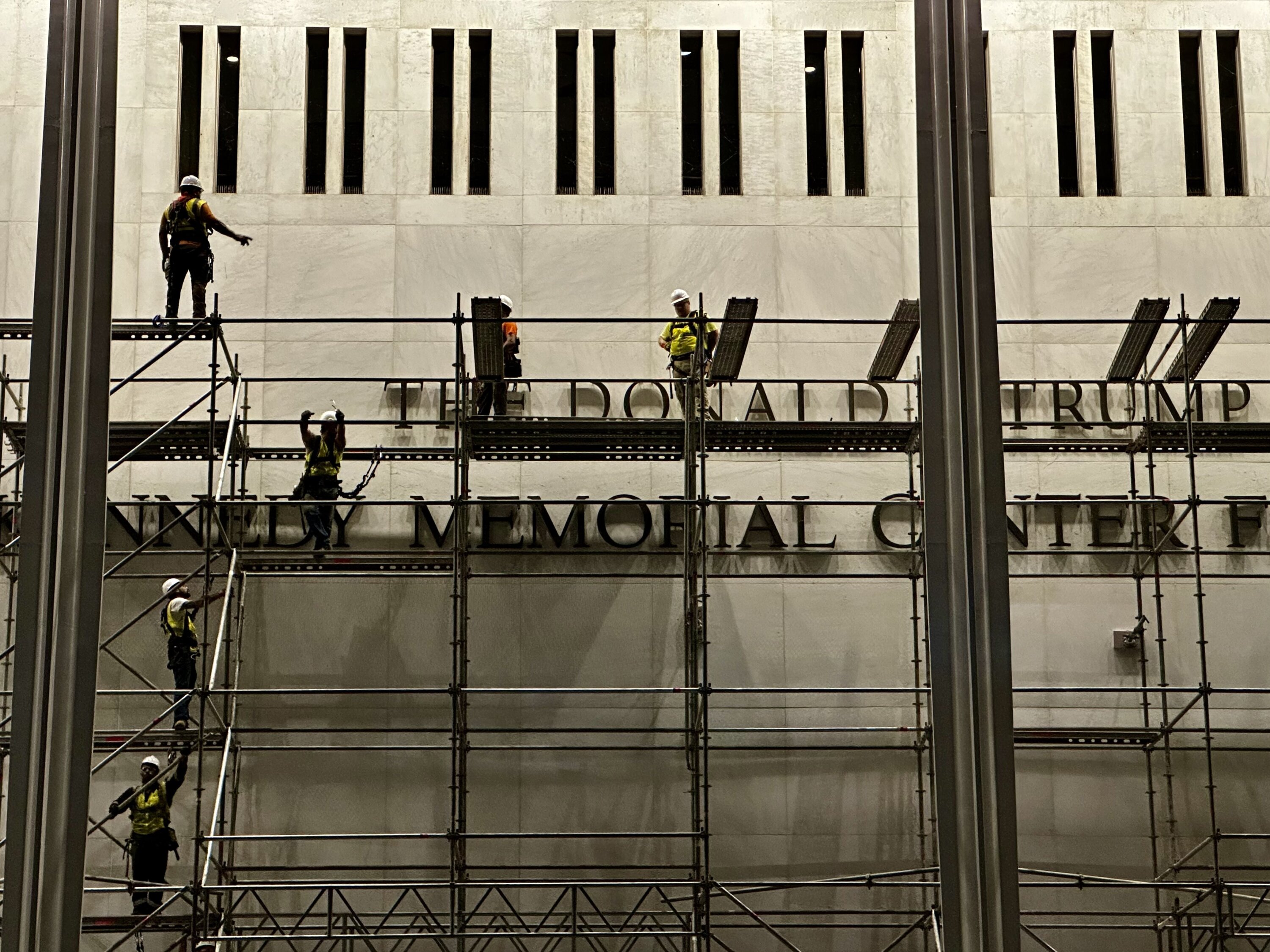
One man suggested that the soon-to-be-removed letters should be auctioned off. That is, if they’re actually going to come down at this rate.
As midnight drew closer, the number of construction workers watching and not building grew to nine. Still, the crowd was going strong and many seemed to have no intention of leaving until the letters did.
“Five minutes! No pressure—you’re doing great!” one onlooker reminded the workers.
“I’m buying you a beer when you get down!” another woman promised.
With three minutes left until the deadline, one woman led “three cheers for Representative Beatty!”
As midnight approached, onlookers counted, “10…9…8…7…6…5…4…3…2…1…” Midnight passed, and the Kennedy Center board was officially in contempt of the court. Angry shouts broke out, with a large chant of “take it down” echoing.
Just before midnight, the Kennedy Center Board filed for a 12-hour extension for the removal, writing that the process “has been delayed because of thunderstorms in the District of Columbia that presented safety concerns for workers.” They wrote that they expect removal work to finish in “the early hours of the morning.”
Beatty’s camp responded that “Defendants had two weeks to comply with the order, and only need an extension because of their inexcusable delay.”
“Just do it!” someone shouted. Over time, the crowd went from hopeful to frustrated. There was a likely correlation with a lack of sleep and being hangry.
The final level of scaffolding was completed around 12:50 AM. Then, the tarps appeared. People booed as the tarps were raised, and the crowd came to terms with the fact that no one would be able to see the letters removed. (As of 4 AM Saturday, it was reported that workers had finally removed the 18 letters “The Donald J. Trump and.” You can see a live stream—though not the missing letters behind the tarp—here.)
Among the last spectators to leave was DC Shadow Senator and current At-Large Council Candidate Oye Owolewa. Clad in Captain America pajama pants, he was excited to gather with other Washingtonians even if he wouldn’t get to physically see the removal.
“This is just a step of us getting our lives back. Facism is real, and it is not okay,” Owolewa said.
Others were angrier. One man walked through the barricades and yelled at workers and security. Others yelled “Shame!” and profanities. As the tarps were hung and the crowd left, disappointment was palpable.
“We came here for a show,” one man mourned.
This is a developing story that will be updated.