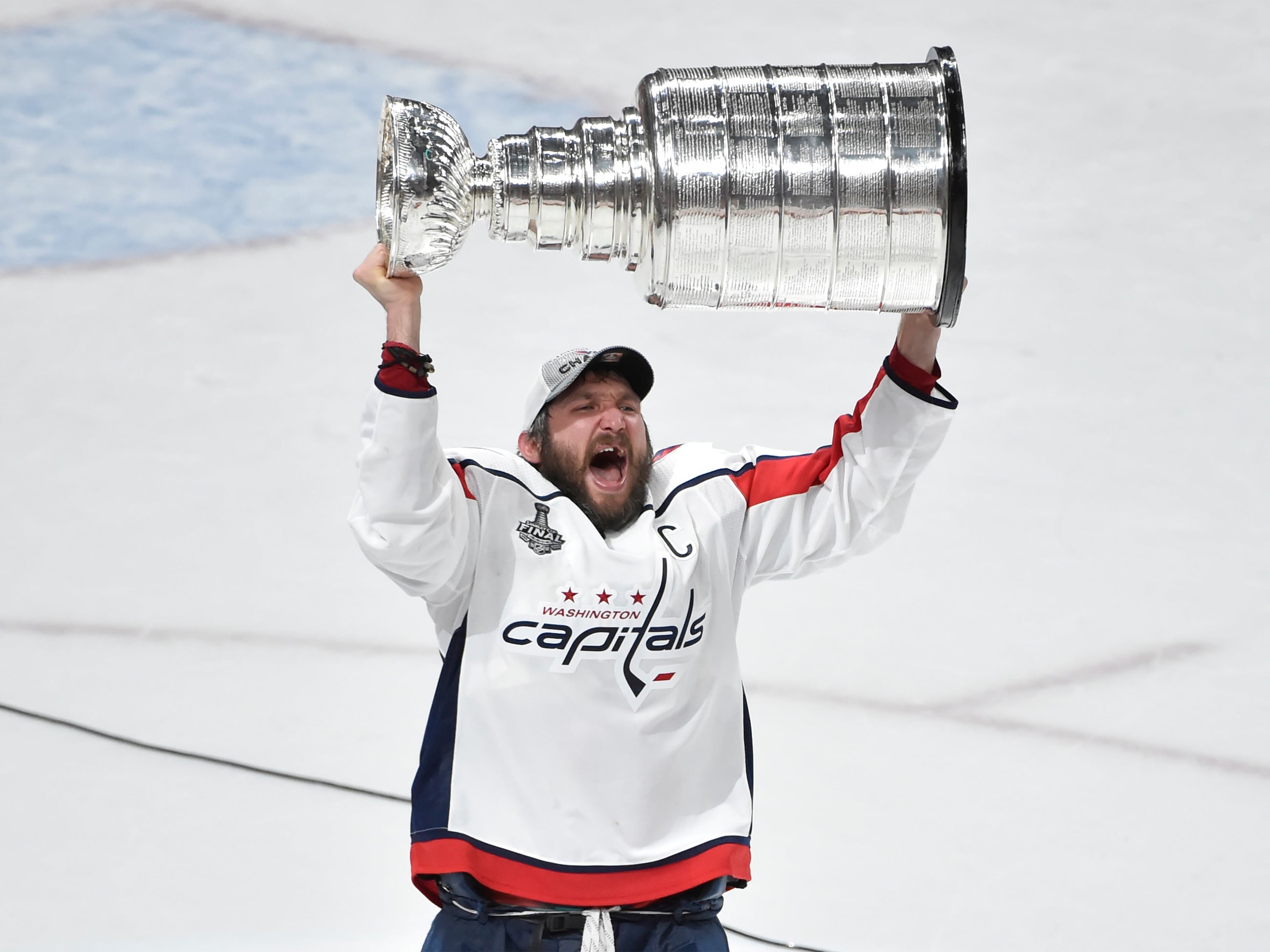
For area sports fans, the Washington Post’s deep staff cuts in early February were especially painful. The paper eliminated its entire sports section, erasing a department that not only birthed Pardon the Interruption and a Congressional investigation into the Washington Commanders’ toxic workplace culture under former owner Dan Snyder, but also covered local teams and athletes with unmatched breadth: where else could you find a column on Alex Ovechkin, coverage of Navy football, and the All-Met high school teams?
Late last week, the Athletic announced the hiring of six former Post sports journalists, with the website’s executive editor Steven Ginsberg stating in a public note that the moves were intended to “provide fans in Washington with unparalleled coverage of the teams and sports they love.”
To better understand how the hires happened and what they mean for the future of local sports coverage, Washingtonian spoke with Ginsberg, who lives in the area and himself worked at the Post before moving to the Athletic. (This interview has been edited for length and clarity).
Just over three weeks after the Post announced its cuts, the Athletic announces these moves. That’s a fast turnaround for a single hiring, let alone a half-dozen. How did this happen, and how did it happen so quickly?
The [Post’s] decision created a vacuum [of local sports coverage]. For us, we’ve already had reporters on Commanders and Wizards coverage for quite some time, and we have a history of covering the Nationals. This seemed like a great opportunity. We’re also home to the best sports journalists in the country, and we are always on the lookout for who we might add to our roster.
It wasn’t hard to identify really talented journalists at the Washington Post. When they made their announcement, I just started reaching out, talking to people. It all came together—I wouldn’t say easily, but somewhat quickly. The work they have all done for a long time is work that we really value, and they can make the Athletic better.
Before joining the Athletic in 2023, you worked at the Post for nearly 30 years—starting as a copy aide and eventually becoming the paper’s managing editor, where you oversaw its sports section. Of the people you hired, how well did you know their work, and how well did you know them as co-workers and as people?
Of the six people, I know them all. I know them well as journalists, and also as former colleagues. It was not hard to immediately have a sense of who was well-positioned to help us expand our coverage.
It certainly helps to be on a first-name basis with people. And not just for me. They are well-known throughout the industry, and other people at the Athletic were eager to bring them on.
As a longtime Post person, how did you find out about the February cuts, and what was your personal reaction?
It was as real gut punch to see close to half of the Post newsroom [cut]. To anyone who worked there, it was a great newsroom full of great journalists, and that made it hard to stomach.
What does the total loss of Post sports mean for Washington-area sports coverage?
The Post was one of our toughest competitors. Since I’ve been here, there have been a few stories that other outlets were doing that made me jealous. The Post was often the one doing those stories.
We all know the Hall of Fame sports columnists they’ve had. But it’s also the loss of the every day people on the beats—that was how Washingtonians got their information about the local sports teams. I think everyone felt that immediately. You have people looking around, asking, “who is going to provide the coverage we are looking for?”
Not all of the hires the Athletic made are going to exactly replicate the way the Post covered Washington-area sports. Jason Murray’s portfolio as an editor will be national, Candace Buckner will be a national columnist, Adam Kilgore and Ava Wallace have what look like national and even international reporting roles. On the other hand, will see Barry Svrluga joining former Post writer Nicki Jhabvala on the Commanders beat, and Spencer Nusbaum on the Nationals beat.
What kind of balance is the Athletic is trying to strike between local and national sports coverage, and how do these hires fit with that?
These hires reflect our ambition. We have always been the place to go for your local teams. In DC, this will help us provide the premier coverage in the area. But we are also a national sports outlet—we do nationally-based investigations, nationally-focused opinion writing. At our best, we do both [kinds of coverage]. We bring our newsroom to bear on the biggest stories, wherever they may be.
And these hires aren’t the only [former Post people] at the Athletic. Jerry Brewer came from the Post. David Aldridge was once there. And Dan Steinberg. I’ve lived in the DC region my entire adult life, as have Dan and many others. We all in and know this area as well as you possibly could.
What can the Athletic bring to DC sports coverage that the Post didn’t? Are there areas where you feel your team can not only fill in the gaps left behind, but improve on what the paper was doing?
I do think we do things a little differently from the Post. We really try to listen to fans. If fans are interested in something, we try to answer those questions for them—we have access to the teams they love, and want to be able to use that access to get those answers.
For example, I think we all know that game stories are mostly a thing of the past. At the Athletic, we have “discuss” tabs while games are being played. We will have reporters in those tabs talking to fans, responding to them, and then after games produce a summary that will be based in part on those discussions. You also have mailbags, like for the Wizards, where fans can ask writers directly about a team.
I think we can expand on that—we can do more than mailbags. We can respond in real time. Fans often have really good questions and know their teams inside and out. You’re on a journey with your team, and we will be on a journey with you.
And we will still pair that with more traditional journalism—investigations and reporting—to get the information people want.
Broadly speaking across sports media, we’ve seen a real retrenchment in local sports coverage of the last 10-15 years. ESPN got rid of its handful of city sites and cut back on having writers cover individual teams. The Athletic started with city-focused local coverage, but has evolved into being more nationally and internationally focused. Meanwhile, local newspapers continue to shrink and fold. How would you characterize the state of local sports coverage around the country, and where does the DC area fit in?
First, I would say we are very much both—we cover around 100 teams locally. I also think that in some places, local coverage is really good, really strong. But other places, not as much. Frankly, it feels like it depends on how those individual media outlets are doing [as a whole].
Related to the last question—there’s clearly a healthy market for coverage of local teams with large local and even national followings. DC sports fans can still read and listen to news from lots of paid professionals covering the Commanders. But what about local teams with smaller followings? Or high school sports? Is there a sustainable business in covering them the way the Post did?
I don’t think that there’s as perfect answer to that right now. It’s incumbent on places like the Athletic that are dedicated to local sports journalism to figure out the answer.
Directionally, community around teams—with the journalist being a part of that community, but also at some level separate from the community—is where we are headed. But how you make the economic model work is something everyone is still trying to figure out.
Are you done hiring former Post sports people, or are more announcements coming? And if the answer is “more coming,” would you like to make those annoucements now?
Good question! I would say the Athletic is as big and growing newsroom. We will continue to look for opportunities to add the best journalists wherever they come from. Some may come from the Post.

Patrick Hruby joined the magazine in 2022. He previously worked as an editor or writer for ESPN, VICE, Sports on Earth, Global Sport Matters, and The Washington Times, and has contributed to publications including The Atlantic, The Guardian, The Los Angeles Times, and The Washington Post.