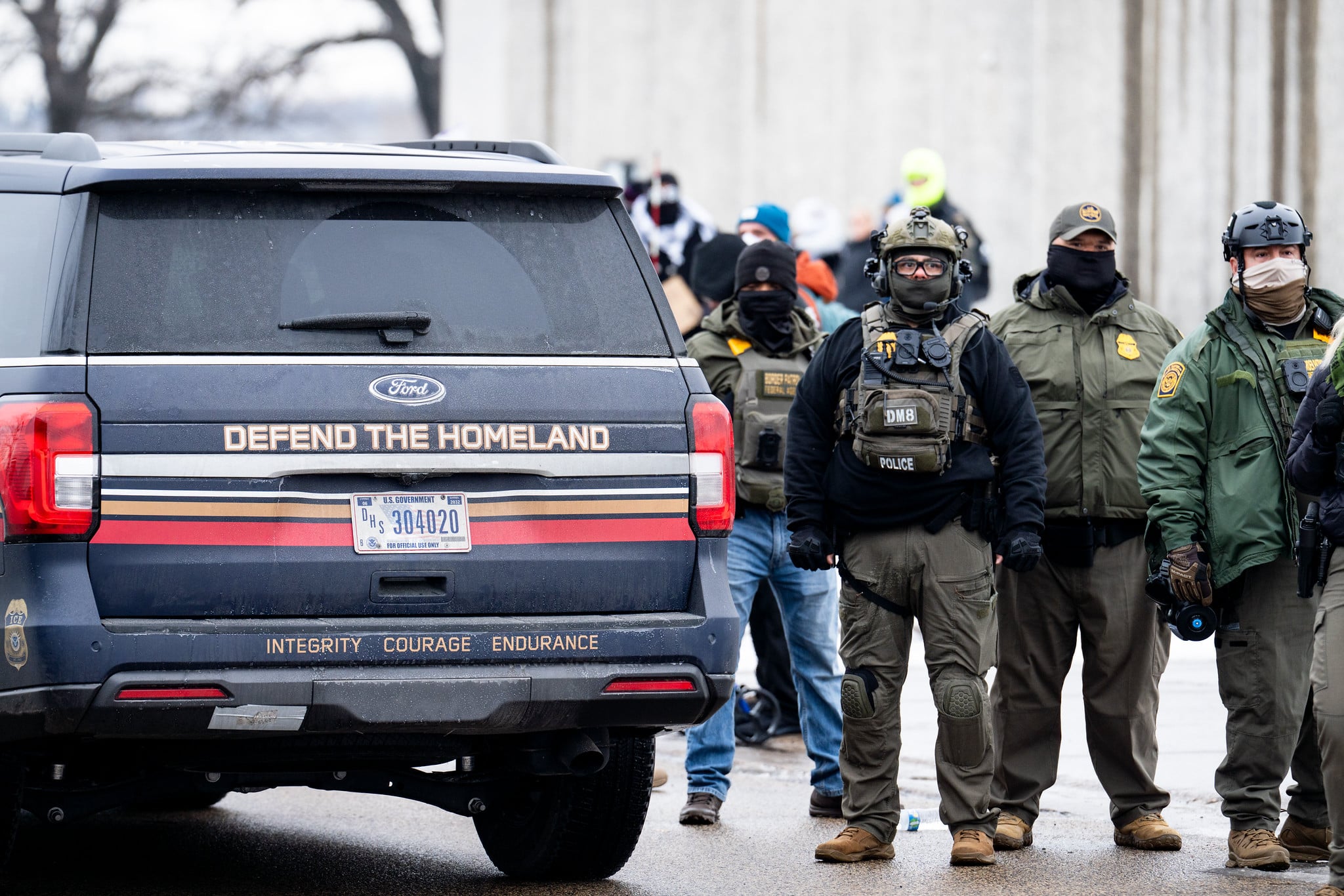
Last week, Loudon County resident Carolina Molina found herself staring down the barrel of an ICE agent’s gun after shouting at agents apprehending two men in Falls Church. While the agents alleged that Molina had attempted to run over the agents, video footage of the incident from several angles shows no evidence to support that allegation. Yesterday, Virginia Democrats Don Beyer and Suhas Subramanyam announced a congressional investigation into the encounter.
This follows nearly 18 months of increased ICE activity across the country and in the DC area. As of March, ICE had arrested nearly 20,000 people in the DC region since the beginning of President Donald Trump’s second term—five times as many compared to the last full year of the Biden administration. With many residents of Virginia, DC, and Maryland on edge, here’s what local immigration law experts say you should know about interacting with ICE:
Anyone can be arrested by ICE
Many of the interactions people can have with ICE agents are protected under the First Amendment. Speaking to agents, no matter how rudely, falls under freedom of speech, while gathering to denounce ICE at a protest falls under freedom of assembly.
However, according to Zachary Abraham Kohn, a DC-based immigration attorney, ICE agents do have the ability to arrest US citizens for interfering with ICE’s operations, which can include:
- Assaulting an officer
- Physical obstruction of a space or an arrest
- Harboring an individual ICE is trying to detain
- Making false statements in an officer’s presence
Molina, a US citizen, was told by ICE agents that her citizenship “doesn’t matter” while threatening to arrest her. Anuscè Sanai, associate director of legal programs at Ayuda, a DC-based organization advocating for low-income immigrants, says that oftentimes ICE agents have the ability—based on the subjectivity of the above criteria—to arrest individuals even if their activity is protected by the First Amendment.
”Even if one does have the right to protest and be vocal and voice their opinions, we’re still confronted with law enforcement, and law enforcement has much more power to create that gray area to then create the reason why somebody may be arrested or a protest may be stopped or a car may be stopped—even if we know that those reasons may not be legitimate whatsoever,” Sanai says.
What to do—and not do—if you’re arrested or detained
If you do end up in a situation where you are being detained or arrested by ICE, Sanai says, remaining calm is important so you can try not to engage, because “when we engage, that’s when we tend to volunteer information.”
Atenas Burrola Estrada, the deputy director of DC-based Amica Center’s detained adult program, says that you have the right to ask ICE agents why they are approaching you, and if they try to detain or arrest you, you can also ask why they are doing so.
Sanai also says everyone, US citizen or not, has the right to remain silent. Whether you are required to give your name when asked depends on where you are—it is required in some localities in Virginia, and in Maryland, you are required to if the officer reasonably believe that you have or are transporting a handgun. DC has no such statute.
“You have the right to not consent to anything that is asked of you,” she says. “So whether it’s a search, whether it is presenting documentation, showing even an ID document, you don’t need to.”
If you’re not documented, you do not need to show any identification—but you also should never show false documents or provide inaccurate information about your citizenship status. However, Kohn says it is a good idea for everyone to carry proof of residency or citizenship if they have it. That way, if you are stopped or detained by ICE, you have immediate proof of your legal status to present to them.
Recording ICE is legal. Interfering with an arrest is not.
If you see ICE agents detaining, arresting, or interacting with someone, Sanai says, it’s legal to pull out your phone and record—in fact, she recommends doing so.
“Even if it’s a calm exchange between an officer and a person, take out the phone and start recording,” she says.
Sanai says that best practices for recording an ICE agent include:
- Capturing key information like the agent’s badge number, name, agency, and any vehicle information.
- Narrating what officers are doing, and what they did before you pulled your phone out.
- Verbally noting the date, time, and location, as well as any other key circumstantial information.
“That, one can do, because then that can become a powerful document,” she says.
Sanai notes that Molina did this well during her confrontation with ICE, which allowed her to prove her account of the incident. DC Migrant Solidarity Mutual Aid (MSMA) and Harriett’s Wildest Dreams have also created filmthepolicedc.org, where you can submit video footage and any other information about encounters with ICE agents or police officers.
Though onlookers and bystanders may want to help those being detained in any way possible, Sanai advises not attempting to physically stop ICE from detaining someone, which can further endanger the individual being detained and escalate the situation.
“Let’s be very clear: there is nothing one bystander or a witness can do to stop the arrest,” Sanai says. “So starting from that threshold, then the next step is, ‘I must ensure that I don’t obstruct the arrest because I can cause more issues for myself and for that person that is being arrested.’”
Kohn says that the safest option is to not agitate officers: “My advice for US citizens is to treat the officers with respect; they can be upset with what they’re doing and not agree with their mission, but to not antagonize them. They’re carrying weapons, they might not be trained well.”
What to know if you’re planning to protest
If you’re looking to protest ICE, it’s always best to be with a large group led by individuals experienced in leading protests and handling any possible escalations. Estrada also advises that anyone passionate about being out in the community and protesting ICE receive formal training, which she says local organizations like Free DC and MSMA have offered in the past.
Non-citizens are entitled to First Amendment freedoms on US soil, but as Kohn says, “exercising them right now comes at a great cost,” like possibly being deported. For this reason, all three experts recommended that noncitizens take extreme caution when participating in any sort of protest or large, public political gatherings.
If a noncitizen does attend a protest, they should have a contingency in place should they be detained, including the contact of an immigration lawyer, care for children or pets, and having a trusted individual to deal with your finances and legal documents.
US citizens and residents also should have a plan before protesting, including a trusted individual others can contact to secure their release from jail if arrested.
Estrada also emphasizes that nonwhite individuals are at higher risk of racial profiling by ICE agents and other law enforcement officials. A recent ACLU study of 1,200 ICE interactions across eight states, including Maryland, found that 437 likely involved racial profiling.
“People who they think fit whatever criteria it may be, usually that the person is brown or Black, not white, ICE is arresting them under the pretext that they think that they are undocumented,” she says.
Kohn says that there are many ways to support immigrants that do not involve physically protesting, including translation work, organizing pro bono legal services, donating to organizations and legal funds, volunteering with local groups, and court watching. “I think it would have a lot of impact if people were donating and volunteering their time for those types of organizations as opposed to exclusively protesting,” he says. “I would just place a greater emphasis on that.”