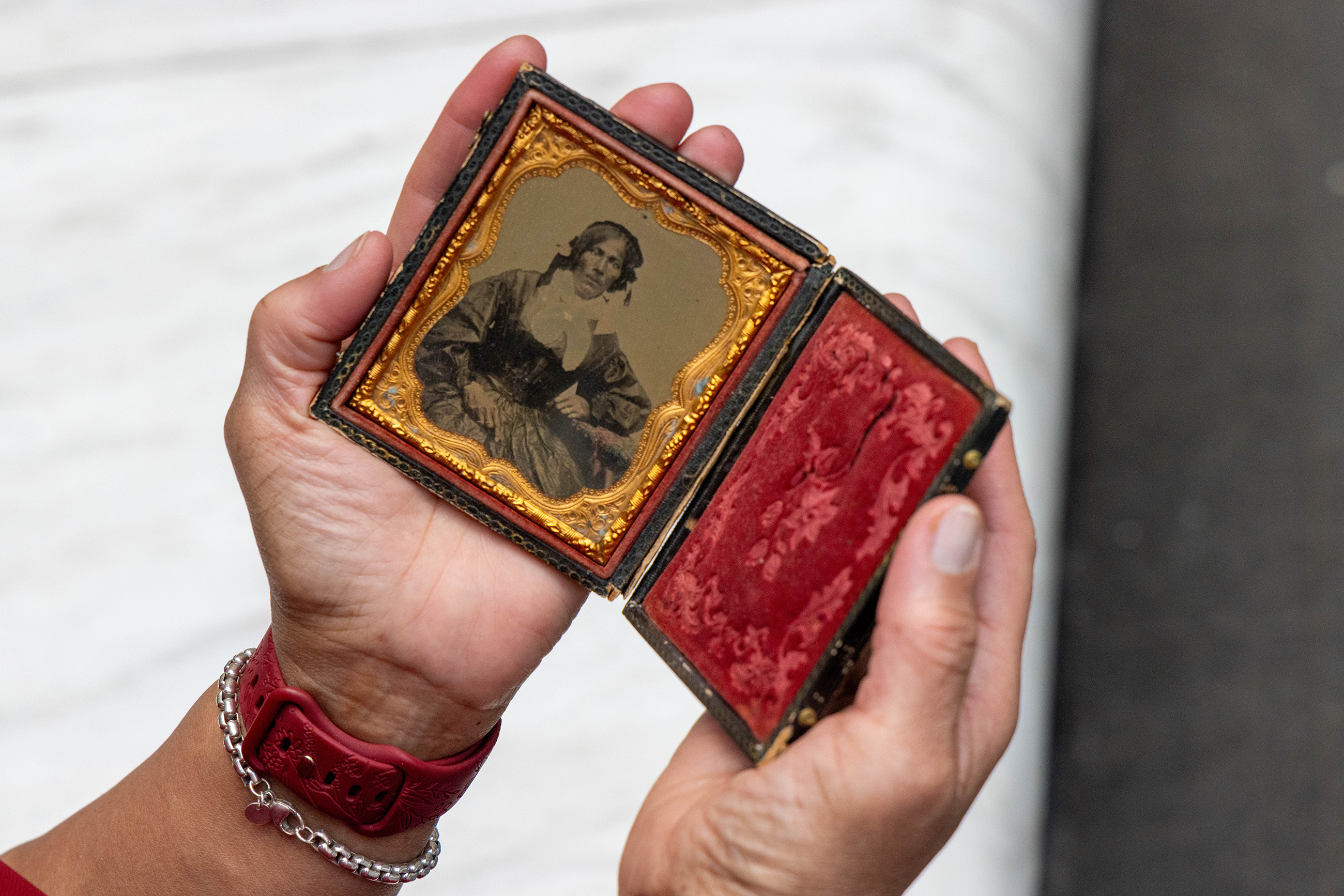
For Patrice Willoughby, the NAACP’s policy and legislative-affairs chief, a picture is worth more than a thousand words. The picture in question? A portrait of her great-great-great-grandmother Jeannette Wilkins, taken before the Emancipation Proclamation, likely around the mid-1850s. It’s a simple photograph of Jeannette in a silk dress and bonnet, her left hand resting on a table to show her wedding ring. What makes it so special is that just ten years prior, she was listed in the census as enslaved in Spartanburg County, South Carolina. By 1860, Jeannette was listed as a fugitive from the state—free but on the run. Here, Willoughby reflects on what the portrait means to her.
“I am moved by it in multiple ways because [it shows the] experience of Black Americans in this country, and Black women specifically. She would have had the wherewithal to get the money and take herself to a portrait studio. These were silver prints: You had to make an appointment, find a photographer willing to take your picture as a Black person, go to the photographer, and then sit for [several] minutes while the photograph actually cured. I find that incredibly inspiring because it reflects the resilience of Black women and Black people, which is emblematic of our experience in the United States.
“Her husband, Terrusa, was a farmer and was listed as a free Black man. In that same census, her daughter, Julia Ann, was also listed as a fugitive from the state, as well as Julia Ann’s husband, who was a minister, and their children. So [the portrait] was very clearly a family endeavor for Terrusa, who must have been a farmer of means who had land and property to support a wife and daughter, his daughter’s husband, and grandchildren.
“What it also represents is what we see today in that family has an extended context in Black American life. We have always been in the business of [lending] support to relatives and close associates as a means of economic uplift. We have a spirit of collective identity and collective strength.
“When I look at her picture and see she was enslaved in 1850 and by 1860 she wasn’t, I understand that anything she experienced was so much worse than anything I have experienced. Despite that, she achieved her place by having a portrait made to show people who she was.
“Even if society didn’t recognize it, she recognized it, and she captured it for posterity. That is something that not everybody has the ability to see right in front of them: Of course you have a place. Of course you are entitled to participate, to have a voice, to have agency. No one can take that from you.
“That’s what motivates me—understanding that we are one tiny family in the history of this country and imagining how many other people deserve to have a sense of agency, to believe in their place in this country, and to assert that right.”
This article appears in the January 2026 issue of Washingtonian.

Before becoming Research Editor, Damare Baker was an Editorial Fellow and Assistant Editor for Washingtonian. She has previously written for Voice of America and The Hill. She is a graduate of Georgetown University, where she studied international relations, Korean, and journalism.