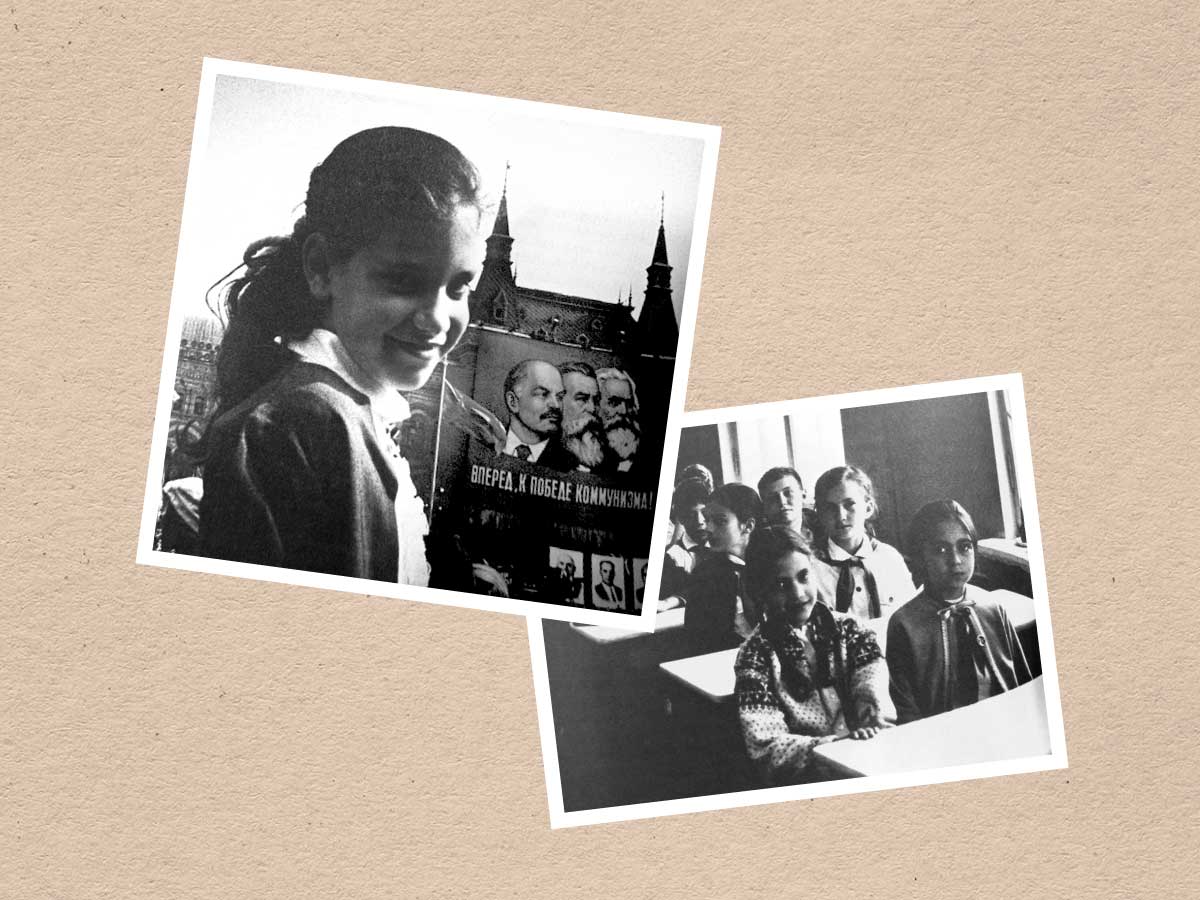
Kate Schecter grew up living in Hong Kong, Tokyo, and Moscow before age 12, but it was her time in the Soviet Union, as one of the first American children to attend Soviet schools, that had the biggest impact. The DC resident is a daughter of the late Jerrold Schecter, the Time magazine Moscow bureau chief who helped smuggle Nikita Khrushchev’s memoirs out of the USSR and later worked in the Carter administration. Over her career at nonprofits, Schecter has worked on healthcare reform in the regions where she once lived. Now president and CEO of World Neighbors, an international development organization that trains rural communities to combat poverty, she reflects here on a childhood experience that inspired her to seek solutions for social problems around the globe.
“In 1968 [when I was nine], we moved to Moscow. People lived in cramped apartments, and there was a real lack of food. It was a level of poverty I’d never been exposed to.
“I’m one of five children, and my parents decided to send all of us to Soviet schools. We learned Russian quickly. The first day of school, we go out into the hall. I’ve just been introduced as this Amerikanka—an American girl—and everybody comes up to me and wants to touch me. [It’s like] they want to feel what a capitalist feels like. We were afraid of ‘commies,’ and they were afraid of ‘capitalists.’
“But I had a couple girl-friends that were really nice to me and not as fearful. [One day] the three of us went to one of the girls’ apartment. That was one of the first times I saw five people living in two rooms. The laundry was being done in the bathroom. There was a bathtub full of wet clothing, and clothes hanging. The parents weren’t there, the grandparents weren’t there.
“We were at the kitchen table, and the girl who lived there brought down a bottle of Cognac or brandy. We all took sips. I remember thinking they trusted me, wanted me to be part of their rebellious act. But also: This is so strange that this is all they can do to break out.
“If you’re starting to drink when you’re a kid, you’re just going to keep drinking. In that country, thousands—perhaps millions—died, after the fall of the Soviet Union, from alcoholism. It stayed with me: How do you help people understand how dangerous it is? How do they manage to not become alcoholics? I did a lot of work helping former Soviet doctors and nurses—especially in Ukraine and Russia—with addiction issues among their patients. We also did education around alcohol prevention and explained that it’s a disease.
“Even as a child, I understood [communism] was a very different system and they were trying an experiment I’ve been focused on for the rest of my life: What does the government need to do for its people? There’s all these things they were trying to do that weren’t bad, but they failed miserably. That question has driven me.”
This article appears in the June 2026 issue of Washingtonian.

Dara T. Mathis is a journalist and nonfiction writer who joined Washingtonian in Fall 2025 as an Editorial Fellow. A 2024 recipient of the American Mosaic Journalism Prize, she resides in Prince George’s County, Maryland.