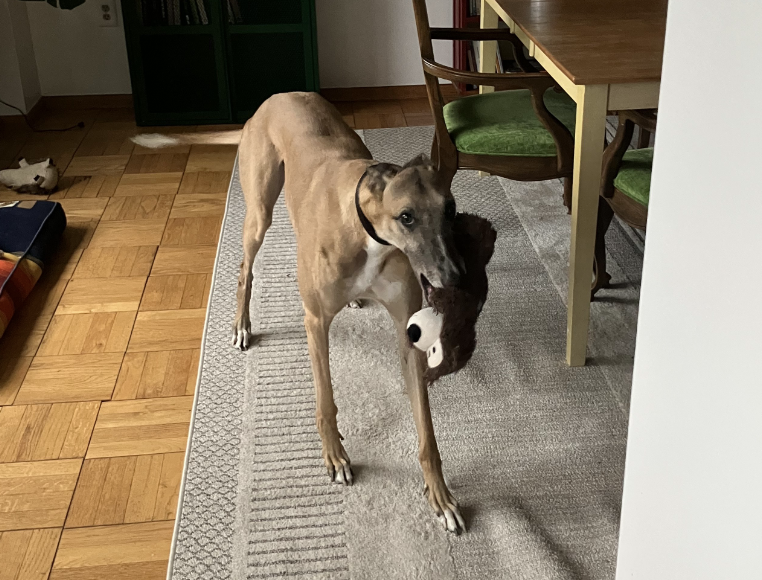
I knew that my dog might be bad two days after I brought him home, when he leapt onto my dinner table, stood atop it with all four paws, and began plucking the figs out of a homemade cake. He didn’t seem ashamed of this behavior, only disappointed once I’d chased him away. There were other issues, too: chewing the backs of my chairs, freezing on walks, shrieking each time I left him alone. Sigmund is an 80 pound dog. He’s tough to control. I thought, What on earth have I done?
To help me, I arranged for a meeting—a reckoning, I imagined—between Sigmund and Jen Golbeck. Golbeck is a professor of computer science at the University of Maryland, but she’s also the guardian of six rescued golden retrievers and the author of a new book called Think Like a Dog. The book takes the principles of positive psychology—a field that investigates what makes humans feel happy and fulfilled—and applies them to our pets. I thought this might help me manage Sigmund. But Golbeck’s ideas turned out to be better at managing me.
When Golbeck walked through my door, she immediately sat on the rug and scratched Sigmund’s ears. “We’re best friends now,” she whispered to him. As she rubbed his back, she explained to me that her book isn’t a training manual—it’s not about teaching dogs specific behaviors, but about how to enable them to live their happiest, fullest lives.
“So much dog training is just getting them to stop doing the bad things,” Golbeck explained. “And we definitely want them to stop doing the bad things,” but she prioritizes making them feel loved and giving them outlets for their energy and skills. According to her, not every problem requires discipline. A more spirited dog, for instance, might benefit from a hobby like flyball or agility. An anxious dog might need a comfort object, like a special blanket or toy. And whatever you’re doing with your dog, she said, “you want more attention on the happy parts.”
Golbeck’s philosophy is not so different from gentle parenting. For a long time, she explained, parents “believed that kids should be seen and not heard, and that they should be perfectly obedient.” But now, parenting norms have shifted to affirming children’s emotions and helping nurture their innate interests and gifts, focusing less on instilling discipline than on building family connection. With dogs, Golbeck says, “Of course we want them to be obedient, but there’s so much more that they can be. Dogs are capable of really sophisticated kinds of fulfillment. Some of that’s happy goofiness, and some of it is loyalty and having a sense of purpose. So let’s think about how to indulge that when possible.”
Admittedly, I was finding it difficult to focus on Sigmund’s good qualities while he was barking in my face, which he did for a portion of our interview. “Oh my goodness,” Golbeck said to him, sympathetically. “Do you just want to play?” She moved to the floor, tussling with his hedgehog toy as she talked. I asked if this would reward the barking. “Well,” she said, “that’s always a concern.” But sitting with him did make him stop, and the barking, she reminded me, is actually a sign of love. Did I really want to meet Sigmund’s love with anger or annoyance? Instead, she recommended a vibrating anti-bark collar that works on one of her dogs.
Golbeck and her husband “intentionally take sick and traumatized dogs,” she said, “and so we’re very gentle in our house—like, nobody gets yelled at. Everything is oriented around making them feel safe and good and cared for.” She does train them; they know basic commands and respond to their names. She makes them stop when they’re being disorderly or unsafe. But she thinks they respond better to praise than correction, “blossoming into full, happy creatures” in her home.
Still, I was fixated on Sigmund eating my cake. “I have not really been able to train that kind of thing out of my dogs,” Golbeck admitted. “We say they’re just this side of feral. They’ve got some basics, and that’s usually enough.” I asked about separation anxiety and she said that “we in our house believe in better living through chemistry,” so some of her dogs take Prozac. But she’s also done fairly time-intensive training to help them feel less nervous when she leaves.
Finally, I explained my frustration with my least favorite of Sigmund’s behaviors, which is that on walks, he will frequently plant his feet and refuse to move except in his preferred direction. “One of the positive psychology answers would be to let him just walk wherever he wants, within limits,” she told me. She herself has a dog like that—an enormous golden named Guacamole—and she’ll often either let him pick his own route, or sit on the sidewalk and pet him until he’s willing to move. “Sometimes I have to tug the dog until he comes,” she clarified. “This isn’t ‘never do anything that makes your dog sad.’ But you want them to be happy about going with you.”
Golbeck doesn’t think that everyone realizes how deeply our dogs love us. “When they see us, they get the same hormonal responses and brain activity that people get when they see their parents or their babies,” she said. “So they just want you to love them.” She encouraged me to lean into that love, to pay attention to what makes Sigmund happy and “maybe respect that in him. Like, try not to quash it.” When he insists on walking a particular way, for instance, perhaps it’s not a pointed act of defiance meant specifically to torment me, but an earnest expression of his curiosity that it would be a kindness to let him explore? This seemed like something to consider.
In the days following our interview, I tried positive psychology with Sigmund. I let him go wherever he wanted on walks, unless he froze in the middle of the street. For the most part, I realized, he just wanted to investigate the nearby community garden, to smell the smells and eat an occasional fallen squash. It was not a big deal to let him have his way. When Golbeck left my house, she knelt down to say goodbye. “Well, you are a joy, and I love you, and I hope you stop barking,” she told Sigmund. I noticed that she did not mention that he’d just chewed the foot off of his toy duck, and I’ve been trying to follow her example.
Jen Golbeck will appear at Politics and Prose at 6 PM on September 4.