I was 37. In 1997, at least, that was considered by most to be too young for plastic surgery.
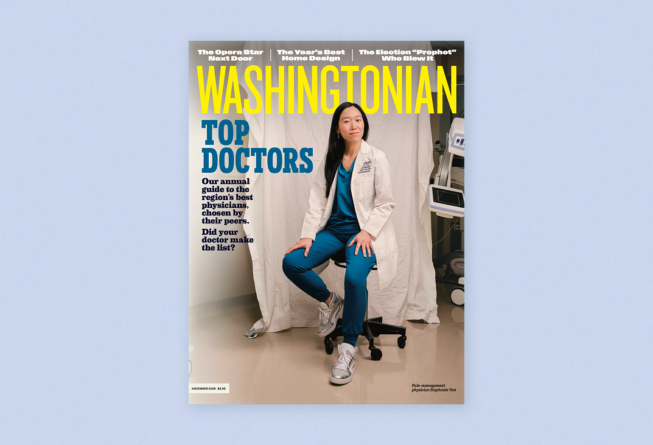
That’s what the editors at Washingtonian and I thought. So they sent me out to visit five local plastic surgeons as a potential client with two complaints about my face: crow’s feet and the lines around my mouth known as nasolabial folds. None of the doctors knew I worked for Washingtonian.
“Does She Need a Facelift?” asked the headline.
Talal Munasifi was the only physician in the article who liked it. Even though he suggested I get the “fat pads” I didn’t know I had in my eyelids removed through surgery, I wrote it was a “soft sell.” (Only one doctor didn’t suggest anything; others recommended creams, injections, laser treatments, and a series of implants to round out my oval face.) Munasifi even sent a funny card complimenting the article, but noting that he had told me I’d come back in two years to have him correct my “turkey neck.” I had mistakenly written “chicken neck,” forgetting that chickens don’t have the biggest wattles. (He was wrong, too: I waited 20 years.)
By the time he died in February, the conservative, Baghdad-born Munasifi had been a mentor to generations of surgeons and a staunch advocate for patients.
His patient safety advocacy extended to me and millions of readers of USA Today, where I was a reporter. It started in my early 40s when I began going to Munasifi for cosmetic injections. (All that solicited advice in ‘97 had cut rather deep.) He showed me photos of botched surgeries others had performed that he fixed, and started telling me what he said was really going on in healthcare.
As doctors’ insurance reimbursements were shrinking, everyone from OB/GYNs to oral surgeons was offering nips, tucks, and enhancements to everything from tummies to tushes. Many of them were already performing medically necessary surgeries, so what was the harm of adding a cosmetic one to boost their bills? The number of hours that the patient was under anesthesia, for one thing, Munasifi explained. Who was policing that? I asked. Not necessarily the hospitals or surgery centers whose bottom lines benefit, he told me.
When Virginia was considering legislation to require abortion clinics to meet the same safety standards as hospitals, he pointed out that other doctors—regardless of their specialties or board certifications—could legally perform surgery in their unaccredited offices in Virginia and most other states. He supported Republican Governor Robert McDonnell, who signed the law, but couldn’t abide that far riskier surgeries weren’t held to such high standards.
My Munasifi-inspired patient safety reporting began with a two-part 2011 project on risky cosmetic surgery procedures, which included an investigation of the company Lifestyle Lift, which was soon required by Florida to change its ads and went out of business in 2015. Many of the lapses in regulation and oversight allowed doctors with little training to perform cosmetic procedures in unsafe facilities and on unsuspecting patients.
Worse, to Munasifi: doctors’ dirty deeds often went unpunished. He was incensed that physicians were often permitted to continue practicing medicine despite substance abuse or high rates of surgical complications. He was especially unsympathetic to doctors’ and their lawyers’ lament during investigations that they might be out of work after years of medical school and loans.
“I don’t care if they have to sell cookies,” he told me.
By the time I got the Washingtonian assignment, I was no stranger to the idea of plastic surgery. My late mother had a great facelift in her 50s after remarrying. She loved it when I appeared as a guest on national TV shows and would say my hair or jacket looked “great.” In Mom’s immutable style, she noted more than once that, “You really need to do something about those lines around your mouth.”
So with that non-too-subtle encouragement, Munasifi, who for years was on Washingtonian’s Top Doctors list, became my go-to for the personal, too. I regularly recommended him to friends considering plastic surgery; he gave one friend a breast reduction and another an eyelift. Both liked him as much as their results. Whenever a new skin treatment, especially lasers, would start getting promoted, I’d ask what he thought of it. He discouraged me and others from treatments or surgery as often as he recommended it.
When videos started being used with every article at USA Today in the 2010s and the 20-something reporters were becoming on-camera reporters, 50-something me decided it was time for Munasifi to do something about my turkey neck—and those lines. I couldn’t imagine trusting anyone else. I got a facelift in my late 50s and a breast reduction soon after.
When the pandemic hit, I’d been doing reporting with Munasifi’s behind-the-scenes help on physicians facing sexual assault allegations in several states. I never finished the project due to Covid coverage and a 2021 buyout. My earlier investigation of a then-Cleveland Clinic colorectal surgeon accused of sexually assaulting two patients led to the physician’s departure, although he didn’t lose his medical license.
Such cases irked him so much that Munasifi, who hunted and played poker with the late conservative Supreme Court Justice Antonin Scalia, had a post-retirement dream job that was decidedly left-leaning. He once told me he’d love to be a healthcare investigator for Public Citizen, which Ralph Nader founded.
Alas, he never got a chance to retire.
Munasifi already needed two knee replacements and had failing kidneys when he had a bad fall in March 2025 that fractured his hip, requiring surgery. He had to take a leave from his plastic surgery practice in Arlington.
He didn’t let on how ill he was when I asked that April if one of the high school journalism students I was working with could interview him for a story, just as Youthcast Media Group students did in 2019.
In August, I texted him about a Brazilian house cleaner I know who had travelled to Florida to get a tummy tuck from a low-cost clinic she found on Facebook. It was just the kind of case we discussed 15 years earlier, prompting that first investigation. The surgery was botched, the site became infected, and she had to pay for another surgery to repair all the damage.
He spent 20 minutes on Zoom with the woman, asked for photos and offered to reach out to Governor Ron DeSantis about the doctor who performed the surgery.
Two weeks later, he started dialysis. He’d never mentioned kidney problems—or that he was also getting treated for lymphoma.
In October, he texted that he wished to talk. He wanted to write an op-ed about what should be done about impaired doctors and other healthcare hazards. In November, I texted that Leah Binder, CEO of the hospital rating organization Leapfrog Group, was willing to join me for a working visit to his house to discuss the state of patient safety. He said he had travelled to the Mayo Clinic in Rochester, Minnesota, three weeks earlier to have one of his knees replaced because he thought he would get the best care there.
Binder, who headed health policy for Rudolph Giuliani when he was the Republican mayor of New York City, describes herself as a moderate and “staunch advocate for never making patient safety a partisan issue.”
Knowing about Binder’s organization, Munasifi told me, “She must be a democratic thinker—or fair like me.”
In January, when he wasn’t responding to my texts, I dropped by his house. Medical technician Sandra Soares answered the door and ushered me into his bedroom, where another technician was giving him dialysis. He was yellow with anemia.
I texted him again on February 5. Soares replied for him. He had gone back to the Mayo Clinic—by private jet, too weak to travel any other way—because he had consulted with a nephrologist while getting dialysis there in November. He thought the health system was best equipped to treat all of his health conditions.
“He told everyone he was not leaving until he was completely okay,” says Soares. “Unfortunately, he decided too late.”
Former Washingtonian contributing editor Jayne O’Donnell was a USA Today reporter from 1993 to 2021. She is the founder of Youthcast Media Group, which trains high school students from under-resourced communities to do multimedia journalism about health and safety.