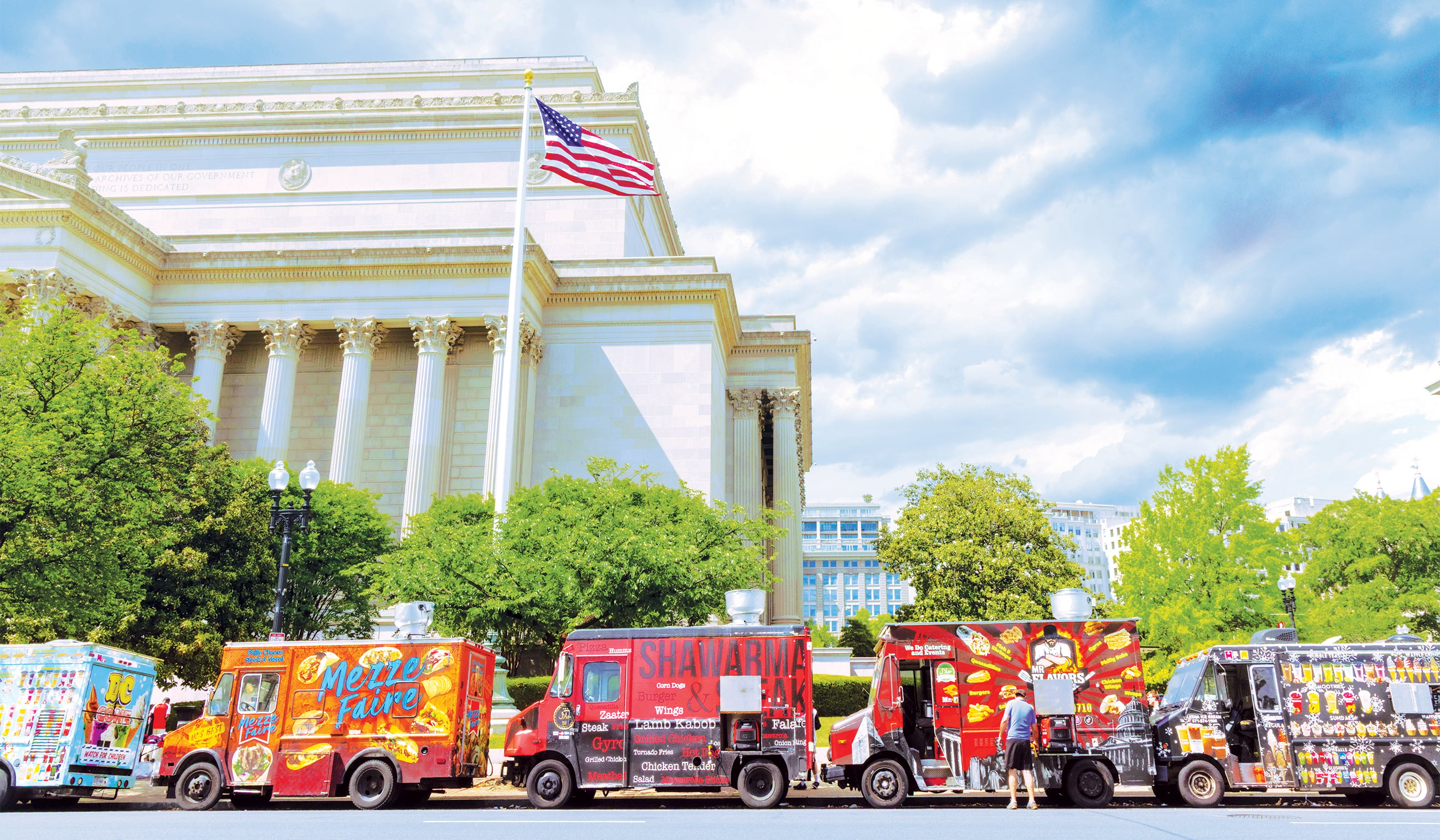
he pirates have commandeered Constitution Avenue. Hawking neon snow cones and chicken shawarma, their food trucks are squished so close together that, in some cases, the bumpers are literally touching. A few are blocking fire hydrants in front of the National Museum of American History. One of the first trucks we approach has no prices listed. Actually, none of them do. But this one looks particularly suspect, with a janky, rusted pipe jutting from its roof.
“I think they’re Mad Max-ing it. That’s exhaust from the generator,” says Zack Graybill, owner of the pizza purveyor DC Slices, one of the city’s longest-running food trucks. “We can start with the fact that this is not legal vending.”
It’s a sunny Saturday during peak bloom in March, and crowds are converging on the National Mall for cherry blossoms, a kite festival, and a “No Kings” protest. I’ve asked Graybill—who’s been legally vending in DC since 2010 and previously led the DMV Food Truck Association—to help me spot the rogue, unlicensed vendors.
“For all the people eating food right here? The food isn’t being refrigerated. That’s fucked up. That’s gross.”
But it turns out you don’t need much expertise to play Where’s Waldo with all things illegal, dangerous, or just plain shady. We spot a gallon container of Mazola corn oil tossed on the sidewalk, leaking over the curb. One truck’s bumper is partially fastened together with packing tape. Another’s license plate is bent at an angle so it can’t be fully read from behind. Several propane tanks aren’t properly secured. And then there’s the intellectual-property nightmare of their designs, a baffling mishmash of cartoon characters seemingly chosen to lure children and their exhausted parents. One ice-cream/boba truck features Snoopy, Minions, and SpongeBob SquarePants. The driver is smoking a cigarette.
Graybill spots a truck operator spilling some gasoline on the street as he tries to fill up a generator perched on the side of his truck. “If this was a hot summer day and he was doing that, the chances of a fire actually happening is high,” Graybill says. “The number-one potential cause of food trucks catching fire is from refilling the generator with gasoline.” In fact, operators aren’t even supposed to have gasoline canisters on their trucks while vending.
In front of another vendor, Graybill stops and listens: “If my ears serve me correctly, he doesn’t have a generator on that truck running.” He walks around the other side of the vehicle to check. Sure enough, the generator is off, which means there’s no ventilation inside the truck. “All the heat fumes are just building up inside,” Graybill says. “For the workers, that’s miserable and shitty. And that’s not healthy. Dangerous. And for all the people eating food right here? The food isn’t being refrigerated. That’s fucked up. That’s gross.”
The longer we sit and watch, the more we fixate on a man dressed in all black with a leather jacket. He seems to be a point person for several of the trucks, so we label him the Lieutenant. He has a gray Toyota Highlander, which he occasionally moves up and down Constitution Avenue, blocking an entire lane of traffic over the course of an hour.
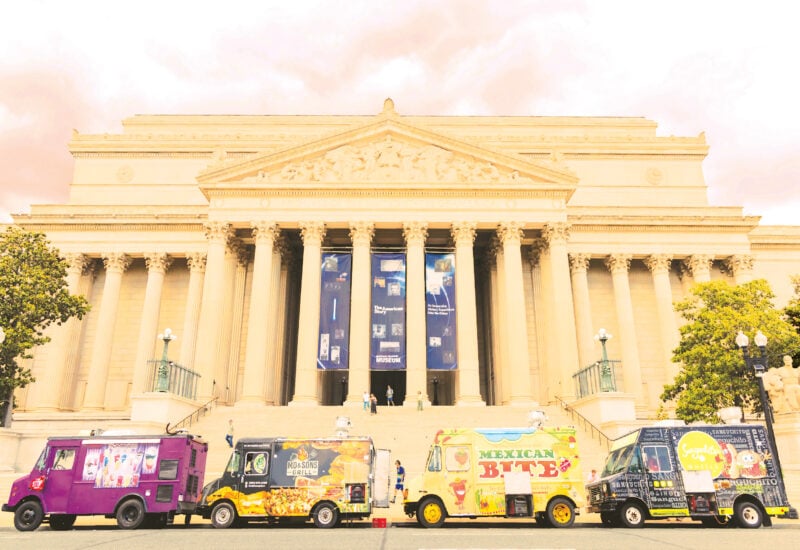

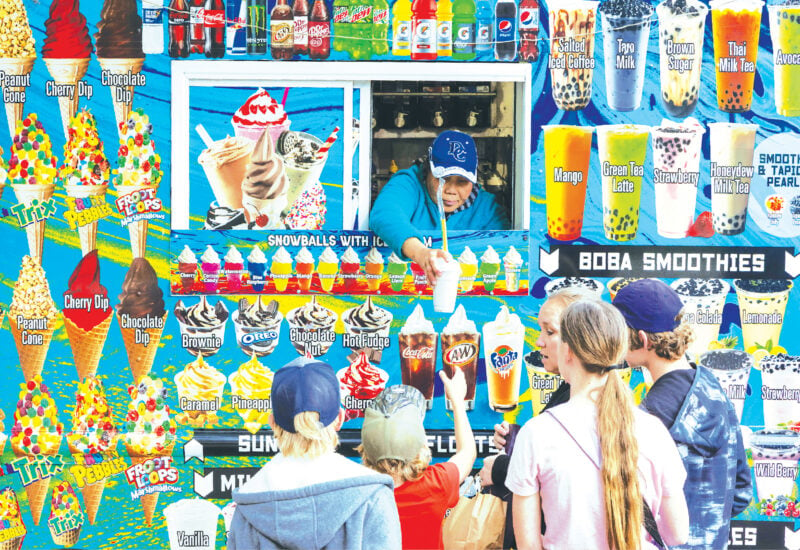
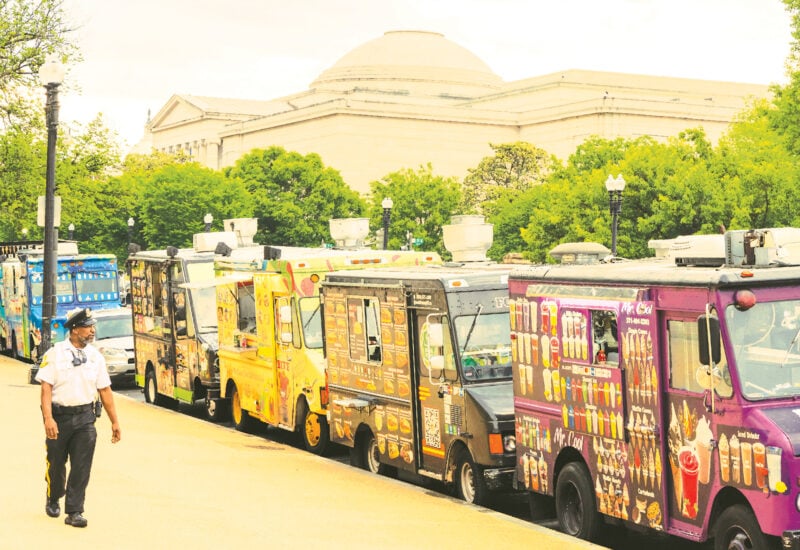

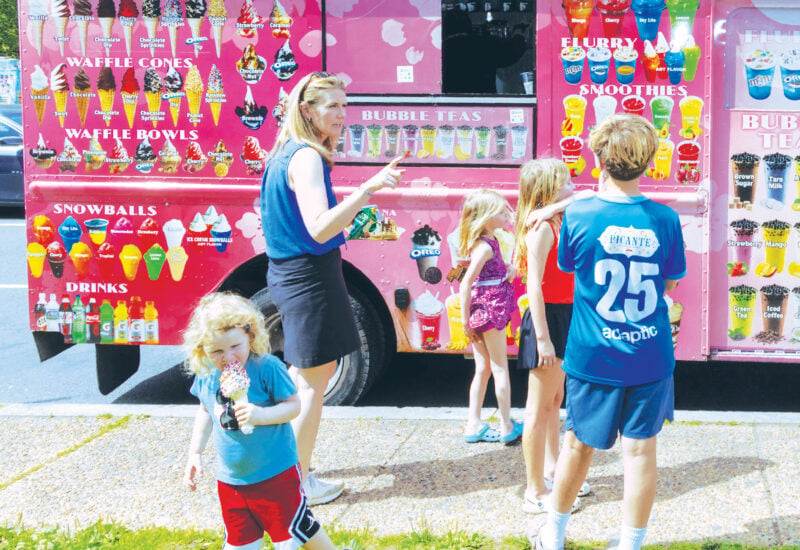
I overhear one guy tell the Lieutenant he’s out of bread. Two others approach him, chat briefly, then run down the block. One of them jaywalks across four lanes of traffic, opens the trunk of a parked car, grabs an empty bin, and ferries it over to one of the many shawarma trucks. Later, an ice-cream-truck operator says something animatedly to the Lieutenant. When we follow him back to his truck—parked in front of a fire hydrant—he’s tinkering with his soft-serve machine. I ask about the ice cream. He tells me the machine is broken. It seems the Lieutenant is the helmsman for this pirate-truck flotilla. It’s becoming clearer: This is not just a hodgepodge of misfit vehicles. It’s a coordinated network.
And it’s all anchored right here on the Mall—home to “I have a dream,” larger-than-life monuments, and more than 30 million visitors each year. Its museums safeguard our country’s greatest treasures and memorialize its greatest tragedies. Its grassy expanses have hosted protests, festivals, and inaugurations. It will be center stage for America’s 250th-birthday celebration, and it’s become a particular obsession of Donald Trump’s in his quest to make over the capital. It’s America’s Front Lawn, a symbol of our very democracy. And it’s also where, US Park Police say, organized crime is operating in plain sight.

“They’ll Bust Your Tires”
On a slow, hot day last summer, I meet a guy who identifies himself only as “Jackie.” He’s an immigrant from Tunisia, and it’s his second season working an ice-cream/boba truck near the Mall, where he makes an average of $100 to $120 a day.
Jackie is parked in a shady spot just off Constitution Avenue, a bit away from the crowd of other trucks. He tells me the main drag is full of US Park Police and Homeland Security. ”Here no one bothers me, you know?” The trade-off? “Over there, you’re gonna make more money.”
Jackie has reason to steer clear of his competitors. A few months prior, he says, another driver pulled in front of him and told him he wanted his parking spot, which he typically snags by 6 am. The two got into an argument that began turning physical. The other driver went back to his truck and grabbed a screwdriver. “He came [and] stab me in my eyes,” Jackie says. “He was trying to make me blind. He do it on purpose.” Jackie pulls up a hospital selfie on his phone. The screwdriver missed his right eye, but blood is streaming down the side of his face.
“They look out for each other. They’re a clique. They don’t like outsiders. They’re really don’t. They’re cutthroat. They’re ruthless.”
“He do it because he thought I’m coming from the border, but I’m not,” Jackie says. “He thought I’m not gonna go call the cops on him.”
Jackie says he did call the cops. They didn’t catch his assailant that time, but two weeks later, Jackie spotted him again and told an officer. He shows me another photo, of a man being led away in handcuffs: “They just detained them over there and later they let him go.”
Jackie still sees the guy operating his food truck around the Mall. “Every day,” he says. “And every time he saw me, he do a sign like that.” Jackie uses his hand to cover his right eye, the one that was nearly blinded.
“He keeps saying, ‘I was trying to make you one eye.’ ”
Other truck owners have their own tales about sketchy characters. Fly Pizza owner Brisa Valentin usually stations one of her trucks across from NASA headquarters near L’Enfant Plaza. But when office business slowed during the pandemic, she decided to try vending along the Mall. Unlicensed operators quickly made her feel unwelcome. When she tried to return the next day, they had blocked off her spot with their trucks.
“I used to tell my husband, ‘Those are the food-truck Mafia.’ They look out for each other. They’re a clique,” she says. “They don’t like outsiders, they really don’t. They’re cutthroat. They’re ruthless.”
Valentin says that when she tried to complain to DC officials, they also seemed afraid of the pirate vendors, telling her “a lot of them have machetes, knives—who knows what they have in their trucks?”
The Department of Licensing and Consumer Protection (DLCP), one of the main agencies regulating food trucks, says it hasn’t received reports of investigators observing weapons on trucks, but in 2021 a food-truck operator was arrested after pulling out a Glock and putting a bullet in the chamber during a dispute with another vendor over a parking spot. “There is a general belief that some vendors may carry weapons due to the amount of cash handled daily,” a spokesperson for the department says.
Nowadays, Valentin tries to steer clear. “They’ll come out there very aggressive, with their chests pushed out,” she says. “They’ll get in your face. The best thing that anyone can do is just get in your truck and go.” Though Valentin hasn’t witnessed it first-hand, she says she’s heard of other trucks being vandalized or having their generators stolen: “They’ll bust your tires or do something, break your windshield.”
None of this seems to surprise Park Police. “When we get a report of an assault at the National Mall, it’s more often than not vendor-related,” an agency spokesperson says via email. The agency has gotten reports of trucks hitting each other or hitting other operators who are standing in parking spaces to save them. While officers haven’t been directly threatened, vendors have made derogatory comments to them and tried to intimidate the police by congregating around them.
“The business is so lucrative that these operators are generally careful not to go too far, though; they don’t want attention or serious charges against them,” the spokesperson says. On rare occasions, Park Police has shared findings from its vending operations with the IRS, FBI, and Department of Homeland Security.
The vast majority of these problematic trucks come from Virginia. And that’s not the only thing they have in common. “All, if not 95 percent, of the food trucks can be traced back to three or four people,” says Christopher Johnson, who until recently was an investigator with DLCP. “They own multiple trucks—ten, 15 trucks. Some trucks are licensed that they own, and some are unlicensed.When you run the tags and we give out citations, you see a lot of the same addresses, a lot of the same people.”
I ask DLCP director Tiffany Crowe if these food-truck operations qualify as organized crime. “I won’t speak to whether or not we officially designate it as organized crime, but I would say there’s certainly information-sharing and a network within the food-truck community about how to evade licensure and the law,” she says. “They know the law as well as we do in many cases.”
According to Park Police, many of the individuals who own multiple food trucks operate them under several shell companies. The agency is also a little more explicit about what it’s dealing with: “What we can tell you is that the majority of the illegal operations in the city are organized crime,” says a spokesperson. “The majority out there illegally are not individual food-truck operators trying to make an honest living who just legitimately didn’t know or understand the requirements and/or got tired of waiting on some part of the process. We’re talking about repeat offenders who ensure that if we remove one truck off the street, that another stands ready to continue collecting money from an unsuspecting public.”
Moldy Milk—and Explosions
One afternoon in early May, I order a chocolate ice-cream cone from a shiny blue truck emblazoned with Bluey and Dragon Ball Z characters, parked directly in front of a sidewalk on 14th Street at Constitution. I receive a small, slightly lopsided swirl with a paper cone wrap that reads “Joy.” I purposely do not ask the price.
It costs me $16.50.
I order a chocolate ice cream. I receive a small, slightly lopsided swirl with a paper cone wrap that reads “Joy.” I purposely do not ask the price. It costs me $16.50.
I linger to eavesdrop on the crowd of customers who follow me. One guy wisely asks for the price of his ice cream before ordering. It’s $10. Hopefully, that’s what he actually paid: There have been reports of trucks scamming customers by overcharging their credit cards.
Of the $16.50 I was charged, my Square receipt shows $1.50 in DC sales tax. The DC Office of Tax and Revenue later tells me it has no record of Fusion Swirl LLC, the company named on my receipt. That’s another big problem with the pirate trucks: They’re typically not paying taxes, never mind any licensing fees.
I also look up the Virginia license plate of the shiny blue truck for traffic violations. Since last October, it has racked up 27 tickets totaling $2,842, mostly for illegal parking and not displaying a front license plate.
The receipt also has a phone number. A few days later, I call. The person on the other end tells me he’s the owner and has multiple food trucks. I explain I’m a journalist and ask his name.
“Uh, yeah, my name is . . . .” The call ends. Subsequent calls go straight to voicemail.
In 2025, DLCP issued 137 sidewalk and street-vending-related citations across DC—nearly double the number from the previous year. Meanwhile, Park Police issued 680 vending-related violations in 2025, up from 480 in 2024. Often, though, rogue operators avoid getting caught. “A lot of them will just pull off and leave before we can even talk to them,” says Bruce Flippens, an inspector with the DC Department of Health.
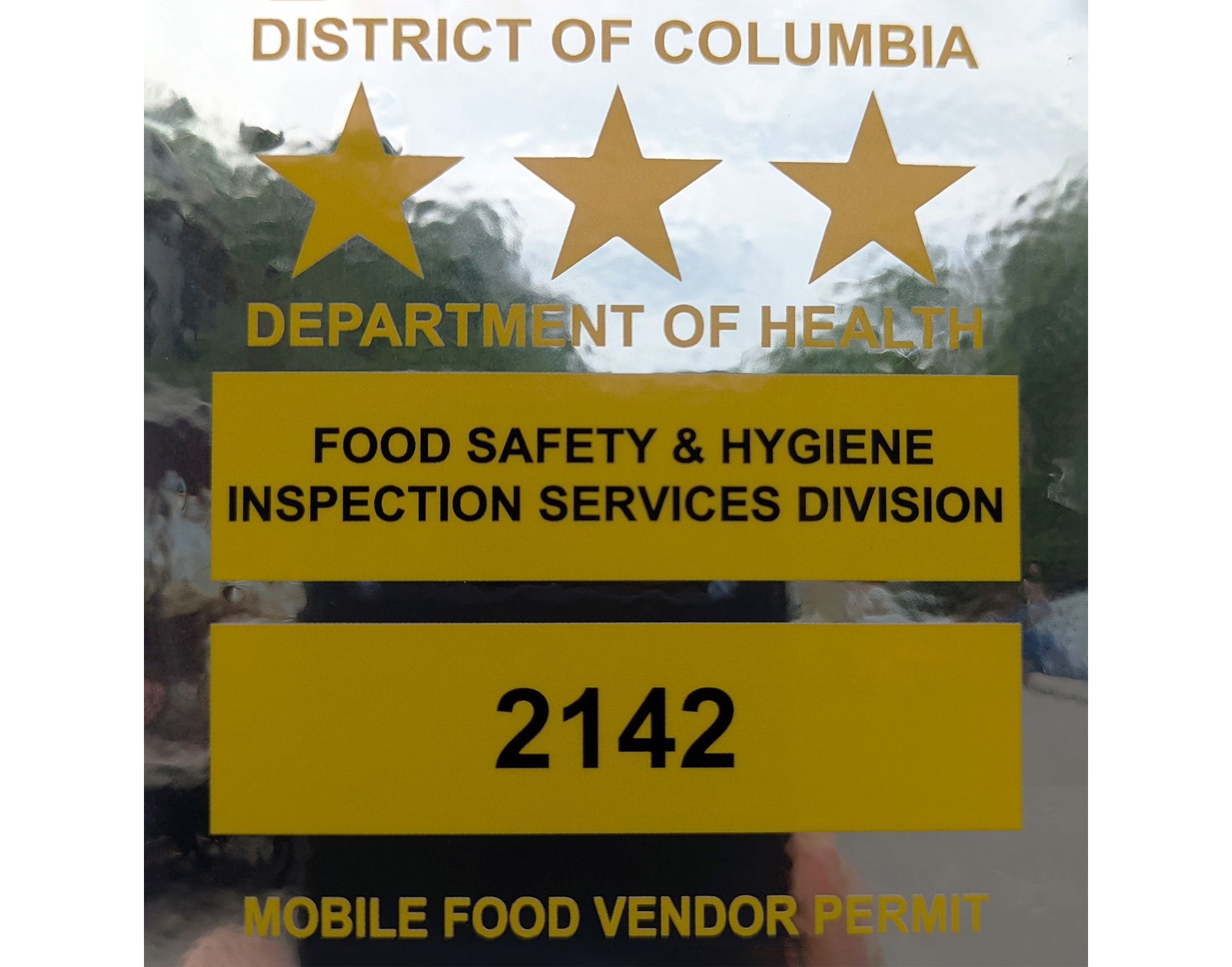
Food trucks are supposed to be inspected by the health department every six months, and licensed vehicles must display stickers provided by DOH and DLCP. Flippens says the health department will do quarterly sweeps in which three or four inspectors approach a block of trucks. The most common violations involve water—it’s not hot enough or the truck ran out altogether.
Licensing investigators have seen worse: An ice-cream truck with moldy milk and garbage covering the dashboard. Food stored overnight in so-called junk cars,which are used to reserve parking spaces. Some food-truck operators used to leave their vehicles parked on Constitution Avenue overnight. Rats moved in. Graybill has heard of fryer oil being dumped on the street. I personally watched a guy sweep a pile of Froot Loops, an ice-cream topping, onto the curb. The photographer of this story spotted a vendor wearing only socks. And perhaps you saw the viral Reddit photos from 2023, showing an ice-cream purveyor filling jugs of water from a public fountain, purportedly to wash the truck’s floor.
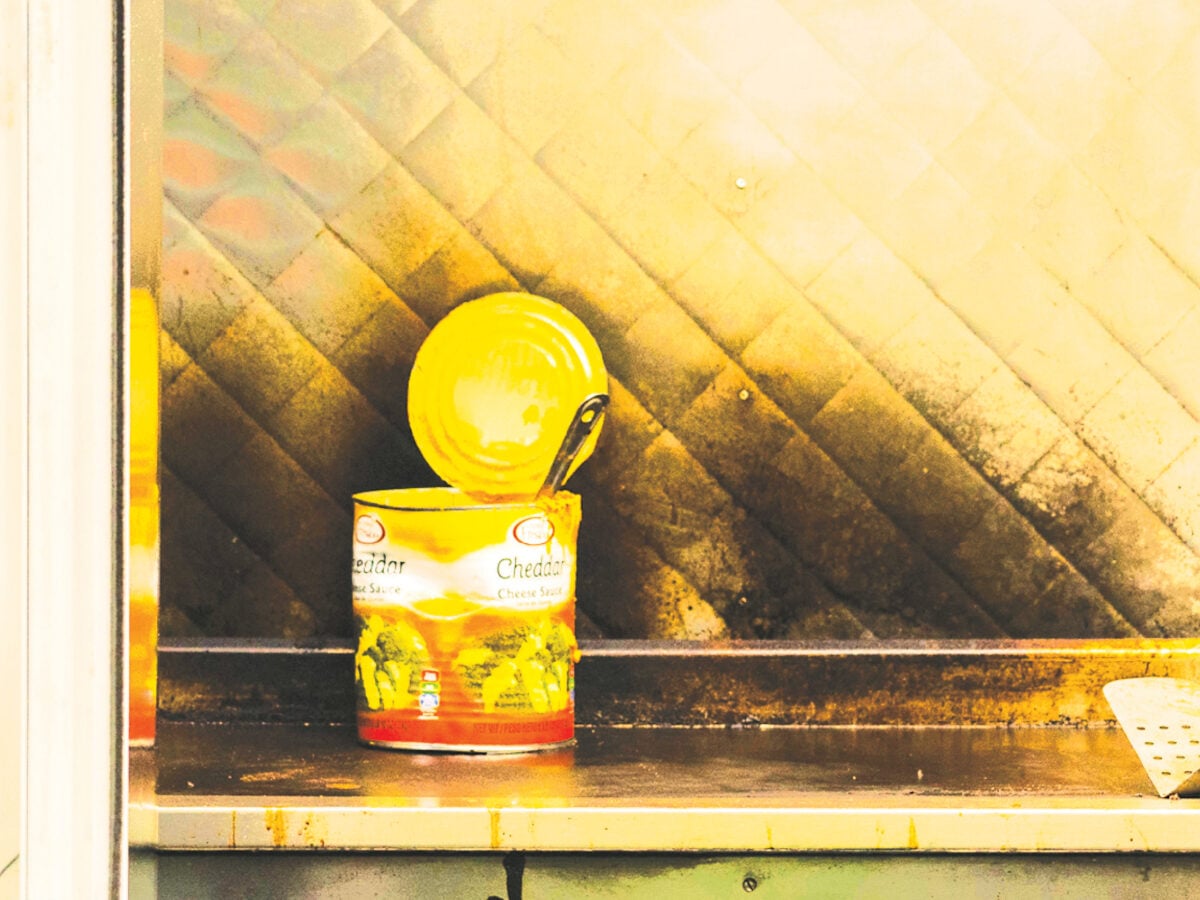
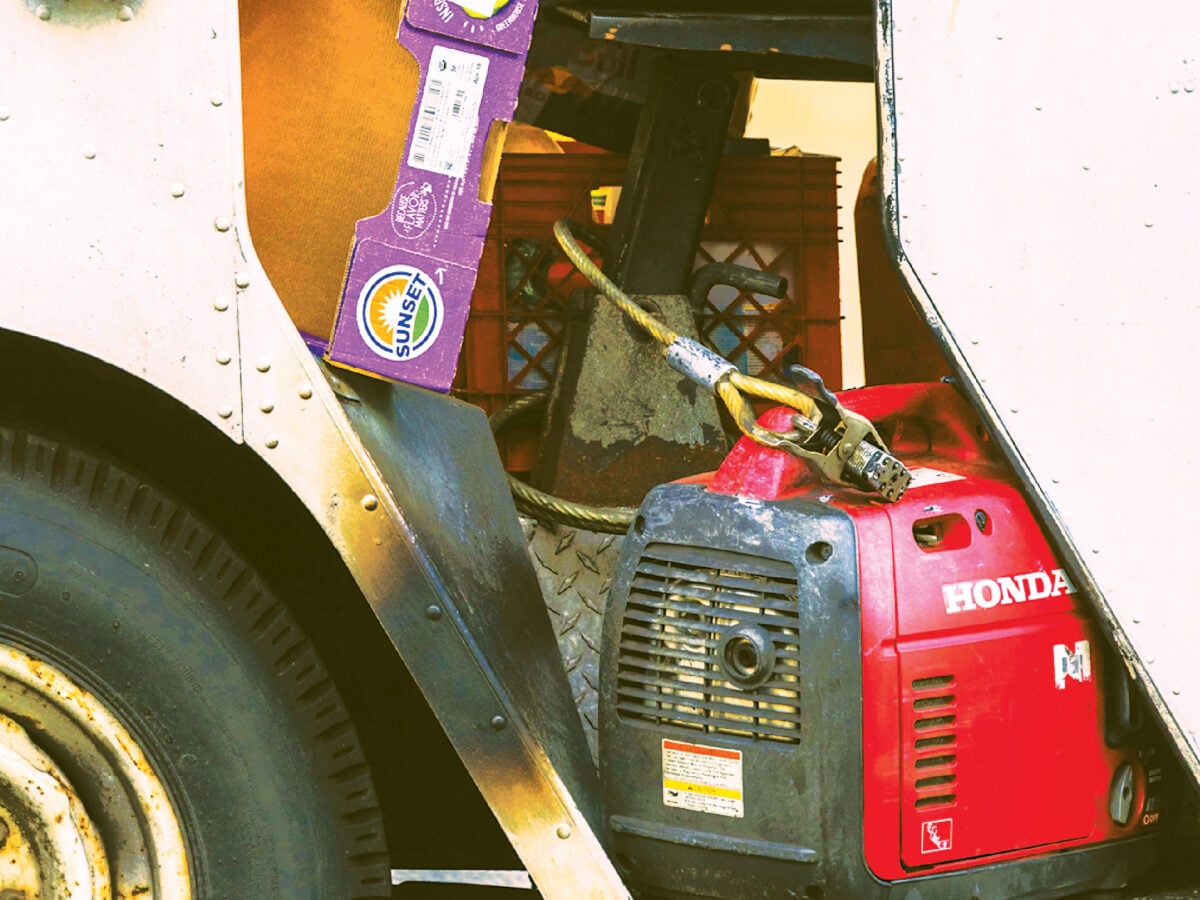
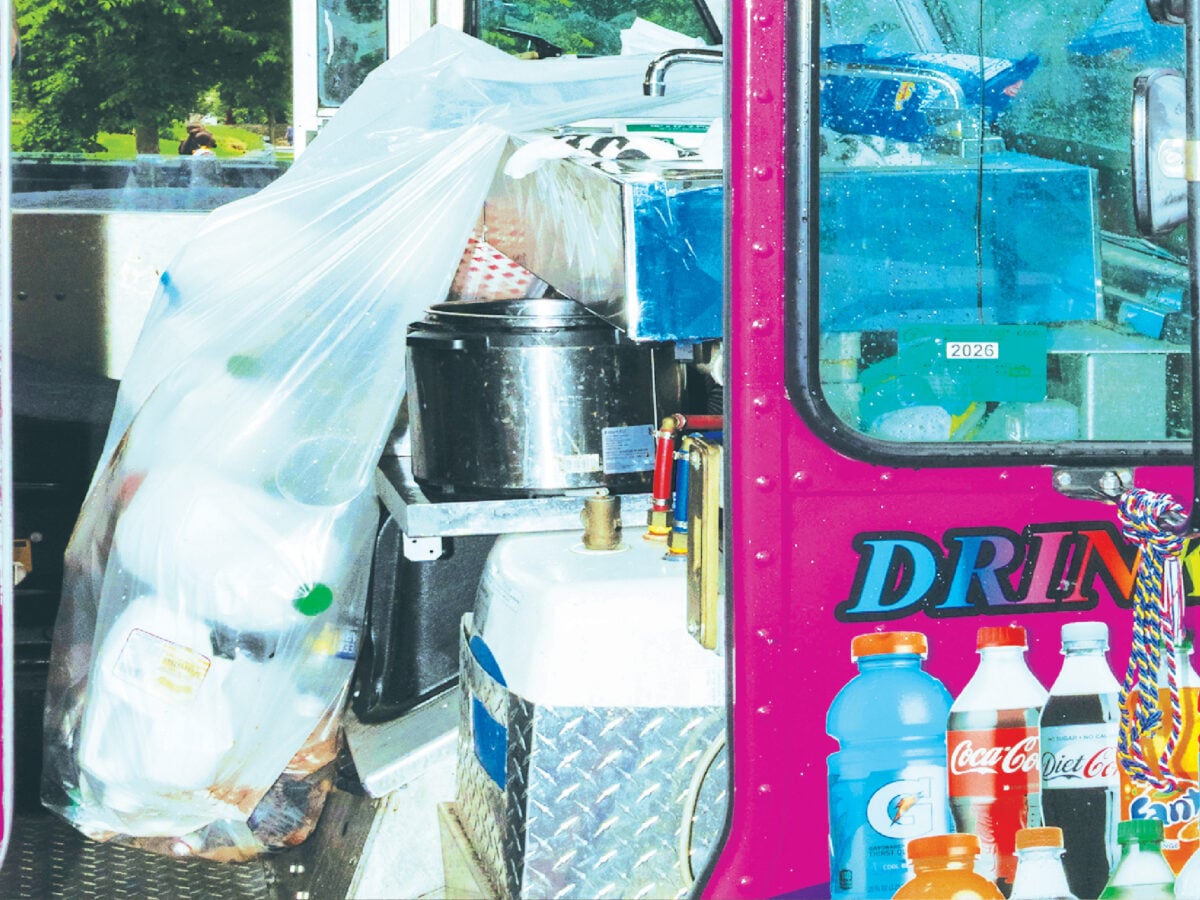
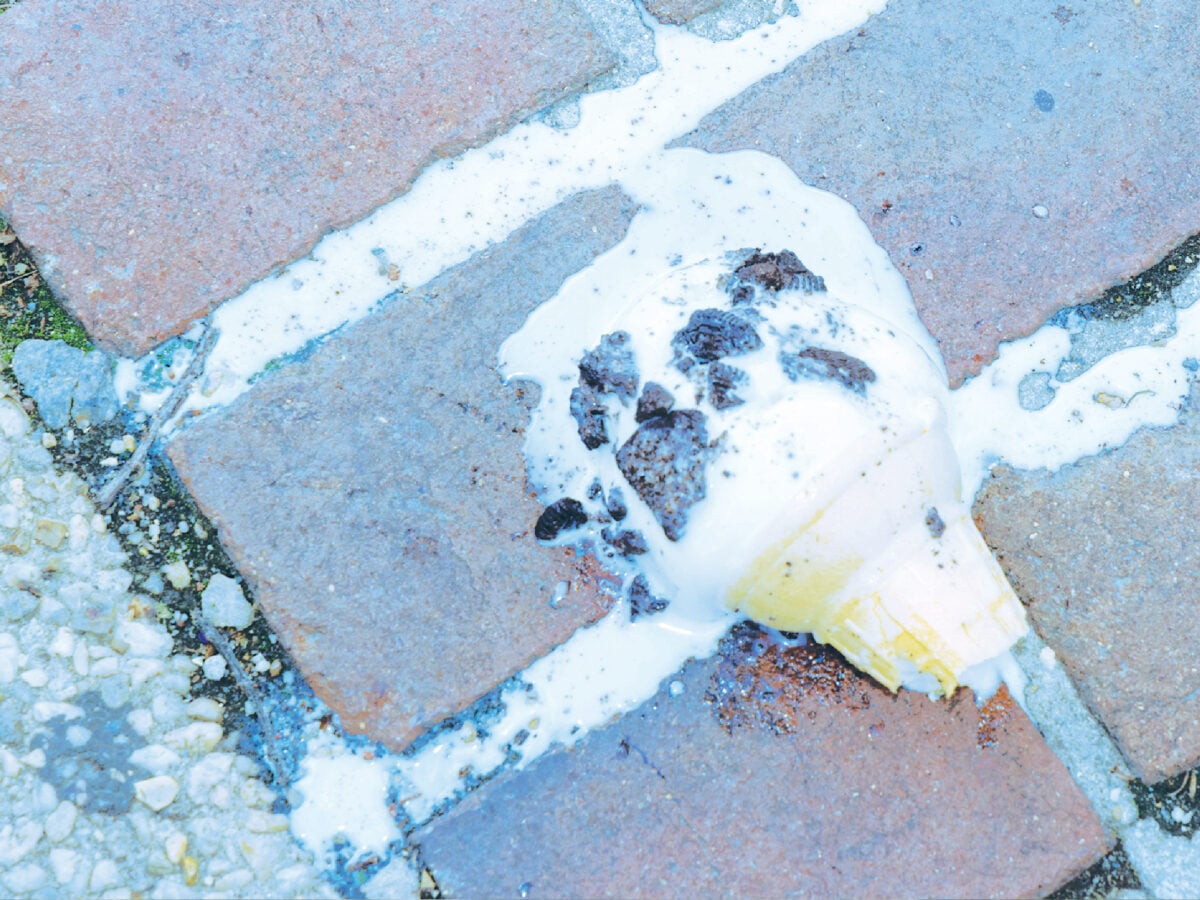
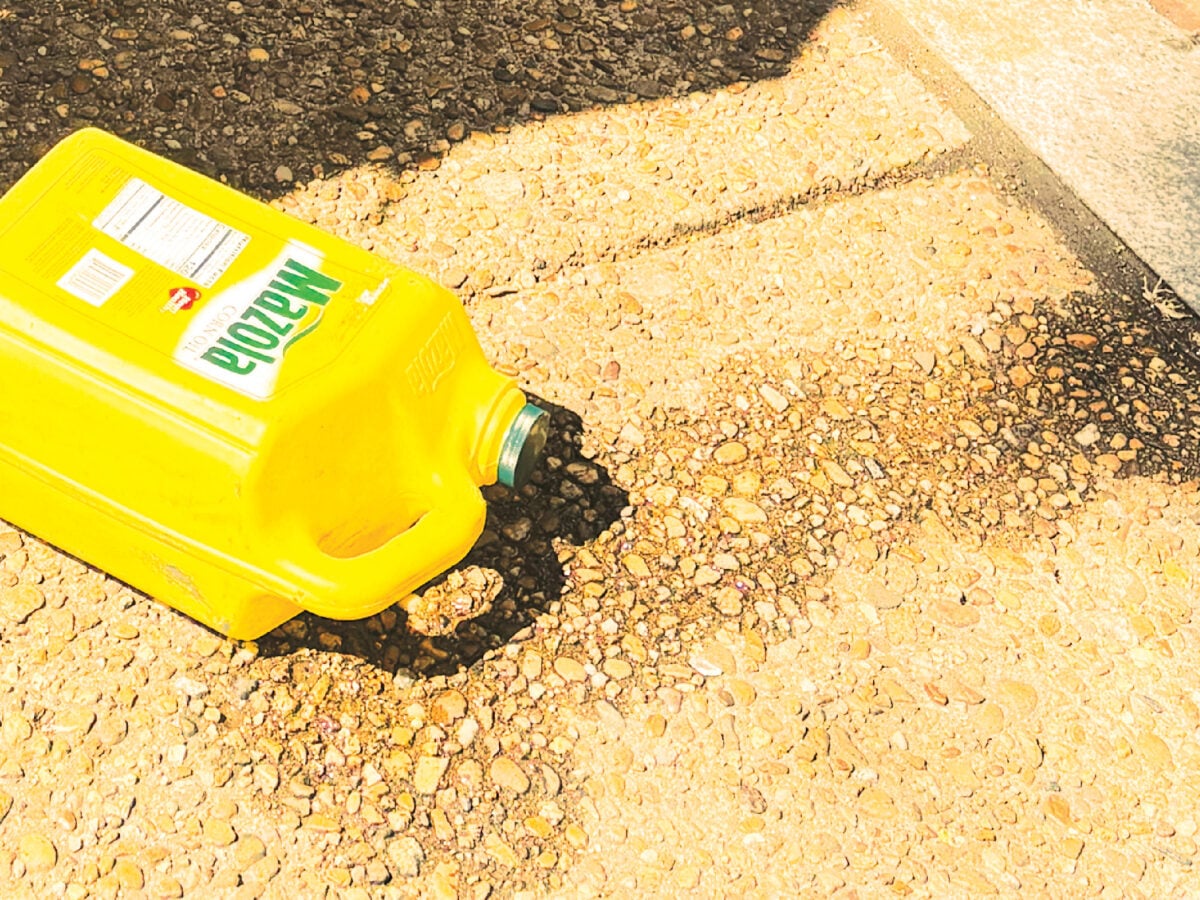
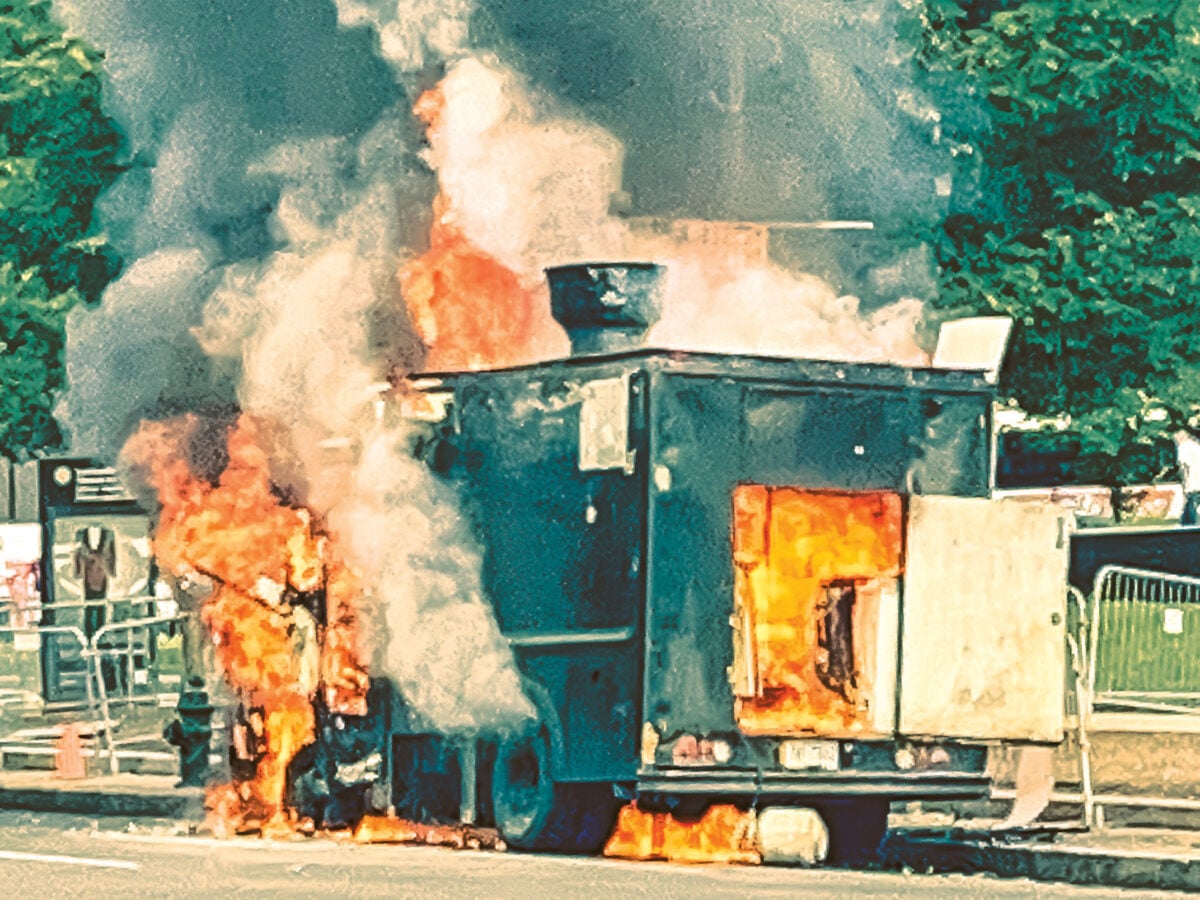
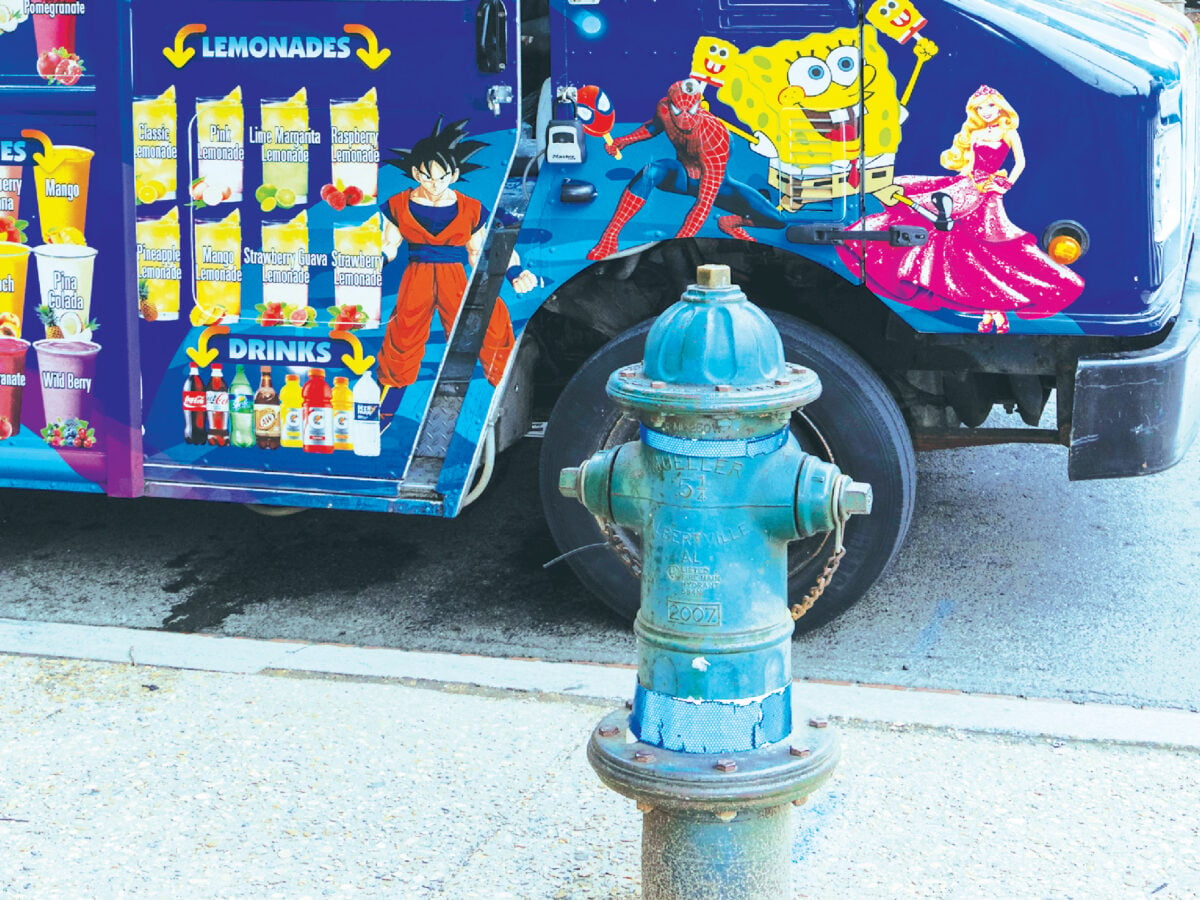
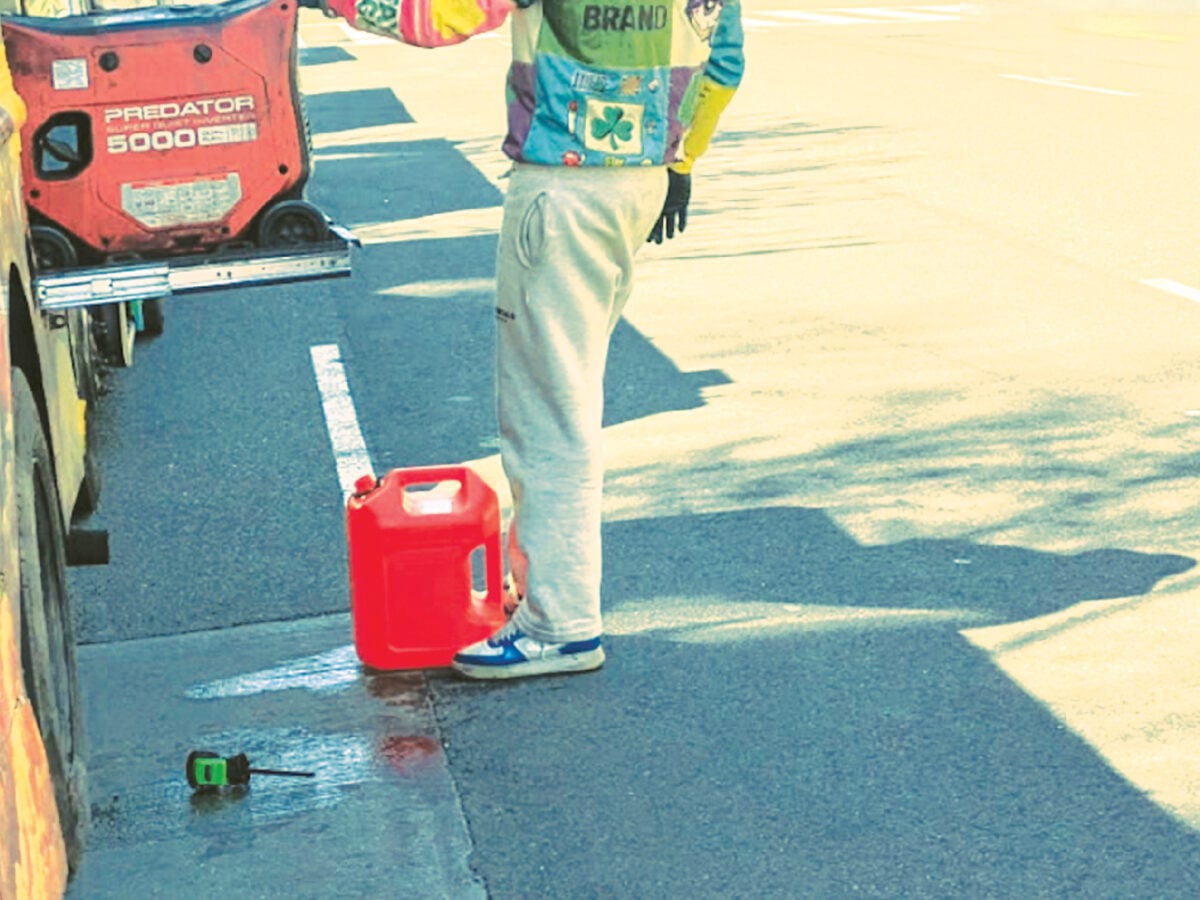
Then there are trucks that have literally exploded. In July 2024, two men were rushed to the hospital with critical injuries after an unlicensed food truck caught fire and became engulfed in flames in front of the National Museum of African American History & Culture. In total, the Fire and Emergency Medical Services Department has responded to 15 food-truck fires in DC over the last four years.
Food trucks aren’t supposed to carry more than 60 pounds of propane, but DC fire inspector technician Niggora Moye says he’ll sometimes see them equipped with one or two 100-pound tanks so the operators can cook all day and keep the cash flowing. Other times, someone will pull up in a personal vehicle to swap out an empty tank. “By code, once you run out of propane, you’re done for the day, you cannot change out,” Moye says.
The biggest hazards are propane leaks, which will immediately get a truck shut down. “Any propane leak is egregious, or can be egregious, because you have that chance of somebody walking by with a cigarette,” Moye says. “Or people onboard, believe it or not, they will be smoking cigarettes.”
But often Moye never gets close enough for these safety checks. “Nine times out of ten, some of the food-truck vendors run when they see us,” he says. “We don’t chase. We’re not allowed to pursue.”
Whack-a-Mole
For decades, the Mall has been home to stationary trailers selling hot dogs, soft pretzels, and popsicles. (The trailers have their own Mafia-esque lore: In the 1990s, the Washington Post reported, at least two DC police officers were arrested for accepting bribes from vendors in return for prime spots and preferential treatment.) It wasn’t until Barack Obama’s inauguration in 2009 that the first modern food trucks arrived—full of hope and change—specializing in pho, empanadas, Korean-style tacos, and more.
Opening a food business was suddenly democratized in a way it hadn’t been before. You could launch a mobile eatery for a fraction of what it cost to open a brick-and-mortar restaurant, and hustle your way into a thriving business. Many area establishments—TaKorean, Fava Pot, Sloppy Mama’s, Roaming Rooster—got their start that way.
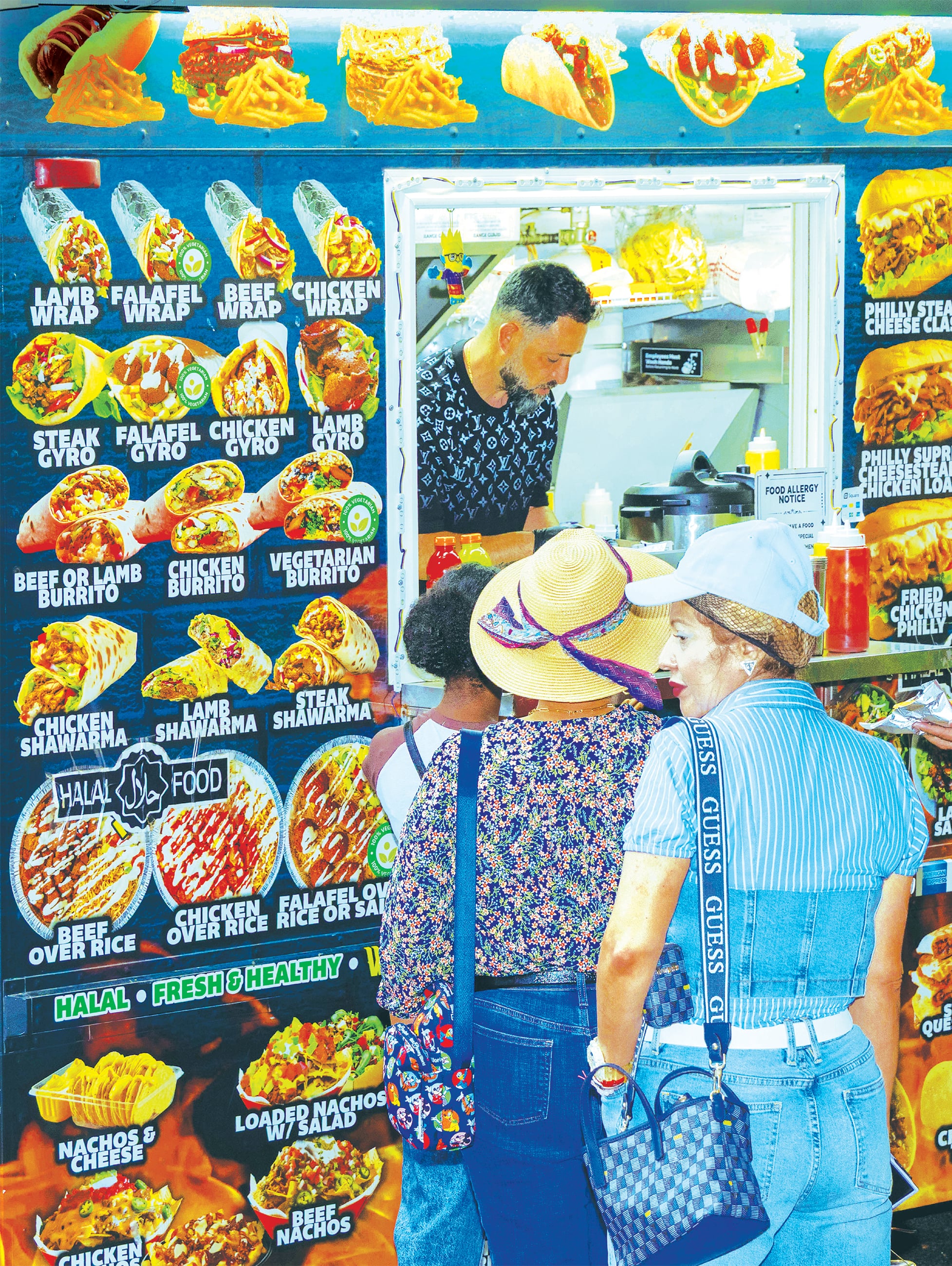
Initially, the city didn’t have laws to govern this new species of eatery—not until 2013, when the District created mobile vending zones where trucks participated in a lottery for guaranteed parking spaces in different areas. A zone around the Mall, now with 54 slots, wasn’t introduced until October 2014. It’s now the only lottery zone still active.
Food trucks, though, had already been illegally swarming the tourist hot spot. In September 2014, the Post reported that DC police and Park Police had arrested nearly 200 street and sidewalk vendors for vending on the Mall that year without a license—at the time, a criminal offense that came with potential jail time. (DC decriminalized unlicensed vending in 2023.)
“It attracted the people that were just wanting to make a quick buck,” Graybill says. “And it makes sense because your customers down there are tourists, and there’s already this assumption about the tourists.”
Over the years, DC and the National Park Service have eliminated parking lanes and put up fencing to deter food trucks from illegal vending. Last spring, as complaints about the scammy trucks started escalating, eight local and federal agencies coordinated their largest joint food-truck enforcement blitz ever: 46 citations were issued, 32 trucks were towed, and five “junk vehicles” were removed. Later that summer, the National Guard and federal immigration agents arrived in DC en masse, detaining at least some “illegal street vendors.”
“I’m actually a little surprised that these guys are still doing this, because so many of them are immigrants and there’s so much ICE activity going on right now,” says Patrick Rathborne, owner of a licensed grilled-cheese truck called Big Cheese. He says that even one of his employees, a legally documented immigrant, was nervous to vend in DC amid all the headlines about immigrants being pulled over: “He was flat out like, ‘If you take anything in DC, you’re going to have to do it yourself. I’m not driving the truck down there.’ ”
Whatever chilling effect these crackdowns have had was only temporary, a game of whack-a-mole. This year, the pirates seem to be back in full force. DLCP maintains a daily presence around the Mall with two to four investigators deployed at a time, but with fewer investigators available on busy weekends. Meanwhile, unlicensed vendors “get tickets every day,” says Johnson, the former investigator. “They don’t care about them. If they get towed, they just go and they pay, and they get them back and they put the vehicle right back where it is.”
Unlicensed vendors “Get tickets every day. They don’t care. If they get towed, they just go and they pay, and they put the vehicle right back where it is.”
Complicating matters are the Mall’s converging law-enforcement jurisdictions, which make the trucks both everybody’s problem and everybody else’s problem. For example: DC is responsible for the roads, but the National Park Service oversees the sidewalks. While there’s plenty of collaboration between city agencies and Park Police, the latter ultimately has a lot more power. “They just aren’t as constrained as we are in terms of authority,” says DLCP’s Crowe. “They can ticket, they can tow, they can confiscate goods, they can make arrests. We need two or three agencies to be able to accomplish all of the things that the Park Police can do.”
Take towing. DLCP investigators can’t actually call for a tow truck directly. Instead, they have to call the Department of Public Works, whose trucks aren’t always readily available. The system was so uncoordinated that for a long time, investigators had to call 311—just like any other regular Joe reporting a pothole or missed recycling collection—to request a tow. They’ve since set up more direct lines of communication.
DLCP investigators also can’t compel drivers to show their IDs. And without the IDs, they can’t really issue citations. “It’s a little bit voluntary right now for people to provide an ID because there’s no criminal penalty for not providing it,” Crowe says. She says a section in the current law allows civil investigators to detain someone, but “that’s not safe. We’re not doing that.” Be-cause vending violations are decriminalized, investigators can’t involve DC police in vending enforcement, either.
“The vendors are not necessarily intimidated by our investigators,” Crowe says. “They know that we are not able to call the police. And so there are times when they would be yelled at or followed to their vehicles.”
Fines for unlicensed vending start at $2,549 and escalate for multiple offenses. A number of trucks have racked up tens of thousands of dollars in penalties. But because they come primarily from Virginia, DC is somewhat constrained in making them pay. “We have to run the plates through a multistate system and hope that we get the information from another state,” Crowe says. She adds that DLCP implemented a lien policy at the beginning of this year to go after truck owners with hefty unpaid fines, but so far no liens have been levied. “Similar to reckless driving and all the tickets, our sister states have to agree in some ways to help us implement liens, particularly on property that is licensed in Virginia or Maryland.”
Last year, Mayor Muriel Bowser and DC Council member Brianne Nadeau introduced rival pieces of legislation that would give District civil officials more power to crack down on evasive vendors. Both bills are making their way through committee and likely will be voted on by the full council later this summer or fall. They share some key fixes: DLCP would be able to call private tow trucks, which tend to be much faster, and even permanently seize particularly problematic food trucks. DC investigators also would be given the ability to tap in police as backup in certain situations. “If someone refuses to cooperate, refuses to produce an ID . . . then we would call our partners at MPD to provide support to us,” Crowe says.
One big point of contention remains. Bowser wants to make unlicensed vending a misdemeanor again, while Nadeau—who spearheaded legislation to decriminalize street vending three years ago—does not.
“It actually took me about five years, in the first place, to decriminalize street vending,” Nadeau says. The issue got a boost in 2019 after a viral video showed a 15-year-old girl screaming and crying as police physically detained her for selling street food. Unlicensed vending, Nadeau says, “doesn’t raise to the level of something that we want to use our precious police resources on, and it escalates situations that really do not need to be escalated and can cause harm to people.”
As for the pirate trucks around the Mall? “If there is an organized-crime element to this, then there are other levers as well,” Nadeau says. “There are civil offenses, there’s tax violations, there’s all kinds of things that you can use in that scenario.”
The city is also trying to turn rogue vendors legit. Over the last couple of years, Crowe says her agency has tried to make it easier for more trucks to get licensed in the District, including through an amnesty program with the DC tax office. In fiscal year 2023, only 47 food trucks were licensed in the District. That number has steadily increased, and today there are 135 active DC food-truck licenses. Crowe sees these numbers as a reflection of more trucks following the rules rather than more trucks on the streets.
But to Crowe, that doesn’t necessarily mean the problem is going away: “It’s status quo until they at least consider the legislative changes we’re recommending.”
“Ain’t Got No Competition”
On the edge of Anacostia, just off the freeway—a few short blocks from DC Department of Health headquarters—there’s a vending warehouse enclosed in barbed-wire fencing where you can buy ice-cream bars in bulk from behind a bulletproof partition. Star Vending is where many ice-cream-truck operators shop and where they park after-hours. It’s also where I meet Youssef, an operator who’s getting supplies before he heads to the Mall.
We enter a large refrigerated room with crates of ice-cream-milk mix stacked nearly to the ceiling. Youssef grabs seven gallons of vanilla and three of chocolate—$11 a pop—for his soft-serve machine. He tells me he sells a single cone for $6 to $10.
I ask if his truck lists prices.
“No.”
“Why not?” I ask.
“Because it depends on the area you’ll be working in,” he says. Or, as he later explains, “it depends if somebody got a [Casio] or somebody wearing a Rolex, you know? It’s not the same. It really depends on the customer.”
At the Mall, though, he always charges $10. (Anything more, he says, is a “scam.”) “You got to charge so you can make the money, so you can pay for the groceries,” he says. “You pay a lot of expenses on a truck: You got insurance, you got tickets, you got towing.”
I ask him what the competition is like over on the Mall.
“Ain’t got no competition,” he says.
I mention all the trucks fighting over parking spots.
“My spot is ready.”
“So you have someone holding it for you?” I ask.
“Definitely. We got a team. It’s teams,” he says. “They be waiting for you, you know? When you get there, you can find a spot already there. He takes his car, you park your truck, he leaves.”
“So is it a whole network?” I ask. “They’re all owned by the same person and they are coordinating?”
Youssef is stacking his cart with giant jugs of brightly hued strawberry, lemon-lime, and blue-raspberry syrup for snow cones and slushies.
“Pretty much they are owned by the same person,” he says.
I ask how many trucks his boss owns.
“Over 50.”
That would explain why so many of the trucks look so similar. Youssef tells me “we got somebody” who makes the wraps, or vinyl coverings, for all the trucks. Many of the vehicles also have the same Arabic phrase above their passenger doors, translating to “In the name of Allah, the most gracious, the most merciful.”
“The owner is religious,” Youssef says. “Everybody’s religious, pretty much. We’re Muslim people.”
He also explains a bit about how the whole operation works. It’s not just people saving parking spots and selling ice cream. There are also “watchers” who make $80 a day just to stand and look out for Park Police. “They’re everywhere. They don’t let you work,” he says of the officers. “When it’s slow for three days, we gotta make money on the fourth day. We gotta put a watcher. He needs to watch so we can make at least an amount to cover those days that we didn’t work.”
The watchers, however, can only do so much. Youssef says he’s been towed plenty of times before, up to twice a week: “What can I do? You’re going to argue with the police? You’re going to argue with the government? Just keep it quiet. That’s it.”
Youssef says it costs $750 to get a truck out of impound, and the truck is out of commission for three days. But on a good day, he says, he can make $1,500. A slow day is closer to $200.
Youssef argues that the trucks are offering a necessary service: “I mean, if there’s no shops in the National Mall, what are people gonna eat? You don’t even have a 7-Eleven at the National Mall.”
Plus, he adds, it’s not like they’re selling drugs. It’s ice cream. He tells me he has two young kids and a wife to support. “We’re human beings trying to make bread. Very simple people,” he says. “I ain’t got that much options to work.”
By now, we’re outside in the poorly paved parking lot. Youssef has spent about $250 on various jugs of sugary liquids, two cases of bottled water, and three bags of ice. He’s running late but having one last cigarette. It’s a long shot, but this is the closest I’ve gotten to understanding the food-truck food chain, so I ask if his boss might be open to talking to me.
“Nah, definitely no,” he says.
“You can’t share his name?” I ask.
“No,” he says. “People are not going to give you that name.”
“Why Bother?”
It may not have any 7-Elevens, but this year the Mall is adding 25 new food carts—and recently revamped its once-sad food kiosks into themed cafes serving new items like superfood açai bowls and cherry-blossom ice cream. If the National Park Service can’t get rid of the pirates, maybe it can at least take away a share of their bounty.
As for attracting better, more up-to-code trucks? Most of the specialized or “trendy” food trucks that were once a staple of the city’s lunch scene aren’t street-vending anymore. The pandemic and remote work depleted the crowds of hungry office workers downtown, leaving many trucks to refocus on catering and private events, or move operations to breweries, suburban office complexes, and gas-station parking lots.
Moreover, many got fed up dealing with lawless competitors. Rathborne, who operates Big Cheese, stopped street-vending in 2018. Today, he sticks to catering and festivals. “It just became too hard to get parking and too super-saturated with all these banged-up trucks,” he says. “I know that half these guys aren’t permitted. There was no enforcement or limited enforcement. You’re at a disadvantage if you follow the rules. Why bother?”
How to Spot a Licensed Food Truck
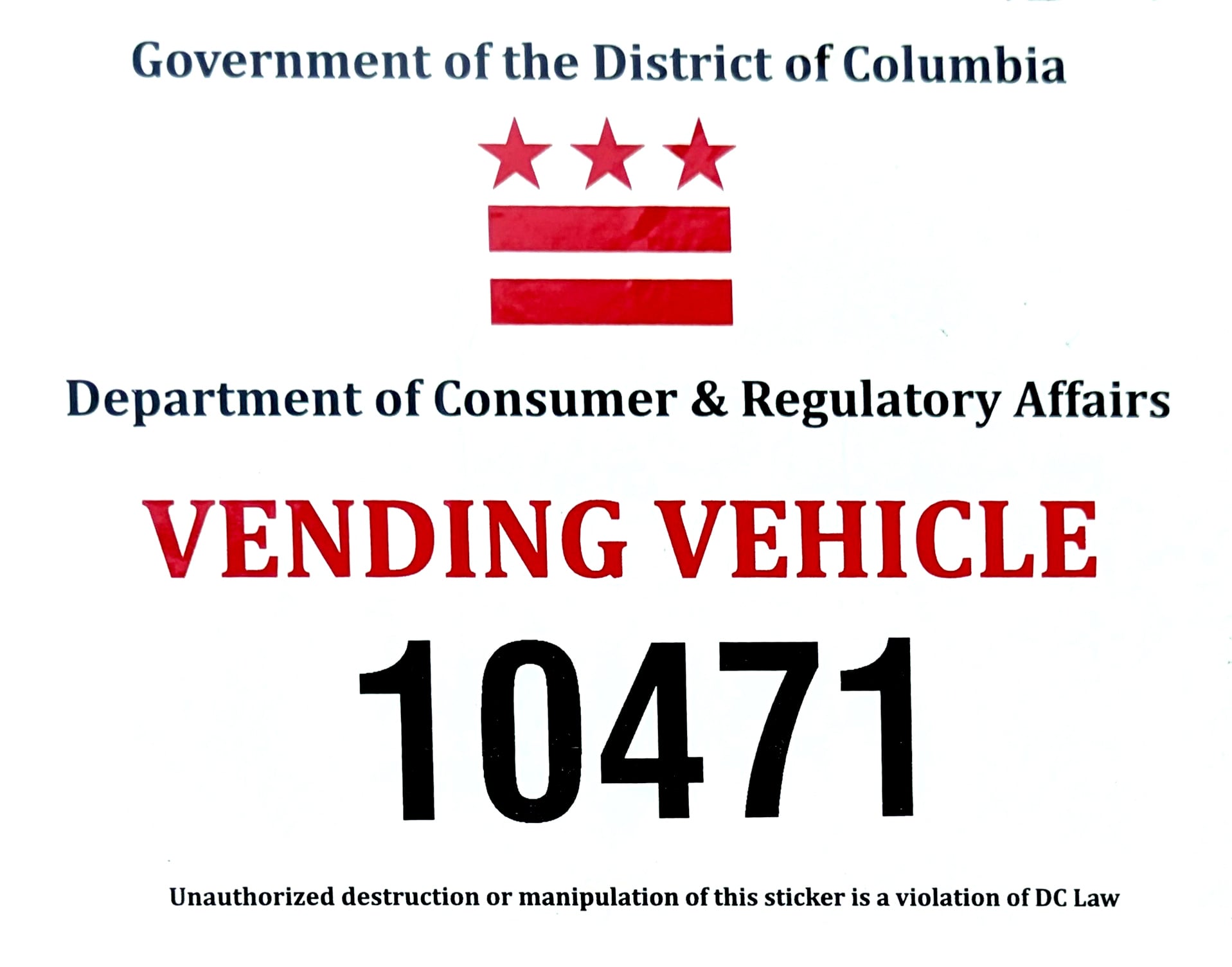
A Department of Licensing and Consumer Protection sticker—indicating that the truck is authorized to operate in DC—must be displayed on the rear driver’s side of the vehicle.
A Department of Health sticker for food trucks that have passed food-safety and hygiene inspections should be visible on the front driver’s side.
Also: For trucks serving hot food, look for a certificate in the front window from the DC Fire and EMS Department approving propane use.
Once upon a time, the DMV Food Truck Association was a prominent player in vending regulatory decisions and one of the biggest advocates for legal operators. It disbanded in 2020, with competing factions fighting over the direction of the organization. DC Slices’ Graybill, who used to run the group, didn’t even know about the latest food-truck legislation making its way through the DC Council until I mentioned it to him. “There’s no voice for the industry anymore,” he says.
Back at the Mall, however, Graybill is taking matters into his own hands. The food truck operating without its generator running and no refrigeration is simply more than he can handle. He approaches an older couple eyeing the menu and tells them what’s up. The woman gasps.
“Every food truck you see here is illegal,” he says. “Just do yourselves a favor, go inside. Each of the museums has a cafe inside. Or just go, like, two blocks north.” Graybill recommends Old Ebbitt Grill.
“Okay. Yeah, I don’t feel like food poisoning,” the woman says with a Southern twang. “I’m glad you stopped us.”
“I had to,” Graybill says. He points to a group of teens who have already ordered. “It’s too late for these guys.”
This article appears in the July 2026 issue of Washingtonian.