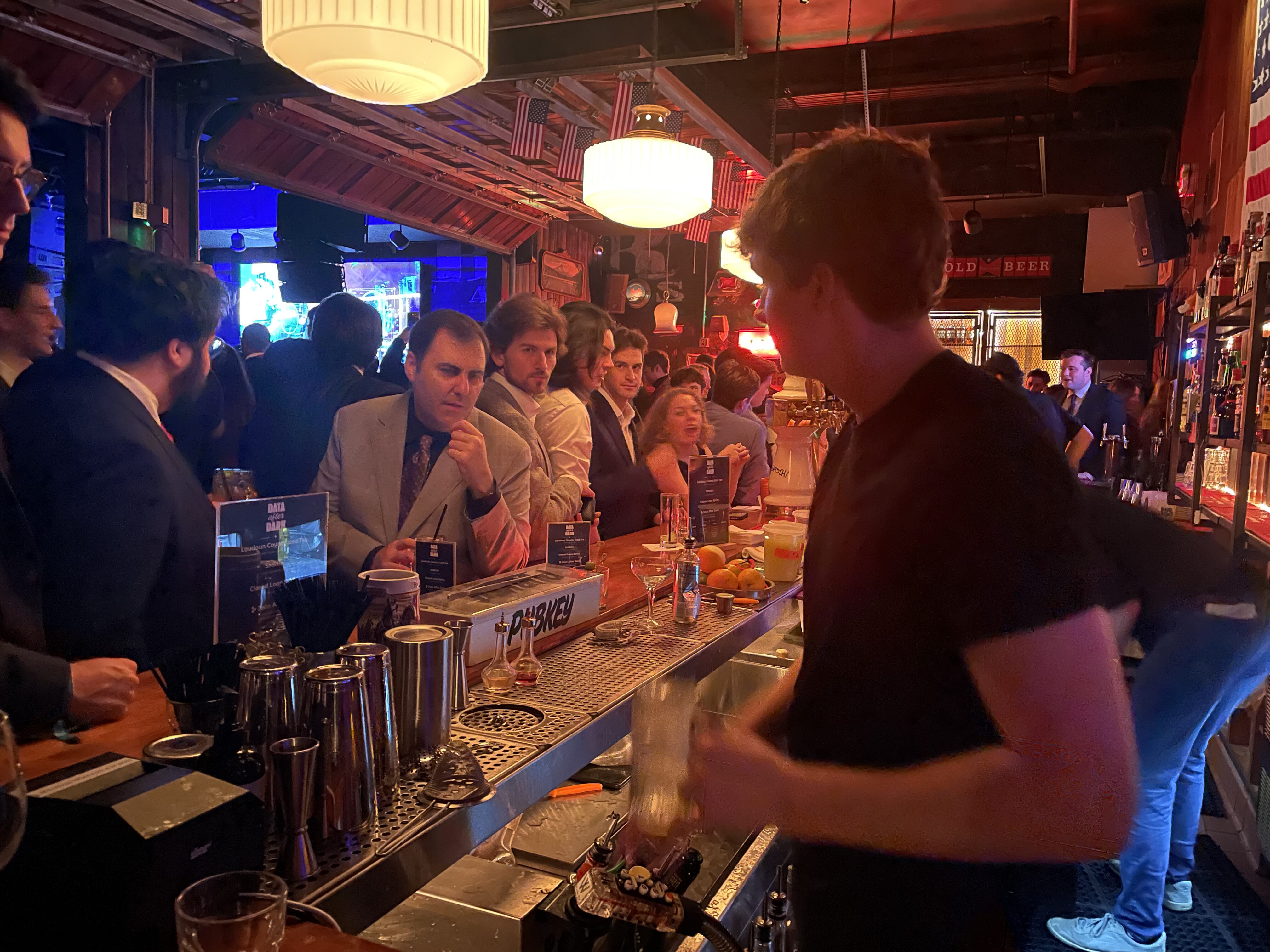
The first thing I found myself wondering about Data After Dark, the “pro–data center party” held Saturday at the tech-bro watering hole Pubkey, was just how much of it was a joke.
Of course a lot of people love AI. But the online invitation to this event in particular seemed to come with a wink and a nudge. “In light of the bipartisan psychosis over AI data centers, it’s about time that the people who haven’t lost their minds get together and celebrate the glory of American compute,” it read. Upon entry, the specialty cocktails (“Closed Loop Spritz,” “Loudoun County Iced Tea”) and gauche decor (a large poster reading “Virginia Is for Servers,” a photo booth turning partygoers into AI versions of themselves) added to the feeling that the party was being hosted purely for laughs and/or attention.
Yet I quickly discovered that the pro–data center movement is very real, and very outspoken. “We’re on the 20 side of an 80-20 issue,” Jonas Du, the brainchild of the party, told me a few days later. “I’d certainly like to convince the 80 percent, but that’s not what this specific pro–data center party was necessarily about. I think it’s simply just useful to get pro-innovation people in the same room to work together on this issue and make the connections that might be necessary to solve the PR crisis.”
Public opinion has never been more bent against data centers than now, with both parties proposing legislation to rein in the digital behemoths. A recent New York Times poll found that 61 percent of Americans oppose construction of data centers in the US. That number shoots up to 78 percent among 18-to-29 year olds, the age group most represented at Data After Dark.
Du himself is a fiery young journalist, who worked at The Free Press before joining the tech-focused, Peter Thiel–backed newsletter Pirate Wires. He’d marketed his party well: nearly 100 journalists were on the press list, and you couldn’t get five feet before bumping into a reporter. Young Voices, a talent agency that co-sponsored the party, were podcasting live from a glass booth adjacent to the dance floor. A handful of technology and policy bigwigs appeared on stage to toast the AI age, with speakers including Cambridge Analytica whistleblower Brittany Kaiser; David Meyer, the founder of the data center company Strata; and Nathan Leamer, executive director of Build American AI (tied to the powerful Super PAC Leading the Future).
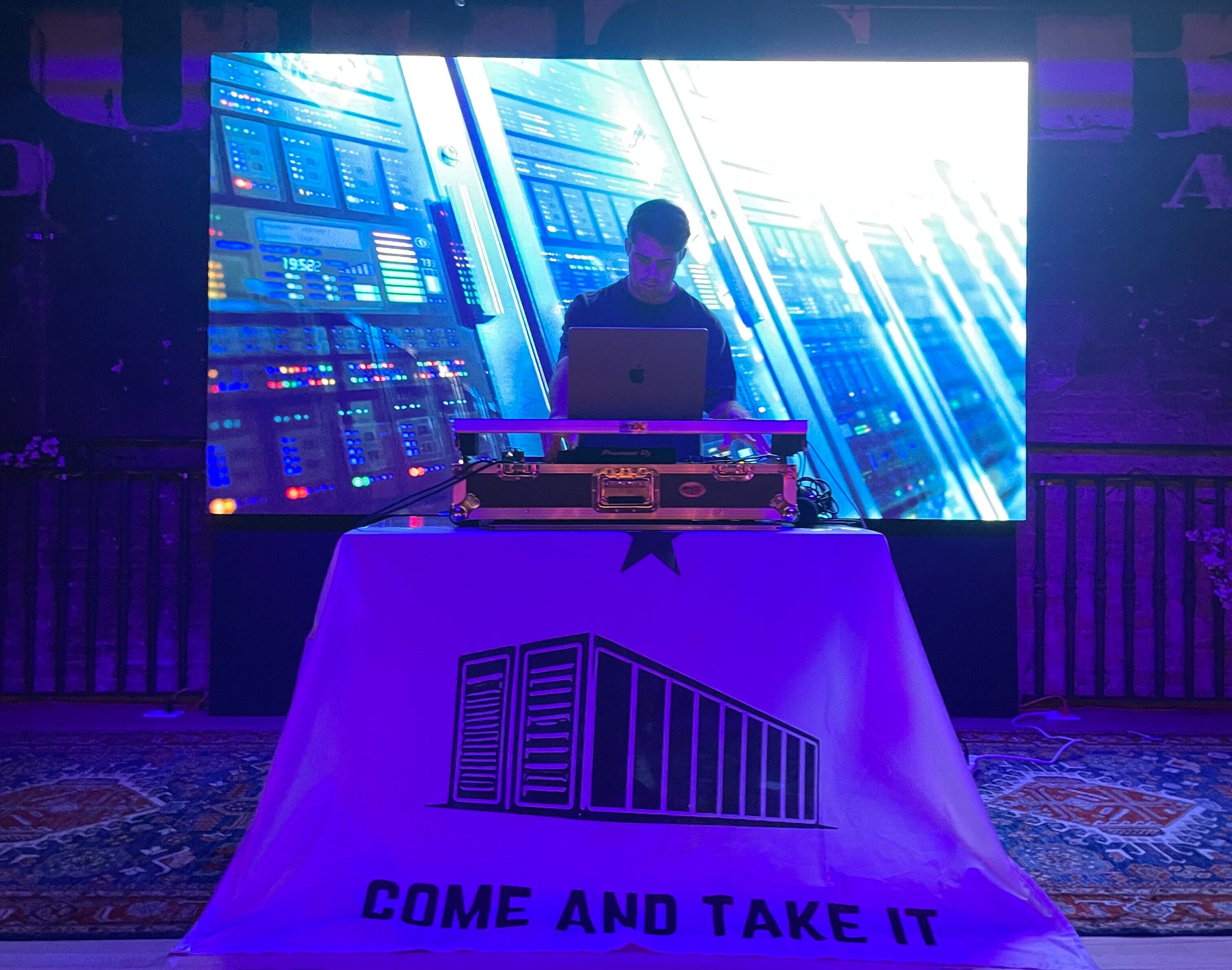
But what was the party like for your average Claude enthusiast? As the DJ blasted a Charli xcx remix, attendees flitted across the floor. Around 600 people had shown up, Du told me. The ratio of men to women, as one would expect, was tilted strongly in favor of the former, but I’d seen worse back in college. In many ways, it was a standard Gen Z party; tech bros sneakily took puffs from their vapes, couples held hands, wallflowers gazed at their phones. But Du and his co-hosts had also cultivated quite the opulent vibe. Though there was no dress code listed on the invite, most of the men wore suits, and the women dresses. (I felt quite conspicuous in my button-down.) A whisky lounge sponsored by the Bitcoin Policy Institute featured bespoke leather furniture; a VIP room downstairs was closed off entirely from the press.
Inside the lounge, two Kick streamers self-identifying as “neoliberal” expressed annoyance that they had been prohibited from live-streaming at the party. It did seem odd, given the amount of media around, but I suppose one has to draw the line somewhere. “I told my belly dancing teacher about this party, and she started speaking about how some data centers are actually really important,” one of the streamers, who went by Zugami, told me. She described her content as “if Anthony Bourdain and Sarah Silverman had a baby.” I told her I’d check it out.
Some attendees wore garb showing their love for everything data-driven. Channing Pear, a Miami resident working in drone-based construction services, had stopped by the party while on his way to a business conference. Along with his suit, he wore a ball cap with an LED screen displaying bright green pixel animations. “I bought it on Amazon,” he said of the hat. “It was, unfortunately, like many things in this country, made by China.” He had coded the animations himself—with the help of AI, of course. Pear said he attended the party in order to “meet more pro–data center people and help show the world that data centers aren’t scary.”
Heather Jones, a tattooed Army vet who had flown in from Portland, Oregon, for the sole purpose of attending, was also looking to meet people. Specifically, she was looking for those interested in partnering with her company, Elkhorn Products, which she said is producing “cooling systems for data centers that delete the water and the power problems.” How was that possible? “I need about an hour,” she said. No time for that tonight. We moved on.
AI, Jones said, had changed her life, exponentially improving her ability to build and create. “We’re developing things like cures for cancer—literally, just happened,” she said. (AI has not actually found a cure for cancer.) Now she just needed someone to hear her pitch. “I’m here to talk to people who are looking to actually get shit done with data centers,” she said. “Problem is, they’re all downstairs. I don’t have a VIP wristband.”
Justin Diamond, a friendly New York native wearing Meta glasses (switched off) and working in the DC energy sector, offered his own thoughts on the buildings. “People’s ideas about data centers that they use to advocate against them are ill-informed,” he said. “If you can have $100 million in tax revenue for a room full of computers, that is, I think, an obvious good.”
I asked attendees whether they were concerned about AI posing an existential risk to humanity. After all, only a few weeks had passed since a handful of top industry executives, including the CEOs of Anthropic and OpenAI, banded together to warn the public about the threat of super-intelligent AI and endorse a slowdown of the models.
Partygoers were nonplussed. “I don’t think there’s a reason to pump the brakes,” Pear said.
Extinction risk is a “uniquely American concern,” Diamond added. “I’m concerned that a lot of it is them trying to over-exaggerate the capabilities of their model by claiming that it’s an existential risk.” He noted that other executives, such as Nvidia’s Jensen Huang, have been far more optimistic in public comments. “I think there are risks, but the risks that people should be concerned about are things like bioweapons and malicious actors, and less that the AI will come alive of its own volition.”
Techno-optimism was the prevailing ideology at Data After Dark. Partygoers were unified in the belief that AI’s ecological impacts were overblown, and that criticism of the tech was largely sour grapes. “The media does a disservice when they peddle false stories about water usage in particular, but also when they’re biased against tech companies and therefore choose to amplify negative stories about data centers instead of the countless positive stories about people getting tons lowered on their tax bills, or teachers getting massive raises due to data center tax revenue,” Du said.
Floating around throughout the night was Maryland native Taylor Frazier McCollum, who had come to “crash the party” alongside her ex-husband, Derrick Corley. This summer, McCollum was one of many residents who fought off a proposed data center in Landover; a Vanity Fair reporter had snuck her in. “I’m anxious to see if there are other anti–data center people that are going to say something,” she said.
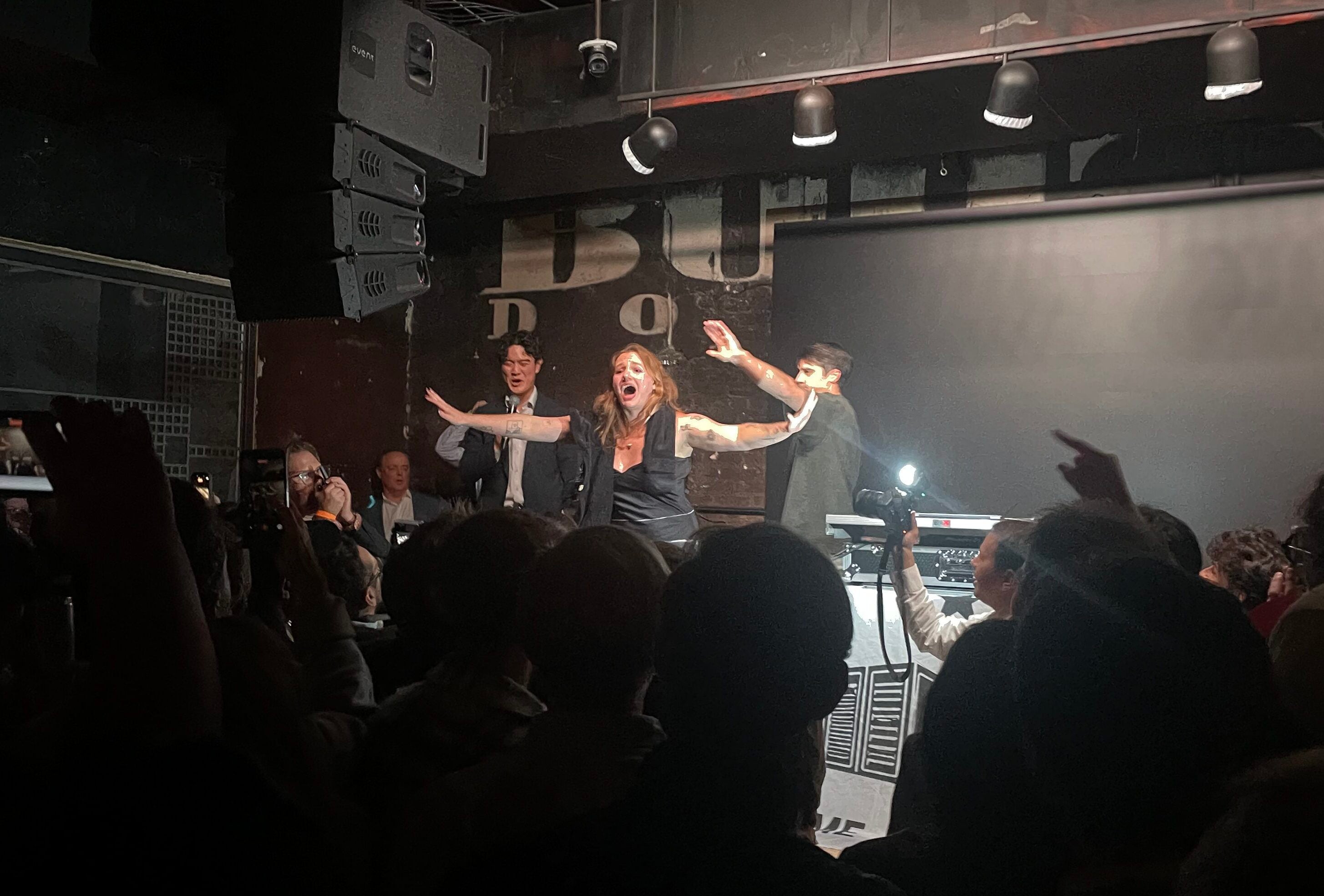
Later in the night, McCollum got her wish. During one of many toasts, a protester jumped on stage and began yelling. While the crowd quickly drowned her out by both booing and chanting “USA, USA,” she disrupted proceedings for a surprisingly long time—Du tried to shepherd the woman off stage to no avail before security eventually escorted her out. Two more protesters would do the same soon after, with similar results.
“We weren’t totally surprised by it,” Du said afterward. “I really do have no respect for people that try to make their case through interruptions, especially interruptions that violate the free speech rights of others.”
I caught up with the first two protesters—who turned out to be sisters—outside of Pubkey to ask why they were so against the structures which so many inside had professed their love for.
“We have a few data centers in northern Maryland, and I’m not able to afford my BG energy bills right now,” Livi Plihal said. “For my 300-square-foot studio apartment, they’re up to $250 in the winter, which is not sustainable for me.”
Livi is an illustrator, while Grace Plihal works as a therapist. Both expressed concern that AI would come for their jobs in the near future. “It’s making things unlivable,” Livi said. “The cost hugely outweighs any benefits. If people are saying otherwise, it’s because it’s directly putting money into their pockets.”
Both sisters, who were born and raised in DC, stressed that data center advocacy was not what the city stood for. I asked Grace how she felt getting heckled by hundreds of people on stage. “I’ve done disruptions before, and this was pretty mild,” she said, laughing. Of Du: “I felt bad. We ruined his house party.”
Standing on the sidewalk with two more journalists, watching yet another protester get booted out by a security guard, I again asked myself what Data After Dark represented. Six hundred revolutionaries standing proud in the face of the establishment? A privileged class laughing in the face of the oppressed? Maybe, in the end, it was some sort of joke. But, if so, who was it being played on?