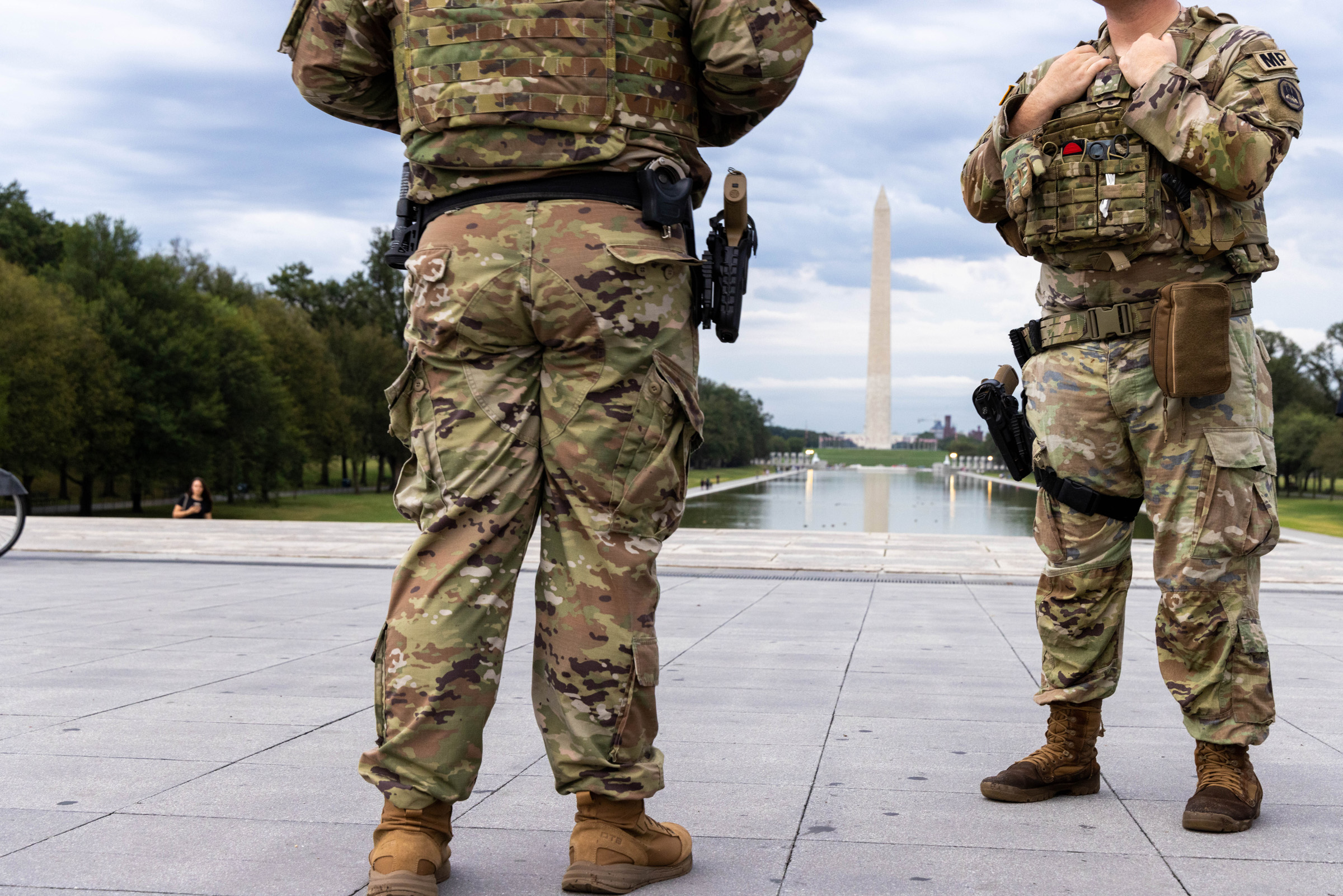
One year ago this week, National Guard troops began appearing on Washington’s streets as part of a federal law enforcement surge. Since then, the sight of armed soldiers has become commonplace in many of the city’s main corridors and transit hubs.
All of this is highly controversial. While the Trump administration has called in thousands of soldiers ostensibly to battle violent crime—part of an effort, the president has said, to “take back” a city “overtaken by violent gangs and bloodthirsty criminals, roving mobs of wild youth, drugged out maniacs and homeless people”—Guard members have spent much of their time standing or walking around. Sometimes, they’ve done municipal yardwork.
Critics have called the Guard’s presence unhelpful, wastefully expensive, an infringement on DC’s autonomy, “political theater,” and a “textbook authoritarian maneuver” by Trump. Earlier this year, a member of the DC Guard told Washingtonian that stationing armed soldiers on the capital’s streets as crime-deterrence props was “objectively unnecessary and almost wicked.”
In July, the Pentagon confirmed to NPR that the Guard’s deployment is expected to continue until 2029. So, a year in and with no end imminent, it’s worth asking: what have we learned?
The Guard’s Impact on Crime Has Been Limited
While delivering a speech to roughly 500 Guard members assembled in Meridian Hill Park ahead of the Fourth of July weekend, Secretary of Defense Pete Hegseth rebuked nearby protestors who were voicing their dissent with chants of “Guard, go home.”
“This background noise this morning is perfect,” Hegseth said. “It’s the sound of ingrates, of ingratitude, of people who are so blinded by ideology they can’t see law and order and common sense in front of them.”
Hegseth additionally suggested that the Guard’s presence had contributed to a “staggering” drop in crime in DC. Was he right? A May study by the Niskanen Center, a moderate Washington think tank with libertarian roots, found that the Guard deployment produced a 24 percent reduction in property crimes such as theft and vehicle break-ins. These so-called “crimes of opportunity” tend to happen in highly-trafficked public spaces, the same areas the Guard’s patrols have been focused.
The same study, however, also concluded that the Guard’s deployment led to no discernible decrease in violent crime, which disproportionately afflicts DC neighborhoods with the highest density of residents who are Black.
“The National Guard deployment was not a waste,” the study’s authors wrote. “But it was an expensive tool deployed in the wrong places for the wrong types of crime.”
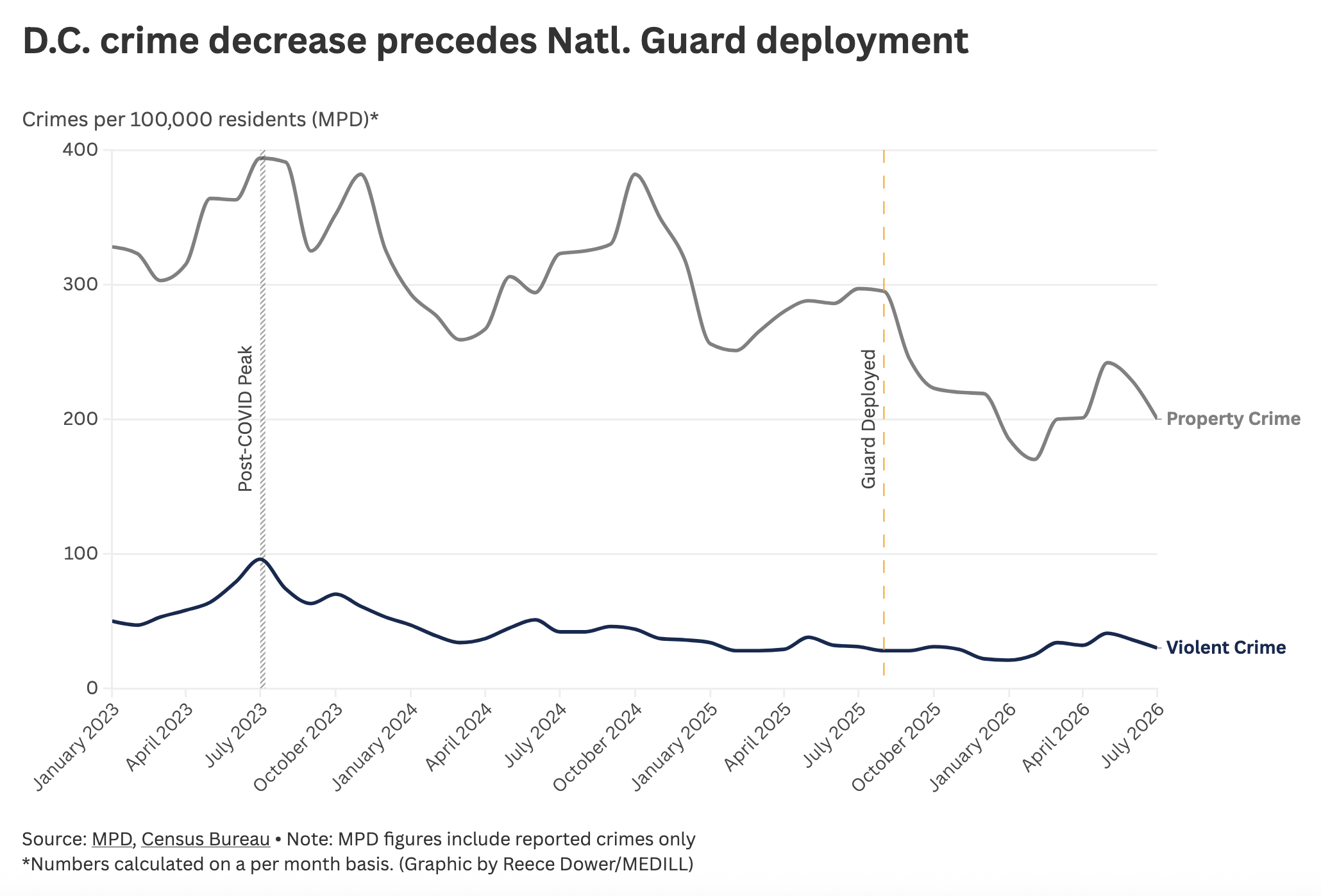
When the Guard deployment began last August, crime in DC already had dropped to a 30-year low following a spike in 2023. Trump and his allies have repeatedly suggested that this drop was illusory, accusing Metro police of manipulating crime statistics to make the city appear safer.
Last December, the Republican-led House Oversight Committee published a report alleging MPD Chief Pamela Smith had pressured staff to lower the classification of certain crimes. Smith, who had recently resigned, denied wrongdoing. A DC Inspector General report released in late July found that MPD’s crime statistics collection experienced a “prolonged, systemic breakdown of its internal control system” from 2015 to 2025, but did not find any fraud or intentionality in the collection flaws.
The Niskanen Center study found that the crime decline since 2023 seen in MPD’s statistics can be independently corroborated. Data from the city’s gunshot detection systems showed that the level of detections fell in 2024 and 2025 before the Guard arrived. Homicides, the most difficult crime to conceal in the data, also fell substantially over that period.
Moreover, MPD commanders who in the House Oversight report raised concerns about how the department was classifying certain crimes nevertheless noted the overall data trends reflected reality. “Crime is down from 2023,” one MPD commander told Congressional investigators in October of last year. “I will say that. I’ve lived that. I’ve experienced that. We are nowhere near where we were in 2023.”
The apparent delta between Trump’s lurid rhetoric and DC’s crime reality—as well as the Guard’s seeming lack of impact on violent crime—raises the question: are troops on the streets actually serving their purported purpose, particularly when they’ve been stationed in areas like the National Mall?
In an emailed response to questions, a spokesperson for the Guard mission in DC wrote “It is important to note that Guard members are providing a visible crime deterrent; they are not performing direct law enforcement actions such as arrests or searches.”
The Guard spokesperson referred questions about troop placement to the Department of Justice, which did not respond to questions, and referred all questions about the mission’s impact on crime to the MPD, which declined to comment. The Guard spokesperson did not answer questions about how the Guard measures the impact of its mission.
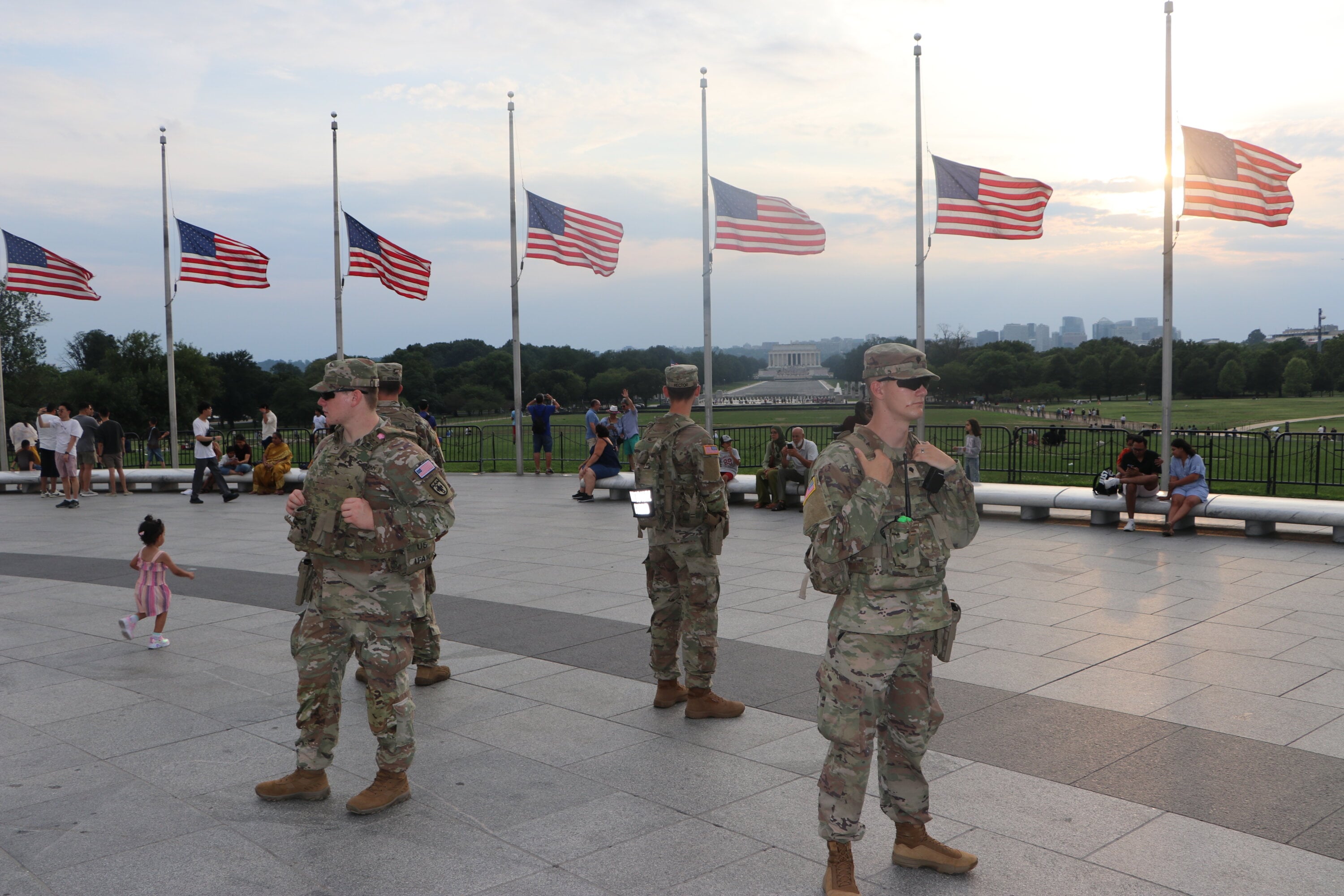
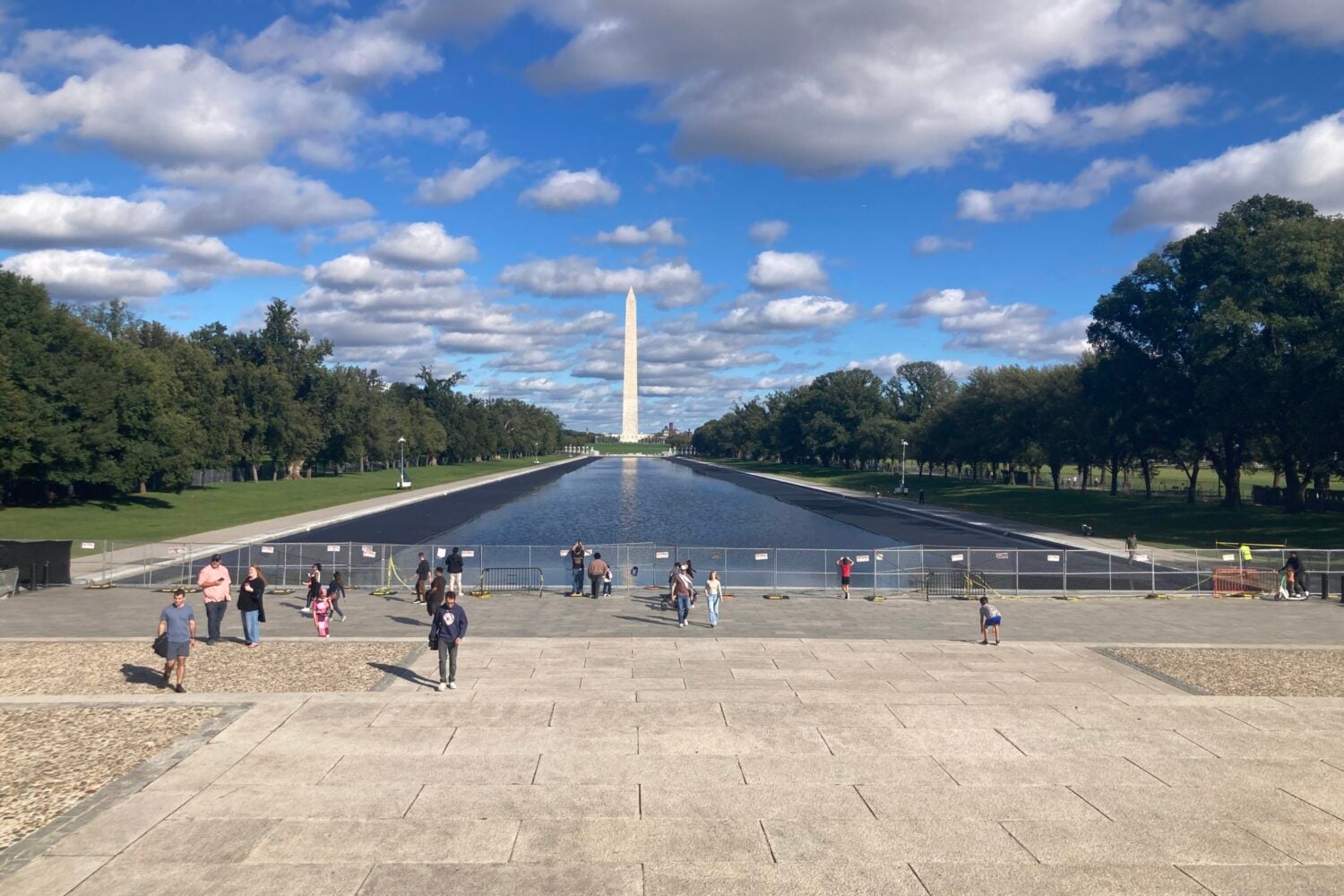
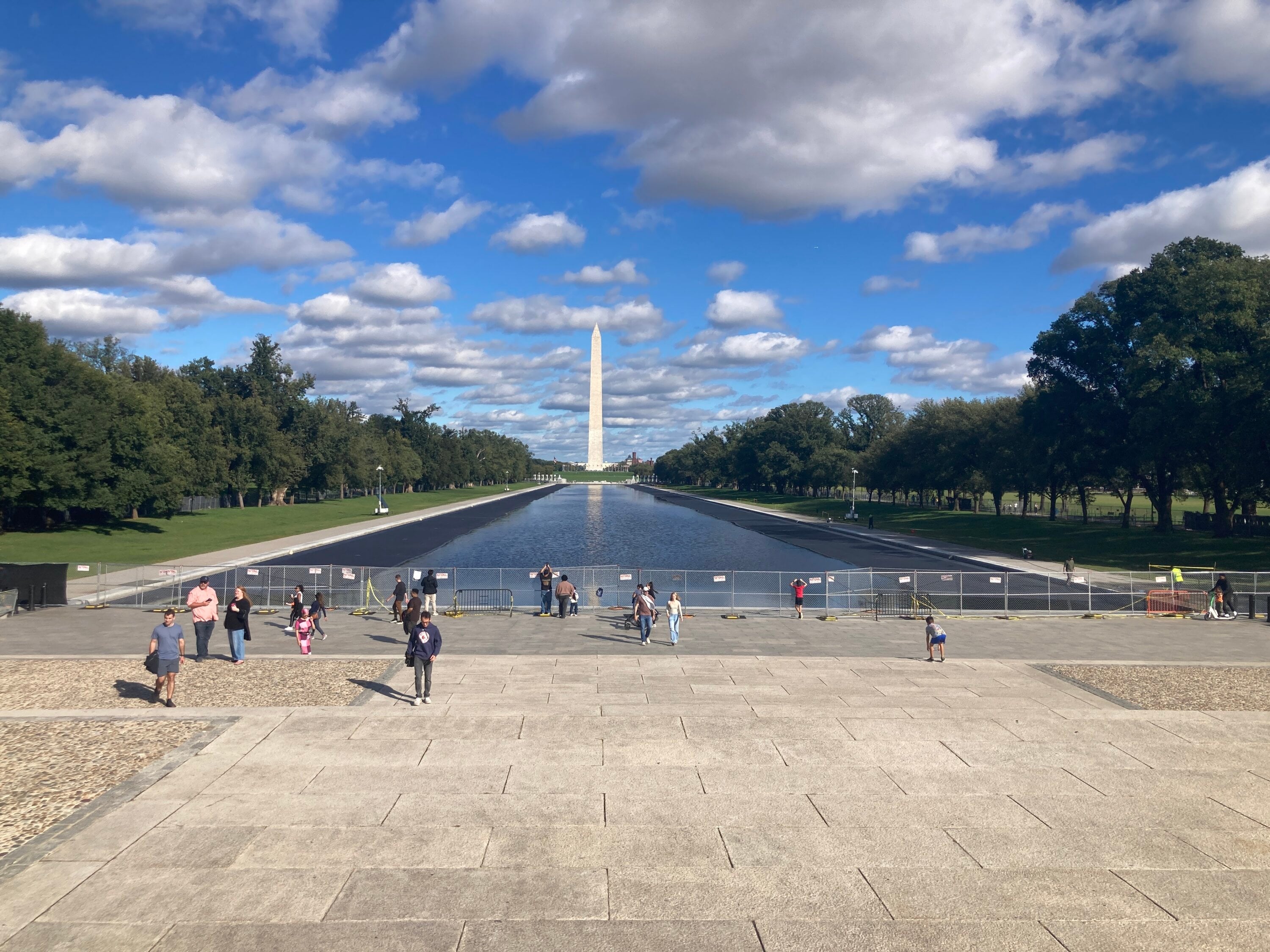
One afternoon in mid-July, three Guard soldiers stood atop a knoll at the foot of the Washington Monument, escaping the sun under a canopy of elm branches. Below, a man playing Afro-funk beats from a speaker bungeed to his bicycle coaxed a group of passersby into a dance-off. He then beckoned to the camo-clad troops, who smiled but stayed planted in the shade.
Around the Mall, other Guard members operated road barriers, directed street traffic, shepherded soccer fans watching the World Cup at an outdoor venue, and huddled around their Humvees. Nearby federal buildings were adorned with big, hanging banners emblazoned with Trump’s glowering face.
Barbara Matthews, who said she has lived in DC for nearly 70 years, told Washingtonian she had never seen any troops in her Anacostia neighborhood. That area has much higher crime rates than the Mall, home to one of the city’s lowest overall rates and just eight violent crimes committed in its immediate vicinity over the last decade.
“I see no purpose in them being here,” Matthews said. “What’s the point? When was there crime at the [National] Mall? Maybe they’re not here to make me feel safe.”
Troops Have Been Given a Variety of Odd Jobs
In July, two Guard soldiers with Sig Sauer pistols at their hips stood at the entrance to a Metro station in Navy Yard. Steps away, a man with red hair sat on a fold-out stool in the scorching heat. He held a sign that said he was homeless.
Two other Guard members approached the man. They handed him a Gatorade, a sandwich, and a bag of chips. The man thanked the troops.
“Dude, they’re fucking awesome,” the man later told Washingtonian.
This kind of interaction isn’t unusual: one of the soldiers in Navy Yard told Washingtonian that talking to civilians and helping the homeless were his primary duties. Over the last year, troops also have been seen:
- Picking up trash
- Taking pictures with visitors to the Lincoln Memorial
- Cutting grass on riding mowers
- Shoveling snow
- Passing out American flag patches to small children
“Guardsmen assigned to the DC Safe and Beautiful mission are assisting with a range of tasks, including monument security, community safety patrols, and protecting federal facilities,” a spokesperson for the Guard wrote.
Guard members also have been involved in addressing the ongoing opioid crisis. At the same Meridian Hill Park event where Hegseth spoke, Gen. Steven Nordhaus, the highest-ranking officer in the National Guard, lauded the troops for having “saved over 235 lives.” A spokesperson for the National Guard’s DC task force later clarified that as of the end of June, its personnel had administered Narcan—a nasal spray that can stop an opioid overdose from being fatal—to unresponsive individuals 235 times.
The spokesperson did not indicate how, or if, the Guard distinguished between Narcan administrations and lives saved.
Similar to some high-ranking members of the Trump Administration, the Guard also has been busy creating online content. On its public affairs website, the Guard has archived scores of videos documenting its DC deployment. One such video follows a group of Alaska Guard members on a June patrol in Georgetown. At one point, the soldiers form a shoulder-to-shoulder phalanx amid Wisconsin Avenue’s upscale shopping and dining, while a woman with a neon pink shopping bag leans in to snap a photo of the formation.
In a February video, two soldiers from the Arkansas National Guard appear to repeatedly wait for cues from offscreen before starting a series of marches through Dupont Circle. “This feels weird,” one soldier says. The other soldier chuckles as the pair continues their march.
This Deployment Isn’t Cheap
As of August 4, there were roughly 4,600 Guard troops deployed to Washington from nearly 18 different states and territories. Only about 700 of those troops were from the DC Guard; almost all of the rest were sent from states with Republican governors.
By comparison, the MPD had about 3,800 officers as of July.
The Guard’s presence isn’t cheap. The nonpartisan Congressional Budget Office estimated that 2025’s deployment cost taxpayers $223 million and that each additional month would cost $55 million, meaning the deployment has potentially cost more than half a billion dollars to date. However, that’s likely an undercount, as the CBO estimate assumed troop levels in the city would remain around 3,000—about 2,000 fewer than were mobilized this summer during semiquincentennial activities.
The Defense Department did not respond to questions about the deployment’s cost. In early August, however, the Pentagon told Congress that extending the Guard’s deployment to 2029 is expected to cost an additional roughly $1.4 billion.
In late July, the National Guard Bureau announced the award of a $292 million contract to provide up to 2,000 housing units as a “long-term housing solution” for troops deployed to Washington. The press release said that the contract, which was awarded on an expedited basis, was the largest of its kind in the Guard’s history and claimed to be a cheaper alternative than the status quo, in which Guard members have stayed in hotels scattered across the region.
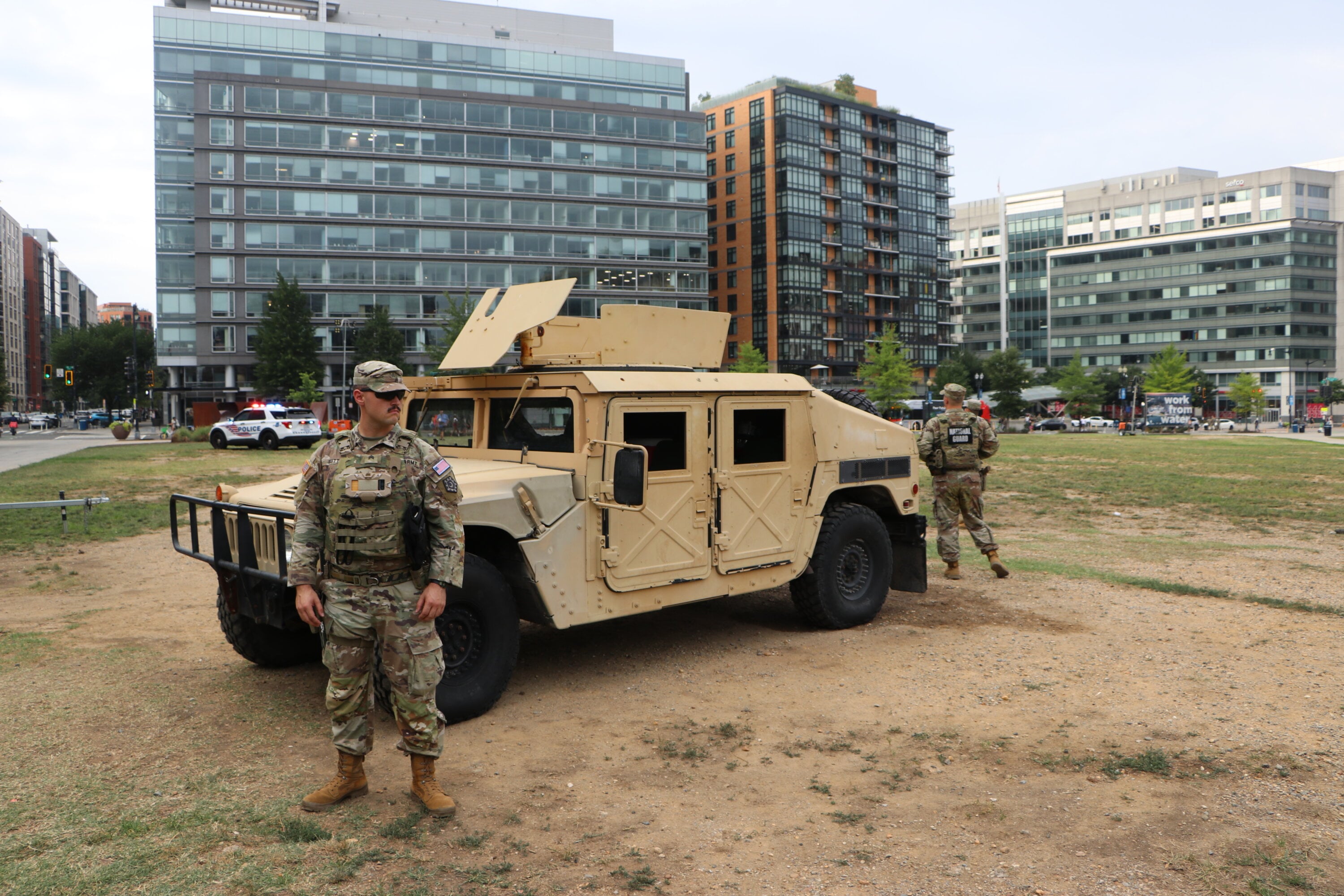
In addition to its financial costs, an extended DC deployment may be reducing troop readiness. Senior Guard officials have publicly insisted that isn’t the case—to the contrary, they claim patrolling Washington has made soldiers better trained.
Experts say, however, that any sustained domestic deployment diverts soldiers and airmen from their normal training regimens, which build skills and are needed for career advancement. Allyson Solomon, a retired brigadier general in the Maryland Air National Guard, said foot patrols and installation protection, two duties which make up much of the DC deployment, are small parts of what Guard members are expected to be able to perform on any given deployment. A focus on those can come at the expense of other crucial skills.
Solomon also said that the deployment runs counter to some of the Guard’s main selling points to recruits: serve close to home while maintaining a relatively undisrupted civilian career.
“I’m not buying that this improves readiness, because who signs up to do this?” she said.
The Guard referred questions about the deployment’s effect on troop readiness to the Defense Department, which did not respond.
Late last year, two Guard members from West Virginia were shot while on patrol near the White House. The man who allegedly drove across the country to ambush them had worked for the CIA while in his home country of Afghanistan. One of the soldiers, 20-year-old Sarah Beckstrom, died of her wounds. The other survived.
Edwin Palmer, a 60-something DC native, spoke to Washingtonian in July while waiting for the bus near the Waterfront Metro station. Across the street, four Guard members stood by the station’s entrance.
After expressing skepticism over the cost of the Guard’s deployment—”even $50 a day is too much,” he said—Palmer brought up Beckstrom’s death.
“Had she not been here,” he said, “that wouldn’t have happened.”
Even if Normalized, the Guard’s Ongoing Presence May Be Illegal
Around the time of President Trump’s order to deploy the Guard to DC last year, a Washington Post poll found that 79 percent of Washingtonians opposed or strongly opposed the move.
Historically, the Guard has been deployed domestically to quell severe civil unrest and respond to natural disasters. Carrie A. Lee, a DC resident who studies civil-military relations as a senior fellow and managing director at the German Marshall Fund, said that Americans long have been allergic to the military being used in day-to-day life—a revulsion, she added, that has acted as a bulwark against abusive uses.
One of the “big concerns” about the Guard deployment in DC, Lee said, is that it would normalize locals and “Americans generally to the idea that we can have troops patrolling the streets.”
Lee said she thinks that has happened, at least to some extent. A nightly, spoon-and-pot banging protest at Lincoln Park has been one of the only sustained demonstrations against the Guard’s presence. “You do not see nearly as much outrage across DC today,” Lee said. “People have kind of learned to live with it.”
Last November, a federal judge ruled that the Guard’s DC deployment was illegal on the grounds that the Trump Administration lacked the authority to deploy the Guard to fight crime without a request from the city government. An appeals court later paused that ruling and allowed the troops to stay while the case worked its way through an ongoing appeals process.
With oral arguments yet to be scheduled, the case now sits in limbo. Any eventual decision may come down to whether DC has standing to sue the administration over the deployment rather than the actual merits of the case, said Loren Voss, a senior fellow at the German Marshall Fund who is an expert on domestic deployment of the military. Voss added that arguments from both sides are “unusual,” and that she was unsure how exactly the case would play out.
For now, Guard troops will remain on the city’s streets even as some units may rotate out as the summer winds down. One July afternoon, a sergeant from the Puerto Rico Army National Guard posted near the US Navy Memorial Plaza downtown said he had been in Washington for a month, and was set to depart the next day. Was he ready to go home?
“Oh, heck yeah,” he said.