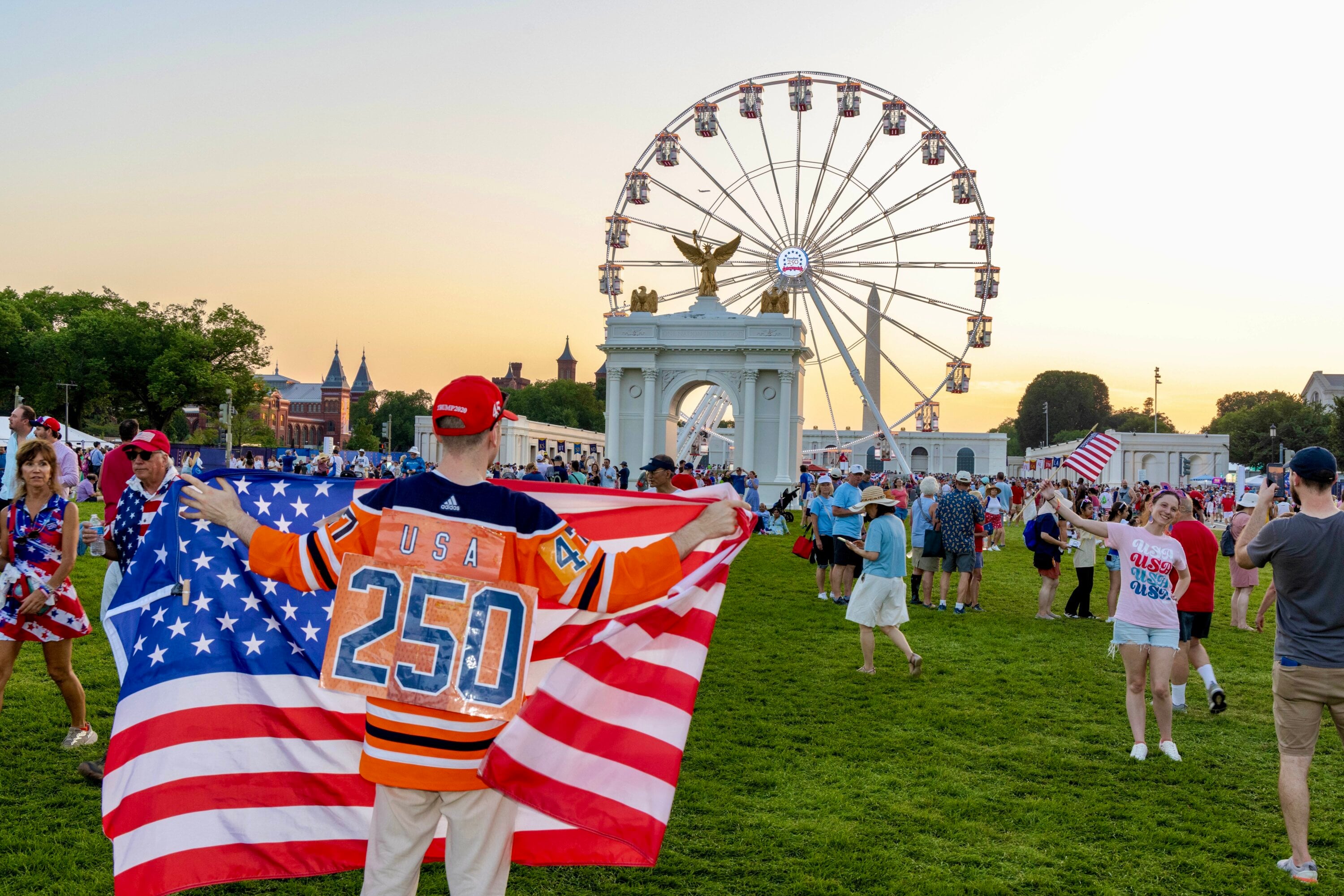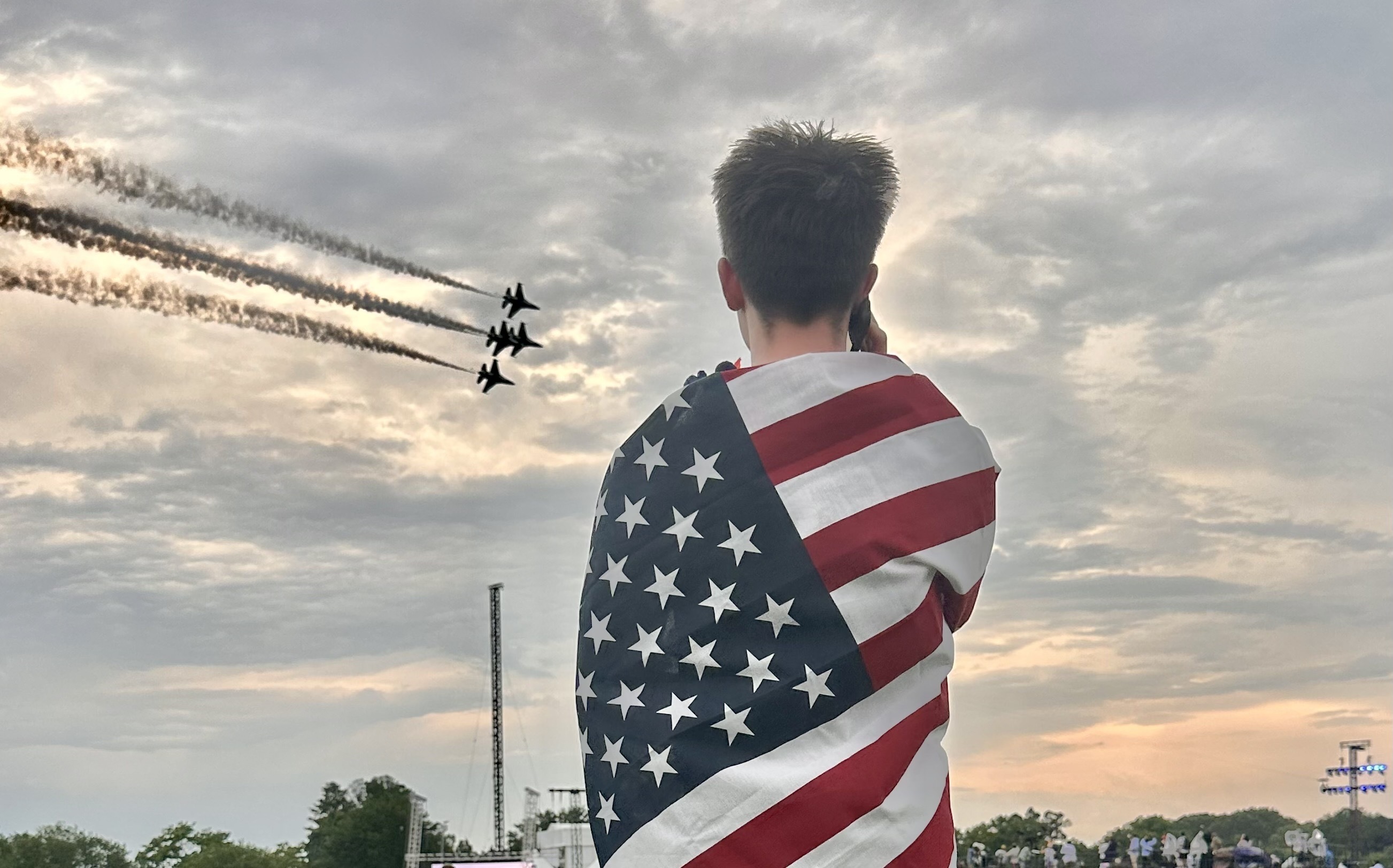
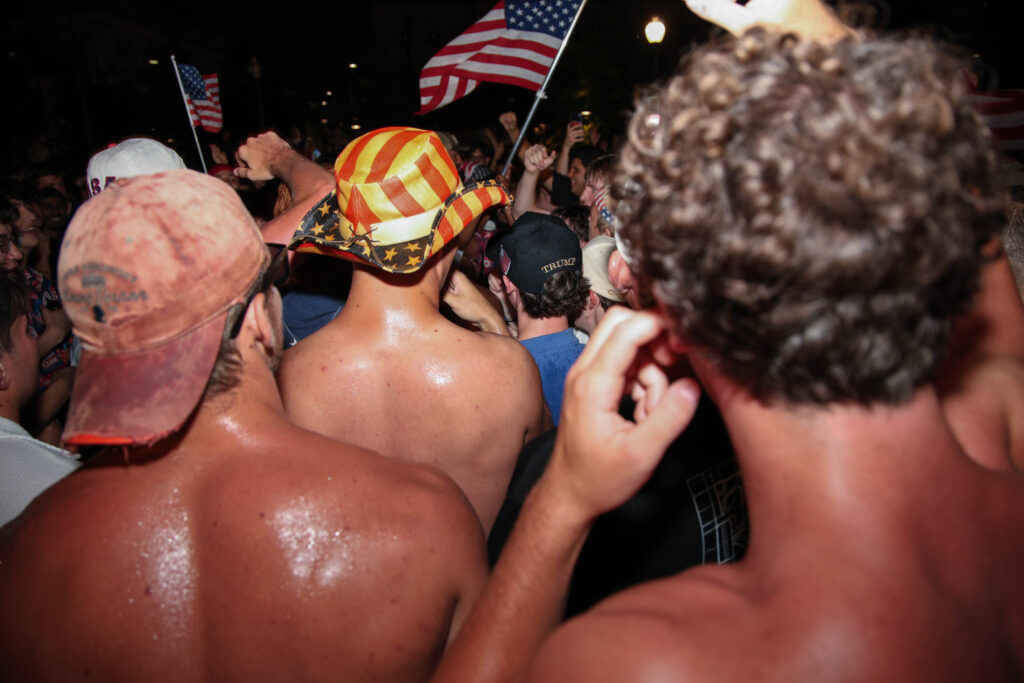
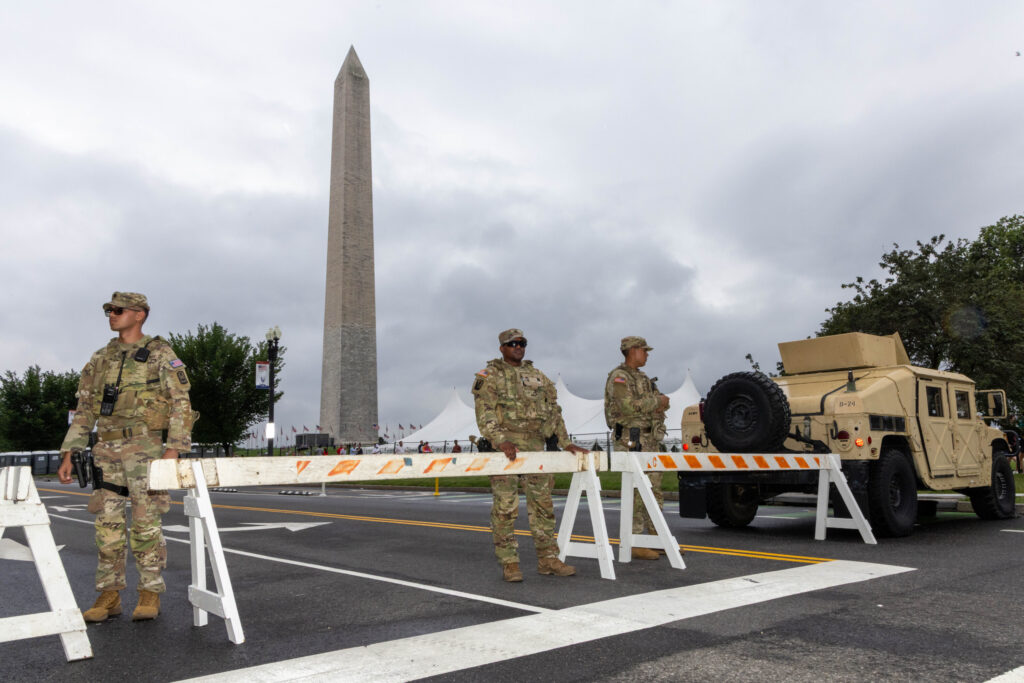
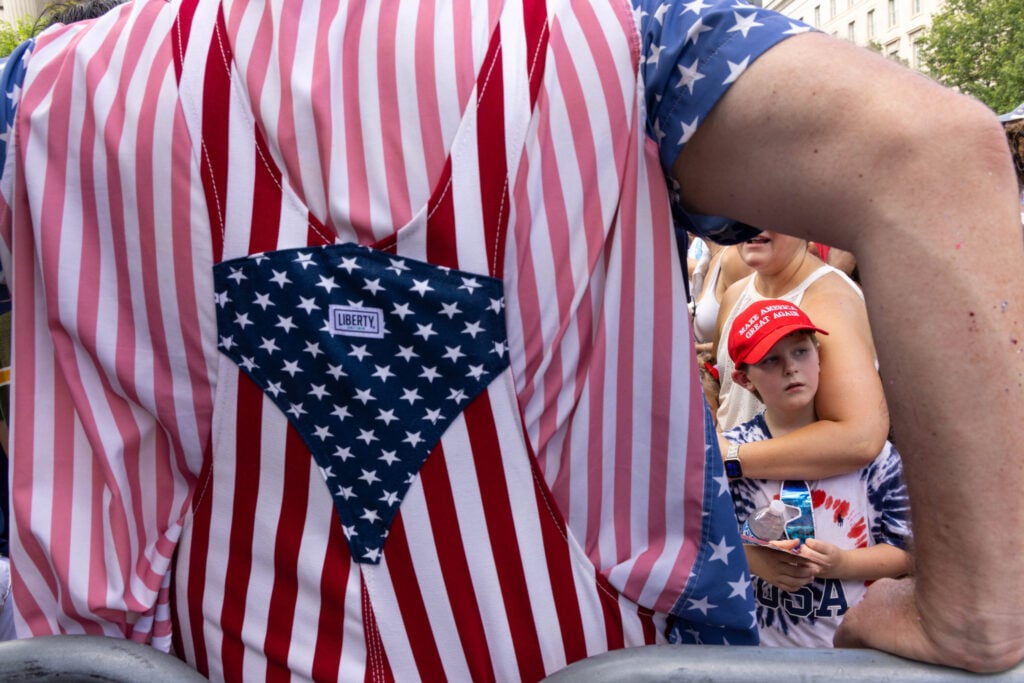
On America’s 250th birthday, while lightning sporadically lapped at the National Mall, I sat on a curb outside of the Willard Hotel. Around me was a scrum of Americans: street preachers and squalling children, folks in MAGA hats and bucket hats and sequined “47” hats. A utility wagon stuffed with five tiny gingham-clad boys. I saw a tall man in a priest collar and cowboy boots and a guy with a 2A shirt and an enormous black eye. Flags rippled. Sirens whooped. On garment after patriotic garment flew various forms of bellicose eagles—talons out, eyes crazed—positioned atop fields of stars and stripes.
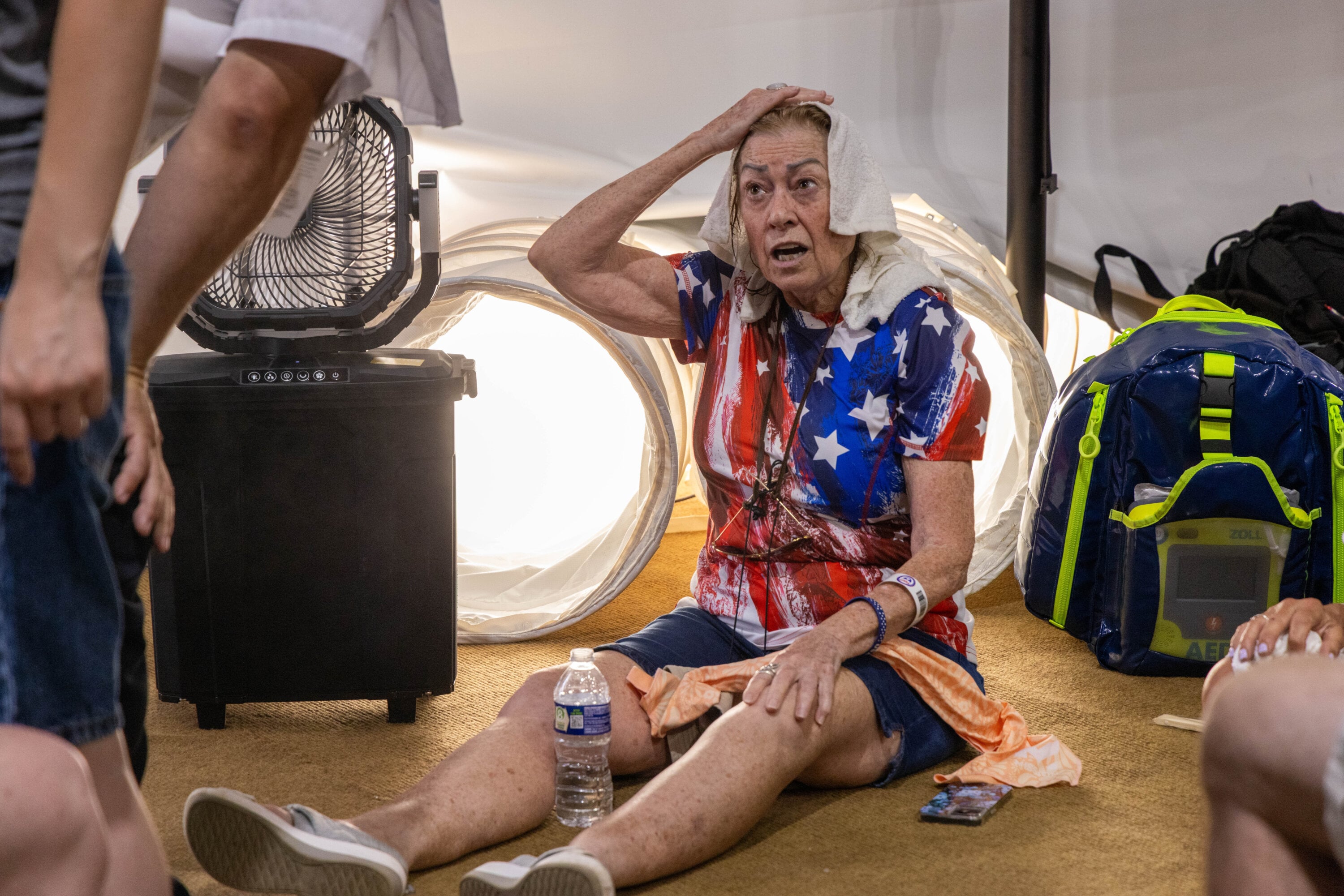
This crowd of thousands was milling around outside the Mall, hoping to get back into the Trump rally. But thunderstorms prowled downtown, and officers had evacuated the area, forcing out throngs of people who’d waited for hours in the broiling heat to hear the president speak. Inside the security fencing, folks groused and loitered and argued with officers trying to get them to leave. Outside the fencing, those who’d been more cooperative bobbed and swayed while a DJ played “YMCA.” A graying man in sunglasses danced lazily atop a police barricade. A young Black guy ambled by wearing a “just here for the fireworks” shirt.
For a week now, a line from a New York Times op-ed has been rolling around my brain: The Trump-inflected America 250 spectacle has “looked like the kind of imperial indulgence that tends to mark the end, not the apogee, of a given reign.” I guess I’d come to see if that felt true, whether the MAGA movement seemed to be out of gas, flagging under the weight of high grocery prices and petty government bickering and hypocritical wars. It certainly felt ominous that the nation’s birthday party had turned into a slapdash partisan festival fixated on military displays and evangelism and trite simulacra of the American heartland. And a late-night political rally followed by the “largest pyrotechnics display in the history of the world” didn’t quite strike me as the hallmark of a nation that’s functioning smoothly with nothing to prove. But what did I know, since I couldn’t actually get onto the Mall.
After a couple of hours, the rains came in and thwarted rally-goers sheltered under awnings and in stairwells, looking glum, pulling clear plastic ponchos over their heads. I passed two drunk men in America 250 shirts literally fist fighting on the sidewalk. A weary National Guardsman drank a Celsius while staring blankly into the night, as teens in red-white-and-blue tank tops careened around on motorized scooters, menacing anyone within the splash radius of the street. Clearly, the president had wanted a patriotic event of historic proportions that primarily honored himself—and instead, he seemed to be getting a rained-out rally during a record-breaking heat dome. The excessive fireworks show he planned was unlikely to occur. It all seemed over, so I left.
But of course, the rally later went forward. World-historic pyrotechnics ensued. The next day, a toxic miasma hung over Washington, a “hazardous firework-induced smog.” Walking the dog, I could feel it grate at the back of my throat.
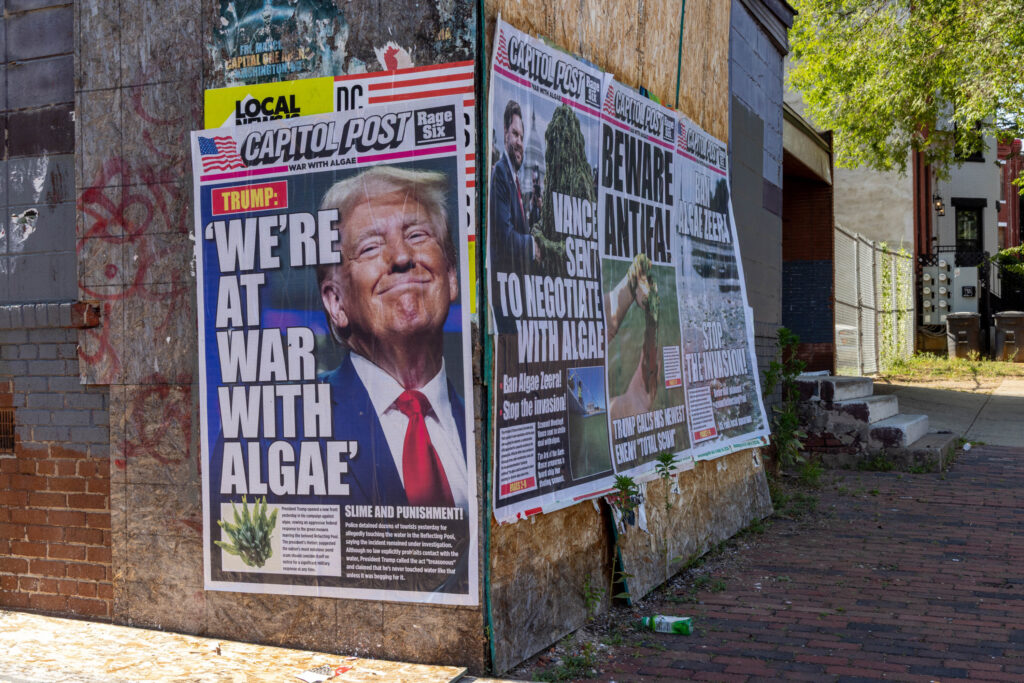
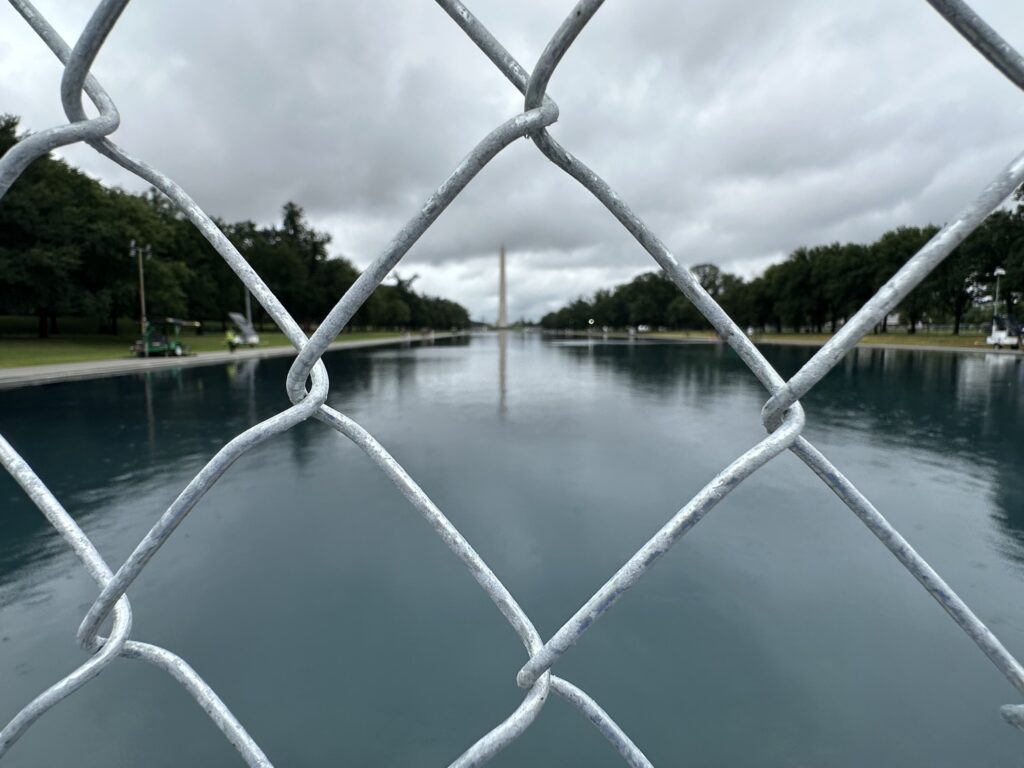
All summer, DC has felt bad. Downtown is engulfed by Trump’s ego. We have his vanity fountains and vanity arts center and vanity gas prices and ballroom and military presence and arch. The other day, I jogged past members of the US Marshals Fugitive Task Force surrounding the algal Reflecting Pool, which was recently repainted in American Flag Blue and then quickly beset, I’m told, by deranged leftist vandals who are tired—so tired—of America being great.
People from out of town keep texting me. They want to know about the duck carcasses in the Reflecting Pool and the tarp hiding the Kennedy Center’s facade and the vast, empty expanses of the Great American State Fair and the Trump rallies and the UFC fight and the man doing motorcycle flips on the White House lawn. Other times, when I tell friends things feel bad here, they say, sheepishly, “I’m sorry, but what’s been happening? I’ve totally tuned out the news.”
To those friends, I try to describe the day-to-day strangeness of living in a city that’s been relentlessly brutalized by Trump. Imagine what it feels like, I say, when a gazillionaire saunters into town, running an agency trollishly named “DOGE,” and casually slashes tens of thousands of local jobs. Imagine this rippling across the region’s schools and churches and restaurants and hospitals. Imagine what that means for our tax base, for our social services, for morale.
And then just contemplate, for a moment, that the reporter who told these stories best got a knock at her door one morning. Federal agents swarmed her home and confiscated her phone and laptop, rendering her essentially unable to continue on that beat. Notably, she’s at the Washington Post, another sizable local employer that’s been devastated since Trump’s return.
I cannot possibly describe all the ways this president has hurt DC. There were the federal immigration agents who fanned out across the city, creating ad hoc checkpoints at busy intersections, terrorizing folks on their way to work. There was the spiteful shuttering of the Kennedy Center, leaving hundreds of arts workers out of jobs. Once, I grabbed an Uber in Bethesda and the driver was a former researcher from the National Institutes of Health who’d studied antibiotic-resistant bacteria before his lab’s federal funding got slashed. And the victims aren’t always who you’d think. Last fall, I spent hours on the phone with a distraught member of the DC National Guard who despises Trump’s “Safe and Beautiful” mission. He’d enlisted because he wanted to help people—to hand out pallets of food, or stack sandbags in advance of a flood—not intimidate civilians at the president’s behest.
All over town, there’s a sense that it didn’t need to be this way, that Trump has senselessly hijacked functioning local institutions and run them into the ground, all while insisting that he’s saved DC. In general, my reaction is not fear but exhaustion, and sometimes a grim appreciation for the absurdity of it all. On Wisconsin Avenue, I recently saw a middle-aged white man in pressed slacks and a collared shirt dismount his bicycle and, helmet still on, delicately spray paint “Fuck Trump” onto an electrical box right across from Sidwell Friends in the middle of the day.
Sometimes it seems like the worse things get, the pettier I become. On the night of the Fourth, for example, I didn’t even see the fireworks. I was asleep before midnight when they began, and then woke to the most polluted air of any city on Earth. I feel personally victimized by those fireworks, so it was a little bewildering to find myself speaking of them with glee, cackling about the trapped smoke that obscured the grand finale, which made it look vaguely like the Capitol got nuked.
That’s what happens, I think, when our local misfortunes become national in scale. There’s a sleight of hand that we sometimes perform in DC, where Trump blunders in a way that hurts both himself and the city—he ruins the Reflecting Pool, or rips up the grass on the Ellipse—and instead of registering it as a civic loss, we relish it as a partisan win.
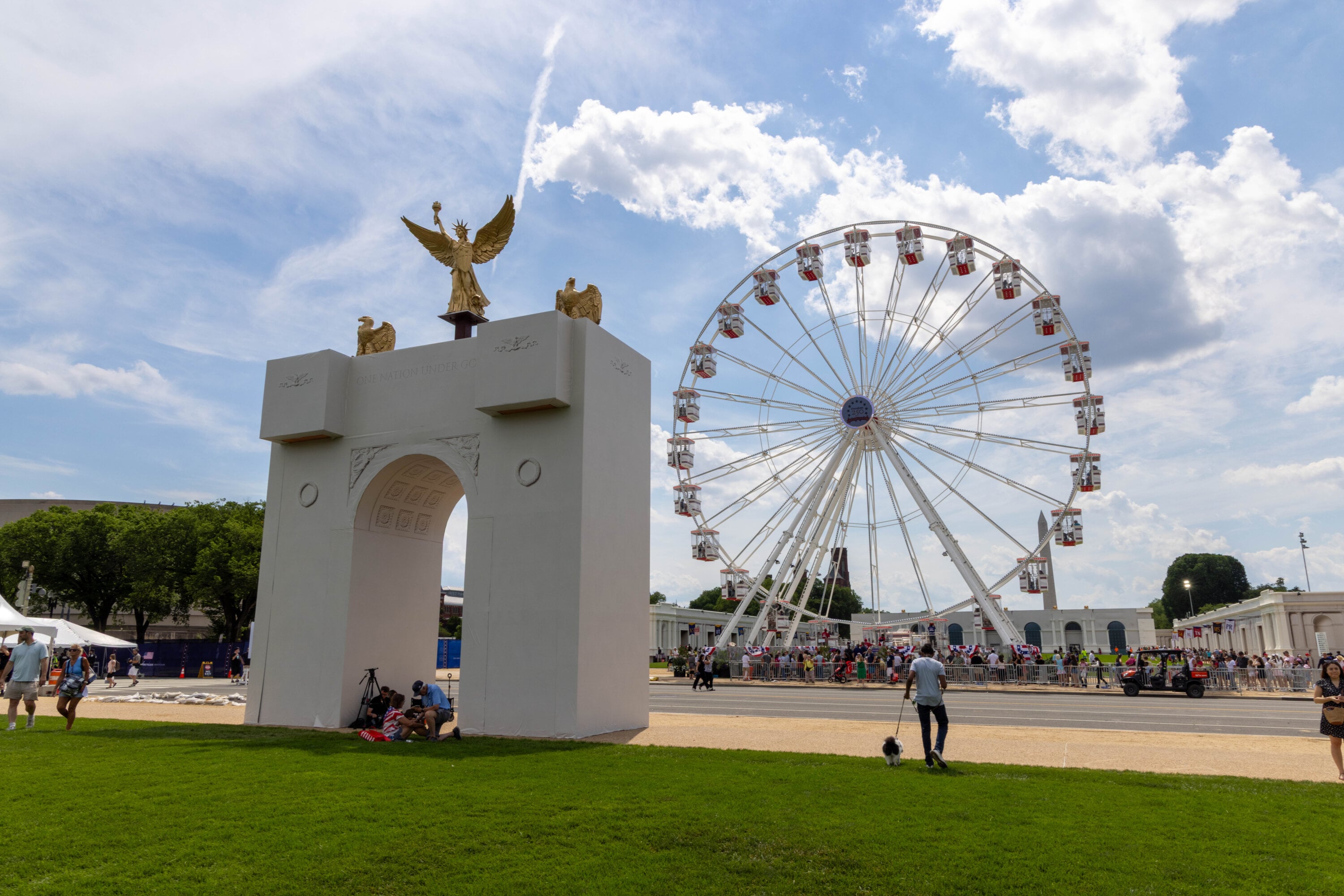
At its laziest, the emotional logic goes something like this: “Sure, we are losing on most issues of substance, but at least the caulk is oozing on Trump’s miniature arch.” One notch more thoughtful, perhaps, is to believe that emphasizing Trump’s embarrassments might slightly chasten him, while also signaling to the downtrodden left that his victories may not stand, that his catastrophic changes to our tax code and reckless meddling abroad and damaging wins on abortion or immigration or voting rights might turn out to be just as flimsy as that deteriorating arch. That strikes me as magical thinking. I do not believe that the peeling paint on the Reflecting Pool portends a greater fall. And crowing about Trump’s inconsequential failures reads to many Americans not as helpfully pointing out his ineptitude, but as radiating pure contempt.
It’s difficult to discern which political actions even matter these days. Yelling at Trump officials in restaurants? Tweeting hair-on-fire news stories? Banging a cowbell outside the Supreme Court? Surely not the electrical-box graffiti, or sending emails to Eleanor Holmes Norton, or the armada of trite protest statues that incessantly colonize downtown: Trump dancing with Epstein, or the ice sculpture that read “DEMOCRACY” before it melted on the Mall.
I think about this a lot with the Kennedy Center. It makes sense to boycott until Trump quits the board. He’s commandeered the place, revamped it to glorify himself, and announced—with breathtaking arrogance—his ambition to create the “greatest arts complex in the history of the world” while driving out anyone with actual expertise. Why reward that behavior? Why not force him to fail? But the question becomes thornier when contemplated at a more human scale.
To boycott the Kennedy Center is to make a specific and somewhat perilous calculation: that jeopardizing the livelihoods of hundreds of artists and arts workers—hundreds of families who live in this city—is worth it in order to maybe (maybe!) make the president feel a little bad. I think it’s defensible to argue that resisting authoritarianism is more important than preserving a local institution. But when we interpret our civic obligations primarily through the prism of opposing Trump, who does it actually serve?
Trump uses DC as a stage from which to project power, hanging authoritarian banners from our federal buildings, rolling tanks through our streets, subjecting us all to military flyovers and hostile renovations, slapping his cheap pseudo-opulence atop our civic life. In turn, we want to puncture that sheen of power, to reveal that the strongman shtick is flimsy—the pettiness of draping a tarp over the Kennedy Center’s sign, the bewilderingly poor planning of the Great American State Fair.
But I want to suggest that when we react to Trump on the terms that he’s set—arguing about crowd size, jeering at the botched Reflecting Pool—the central question remains about his power, about whether it’s as great as he thinks it is. And in a lot of ways, unfortunately, it is. Trump is unconstrained by most of the things that typically constrain a president, including norms and laws and decency and the fear of either voters or God. When we wage a symbolic fight over power, we lose it. We’re battling on his terrain.
I’m sad to have written so many words about the ridiculous fireworks display that I didn’t even watch, because here’s the part of the Fourth that mattered to me: That morning, I went to the Palisades parade. It was joyful there—full of Boy Scouts and Bolivian dancers and kids draped in DC flags. For an hour, I stood behind two girls in striped dresses who licked rocket pops while applauding local marching bands and beauty queens as they passed. This version of the city still thrives—the one that is normal and alive, where the mayor throws bouncy balls to children and neighbors crack morning beers. Opposing Trump might be among our civic obligations. I just don’t think it’s the most important.