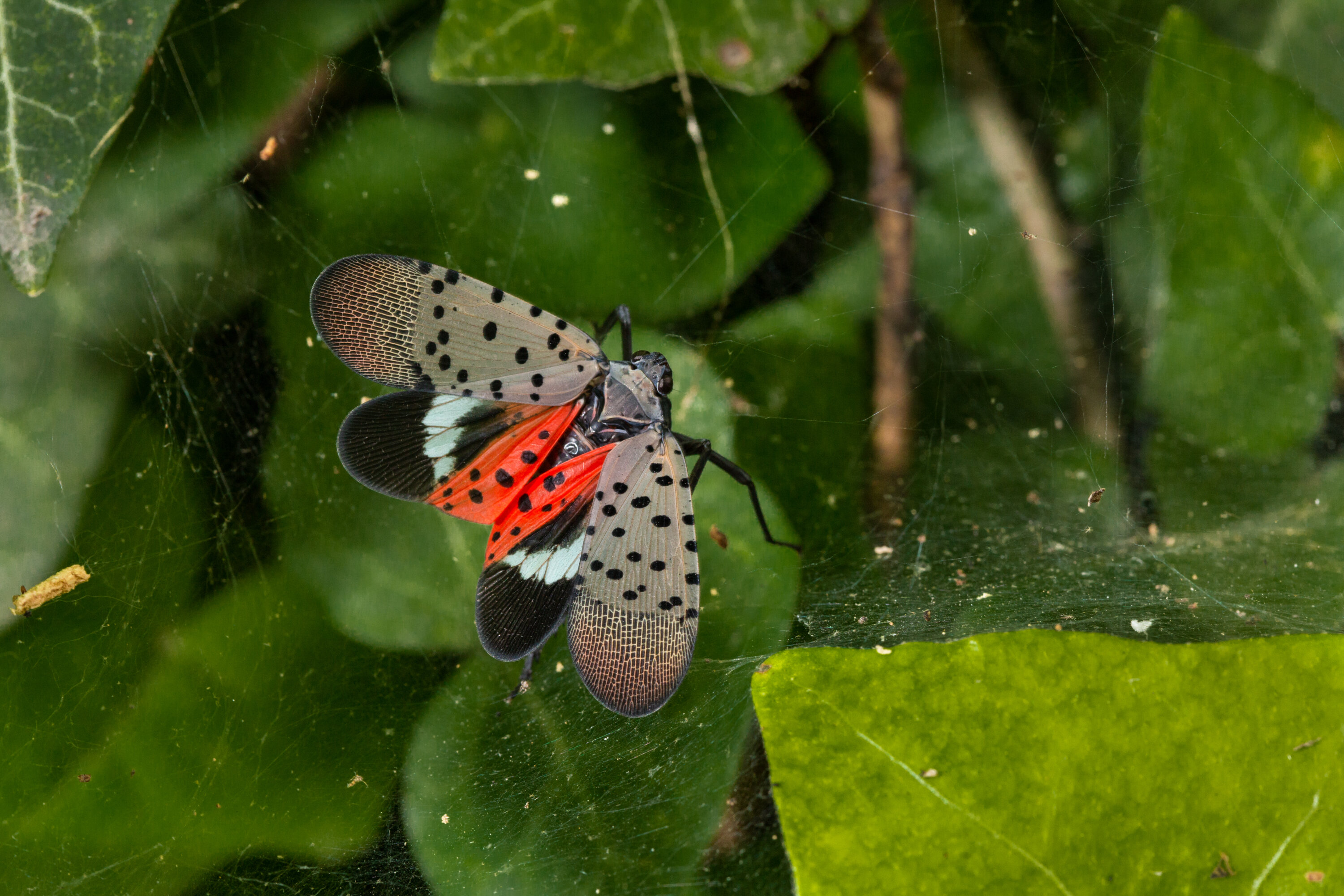
Spotted lanternflies are about to swarm the DC area. Here’s everything you need to know about what to expect and how to lantern-proof your yard.
Spotted lanternflies are an invasive species notorious for their size, bright colors, and tendency to get in your way. According to Earl Eutsler, of the urban forestry division at the DC Department of Transportation, this year Washington will see more lanternflies than ever.
“I’ve been with urban forestry for 23 years,” Eutsler said. “It’s not the first invasive pest invasion, but it’s certainly one of the most visible in that 23-year period.”
Spotted lanternflies have been prevalent in other parts of the northeast for a while, but didn’t show up in Washington in large numbers until 2023. According to Eutsler, spotted lanternfly populations tend to plateau after four years of exponential growth—meaning that this year will be the most abundant population of the cycle.
The insects come into gestational maturity in July, which is when they start non-consensually landing on your shoulders and cluttering walkways. You may have already seen them scuttling along branches as baby and teenage nymphs.
Spotted Lanternflies don’t bite people, so unless you work in agriculture, they’re more nuisance than threat. The bugs feed off tree sap, which is why you’ll see them blanketing trees in your neighborhood.
They are drawn in particular to Ailanthus trees, or colloquially the “Tree of Heaven.” These trees are also non-native but fairly common, with a population of 69,000 in the District.
However, there are several native lookalikes, so don’t take an ax to one in your backyard without checking first. If you do have an Ailanthus tree, or some other tree they’ve infested (they aren’t picky eaters), there’s a few things you can do.
First, you can report sightings to DC’s Urban Forestry Department. According to Eustler, reporting is helpful for their teams in tracking populations and protecting the urban canopy.
“We have a team of more than two dozen urban foresters that are in the field every day,” Eustler said. “But we have 700,000 residents in the District, and that’s a lot of eyeballs.”
You can also use pesticides to get rid of infestations on trees in your yard. Dinotefuran is an insecticide that, with the help of a licensed applicator, can be injected into trees so they poison feeding lanternflies.
Eustler said he discourages the use of sticky bands on tree trunks since they’re largely ineffective once flies are in the tree, and they run the risk of catching birds and squirrels. Instead, he said you can easily get rid of an infestation by taking a shop-vac to the branches.
If you’re seeing the not-fully-grown nymphs, you can knock those out of the tree by spraying them with mildly-soapy water.
Luckily, Eustler said spotted lanternfly populations are likely to decrease in coming years as the local ecology adjusts. It won’t be long until wildlife populations learn that, despite their bright color, lanternflies are edible, slow, and packed with protein.