Although David Brooks spent 22 years as a columnist at the New York Times, the job, he says now, wasn’t a great fit. He chafed at the op-ed format’s tight space and struggled to muster the volume and certitude of opinion that punditry demands. Brooks says he knew he was miscast even before he was offered the column. “Say no. Say no. Say no,” he told himself in 2003 as a DC–to–New York train carried him toward a meeting with Times publisher Arthur Sulzberger Jr. “Instead, I just had a failure of courage and said yes.”
Times readers savaged Brooks’s first efforts. “I had never been hated on that large a scale,” he says. Over the years, media critics and fellow pundits joined in to routinely pummel him even as he cranked out bestselling books and ascended the ranks of influential pundits. Detractors ridiculed him as arrogant, vapid, and worse. “I am in my 22nd year of publicly pronouncing that David Brooks sucks,” author and Chicago Times book reviewer John Warner wrote on Substack not long ago.
Critics don’t just disagree with him; they’re outraged. Brooks told me he’s grown inured to the criticism. Some of it is deserved, he acknowledged.
Such exasperation is not uncommon. Thanks to that twice-weekly Times presence (some 2,000 columns), nearly 25 years as a commentator on the PBS News Hour, regular NPR guest spots, six books, and countless paid speeches (at least one agency sets his fee at a minimum of $100,000), Brooks has provided a whole lot of ways for people to find him irritating.
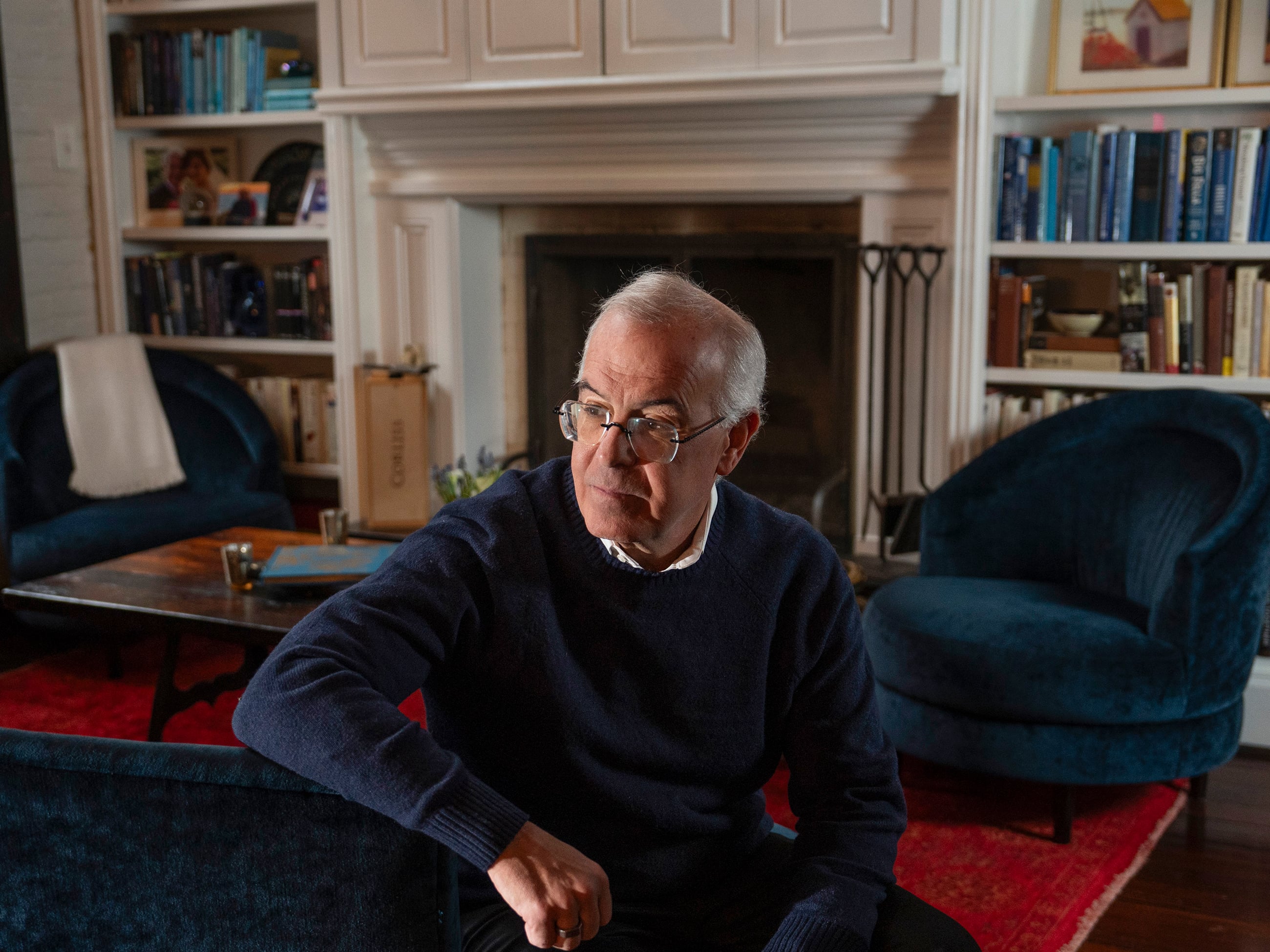
Recently, I met Brooks at a Capitol Hill coffee shop near the Lincoln Park home he shares with his wife, Anne Snyder, editor in chief of the Christian-humanist magazine Comment. He arrived in a suburban-dad uniform: black pants, black Under Armour sneakers, and a blue cardigan that he never removed even as broiling sunlight beat down on our window table.
At that moment, American forces were massing in the Persian Gulf ahead of the war with Iran. But for the first time in years, Brooks wasn’t mulling over the news of the day for a column. The 64-year-old stepped down from the Times in January and is largely retreating from politics, which he’s covered for four decades—from his Times perch and, previously, the National Review, Wall Street Journal, and Weekly Standard.
In January, Brooks was hired as a staff writer at the Atlantic, where he’s dedicating himself to work that grew out of his failed first marriage and an ensuing personal reckoning. America, he contends, has become a meaner, sadder, and lonelier place, conditions that gave rise to Donald Trump.
As a correction, Brooks—a self-described conservative—calls for the reconstruction of a lost “shared moral order.” His is not a Jerry Falwell–like campaign against sin but rather a bid to restore kindness, humility, and generosity, virtues he believes lie buried under 60 years of moral relativism.
“What the hell happened to us?” he asked on a recent Times podcast. “Why did 77 million people last election take a look at Donald Trump and didn’t see anything morally disqualifying? I do not think that would’ve happened in America 50 years ago. I think there was a moral ruination, a loss of moral knowledge that preceded Donald Trump’s arrival on the scene.”
Politics, Brooks has come to believe, is exciting but lacks depth. He wants to devote himself more fully to weightier matters. “What the novelist deals with, what a historian deals with, what a moral philosopher deals with—that just strikes me as more important.”
Not long ago, Brooks and Snyder hosted dinner parties at their home on three consecutive nights. He spends some 200 days a year on the road giving speeches and making appearances, so this was a rare opportunity for sustained conviviality. On one of the evenings, Brooks presented a conversational topic to the room: “Describe 30 seconds of your life when you were deliriously happy.”
That’s the sort of question that now dominates his professional life. Beginning this summer, Brooks will host a weekly Atlantic video podcast tentatively called The Great Conversation (produced in partnership with Yale University, where he recently started a five-year stint as a senior fellow). Guests will include historians, scholars, writers, and thinkers discussing fundamental questions of the human existence, from the nature of democracy to how to find meaning in retirement.
Brooks has been delivering on such grand notions for years, at times wrestling with his own often messy path. A decade after his arrival at the Times, he was a top-tier political writer and talking head, living with his wife of 27 years, Sarah—a college sweetheart from their days at the University of Chicago—in a $4 million Cleveland Park home, the nest nearly emptied of their three kids.
But in 2013, she and Brooks divorced, an event he attributes in part to his own failings. His climb to success had left him “aloof, invulnerable, and uncommunicative,” he writes in The Second Mountain: The Quest for a Moral Life, his 2019 book about how to find meaning and purpose. He moved into a Wisconsin Avenue apartment where he did little but work, his playlist heavy on melancholy songs by Sinéad O’Connor. He deeply missed his family’s lively Friday Shabbat dinners.
A champion of marriage as a societal bedrock, Brooks was humiliated by the failure of his own relationship. His frequently professed admiration of Barack Obama also had left him estranged from his conservative brethren. He was adrift and alone.
To escape this wilderness, Brooks refocused his work and life. Persuaded that his loneliness was symptomatic of a national malady, he started a nonprofit through the Aspen Institute, called Weave: The Social Fabric Project, which aims to strengthen community in towns and cities nationwide. His books also became more personal and earnest. His first, 2000’s Bobos in Paradise, had been an extended skewering of elites. By 2015’s The Road to Character—much of which was written during his post-divorce meltdown—he was mixing self-help, philosophy, and religion as he tried to help readers—and himself—build a meaningful life. “I’m working out my shit in public,” he says.
Snyder, who is 23 years younger than Brooks, was his research assistant on The Road to Character, hired while he was married to Sarah. He says the relationship remained purely professional during the period when he was still married. When he later made his feelings clear, Snyder rebuffed him, left DC, and cut off communication.
Still, Brooks pursued her, planting messages for her in his Times columns. Eventually, his efforts paid off. They married in 2017. At the recent dinner party, when it came time for him to talk about his own memory of when he was deliriously happy, he first played it for laughs, pointing to the New York Mets World Series victory in 1986. Then he told the story of falling in love with Snyder.
The unconventional details of Brooks’s personal life have served as fodder for his critics anytime he has addressed questions of morality. In April, social media lit up with mockery after Yale announced that he’d be giving a lecture called “David Brooks: How to Fall in Love With Someone.” The New York Post covered the ensuing reaction in a news story: “Atlantic writer David Brooks, who married his much younger former research assistant after divorcing his longtime first wife, was blasted online for a planned lecture on—of all things—love.”
Brooks has always inspired such animus. The man can get under the skin. Critics don’t just disagree with him; they’re outraged. They think he’s a fraud, a poseur, a hypocrite. They accuse him of cherry-picking facts and twisting reality to fit his worldview. “He’s just making this shit up,” says the Nation’s Chris Lehmann, who earlier this year wrote a column thumping Brooks as “smug and vacuous.”
Like a lot of liberals, Lehmann argues that Brooks wrongly blames America’s cultural failings for its ills, dismissing economic inequality. Brooks beats up Democrats as out-of-touch elites, but he couldn’t be more out of touch himself, Lehmann says. Exhibit A: a widely mocked 2017 column in which Brooks uses a gourmet sandwich shop to argue that cultural barriers do more than policy or income to separate elites from the rest of us. The reaction was explosive, with detractors on social media and in the press slamming him as cartoonishly out to lunch.
At least some of the outrage against Brooks stems from what, in an era of partisan extremes, seems like his ideological squishiness. Conservatives fume that the mainstream media calls on him to represent them despite apostate sins such as gushing praise for Obama. Liberals believe that his lefty leanings are disingenuous given his cheerleading for George W. Bush’s Iraq war and tepid early criticism of Donald Trump. (He now describes his boosterism for that war as “the biggest error in judgment of my career.”)
In the coffee shop, Brooks told me he’s grown inured to the criticism. Some of it is deserved, he acknowledged. No one can do their best work writing a column essentially every two days.
“If only saints could talk about and wrestle with moral issues in public, it’d be pretty quiet.”
Brooks expects that the barbs won’t abate as he now focuses on promoting a moral renewal. “Some people just have an aversion to moralizing in public, and I get that,” he says. He knows he can come off as self-righteous, he adds, though he tries to be humble. To those who think his marriage precludes morality as a topic to explore, he responds, “If only saints could talk about and wrestle with moral issues in public, it’d be pretty quiet.”
Brooks is optimistic about his new venture. Thanks to his post-crisis personal evolution, he feels more equipped to talk about how to be a better person and lead a meaningful life. Previously, he had “the emotional capacity of a head of cabbage,” he has written.
Today, Brooks says he’s more open and vulnerable, quicker to ask about a friend’s personal life, more ready to talk about his own. He’s part of a men’s reading group that he describes as “soul-baring.” Oprah Winfrey told him not long ago that she’s never seen someone go through so much change at midlife.
On the road, college students talk to Brooks about their love lives and CEOs open up about their loneliness. It shocks him. “A kid came up to me a couple years ago and said, ‘My mom died, and I’ve never cried. I’ve never mourned her,’ ” he recounts. “Now I have something to say to that.”
Meanwhile, his own emotional state remains an ongoing project. If you’re more open, he says, you feel everything more deeply. “I am both more happy,” he says, “and more sad.”
This article appears in the June 2026 issue of Washingtonian.