Lindsay Owens believes that corporate profiteering has been turbocharged by technology, and she wants the government to fix it. She does not want rideshare apps to spike fares when your phone battery is low. She does not want landlords to coordinate rent hikes via shared pricing algorithms. And she does not want your airfare to rise because you just visited the website of a funeral home, making your travel seem urgent.
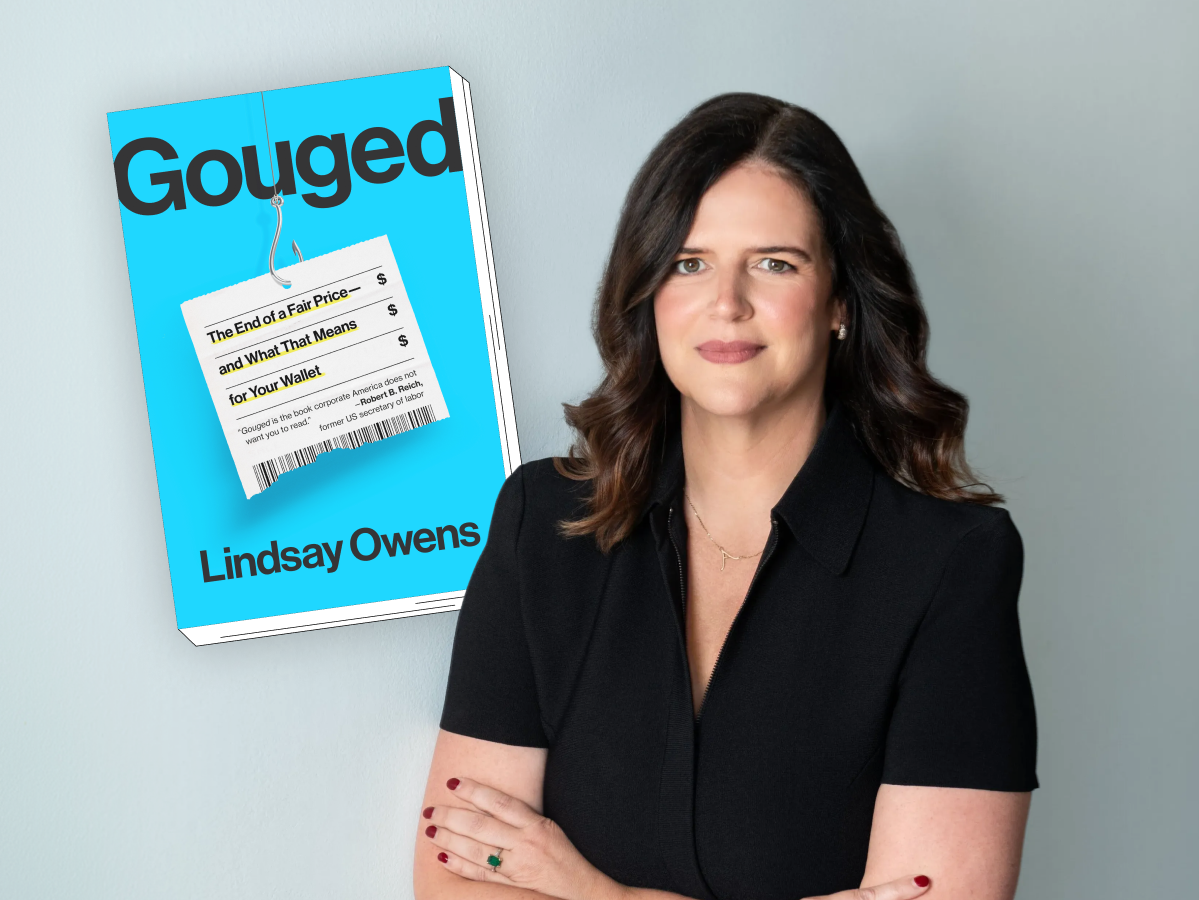
As executive director of the DC-based Groundwork Collaborative—which is part consumer-advocacy think tank, part corporate watchdog—Owens knows the unsavory tricks that companies use to raise prices. She spends a good chunk of her life listening to corporate-earnings calls and poring over patent applications, researching “the lengths that companies will go to in order to squeeze every penny out of you.” In her new book, Gouged , Owens walks readers through the bizarre, tech-addled landscape of contemporary shopping, explaining the mechanics of surveillance pricing, dynamic pricing, algorithmic price fixing, and junk fees. The book is not a how-to guide for outfoxing corporations; it’s a cri de coeur for lawmakers and regulators to protect consumers at a broader scale.
An economic sociologist who spent years advising Senator Elizabeth Warren, Owens is righteously angry. “Companies are doing well while many Americans are suffering,” she told me recently over coffee. We spoke about why prices are so high and how we could fix it.
Companies are very secretive about their pricing technologies. How do you uncover what they’re doing?
At the end of the Obama administration, when I was working for Senator Warren, one of the things I spent the most time on was called the fiduciary rule, which was so people who bill themselves as financial advisers, retirement advisers, or brokers can’t cheat people out of their retirement savings. I got kind of radicalized by it because I watched how lobbyists slithered through Washington trying to undo this stuff, spewing scare tactics about how if they couldn’t cheat retirees, they wouldn’t offer financial advice anymore at all and the whole industry would evaporate.
So they were on the Hill telling us the sky is falling, but when we went to their earnings calls, they were telling investors they’ll be able to weather this regulatory change, no problem—and actually, they have all these new technologies to make sure they’re compliant with the law. I think this was a training ground for the research skills that show up in Gouged . You have to look at the places where corporations are more truthful, like in the patents they file, which tell you about the technologies they’re planning to roll out.
You mentioned earnings calls. What’s happening in those?
Publicly traded corporations have regular earnings calls with their investors to update them on how the past quarter went. By law, companies have to tell the truth to their investors with regard to things that impact the material circumstances of the company. These calls can be really interesting ways to understand how specific corporations work.
What has struck you?
The most galling and eye-opening experience for me was how little concern CEOs initially expressed about inflation during the pandemic and how corporations took advantage of that moment to charge higher prices than they needed to. Consumers were all freaking out about inflation. Most of us had never experienced it—this was the first period of high inflation in decades. But over and over again, what we found was that CEOs were really bullish on getting through this. On earnings calls, they were doing an inflation happy dance, talking to their investors about how “a little bit of inflation is always good in our business” and praising their employees and their teams for their excellent work in “driving price,” which means increasing prices. They had already built a whole host of technologies that would help them exploit this moment.
Some of those technologies were related to surveillance pricing. What is that?
Surveillance pricing is probably the gnarliest of the pricing tricks. The idea is that companies are collecting data about you for the purpose of extracting the maximum amount of your wealth. They use data—like your demographics and location and purchase history—to determine the highest price you might be willing to pay.
Americans seem furious about it.
Surveillance pricing is at the intersection of two things Americans hate: being spied on and being ripped off. People hate how pricing works in general. It feels unfair if they’re charged more for ice cream on a hot day. They’re mad about FIFA World Cup tickets being auctioned off to the highest bidder, such that revenue maximization trumps having a shot at taking your kid to a once-in-a-generation World Cup match. It’s not just that the prices are high; it’s the way that pricing works. It feels like the game is increasingly rigged against you.
And you think AI will make that worse.
Yeah. One of my biggest concerns is the extent to which agentic commerce is going to supercharge these dynamics, because [AI companies] have so much information about you. The example I give is that I use ChatGPT a little bit in potty training my toddler, and if I then started shopping using AI, would my agent exploit the fact that I’m a stressed-out mom? Am I willing to buy whatever potty-training tools I need at a higher price point?
Google has already announced they are building out the infrastructure for folks to use Gemini to shop online, and I think that has the potential to be a price-gouging nightmare. There are a whole host of conflicts. Like, does your agent work for you? Do they work for whatever retailer pays Gemini the most for your information?
Some might argue that tech-optimized pricing isn’t fundamentally different from what companies were doing before. Senior discounts are a form of personalized pricing. Dynamic pricing, like peak and off-peak rail fares, can help balance supply and demand.
For me, broadly applicable discounts are fine when they’re disclosed and available to everyone—or to all members of a socially accepted class, like students or seniors. I also think there is a place for dynamic pricing in managing scarce resources effectively. I think the question in any setting is: What is the goal of this pricing strategy, and what are its consequences?
The thing that worries me is we’re seeing dynamic pricing move into a whole host of arenas where managing scarce resources really isn’t at the center. Like, Las Vegas casinos are not running out of sunscreen. They’re charging more for sunscreen on a hot day because they know it’s hard to hike across the street to get a cheaper product at CVS.
And there’s an anticompetitive aspect to dynamic pricing, too, because it makes it almost impossible to comparison-shop.
Yes. If you’re on a budget, you vote with your feet. You say, “Oh, that seems a little high. Let me go across the street and see if I can get a lower price.” Well, if the high price at this first store has changed by the time we get to the next store, there’s no way of comparison-shopping.
The problem for the economy is that the mechanism by which prices stay competitive is actually, in part, on-the-ground budget shoppers. When everyone starts moving to the lower-price item, the higher-price store should bring down their price. If that mechanism is unraveling, it creates problems for ensuring pricing competition in the economy writ large. And so I think this is bigger than just the household budget. There’s a way in which the budget shopper is actually doing really important work in the economy that’s being undermined by these new types of prices.
How do you personally shop?
The first thing I’ll say—and I don’t mean to dodge the question, but I just really feel strongly about this: I do not think it should be up to individual shoppers to figure out how to beat the machine, to bob and weave and try to get out of being ripped off online. I think it’s time for lawmakers to reevaluate the rights of consumers in the digital era so that they are not exposed to as much of this grift and gouging.
But I try to do as much brick-and-mortar shopping as I can. And I am not using AI a ton. I’m not someone who gives my phone number to companies or signs up for loyalty programs. My staff make fun of me for not getting airline points when I travel, but loyalty programs are data-harvesting operations, and as they get more and more information about your purchases, the perks and freebies go away. There is a real concern that they start to exploit the most loyal customers because they know you’re a sure thing.
How angry is the public about these pricing tricks?
We have done quite a lot of recent polling on these topics, and we find that overwhelming majorities of Americans support very aggressive policy intervention to eliminate these practices. Around 80 percent of people are interested in banning surveillance pricing and other similar practices, depending on the question in the poll. When I see numbers like that, it says to me that this isn’t a partisan issue. It’s a values issue. It’s hitting on something deeper than policy or politics—it’s hitting on a core value, and that’s fairness.
What would your top policy solutions be?
An outright ban on surveillance pricing is top of my list. There is no need for companies to set prices based on your personal data. Another is that I really like the idea of requiring AI agents to work in the consumer’s best interest when they’re doing shopping. [Senator] Mark Warner has introduced legislation that he’s calling the “AI AGENT Act” that will require AI agents to act in your interest, just like a Realtor has to act in your interest. And we’ve got to make it so that algorithms cannot help industries coordinate their pricing in anticompetitive ways. Price fixing is illegal. Companies cannot get together and decide to coordinate on price. Algorithmic price fixing is price fixing. It’s anticompetitive. It’s collusive. It has no business in the American economy.
All this pricing technology is too complicated to follow.
That’s the big fear, that everything becomes as complex and vexing as shopping for flights online, a world in which shop-ping for milk requires building an extension for your browser that helps you comparison-shop across five different grocery outlets. It’s a very onerous burden to put on consumers who are already dealing with scarce time, scarce money, and information overload. My interest is in creating a fair economy where these pricing tricks aren’t the rule.