For Father’s Day, Buffalo & Bergen owner Gina Chersevani decided to create a social media promotion using ChatGPT for her DC bagel shops. Her husband—the father of her two young girls—died last fall, making this year’s holiday a particularly tough one.
“I didn’t want to post on Father’s Day. It was emotionally draining that day,” she says. “We made the post, and then I didn’t really check it.”
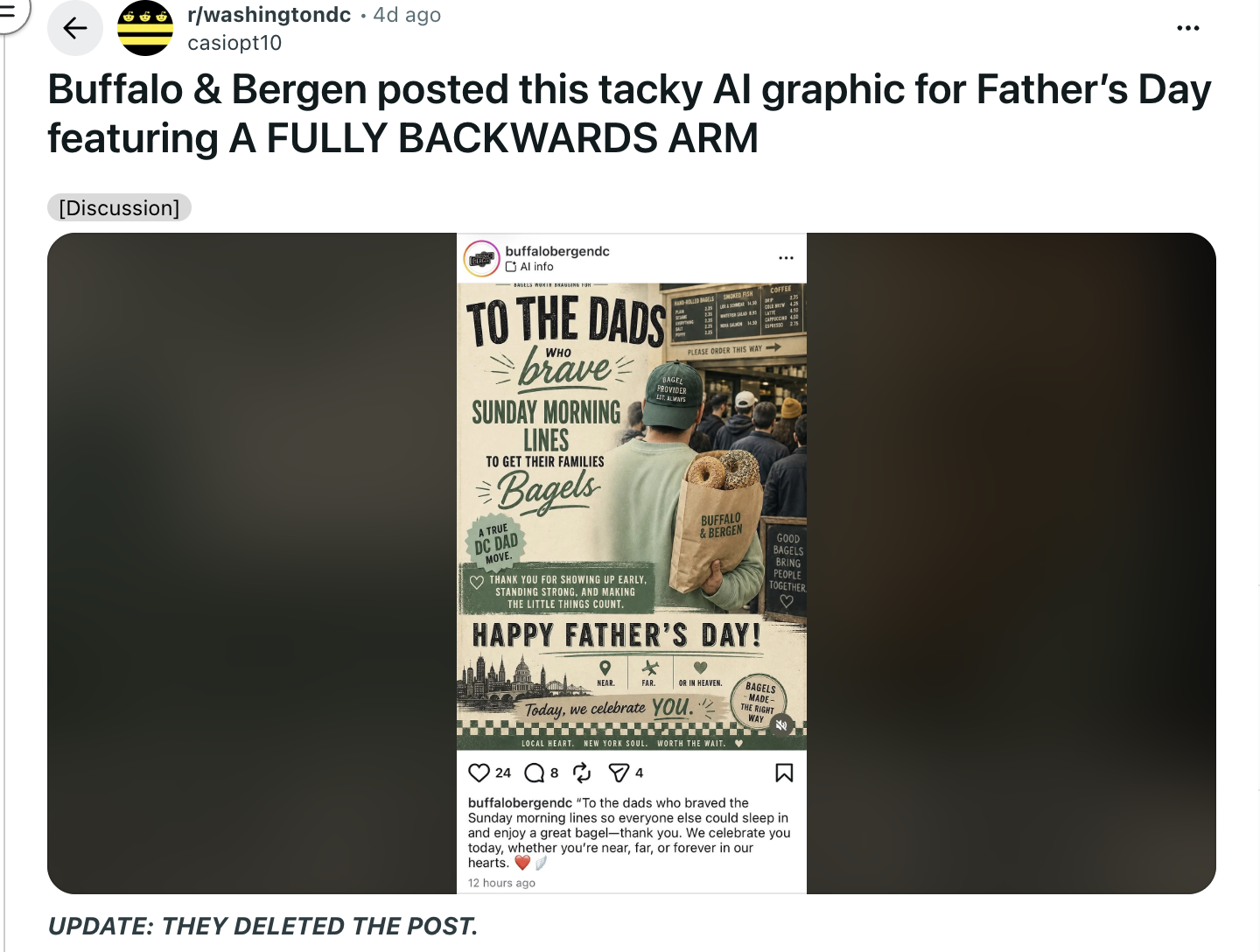
Because she was distracted and distraught, Chersevani says she didn’t closely examine the slop image the AI spit out: the man’s arm was twisted backwards holding a bag of bagels, and he was wearing a baseball cap generically reading “BAGEL PROVIDER EST. ALWAYS.” Meanwhile, ChatGPT hallucinated New York skyscrapers along DC’s skyline.
“One of my regulars came over to the store and was like, ‘You know you’re getting slammed on Reddit right now? And I’m like, what are you talking about?,'” Chersevani says. The Reddit post amassed more than 100 comments making fun of and dissing the post. Chersevani says she also started getting DMs, including one calling her a “fucking loser.”
“People went bananas. Attacking me, attacking each other, like I caused all the issues for AI that ever happened,” she says.
The incident is just one more example of local businesses getting caught in the crosshairs of the greater AI debate. In an industry where margins are notoriously thin and staff are are overstretched, it’s a tempting and often helpful tool, especially for mom-and-pop operators who have to wear multiple hats and do their own social media and marketing. At the same time, some are finding they also risk getting attacked for not supporting local creatives, contributing to environmental harm, or being lazy and taking shortcuts.
Chersevani promptly deleted the ChatGPT image from Buffalo & Bergen’s Instagram. She later posted about the backlash, saying “Fortunately, the internet stepped in to remind me that after 14 years of running a small business, employing people, supporting the community, and serving millions of bagels, I should never attempt to learn anything new.” (That prompted a second Reddit post with more than 400 comments.)
Chersevani notes she works with countless artists in her stores, and she says she hasn’t been following the larger cultural conversation around AI. “I didn’t know it was a hot topic. I live in a bagel world. I make food all day. I’m in a kitchen. I don’t live in social media land,” she says.
Buffalo & Bergen is far from the only local restaurant experimenting with AI on its social media feeds.
“It’s not like a virus or a disease, but it is everywhere now,” says one local restaurant social media manager, who uses ChatGPT to produce graphics and posters when he’s in a time crunch. (He requested anonymity for fear of the same backlash Chersevani faced.) Still, he says he tries to incorporate original photos within the posts, and he’ll often tweak the content using Canva, a graphic design tool, to make it look less generic. Sometimes he’ll even prompt AI to make the design “less AI.”
“Everyone wants to turn out good work, original work,” he says. “But you’re under the budget restraint, under the time constraint, so you do the best you can with what you’ve got.”
Corynn Gonçalves, an independent Toronto-based marketing manager whose clients include the new Caribbean-inspired DC restaurant Isla, says she will sometimes use AI for light photo editing—like removing an ugly exit sign from a beautiful interior shot. But she says Isla draws a red line at altering or creating images of food.
For her, the issue isn’t so black and white. She says she doesn’t stand for AI slop and she believes the role of restaurants in creating culture means they should elevate artists, whether in the kitchen or on social media. But she’s also sympathetic to small businesses that don’t have a lot of time and resources.
“It’s bad for the environment, it isn’t ideal, but this is a tool that’s coming out in the hospitality industry over and over again. We have hostesses that are now completely AI, OpenTable is using more AI-based communications. You kind of need to use it as a tool, but still respect that the hospitality industry is based in human connection,” Gonçalves says.
Others would rather not touch AI at all if they can avoid it. In an industry full of artists and creators, “why on earth would you rely on a robot? For efficiency? That’s an excuse,” says Chris Van Jura, whose Catalyst Hot dog business includes two food trailers in Montgomery County.
The way he sees it, restaurants depend on having their own voice. AI-generated content mutes that individuality. “They all look the same. They’re all cookie cutter. You can spot one a mile away,” he says.
Some of the food events that Catalyst Hot Dogs has participated in have used their own AI flyers, and he’s seen other operators refuse to participate because of that. His own stance is he won’t share the flyer, but he’ll still go to the event. And ultimately, he doesn’t think small businesses should be trashed online if they do choose to use AI.
“Sometimes you’ll take the shortcut. I’m not justifying it any way. And again, I don’t agree with it, but I don’t believe they deserve to get roasted for it,” he says. “I don’t think it’s fair to hide behind a keyboard and assault that person.”

Jessica Sidman covers the people and trends behind DC’s food and drink scene. Before joining Washingtonian in July 2016, she was Food Editor and Young & Hungry columnist at Washington City Paper. She is a Colorado native and University of Pennsylvania grad.