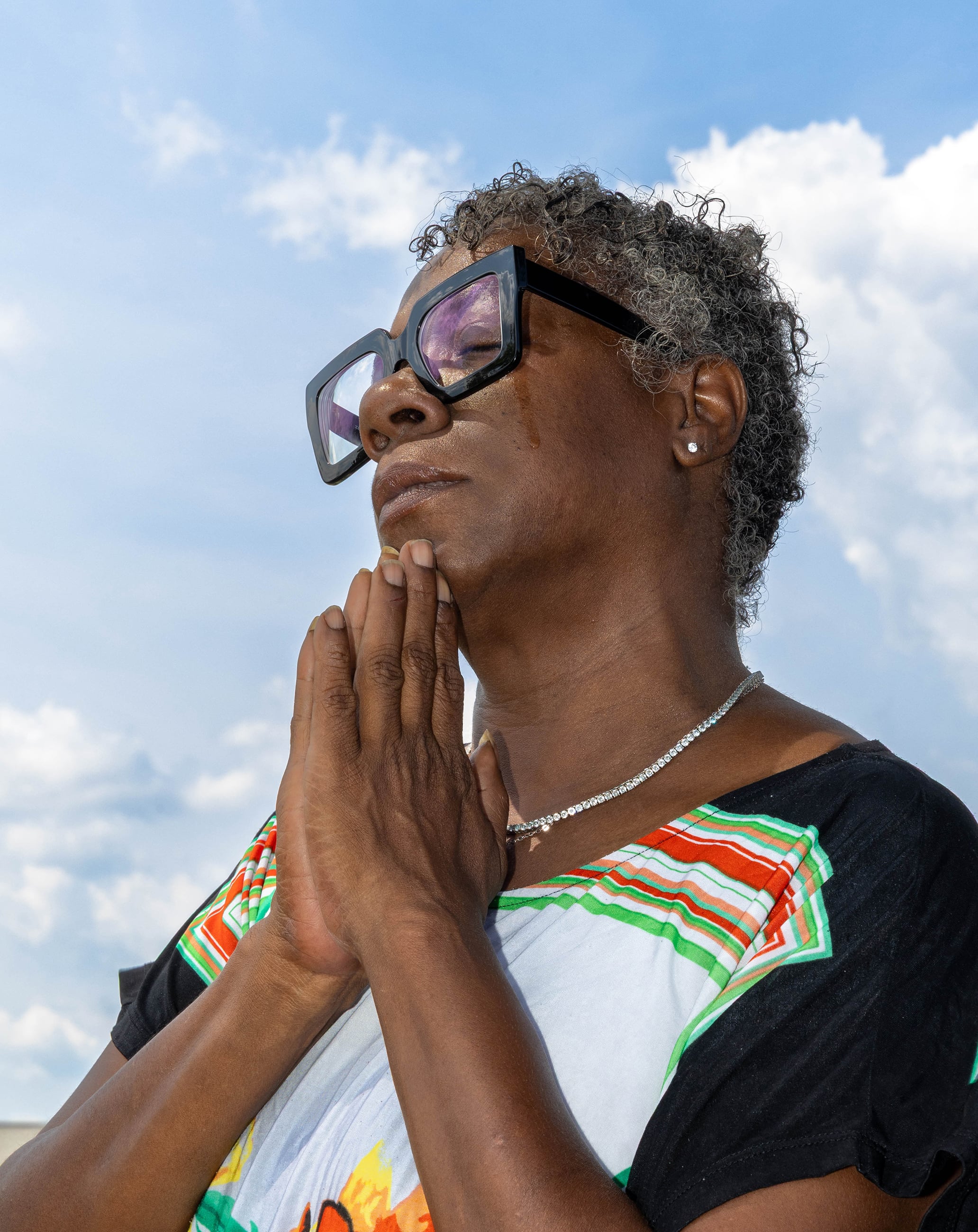
On the day of her retirement lunch, Racquel Kelley arrives early.
She’s dressed for the occasion: bright-pink linen blouse, coordinating accessories, a large pair of magenta cat-eye glasses resting on the bridge of her nose. Her hair is freshly styled. It’s a gray Wednesday in February, but inside this Chili’s restaurant on Richmond Highway in Alexandria, the mood is bright. Some three dozen friends, family members, and colleagues from Kelley’s workplace at nearby Fort Belvoir are coming to celebrate.
Kelley, 56, greets them with excitement and hugs. At first, she admits, she didn’t really want a farewell party, even after 33 years of working for the Department of Defense. But her boss at the Programs and Manpower Division, Tina Manns, “kind of made me have something,” Kelley says. “It’s nice to see the people come out for me. It’s heartwarming.”
It’s also extraordinary. Twenty-five years ago, Kelley was a 32-year-old mother with a six-month-old baby, working as a computer specialist at the Pentagon. On the morning of September 11, 2001, she was programming laptops in an open workspace on the first floor when al-Qaeda terrorists crashed a hijacked passenger jet into the building, just 700 feet from her desk.
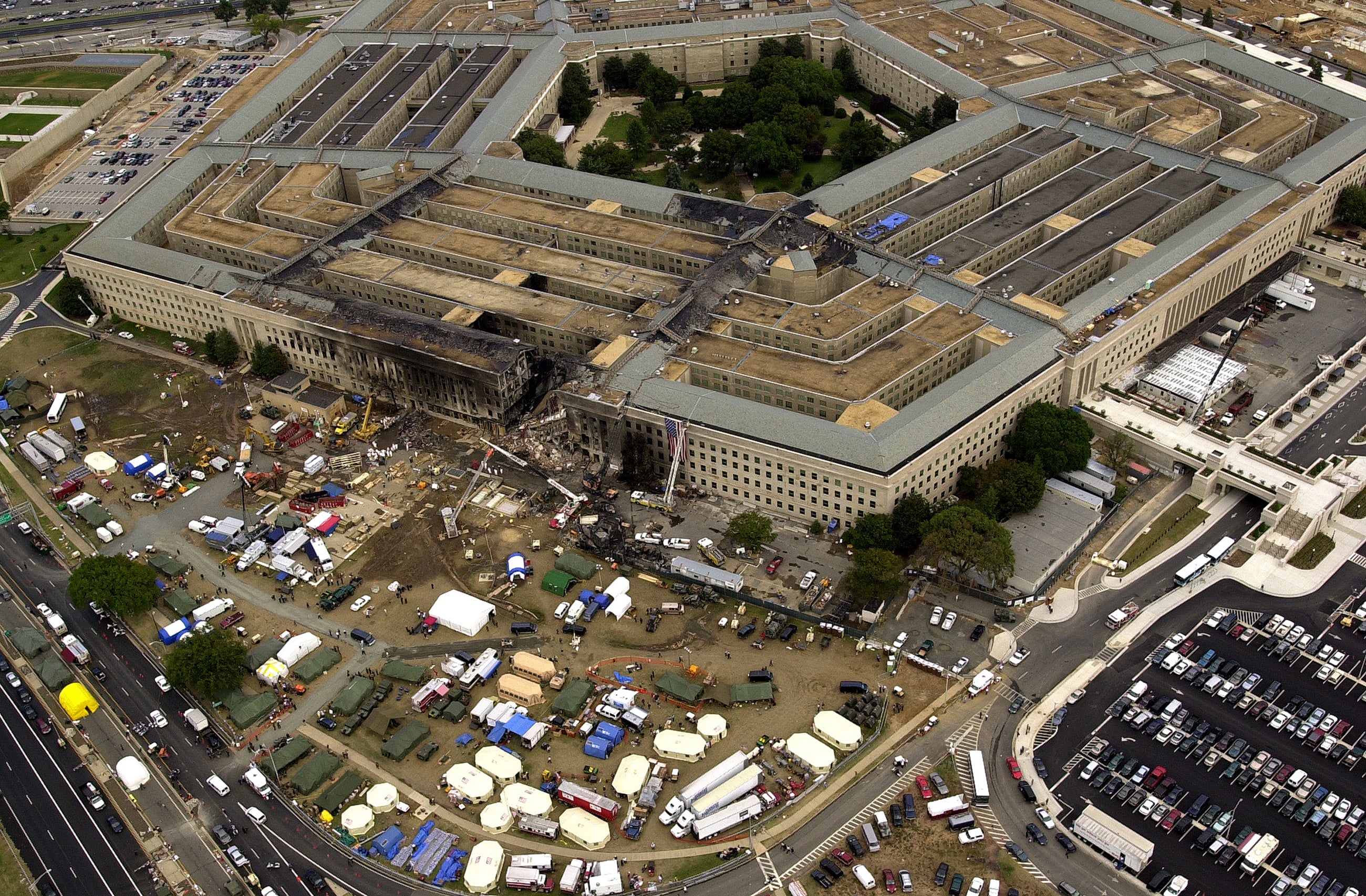
One hundred and eighty-four people were killed in the attack on the Pentagon. A concurrent attack on the World Trade Center in New York City and the crash of another hijacked jet in Pennsylvania made 9/11 the deadliest terror attack in US history. Kelley is alive today because a medevac helicopter crew on its way to the Pentagon defied orders to turn around and instead descended toward the smoke. They found her amid the carnage—unconscious, burned, and struggling to breathe—and brought her to a hospital before it was too late.
Kelley survived and recovered. She returned to her life and the career she loved—and to her baby, Antonio, now a grown man. He sits at the restaurant across from his mother, quietly watching, beaming with pride. Amid the food and drinks and laughter, Kelley doesn’t expect any talk of that day.
But 9/11 is never far from her mind. There are the cute shoes Kelley used to love but can no longer wear because of the burn damage on the soles of her feet. There’s the explanation she gives every time she gets her hair done, about how her scalp remains tender, years after her singed hair grew back. There are the near-weekly counseling sessions for posttraumatic stress disorder and the terror that remains with her still—like a cloud of dust that briefly settles, only to stir again every time there’s a bit of breeze.
Sitting at the head of several long tables that have been pushed together, Kelley sips a festive cocktail from a large plastic martini glass. Today is a well-deserved capstone, a joyous sendoff following a long career in public service. But it’s also a reminder of all that Kelley has overcome, and what she continues to endure.
The Attack
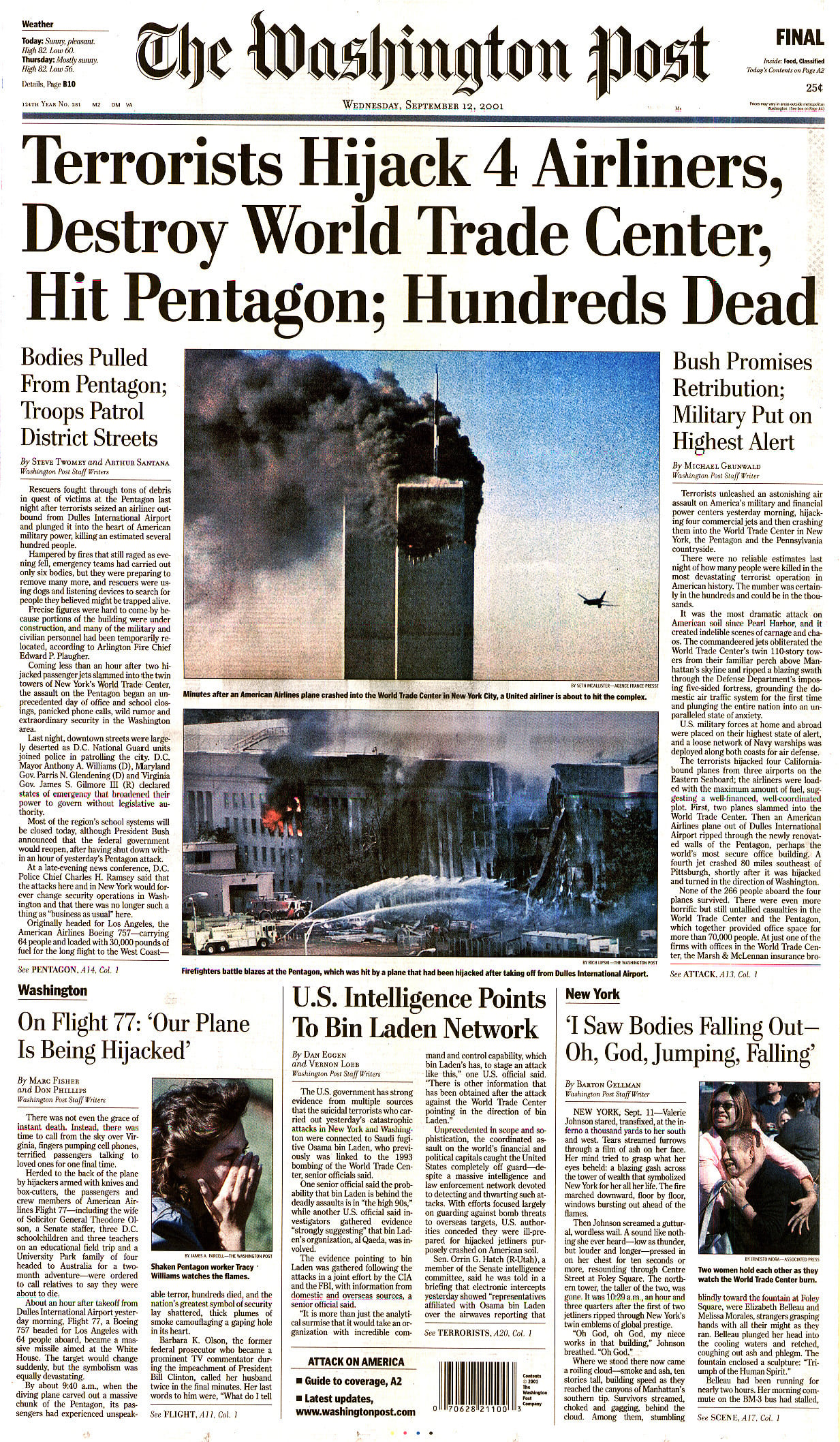
Shortly after American Airlines Flight 77 hit the Pentagon’s western facade at 9:37 am, Kelley regained consciousness. She was sitting in her chair. She was also on fire. Kelley recalls using her hands to slap down the flames on her body and calling out to her coworkers in the smoke-filled room.
Dave?
JJ?
Shay?
Kelley waited for a response. No one answered. What was happening? Why am I on fire? Kelley was in shock. A civilian information-management specialist at the time, she loved working at the Pentagon. Her father had worked there. Aunts and uncles, too. She had started in 1992, right after graduating from Morgan State University. The building felt like home. Now the wall by her desk was gone. Where did it go?
Recently returned from maternity leave and feeling under the weather, Kelley had almost stayed home that morning. On her way in, she dropped Antonio off at daycare. She never turned on the car radio. Arriving late, she found her coworkers watching something terrible happening in New York, on the TV news. Two planes had slammed into the World Trade Center’s north and south towers.
We might be next, Kelley remembers someone saying.
Moving at more than 500 miles an hour and carrying roughly 5,300 gallons of jet fuel, Flight 77 penetrated three of the Pentagon’s five concentric rings. It left a hole in the side of the building approximately 75 feet wide. Kelley recalls being under her desk. She said a prayer: Lord, you have to help me. I don’t know what’s going on, but I can’t die now. I just had this baby. Take an arm, an ear, a leg, whatever, but I can’t die. She crawled out and somehow pulled her purse from a drawer. She searched for her phone but couldn’t feel it. Something fell on her from above.
Kelley regained consciousness. She was sitting in her chair. She was also on fire. She used her hands to slap down the flames. The wall by her desk was gone.
Kelley lost consciousness. Surviving coworkers later told her they found her under a pile of rubble, screaming and crying, clutching her purse across her chest. They got Kelley up, linking arms with her as they made their way toward the hole. Others joined the chain. Everyone seemed to be bleeding. The air smelled like burnt flesh. There was a body, Kelley remembers. It was holding a piece of paper.
Why do they have a paper in their hand? Kelley recalls asking one of her coworkers. They can’t read. Their head’s not there.
When they reached the hole in the building, someone told Kelley to jump, one floor down. When she did, she realized her feet were badly burned.
The Rescue
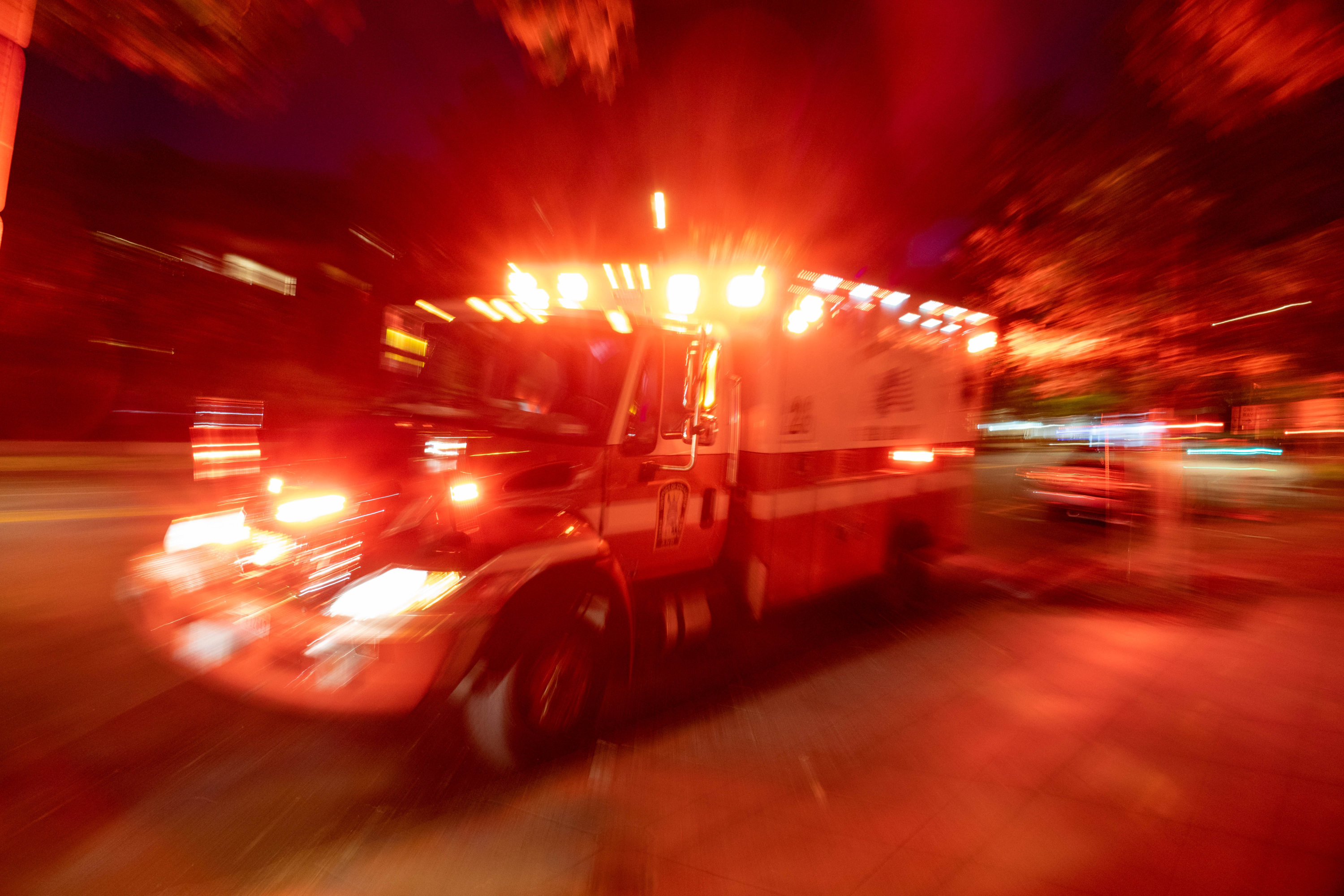
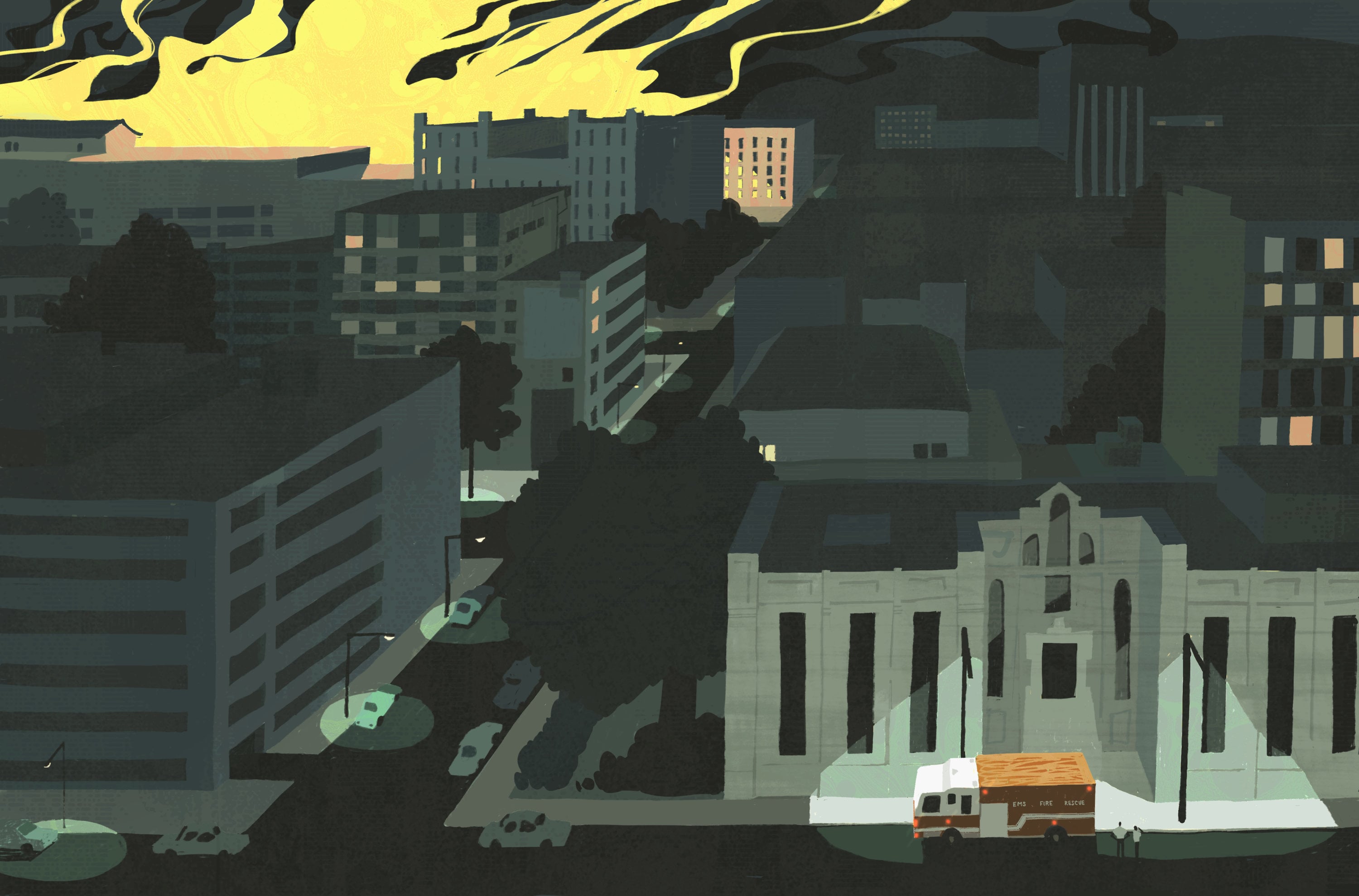
Across the Potomac River, the medevac helicopter crew at MedStar Washington Hospital Center was watching live coverage of the World Trade Center attack when they heard an alarm blaring in the trauma center. For just a moment, they believed it was the daily test of the emergency response system—but from the hospital’s rooftop helipad, less than five miles from the Pentagon, they could see thick clouds of black and gray smoke.
Barbara Brown and Tammi Rippeon quickly put on their flight suits, then checked to make sure their helicopter was stocked with medical supplies. Rippeon had only a few months’ experience as a flight nurse and was still getting nauseated from airborne turbulence. She wasn’t scheduled to be part of the crew that day but was happy to fill in when a manager asked. Brown, a paramedic, had more than a decade of experience and also worked in the Dale City volunteer fire department. Colleagues considered her skilled and steady in a crisis.
Ted Chittick was the pilot on duty. He had served in the Air Force and then flown for the US Park Police. When he retired in 1983, MedStar asked him to create the hospital’s medevac program. As the helicopter flew toward the Pentagon, Rippeon sat in the back, with no view of what lay ahead. “We didn’t really know what exactly had happened,” she says. “You just grab your helmet.” Brown and Chittick were up front. Rippeon heard her seasoned colleagues gasp.
Oh my God! Oh my God! Oh my God!
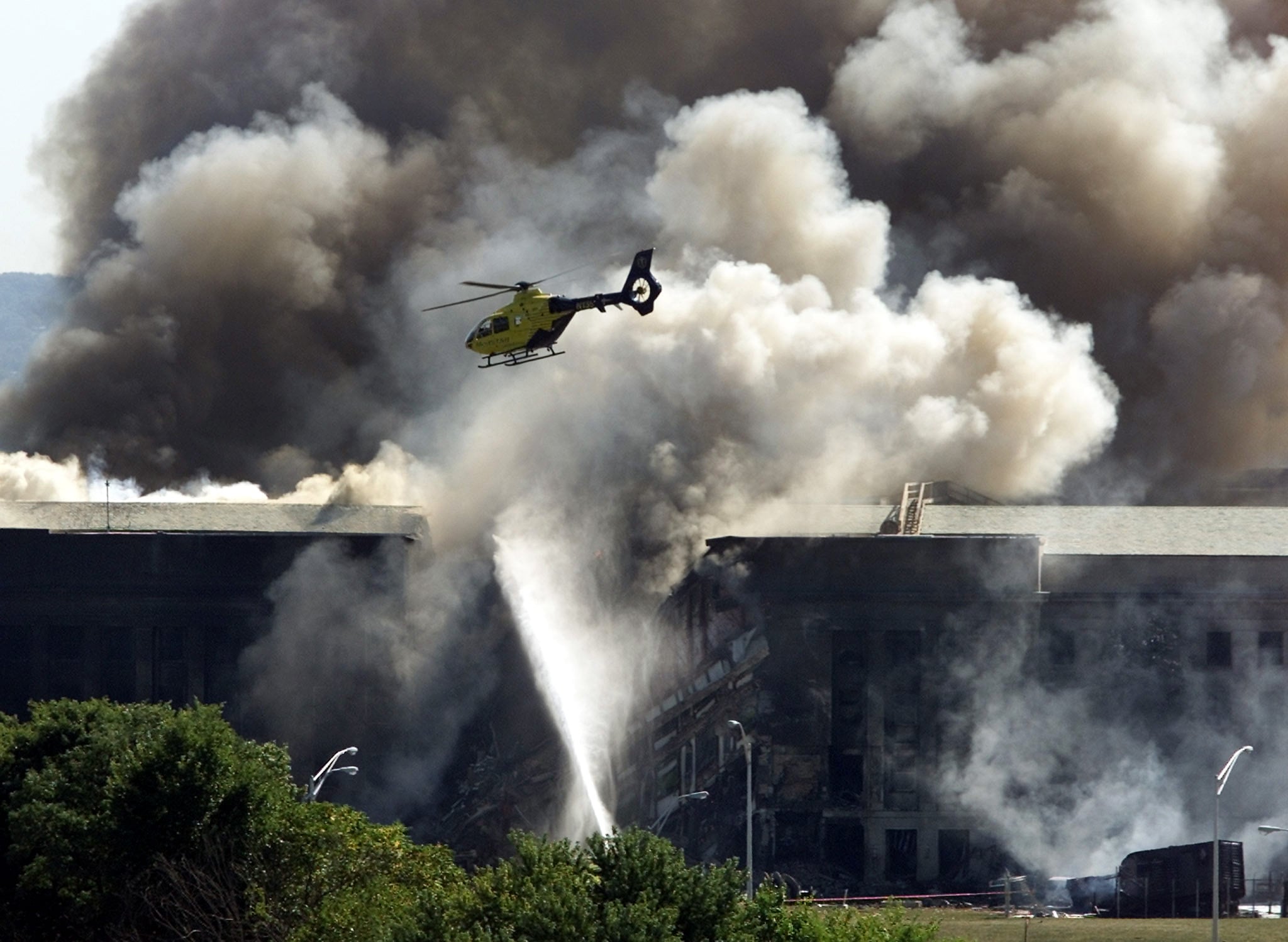
The scene was horrific: Flight 77’s tail protruded from the building at a downward angle, with wreckage and bodies strewn in a wide swath around it. Burning jet fuel produced toxic flames and heavy smoke. People were fleeing in every direction. By 9:45 am, the Federal Aviation Administration had ordered all aircraft in US airspace to land immediately, including medevac helicopters.
Chittick was told not to land at the Pentagon. He ignored those instructions, circling the gigantic building until he found a safe place to set down. “I [was] an Eagle Scout from the Boy Scouts,” he says. “Instead of running away from danger, it makes you go and try to assist people that have fallen or are in some sort of distress.” Brown and Rippeon grabbed triage supplies and a stretcher. Heading out from the helicopter, they exchanged a solemn look. Their own lives were now in grave danger.
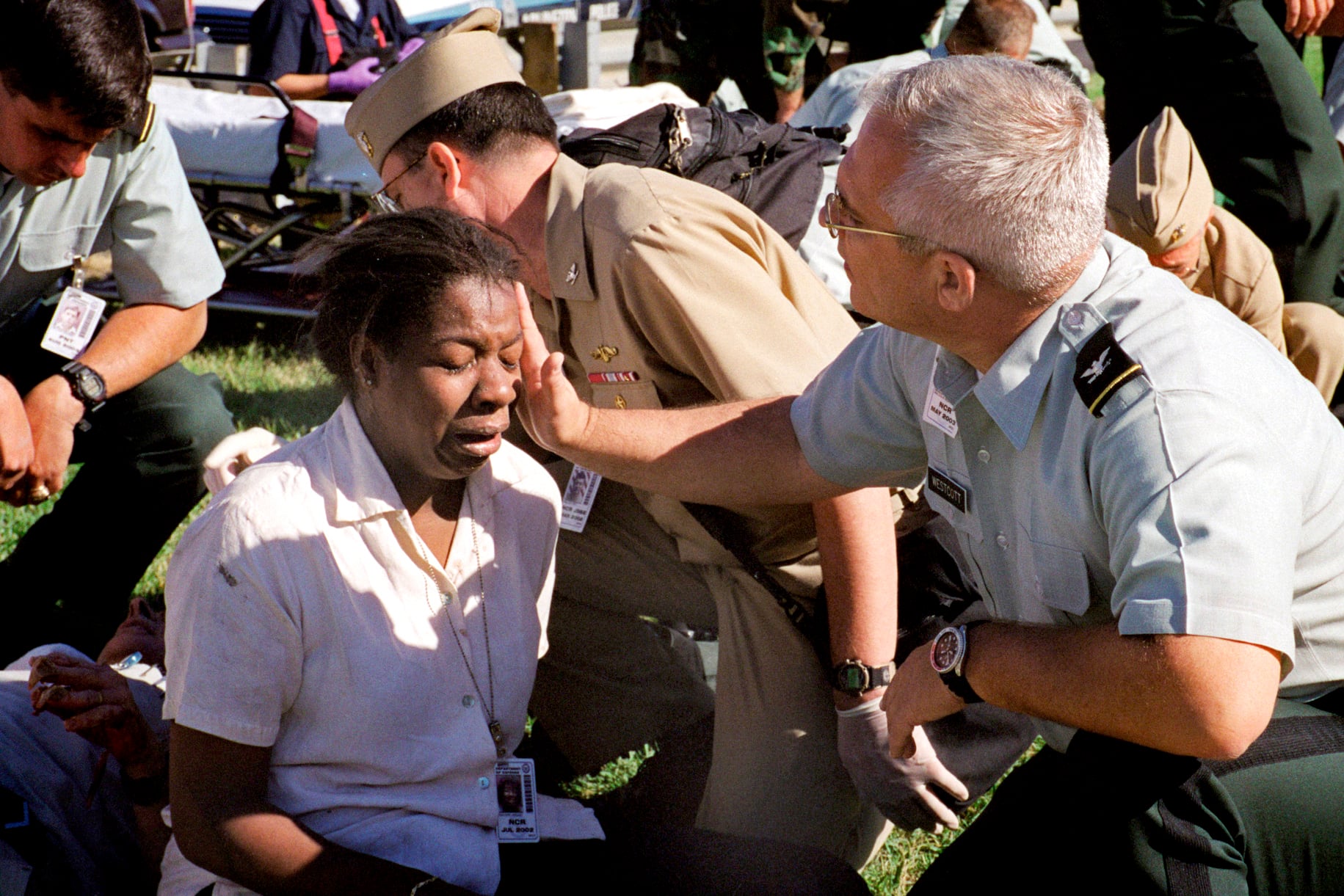
Outside the building, Kelley sat on a patch of grass. Somehow, she remembers, her orthodontic braces had been blown off. Her teeth were charred. She received first aid from Colonel Bruce Westcott, deputy chief of the Army Reserve, who had begun his Army career as a medic. Kelley recalls seeing one of her coworkers, also a mom. The woman looked pink because her skin was gone. There was panic over a fourth hijacked plane believed to be heading toward DC—United Airlines Flight 93, which would ultimately go down over an open field in Somerset County, Pennsylvania, after passengers and crew fought back against their hijackers. Everyone had to move. Kelley remembers lying beneath an overpass. Everything went dark.
Kelley’s constricted airway was “probably smaller than a dime.” If rescuers didn’t insert a breathing tube right away, she was going to die.
When military personnel brought Brown and Rippeon to Kelley, she was lying unconscious on the ground. Someone had written her name and contact information on her sleeve. Toxic smoke was swelling her airway—and before Brown and Rippeon could inspect her burns, she stopped breathing. Her airway, Brown later recalled, was “probably smaller than a dime.” If they didn’t insert a breathing tube right away, their patient was going to die.
With Kelley still on the ground, Rippeon carefully administered drugs to sedate and briefly paralyze her so Brown could insert the tube. Intubation is a tricky procedure that can easily go wrong, causing injury and infection, especially if the airway is closing up. Brown succeeded on her first attempt. She and Rippeon exhaled and started to look for their helicopter.
Chittick had been ordered for a second time to get away from the Pentagon but refused to leave his crew and their patient behind. He found a landing spot closer to Kelley. Brown and Rippeon carried her to the helicopter on a stretcher, and she became the only civilian casualty airlifted from the Pentagon to a hospital. Everyone else was taken by ambulance or bus.
The Fallout
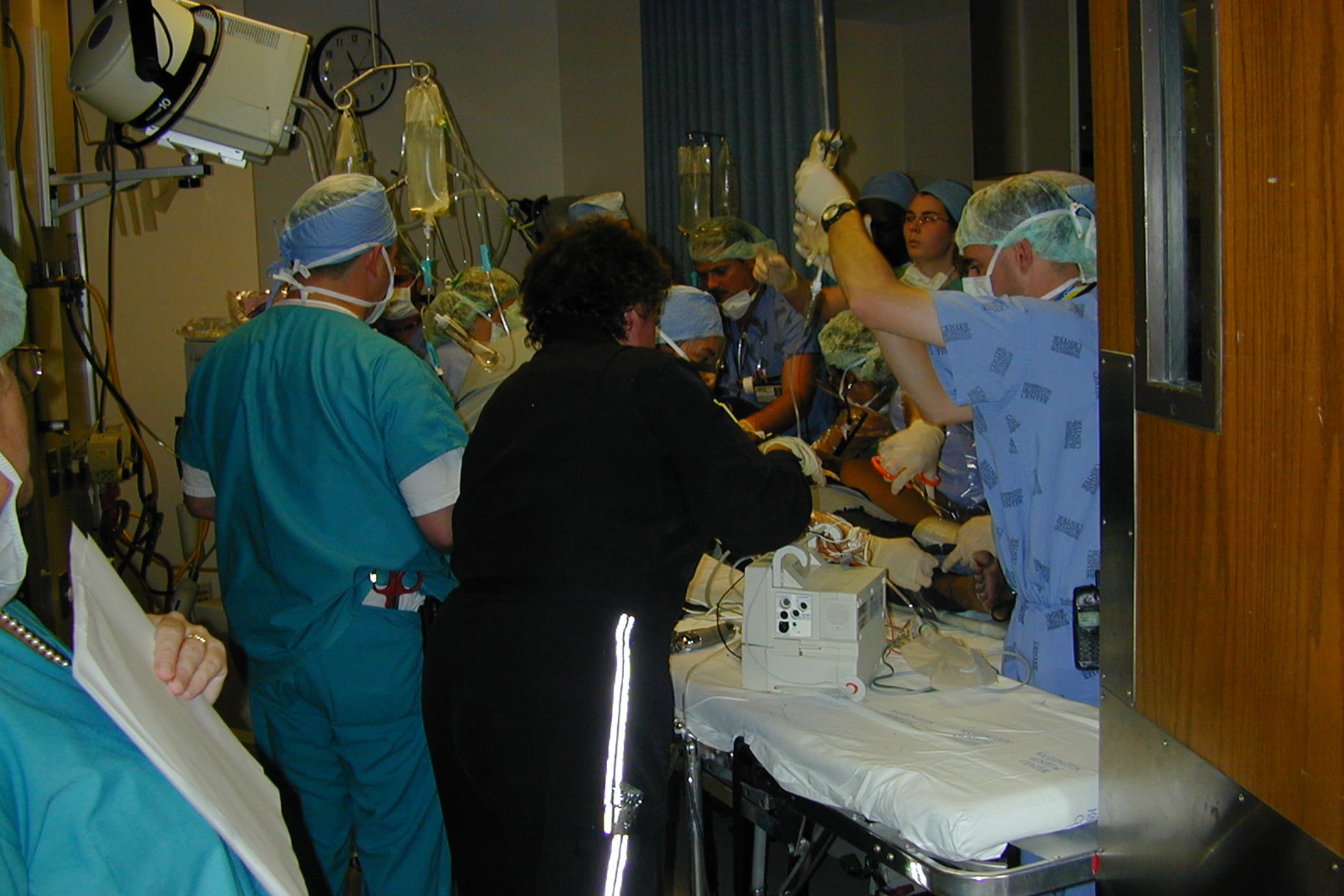
A small army of medical personnel was waiting as the helicopter arrived at MedStar Washington Hospital Center. Kelley had been exposed to intense heat; dust and debris; and fumes from burning jet fuel. In the ICU, Kelley was placed on a ventilator, and once she could breathe on her own, she was moved to a room adjacent to the hospital’s helipad.
The roar of rotors terrified Kelley. And that wasn’t all. She was sure someone would break in through her room’s window and harm her. Suddenly afraid of the dark, she would roll her wheelchair out to the nurses’ station, spending her nights under the fluorescent lights. The flash burns on Kelley’s feet and scalp required careful treatment. She spent almost a week in the hospital. Following discharge, Kelley returned for outpatient psychiatric care and was diagnosed with PTSD. Her burns were slowly healing, but emotionally, she says, “I was a mess. I was a wreck. I was scared.”
When driving over the 14th Street Bridge, Kelley would ask herself: What should I do if I see a plane coming? Speed up? Slow down?
One day, Kelley was in a car with her family when they encountered an empty vehicle stopped in the traffic lane on New York Avenue—hazard lights blinking, nobody in the driver’s seat. Kelley freaked out. She started screaming. “I thought there was a bomb in that car,” she says.
About five months later, Kelley returned to work for the Defense Department, but not at the Pentagon. Instead, she and some of her coworkers were moved to an office in Crystal City. On Kelley’s second day there, a fire drill in the building frightened her so much, she says, that she grabbed hold of a female coworker for safety, “digging my nails into her arms.” The woman seemed shocked, as if she didn’t know what Kelley had been through.
Ever since the attacks, Kelley has been in some form of mental-health treatment: three months of hospital outpatient care, weekly individual counseling, regular group therapy. She says talking about 9/11 can be helpful—chipping away, little by little, at the fear she feels. But her painful memories remain vivid.
On the first anniversary of 9/11, Kelley attended a Pentagon remembrance ceremony. The experience was overwhelming. When driving over the 14th Street Bridge, she would sometimes ask herself: What should I do if I see a plane coming? Speed up? Slow down?
Roughly a decade after the attacks, Defense Department cutbacks forced Kelley to shift her work role from IT to payroll and accounting. She also was moved to Fort Belvoir. The changes were trying: Kelley was a single mother with a young son, now saddled with a longer commute, learning a new set of skills in an environment where she didn’t always feel welcome. One day on the job, a highly realistic active-shooter drill left her deeply shaken. She was triggered by gunfire sounds, by the roar of a Blackhawk helicopter hovering overhead and then landing nearby, and by the sight of people posing as bloodied victims on the ground. Disregarding instructions to remain with coworkers behind locked doors, she hid in a restroom for safety.
In the hallway of her building, Kelley encountered someone portraying an active shooter. The man happened to know about what she’d experienced on 9/11 and felt terrible that he’d frightened her. For Kelley, that sort of empathy and understanding at work had become less common over the years. It hurt, she says, when colleagues would tell her to “get over” or “move on” from her trauma, as if it were something she could simply choose to forget. Kelley sometimes felt misunderstood, even disrespected.
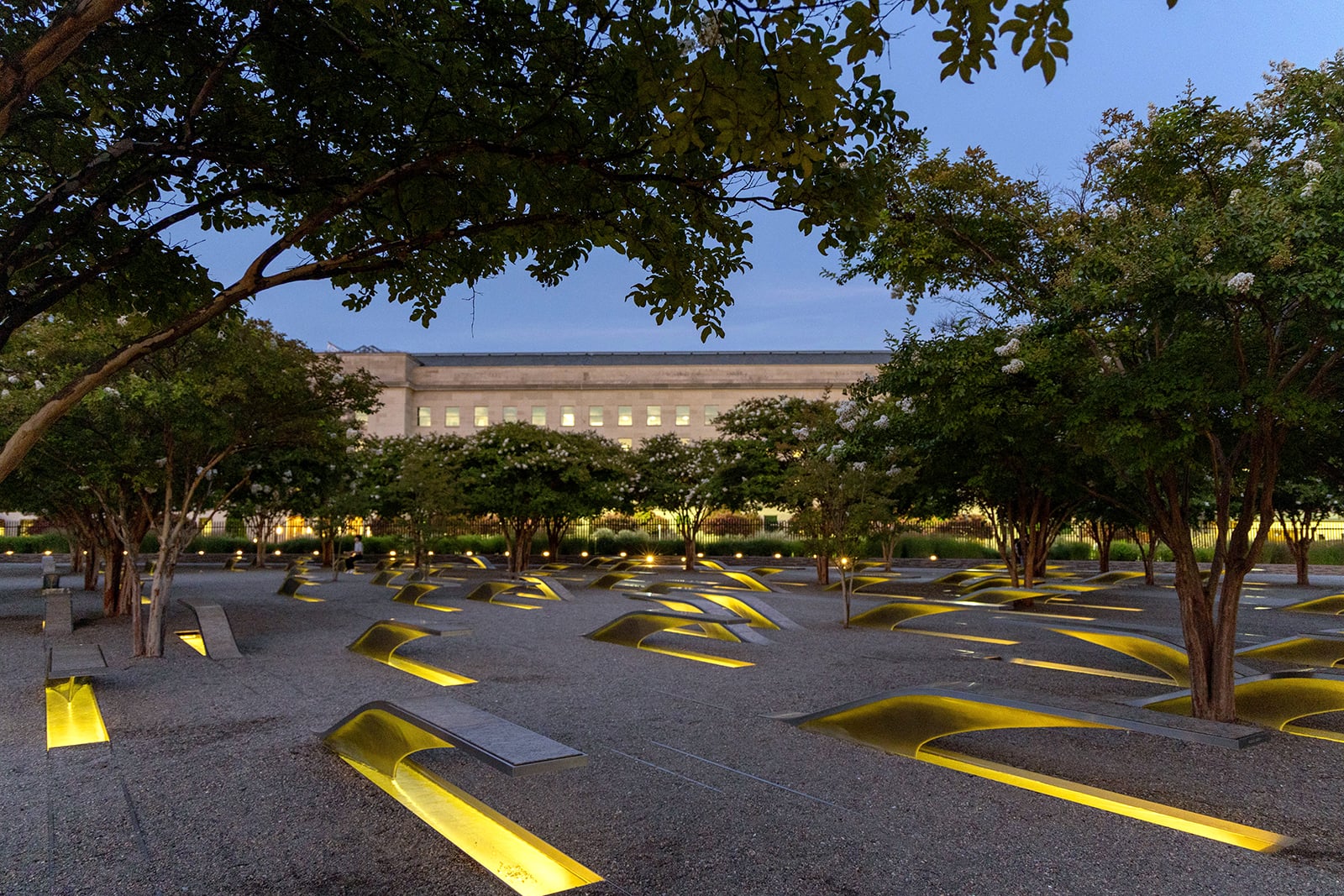
When the Pentagon’s 9/11 Memorial opened in 2008, Kelley and her son visited and spent time in the chapel there. She has been back only once since. She hopes to visit the New York memorial someday but doesn’t feel ready.
The Endless Day
In September 2021, I met Kelley for the first time. I was a news reporter at NBC4, covering her reunion, 20 years later, with the medevac crew who had saved her life on 9/11.
The crew had kept in touch over the years—Chittick, the pilot, called Brown and Rippeon every year on September 11. And he had also walked Rippeon down the aisle at her wedding in 2004. Kelley and the crew had followed each other on social media, and Brown and Kelley were in regular contact online. But this was the first time all four had reconnected in person.
Sitting in front of the same bright-blue-and-yellow MedStar helicopter that had carried Kelley from the Pentagon, the group shared hugs and tears—and photos of their kids and grandchildren. Chittick admitted he had “goosebumps, right now.” Rippeon wept as she described the shock of approaching the scene. Kelley recalled fading in and out of consciousness and expressed gratitude to the crew who had “risked their lives” to save hers. Brown talked about the fateful decisions to land and to intubate Kelley—and how seeing Antonio grow from a baby to a man was “rewarding to see you made the right decision.”
When the story aired, it was touching—a true tale of bravery, compassion, and enduring connection. But what Kelley hid from all of us that day was just how much she was still struggling. At work, she says, her mental-health issues played a role in her security clearance being revoked, leaving her suddenly unable to do her job. At home, Kelley was grieving the death of the grandmother who’d raised her. She was struggling to get along with her mother, who had reentered Kelley’s life and moved in with her. Kelley had gotten divorced in 2005 and was helping raise her ex-husband’s four children along with her son. The pandemic was isolating and scary. Believing she was about to hit “rock bottom,” Kelley felt angry with God.
On a Friday afternoon following the reunion, Kelley got into a small van and was taken to an inpatient psychiatric treatment facility in suburban Maryland. This was her choice. Feeling “lost and depressed,” she checked herself in. After a session on the house rules, Kelley was shown to her spartan basement room. She had to give up her cellphone at 11 pm. As she started to settle in, she thought: This is what peace feels like.
Kelley stayed for 45 days of treatment. When she left, she felt stronger and less vulnerable. With the help of more therapy, she began enforcing boundaries with her mother, then moved into her own place. She returned to work and got her security clearance restored. But since then, everything has not been—as she puts it—“hunky-dory.”
In a 2024 interview posted on YouTube, Kelley likened the attacks on the Pentagon to a reel from an old projection movie, one that keeps winding up and unspooling. She remembers the boom, waking up, and the flames, over and over. Sometimes she bursts into tears, thinking about those killed. She knows 9/11 will always be a part of her, a day that never ends.
And so Kelley copes. She does Pilates, takes walks, and keeps a journal. She tries to avoid triggers, such as news about war in the Middle East. She gets counseling for her PTSD almost every week and finds groups for people with trauma. At one point, she went to a hospital emergency room and spent a week in a psychiatric unit. She needs, in her own words, “all the help I can get.”
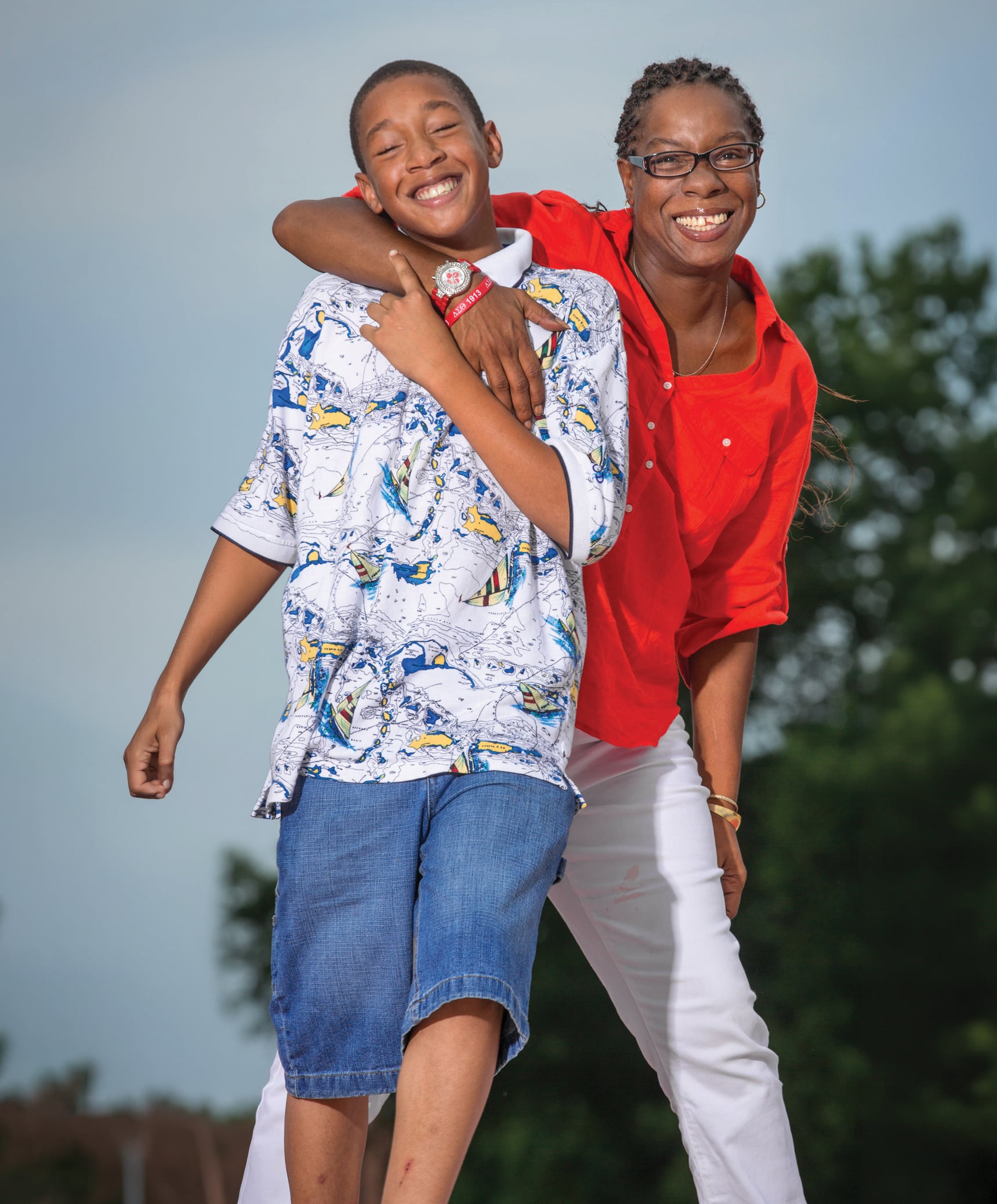
Fortunately, Kelley has found some. In 2002, she accepted an invitation to join other 9/11 survivors and their families at a free, weeklong getaway at Camp Kieve, a hundred-year-old summer camp that sits alongside a rural lake northeast of Portland, Maine. As soon as Kelley and Antonio arrived, taking in the serene setting and breathing the fresh, pine-scented air, she knew it was a “safe space.” A city girl who’d grown up in DC, she kayaked all over the lake. She rode horses. More important, she was surrounded by others who understood her emotions, no explaining necessary. Kelley and her son made a number of meaningful connections, friends they still keep in touch with, and continued to return to Camp Kieve in the summers until 2020’s pandemic.
On every September 11 since the attacks, Kelley takes the day off and avoids television. Instead, she’s surrounded by a group of sympathetic girlfriends. They’ve taken her to dinner, out dancing, to Topgolf—which Kelley loves even though she doesn’t play herself. Last year, they gathered for a laid-back evening at home. “They’ve basically been there since day one,” she says. Their support means everything.
The Gift
Back at her retirement lunch, Kelley orders an appetizer and the surf-and-turf platter. Her spirits are high. She’s looking forward to retirement. She’s planning a late-summer return to Camp Kieve, her first since Covid, and a pair of cruise vacations, in Alaska and the Caribbean. She feels a special peace when sitting on a deck chair, gazing out at the ocean and sky.
The ceremony begins. Colleagues from Fort Belvoir lavish Kelley with praise. A girlfriend who shares her passion for cruises delivers a tribute, presenting a series of silly gifts for Kelley’s next trip: motion-sickness bags, a travel toiletry kit with her name on it, another bag with her Delta Sigma Theta sorority logo, some Dallas Cowboys swag. Kelley laughs, and so does everyone else. Antonio watches with a smile. He’s seen his mother struggle, knows just how much she appreciates the love and attention.
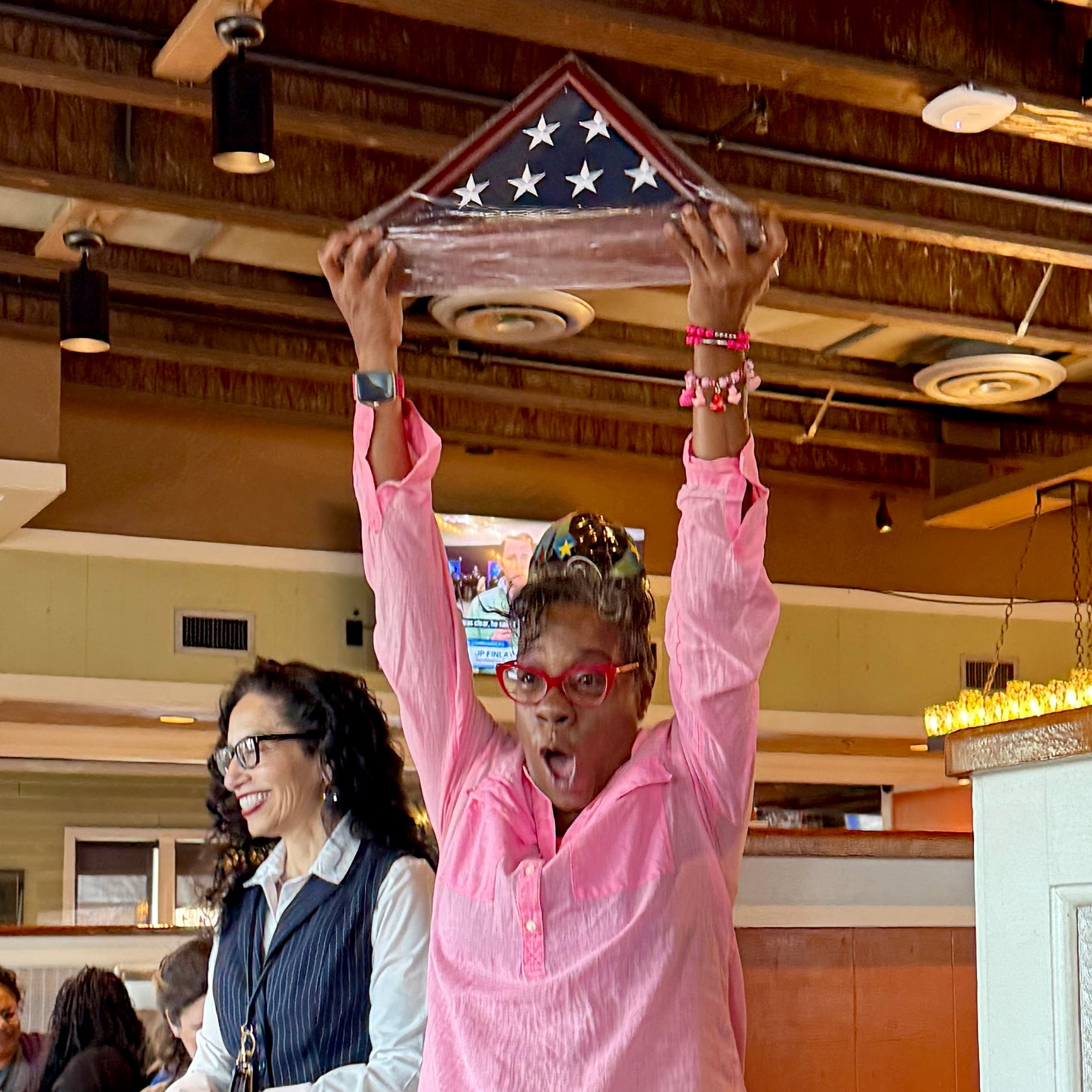
Kelley is asked to stand. She’s given several certificates and plaques, plus a medal recognizing her government service. None of this surprises her. But a final tribute does. The room quiets. Manns, Kelley’s boss, holds aloft a triangular case made of wood and glass, with an engraved brass plaque bearing Kelley’s name. Inside is an American flag that flew over the Pentagon.
This is a gift. It’s also an honor, one usually reserved for active-duty military. Kelley was a civilian. An office worker. She never imagined that her job would one day make her a target, nearly cost her life, and leave her physically and emotionally wounded. She never imagined the sacrifice her service would demand.
Kelley tears up. Finally, she feels understood. Eyes wet, she tells the group she already has two of these special flags on display at home. One was given to her grandfather, who served in the Army. The other was given to her father, also an Army veteran. Kelley treasures both flags. She’ll be proud, she says, to place a third beside them.
Life Savers
hile hundreds of first responders put themselves at risk to conduct rescue-and-recovery operations at the Pentagon on 9/11, Racquel Kelley likely wouldn’t have survived without the heroism of the three-person medevac helicopter crew that treated her onsite and flew her to a hospital. Here are their stories.
The Pilot
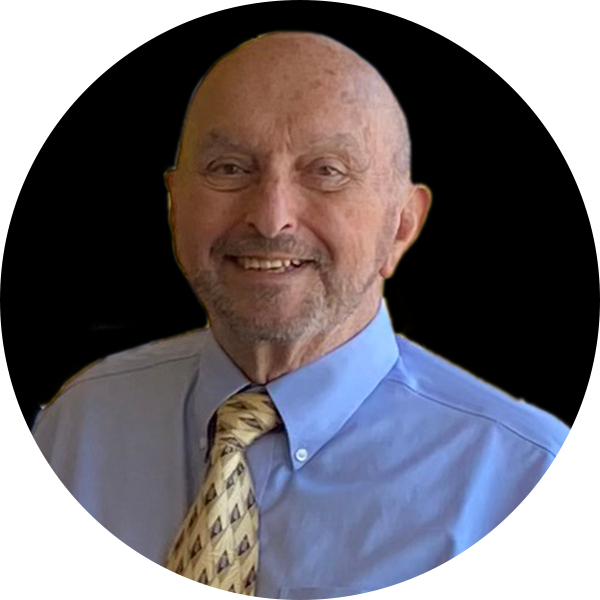
Ted Chittick, then 63, was heading to work on his motorcycle when he heard radio hosts talking about a plane having hit the World Trade Center. He didn’t imagine that the event might affect his day—until he arrived at MedStar Washington Hospital Center and found the overnight pilot waiting for him in the doorway.
A childhood Eagle Scout with a strong desire to help people in need, Chittick had entered the Air Force out of high school. When he learned that refueling bombers in flight was as close as an enlisted man could get to becoming a pilot, he left the military and enrolled at George Washington University. He then joined the US Park Police, took flying lessons, and became one of the agency’s first helicopter pilots. After retiring in 1983, he created MedStar’s first medevac program and ran it for 23 years.
Chittick and his wife raised four daughters and a son, who now flies a helicopter for DC’s Metropolitan Police Department. Three of their daughters are nurses. The couple now lives in Gettysburg, Pennsylvania, where their grandchildren are frequent visitors.

The Flight Nurse
Tammi Rippeon was the crew’s rookie, just 31, and that January had finished her training to be a flight nurse. On the morning of 9/11, she arrived at the hospital expecting to pull a 12-hour shift in the trauma center, only to be asked to fill in on the medevac team. A risk-taker who loved skydiving and going up in the MedStar helicopter, she was happy to volunteer.
Rippeon had learned how to be a caregiver early on. After her parents divorced while she was in high school, she and her two sisters lived with their father. When he developed cancer and later died, she left college to take care of them. Years later, she returned to school and earned a degree.
Following 9/11, Rippeon and Chittick became close: When she married a firefighter in 2004, Chittick walked her down the aisle. She and her husband have two daughters, and she now works with cardiac rehab patients at Howard County General Hospital.
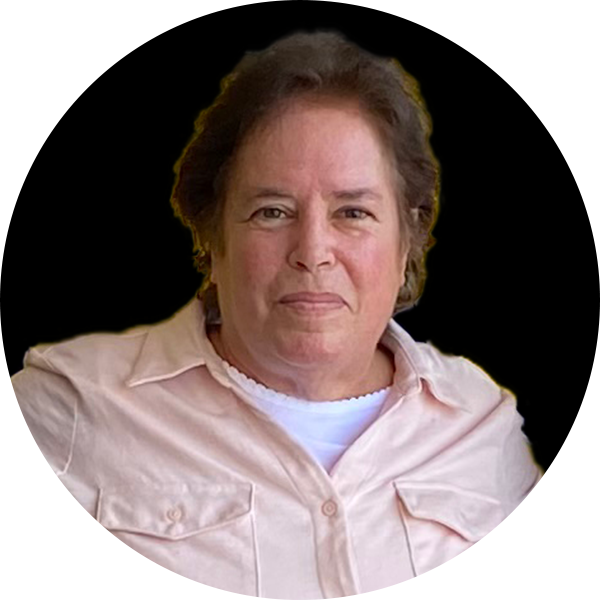
The Paramedic
Barbara Brown was 36 on 9/11 and already an experienced first responder. A military kid who moved a lot before settling in Prince William County, she befriended some Dale City volunteer firefighters, became an ambulance driver, then trained to become an emergency medical technician. She stayed in touch with Kelley following the attack on the Pentagon, a relationship that was meaningful to both women, and she initiated the 2021 reunion of Kelley with the rest of the medevac crew.
Brown died in her sleep from a heart attack in August 2022. She was 57. Her sister notified the Dale City volunteer fighters, who remember her with great respect as a person, leader, and teacher, someone who trained others in special skills for cardiac patients with implanted devices. “She was really grounded,” says Dale City volunteer fire chief Chris Hool. “BJ always wanted to help people. That was her motivation.”
Photographs of helicopter crew courtesy of Doreen Gentzler
On the day of her retirement lunch, Racquel Kelley arrives early.
She’s dressed for the occasion: bright-pink linen blouse, coordinating accessories, a large pair of magenta cat-eye glasses resting on the bridge of her nose. Her hair is freshly styled. It’s a gray Wednesday in February, but inside this Chili’s restaurant on Richmond Highway in Alexandria, the mood is bright. Some three dozen friends, family members, and colleagues from Kelley’s workplace at nearby Fort Belvoir are coming to celebrate.
Kelley, 56, greets them with excitement and hugs. At first, she admits, she didn’t really want a farewell party, even after 33 years of working for the Department of Defense. But her boss at the Programs and Manpower Division, Tina Manns, “kind of made me have something,” Kelley says. “It’s nice to see the people come out for me. It’s heartwarming.”
It’s also extraordinary. Twenty-five years ago, Kelley was a 32-year-old mother with a six-month-old baby, working as a computer specialist at the Pentagon. On the morning of September 11, 2001, she was programming laptops in an open workspace on the first floor when al-Qaeda terrorists crashed a hijacked passenger jet into the building, just 700 feet from her desk.
One hundred and eighty-four people were killed in the attack on the Pentagon. A concurrent attack on the World Trade Center in New York City and the crash of another hijacked jet in Pennsylvania made 9/11 the deadliest terror attack in US history. Kelley is alive today because a medevac helicopter crew on its way to the Pentagon defied orders to turn around and instead descended toward the smoke. They found her amid the carnage—unconscious, burned, and struggling to breathe—and brought her to a hospital before it was too late.
Kelley survived and recovered. She returned to her life and the career she loved—and to her baby, Antonio, now a grown man. He sits at the restaurant across from his mother, quietly watching, beaming with pride. Amid the food and drinks and laughter, Kelley doesn’t expect any talk of that day.
But 9/11 is never far from her mind. There are the cute shoes Kelley used to love but can no longer wear because of the burn damage on the soles of her feet. There’s the explanation she gives every time she gets her hair done, about how her scalp remains tender, years after her singed hair grew back. There are the near-weekly counseling sessions for posttraumatic stress disorder and the terror that remains with her still—like a cloud of dust that briefly settles, only to stir again every time there’s a bit of breeze.
Sitting at the head of several long tables that have been pushed together, Kelley sips a festive cocktail from a large plastic martini glass. Today is a well-deserved capstone, a joyous sendoff following a long career in public service. But it’s also a reminder of all that Kelley has overcome, and what she continues to endure.
The Attack
Shortly after American Airlines Flight 77 hit the Pentagon’s western facade at 9:37 am, Kelley regained consciousness. She was sitting in her chair. She was also on fire. Kelley recalls using her hands to slap down the flames on her body and calling out to her coworkers in the smoke-filled room.
Dave?
JJ?
Shay?
Kelley waited for a response. No one answered. What was happening? Why am I on fire? Kelley was in shock. A civilian information-management specialist at the time, she loved working at the Pentagon. Her father had worked there. Aunts and uncles, too. She had started in 1992, right after graduating from Morgan State University. The building felt like home. Now the wall by her desk was gone. Where did it go?
Recently returned from maternity leave and feeling under the weather, Kelley had almost stayed home that morning. On her way in, she dropped Antonio off at daycare. She never turned on the car radio. Arriving late, she found her coworkers watching something terrible happening in New York, on the TV news. Two planes had slammed into the World Trade Center’s north and south towers.
We might be next, Kelley remembers someone saying.
Moving at more than 500 miles an hour and carrying roughly 5,300 gallons of jet fuel, Flight 77 penetrated three of the Pentagon’s five concentric rings. It left a hole in the side of the building approximately 75 feet wide. Kelley recalls being under her desk. She said a prayer: Lord, you have to help me. I don’t know what’s going on, but I can’t die now. I just had this baby. Take an arm, an ear, a leg, whatever, but I can’t die. She crawled out and somehow pulled her purse from a drawer. She searched for her phone but couldn’t feel it. Something fell on her from above.
Kelley regained consciousness. She was sitting in her chair. She was also on fire. She used her hands to slap down the flames. The wall by her desk was gone.
Kelley lost consciousness. Surviving coworkers later told her they found her under a pile of rubble, screaming and crying, clutching her purse across her chest. They got Kelley up, linking arms with her as they made their way toward the hole. Others joined the chain. Everyone seemed to be bleeding. The air smelled like burnt flesh. There was a body, Kelley remembers. It was holding a piece of paper.
Why do they have a paper in their hand? Kelley recalls asking one of her coworkers. They can’t read. Their head’s not there.
When they reached the hole in the building, someone told Kelley to jump, one floor down. When she did, she realized her feet were badly burned.
The Rescue
Across the Potomac River, the medevac helicopter crew at MedStar Washington Hospital Center was watching live coverage of the World Trade Center attack when they heard an alarm blaring in the trauma center. For just a moment, they believed it was the daily test of the emergency response system—but from the hospital’s rooftop helipad, less than five miles from the Pentagon, they could see thick clouds of black and gray smoke.
Barbara Brown and Tammi Rippeon quickly put on their flight suits, then checked to make sure their helicopter was stocked with medical supplies. Rippeon had only a few months’ experience as a flight nurse and was still getting nauseated from airborne turbulence. She wasn’t scheduled to be part of the crew that day but was happy to fill in when a manager asked. Brown, a paramedic, had more than a decade of experience and also worked in the Dale City volunteer fire department. Colleagues considered her skilled and steady in a crisis.
Ted Chittick was the pilot on duty. He had served in the Air Force and then flown for the US Park Police. When he retired in 1983, MedStar asked him to create the hospital’s medevac program. As the helicopter flew toward the Pentagon, Rippeon sat in the back, with no view of what lay ahead. “We didn’t really know what exactly had happened,” she says. “You just grab your helmet.” Brown and Chittick were up front. Rippeon heard her seasoned colleagues gasp.
Oh my God! Oh my God! Oh my God!
The scene was horrific: Flight 77’s tail protruded from the building at a downward angle, with wreckage and bodies strewn in a wide swath around it. Burning jet fuel produced toxic flames and heavy smoke. People were fleeing in every direction. By 9:45 am, the Federal Aviation Administration had ordered all aircraft in US airspace to land immediately, including medevac helicopters.
Chittick was told not to land at the Pentagon. He ignored those instructions, circling the gigantic building until he found a safe place to set down. “I [was] an Eagle Scout from the Boy Scouts,” he says. “Instead of running away from danger, it makes you go and try to assist people that have fallen or are in some sort of distress.” Brown and Rippeon grabbed triage supplies and a stretcher. Heading out from the helicopter, they exchanged a solemn look. Their own lives were now in grave danger.
Outside the building, Kelley sat on a patch of grass. Somehow, she remembers, her orthodontic braces had been blown off. Her teeth were charred. She received first aid from Colonel Bruce Westcott, deputy chief of the Army Reserve, who had begun his Army career as a medic. Kelley recalls seeing one of her coworkers, also a mom. The woman looked pink because her skin was gone. There was panic over a fourth hijacked plane believed to be heading toward DC—United Airlines Flight 93, which would ultimately go down over an open field in Somerset County, Pennsylvania, after passengers and crew fought back against their hijackers. Everyone had to move. Kelley remembers lying beneath an overpass. Everything went dark.
Kelley’s constricted airway was “probably smaller than a dime.” If rescuers didn’t insert a breathing tube right away, she was going to die.
When military personnel brought Brown and Rippeon to Kelley, she was lying unconscious on the ground. Someone had written her name and contact information on her sleeve. Toxic smoke was swelling her airway—and before Brown and Rippeon could inspect her burns, she stopped breathing. Her airway, Brown later recalled, was “probably smaller than a dime.” If they didn’t insert a breathing tube right away, their patient was going to die.
With Kelley still on the ground, Rippeon carefully administered drugs to sedate and briefly paralyze her so Brown could insert the tube. Intubation is a tricky procedure that can easily go wrong, causing injury and infection, especially if the airway is closing up. Brown succeeded on her first attempt. She and Rippeon exhaled and started to look for their helicopter.
Chittick had been ordered for a second time to get away from the Pentagon but refused to leave his crew and their patient behind. He found a landing spot closer to Kelley. Brown and Rippeon carried her to the helicopter on a stretcher, and she became the only civilian casualty airlifted from the Pentagon to a hospital. Everyone else was taken by ambulance or bus.
The Fallout
A small army of medical personnel was waiting as the helicopter arrived at MedStar Washington Hospital Center. Kelley had been exposed to intense heat; dust and debris; and fumes from burning jet fuel. In the ICU, Kelley was placed on a ventilator, and once she could breathe on her own, she was moved to a room adjacent to the hospital’s helipad.
The roar of rotors terrified Kelley. And that wasn’t all. She was sure someone would break in through her room’s window and harm her. Suddenly afraid of the dark, she would roll her wheelchair out to the nurses’ station, spending her nights under the fluorescent lights. The flash burns on Kelley’s feet and scalp required careful treatment. She spent almost a week in the hospital. Following discharge, Kelley returned for outpatient psychiatric care and was diagnosed with PTSD. Her burns were slowly healing, but emotionally, she says, “I was a mess. I was a wreck. I was scared.”
When driving over the 14th Street Bridge, Kelley would ask herself: What should I do if I see a plane coming? Speed up? Slow down?
One day, Kelley was in a car with her family when they encountered an empty vehicle stopped in the traffic lane on New York Avenue—hazard lights blinking, nobody in the driver’s seat. Kelley freaked out. She started screaming. “I thought there was a bomb in that car,” she says.
About five months later, Kelley returned to work for the Defense Department, but not at the Pentagon. Instead, she and some of her coworkers were moved to an office in Crystal City. On Kelley’s second day there, a fire drill in the building frightened her so much, she says, that she grabbed hold of a female coworker for safety, “digging my nails into her arms.” The woman seemed shocked, as if she didn’t know what Kelley had been through.
Ever since the attacks, Kelley has been in some form of mental-health treatment: three months of hospital outpatient care, weekly individual counseling, regular group therapy. She says talking about 9/11 can be helpful—chipping away, little by little, at the fear she feels. But her painful memories remain vivid.
On the first anniversary of 9/11, Kelley attended a Pentagon remembrance ceremony. The experience was overwhelming. When driving over the 14th Street Bridge, she would sometimes ask herself: What should I do if I see a plane coming? Speed up? Slow down?
Roughly a decade after the attacks, Defense Department cutbacks forced Kelley to shift her work role from IT to payroll and accounting. She also was moved to Fort Belvoir. The changes were trying: Kelley was a single mother with a young son, now saddled with a longer commute, learning a new set of skills in an environment where she didn’t always feel welcome. One day on the job, a highly realistic active-shooter drill left her deeply shaken. She was triggered by gunfire sounds, by the roar of a Blackhawk helicopter hovering overhead and then landing nearby, and by the sight of people posing as bloodied victims on the ground. Disregarding instructions to remain with coworkers behind locked doors, she hid in a restroom for safety.
In the hallway of her building, Kelley encountered someone portraying an active shooter. The man happened to know about what she’d experienced on 9/11 and felt terrible that he’d frightened her. For Kelley, that sort of empathy and understanding at work had become less common over the years. It hurt, she says, when colleagues would tell her to “get over” or “move on” from her trauma, as if it were something she could simply choose to forget. Kelley sometimes felt misunderstood, even disrespected.
When the Pentagon’s 9/11 Memorial opened in 2008, Kelley and her son visited and spent time in the chapel there. She has been back only once since. She hopes to visit the New York memorial someday but doesn’t feel ready.
The Endless Day
In September 2021, I met Kelley for the first time. I was a news reporter at NBC4, covering her reunion, 20 years later, with the medevac crew who had saved her life on 9/11.
The crew had kept in touch over the years—Chittick, the pilot, called Brown and Rippeon every year on September 11. And he had also walked Rippeon down the aisle at her wedding in 2004. Kelley and the crew had followed each other on social media, and Brown and Kelley were in regular contact online. But this was the first time all four had reconnected in person.
Sitting in front of the same bright-blue-and-yellow MedStar helicopter that had carried Kelley from the Pentagon, the group shared hugs and tears—and photos of their kids and grandchildren. Chittick admitted he had “goosebumps, right now.” Rippeon wept as she described the shock of approaching the scene. Kelley recalled fading in and out of consciousness and expressed gratitude to the crew who had “risked their lives” to save hers. Brown talked about the fateful decisions to land and to intubate Kelley—and how seeing Antonio grow from a baby to a man was “rewarding to see you made the right decision.”
When the story aired, it was touching—a true tale of bravery, compassion, and enduring connection. But what Kelley hid from all of us that day was just how much she was still struggling. At work, she says, her mental-health issues played a role in her security clearance being revoked, leaving her suddenly unable to do her job. At home, Kelley was grieving the death of the grandmother who’d raised her. She was struggling to get along with her mother, who had reentered Kelley’s life and moved in with her. Kelley had gotten divorced in 2005 and was helping raise her ex-husband’s four children along with her son. The pandemic was isolating and scary. Believing she was about to hit “rock bottom,” Kelley felt angry with God.
On a Friday afternoon following the reunion, Kelley got into a small van and was taken to an inpatient psychiatric treatment facility in suburban Maryland. This was her choice. Feeling “lost and depressed,” she checked herself in. After a session on the house rules, Kelley was shown to her spartan basement room. She had to give up her cellphone at 11 pm. As she started to settle in, she thought: This is what peace feels like.
Kelley stayed for 45 days of treatment. When she left, she felt stronger and less vulnerable. With the help of more therapy, she began enforcing boundaries with her mother, then moved into her own place. She returned to work and got her security clearance restored. But since then, everything has not been—as she puts it—“hunky-dory.”
In a 2024 interview posted on YouTube, Kelley likened the attacks on the Pentagon to a reel from an old projection movie, one that keeps winding up and unspooling. She remembers the boom, waking up, and the flames, over and over. Sometimes she bursts into tears, thinking about those killed. She knows 9/11 will always be a part of her, a day that never ends.
And so Kelley copes. She does Pilates, takes walks, and keeps a journal. She tries to avoid triggers, such as news about war in the Middle East. She gets counseling for her PTSD almost every week and finds groups for people with trauma. At one point, she went to a hospital emergency room and spent a week in a psychiatric unit. She needs, in her own words, “all the help I can get.”
Fortunately, Kelley has found some. In 2002, she accepted an invitation to join other 9/11 survivors and their families at a free, weeklong getaway at Camp Kieve, a hundred-year-old summer camp that sits alongside a rural lake northeast of Portland, Maine. As soon as Kelley and Antonio arrived, taking in the serene setting and breathing the fresh, pine-scented air, she knew it was a “safe space.” A city girl who’d grown up in DC, she kayaked all over the lake. She rode horses. More important, she was surrounded by others who understood her emotions, no explaining necessary. Kelley and her son made a number of meaningful connections, friends they still keep in touch with, and continued to return to Camp Kieve in the summers until 2020’s pandemic.
On every September 11 since the attacks, Kelley takes the day off and avoids television. Instead, she’s surrounded by a group of sympathetic girlfriends. They’ve taken her to dinner, out dancing, to Topgolf—which Kelley loves even though she doesn’t play herself. Last year, they gathered for a laid-back evening at home. “They’ve basically been there since day one,” she says. Their support means everything.
The Gift
Back at her retirement lunch, Kelley orders an appetizer and the surf-and-turf platter. Her spirits are high. She’s looking forward to retirement. She’s planning a late-summer return to Camp Kieve, her first since Covid, and a pair of cruise vacations, in Alaska and the Caribbean. She feels a special peace when sitting on a deck chair, gazing out at the ocean and sky.
The ceremony begins. Colleagues from Fort Belvoir lavish Kelley with praise. A girlfriend who shares her passion for cruises delivers a tribute, presenting a series of silly gifts for Kelley’s next trip: motion-sickness bags, a travel toiletry kit with her name on it, another bag with her Delta Sigma Theta sorority logo, some Dallas Cowboys swag. Kelley laughs, and so does everyone else. Antonio watches with a smile. He’s seen his mother struggle, knows just how much she appreciates the love and attention.
Kelley is asked to stand. She’s given several certificates and plaques, plus a medal recognizing her government service. None of this surprises her. But a final tribute does. The room quiets. Manns, Kelley’s boss, holds aloft a triangular case made of wood and glass, with an engraved brass plaque bearing Kelley’s name. Inside is an American flag that flew over the Pentagon.
This is a gift. It’s also an honor, one usually reserved for active-duty military. Kelley was a civilian. An office worker. She never imagined that her job would one day make her a target, nearly cost her life, and leave her physically and emotionally wounded. She never imagined the sacrifice her service would demand.
Kelley tears up. Finally, she feels understood. Eyes wet, she tells the group she already has two of these special flags on display at home. One was given to her grandfather, who served in the Army. The other was given to her father, also an Army veteran. Kelley treasures both flags. She’ll be proud, she says, to place a third beside them.
Life Savers
hile hundreds of first responders put themselves at risk to conduct rescue-and-recovery operations at the Pentagon on 9/11, Racquel Kelley likely wouldn’t have survived without the heroism of the three-person medevac helicopter crew that treated her onsite and flew her to a hospital. Here are their stories.
The Pilot
Ted Chittick, then 63, was heading to work on his motorcycle when he heard radio hosts talking about a plane having hit the World Trade Center. He didn’t imagine that the event might affect his day—until he arrived at MedStar Washington Hospital Center and found the overnight pilot waiting for him in the doorway.
A childhood Eagle Scout with a strong desire to help people in need, Chittick had entered the Air Force out of high school. When he learned that refueling bombers in flight was as close as an enlisted man could get to becoming a pilot, he left the military and enrolled at George Washington University. He then joined the US Park Police, took flying lessons, and became one of the agency’s first helicopter pilots. After retiring in 1983, he created MedStar’s first medevac program and ran it for 23 years.
Chittick and his wife raised four daughters and a son, who now flies a helicopter for DC’s Metropolitan Police Department. Three of their daughters are nurses. The couple now lives in Gettysburg, Pennsylvania, where their grandchildren are frequent visitors.
The Flight Nurse
Tammi Rippeon was the crew’s rookie, just 31, and that January had finished her training to be a flight nurse. On the morning of 9/11, she arrived at the hospital expecting to pull a 12-hour shift in the trauma center, only to be asked to fill in on the medevac team. A risk-taker who loved skydiving and going up in the MedStar helicopter, she was happy to volunteer.
Rippeon had learned how to be a caregiver early on. After her parents divorced while she was in high school, she and her two sisters lived with their father. When he developed cancer and later died, she left college to take care of them. Years later, she returned to school and earned a degree.
Following 9/11, Rippeon and Chittick became close: When she married a firefighter in 2004, Chittick walked her down the aisle. She and her husband have two daughters, and she now works with cardiac rehab patients at Howard County General Hospital.
The Paramedic
Barbara Brown was 36 on 9/11 and already an experienced first responder. A military kid who moved a lot before settling in Prince William County, she befriended some Dale City volunteer firefighters, became an ambulance driver, then trained to become an emergency medical technician. She stayed in touch with Kelley following the attack on the Pentagon, a relationship that was meaningful to both women, and she initiated the 2021 reunion of Kelley with the rest of the medevac crew.
Brown died in her sleep from a heart attack in August 2022. She was 57. Her sister notified the Dale City volunteer fighters, who remember her with great respect as a person, leader, and teacher, someone who trained others in special skills for cardiac patients with implanted devices. “She was really grounded,” says Dale City volunteer fire chief Chris Hool. “BJ always wanted to help people. That was her motivation.”
Photographs of helicopter crew courtesy of Doreen Gentzler
This article appears in the September 2026 issue of Washingtonian.