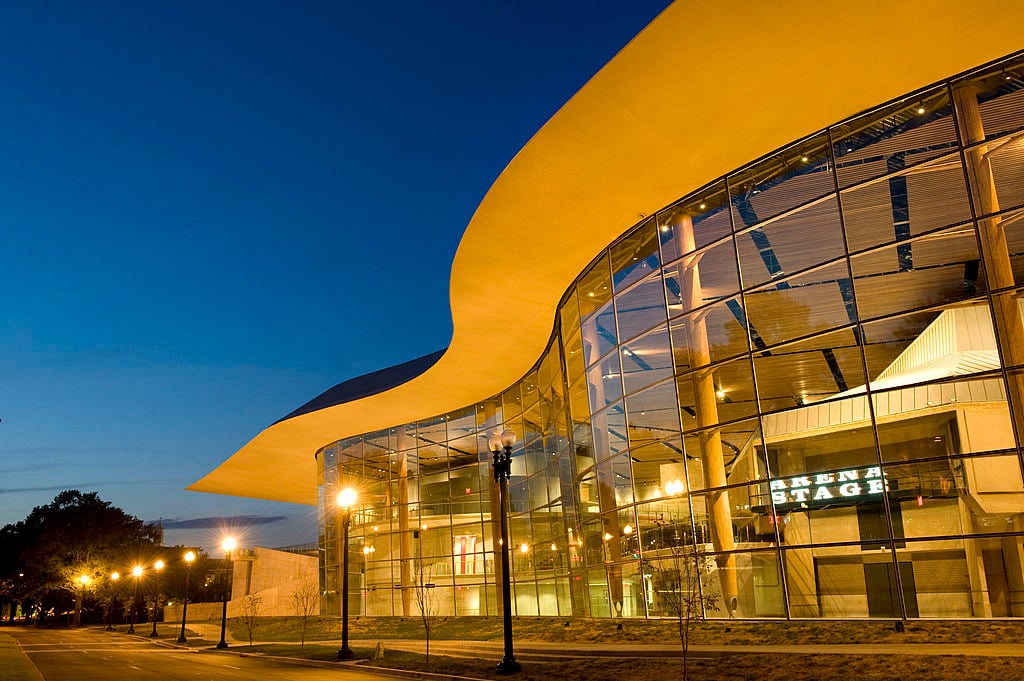
In three years under the stewardship of artistic director Hana S. Sharif, Arena Stage at the Mead Center for American Theater burned through five production managers, lost two of three commercial producing partners lined up for one season, and ran deficits that sources say totaled millions of dollars. Preview performances were canceled right and left, leaving patrons irritated. Costumes went unfinished, leaving actors feeling unmoored. The entire set for one tentpole production had to be “shopped out” to a Canadian builder weeks before opening because designs had been finalized so late.
By the time Sharif’s resignation letter hit the New York Times on June 26, the opening night of the capstone production of Arena’s 75th-anniversary season, the flagship regional theater was, by multiple accounts, in crisis.
In those same three years: Senior staff described their nationally influential artistic director, the first person of color to lead Arena, as “uppity.” A board member gave Sharif a gift with the image of a pig on it. Employees observed, out loud, that it would be much easier working for a white man. And when Sharif—a writer-director who counts Adrienne Kennedy and Edward Albee among her mentors in the craft—moved to program a play she’d written, the Arena board told her no.
Both of these sets of observations are true. All of these things happened inside the same building, among the same people, over the same span of time. The question this story tries to unpack is not whether Hana Sharif was a solid artistic director, or whether she faced ingrained racism and sexism as she tackled a high-profile job. The question is how, with passions running as hot as they apparently were by the spring of 2026, nobody set a match to the Mead Center.
“You’re in for a ride,” is the caution one senior Arena staffer heard from a colleague at the Repertory Theatre of St. Louis, Sharif’s artistic home until the Arena board invited her to take the helm. Like every institution in the nonprofit American theater, the Rep had taken a beating during the Covid pandemic. The picture grew grimmer after the eventual reopening: The Rep’s subscription base collapsed, efforts to replace those patrons with a more diverse audience of single-ticket buyers were hailed as transformative but didn’t entirely fill the gap, and by a few months after the announcement of Sharif’s move to Arena, the Rep had sounded the alarm: It needed $2.5 million by Christmas or it might have to shut its doors.
But then numbers were dire across the industry, and Arena Stage was no exception. It faced an epochal shift with the departure of longtime artistic director Molly Smith, who’d held the chair for 25 years. It still labored under a $65 million debt load associated with its landmark building on DC’s revived Southwest waterfront. And annual structural deficits had persisted for half a decade before Sharif’s arrival.
Arena’s problems before Sharif arrived exceeded financial concerns. Smith’s 2023 retirement coincided with a national movement aimed at diversifying what many called “White American Theater.” Many DC theaters in particular would respond vigorously, but other major institutions took refuge in what has become known as “comfort theater,” backing away from confrontation and coddling audiences with familiar fare.
And Arena staffers were wary of Sharif personally, especially after what one called an “awful” interview process. Some of the seniormost had urged the hiring of Jamil Jude, an Atlanta-based director with an Arena history. Jude was a finalist, but the influential head of the search committee—Catherine Guttman-McCabe, who would ascend to chair the full Arena board after Sharif’s hire—backed Sharif to the hilt.
Like other board members contacted by Washingtonian for comment, Guttman-McCabe did not respond. Nor did Sharif. Two award-winning actors, both with Broadway credits and substantial track records at Arena, did respond but firmly declined to discuss their experiences under Sharif.
And not a single member of Arena’s current rank-and-file production or administrative staff would agree to speak on the record when contacted. This story is based on conversations with nearly a dozen current and former staffers who spoke only on condition that their names wouldn’t be used.
One reason: Retaliation politics are rampant in the American theater, said one former production-side manager whose partner still works in the Mead Center complex.
An established BIPOC actor who worked with both Sharif and previous artistic director Molly Smith did say that “the rule was you can’t tell Hana no.” Some who did, the actor continued, were fired, denied access to their work product, and escorted out of the building.
Sharif was regularly late to rehearsals, by this performer’s account, a claim echoed with regard to other kinds of meetings by other staffers across departments. Overriding staff concerns, she insisted on technical choices that put people in danger—choices that, by one first-hand account, resulted in injury to at least one staffer.
These complaints and more have ricocheted around social media since Sharif’s resignation, drawing no shortage of affirmative echoes.
“My experience with her was deeply, DEEPLY scarring,” wrote DMV-based actor Jeremy Keith Hunter in a June 27 Facebook post. “I’ve never been so humiliated and disrespected in my entire theatrical career; from a decision that she approved and signed off on. It affected me then, it affects me now.”
Hunter prefaces his post with a disclaimer: “I’m never happy to see talented people (especially Black women) in authority have to step down or be dismissed.”
He concludes it with the following: “I don’t wish her ill, but I can’t say I wish her well either.”
Other critical voices have come from St. Louis.
“I understand well the hardships Black theater folks endure along our paths to success and influence,” writes a multidisciplinary artist who appeared in Sharif’s staging of Murder on the Orient Express at the Rep, in a private message to Washingtonian. “That does not excuse the harm any may cause along their way. As a Black actor, working with Hana Sh[a]rif was absolutely harrowing. Offstage Hana is cold, mean, combative. I witnessed it. I received it. I’m a grown man and she literally harangued me to the point of tears before a notes session in the theater. [O]n stage she presents [as] nice, charming, refined, intellectual and maybe even ‘sharp.’ But she’s really just calculated, manipulative, and self-serving.”
I don’t wish her ill, but I can’t say I wish her well either.
That artist’s assessment stands in stark opposition to that of Alexis Kulani Woodard, who was Sharif’s assistant director on the just-closed philosophical thriller The Motion. Woodard posted warmly about the experience on Facebook June 28.
“I saw her interact with every artist and staff member with immense grace, joy, and generosity in the midst of great personal tragedy,” Woodard wrote.
Sharif is “one of the kindest and most generous people I have ever had the pleasure to learn from,” Woodard continued, and a leader committed to a vision encompassing “radical access, artist investment, and making the impossible a reality.”
Bigger names in the national theater community have also come roaring to Sharif’s defense. Visionary administrator Nataki Garrett, actor-director Ruben Santiago-Hudson, and Pulitzer Prize–winning playwright Paula Vogel are among them.
So is Reggie D. White, who followed Sharif from St. Louis to Washington and recently moved on from Arena to take the reins at Woolly Mammoth, the scrappier but similarly influential Penn Quarter theater. There, he succeeds Maria Manuela Goyanes, who came to town promising to make what this magazine called “the most woke theater in Washington.” (Woolly and Arena together represent half of the four DC theaters that have Tony Awards displayed in their lobbies; the others are Signature Theatre and Shakespeare Theatre Company.)
White knows leadership transitions can be difficult.
“So much of the first period . . . is the institution telling the artistic director how to lead,” he says. “‘We do it this way,’ or ‘This works like this,’ or ‘This works like that.’ Which I find challenging, because artistic directors … are hired for their vision. They are hired for their expertise. They are hired for their unique perspective.”
For months on end in Sharif’s tenure at Arena, White says, he watched “people dismiss suggestions that she would make, or decide that they didn’t need to do what she asked of them, because that wasn’t ‘what they did.’ That ‘wasn’t the way that they worked.’ ”
As her number two, and as Sharif’s longtime protégé besides, White’s job was partly “to try to decode, and try to find consensus and common ground, and get us to where we needed to go,” he says. So it leaves him stammering a bit to hear that one senior Arena staffer has described him, in the wake of Sharif’s departure, as “her henchman.”
“I don’t ever really think I had a ‘henchman’ conversation with anybody,” he says, “not in my outside voice. … Maybe I … maybe my face was more expressive than I thought.”
It’s White’s recollections that surface the word “uppity,” which he says he heard more than once. That special, singularly gendered epithet that rhymes with “itch,” too.
He’s philosophical enough to know that some of that comes with the territory when a new leader takes the chair from someone like Molly Smith, who shepherded Arena for 25 years.
“At that point of a leader’s tenure, people are working at that institution because they’re choosing that leader,” he notes. “When you inherit that staff, no one chooses you.”
Legacy staff communicated that fact quite clearly sometimes.
“That was a thing I certainly witnessed at Arena,” White says. “People testing that line—with respect and with disrespect.”
His question: “How much dissonance, how much friction, can you exist with?”
For White, one particularly dissonant moment was that gift from that board member, which came adorned with the image of Miss Piggy, the legendarily temperamental Muppet diva.
Sharif, White points out, is a practicing Muslim who observes Ramadan.
Edgar Dobie, the veteran Arena executive producer responsible for the company’s business operations and Sharif’s partner in leadership, winces visibly when asked about the Miss Piggy incident.
“I did see that gift,” he acknowledges. “And thought it a poor choice.”
Dobie is unable to say whether anything constructive came out of the moment.
Dobie does push back, though, on the notion, circulated by some Arena staffers in recent days, that a pattern of chronic indecisiveness on Sharif’s part was responsible for the slew of canceled previews—as many as 34 of them in a single season, by one account—and massive cost overruns on shows like 2024’s holiday tentpole, Death on the Nile.
“Is it fair to blame her?” he asks, echoing Washingtonian’s question. “No, those problems had many authors.”
The same goes, he insists, for the widely retailed story of difficulties involving an onstage pool requiring an underwater door, which Arena’s production crew insisted couldn’t reliably be made to work. Its persistent leakage complicated the run of John Leguizamo’s The Other Americans in 2024, leading to an upper-body injury for a staffer charged with helping mitigate the issue.
White says the playwright really wanted the dramatic moment that required the door, and Sharif backed him up.
“As I said,” there are many, many inputs into production schedules,” Dobie cautions. “This is so highly collaborative, what we do. I wouldn’t point fingers at any one individual on that.”
When Arena crews struck the Other Americans set, they found black mold. The show went on to respectful reviews at the Public Theater in New York—in a staging that managed without a pool full of water.
For all that they tell tales of Sharif’s management style—and there are stories of props managers shouted at in hallways, artistic fellows belittled in rehearsals and barred from gatherings arguably important to their growth, and much more, all arrayed against counternarratives describing a nurturing mentor, a considerate colleague, and a tireless worker who showed up in the building the morning after her mother died of cancer—Arena’s staffers past and present also keep bringing up the role of the institution’s board of trustees and the question of whether it shouldn’t have intervened sooner.
It’s not as if the board is unreachable. Senior Arena staffers sit in on trustee meetings. Board members are said to visit the Mead Center regularly, for openings and special events and even during ordinary business hours. They presided as production staff voted to unionize with IATSE Local 22, a campaign that organizers describe as four years in the making, starting under Smith and spanning Sharif’s entire tenure.
And they kept a close eye on budgets, approving those annual structural deficits, right up until this year, when they didn’t.
How much dissonance, how much friction, can you exist with?
“This year, in the planning for fiscal year 2027, the mandate from the board was very clear that the budget needed to be neutral,” Reggie D. White recalls. “They were not going to approve any deficit spending. We started planning for the budget in October, so from October to May, I think that’s seven months, Hana and the producing team worked through probably 20 different versions of the season, with different shows in and out, with revenue projections in and out, with sales numbers in and out.”
But Sharif had helped bring in a pile of what’s called commercial-enhancement money—cash backing from Broadway and touring producers to develop shows they hope will move from nonprofit theaters to their for-profit ecosystem. (See the recent hit Chez Joey, the Avett Brothers musical Swept Away, and most famously the smash Dear Evan Hansen.) White’s estimate of the haul? $8 million.
With that on her balance sheet, with earned revenue rebounding from $8.5 million to $12 million, and with audiences hyped for the opening of the TLC musical CrazySexyCool, which she’d brought to Arena, Sharif wanted to program 1880, a play of her own set during the post–Civil War period called Reconstruction. Such a move was explicitly permitted in her employment contract, White says. And the numbers worked. The audience projections for Sharif’s drama were encouraging.
“There was a case made quite clearly for the show to deliver a level of financial success to make it fit within the board’s [budgetary] requirements,” White says.
The board said no. Or perhaps it didn’t.
“I don’t think that was ever a decision of the board,” Edgar Dobie says. “I think they wanted to review any kind of potential conflicts or anything that may be associated with that, but I don’t think they said you can’t do it: “‘You can’t do your play, ever,’ you know.”
White’s clear understanding, by contrast, is that the board did say no, directly or indirectly, and the on-background chatter about 1880 among Sharif’s detractors carries a whiff of glee that her ambitions were blocked. That’s one of the things sitting heavy on White’s shoulders.
Since his mentor’s departure, “I’ve heard a number of people say that they were happy that she finally got put in her place,” White says. “I feel like the kind of resentment that must have been [subdued] when she got this job is now being allowed to sound out loud, that it’s surfacing.”
“It takes time to build a system, White says. “And it’s certainly hard to build a system when a meaningful contingent of the staff just decide wholesale they’re not interested in working the way that their leader wants them to work.
“If Hana [had been] greeted with the kind of grace that she arrived with, there would be a system. There would be a mechanism. This would be a well-oiled machine, but because there was so much resistance . . . .”
He sighs.
“I’m just trying to make sure that this fate doesn’t befall me” at Woolly Mammoth, he says, “and that you’re not talking to my associate artistic director in six months.”
Meanwhile Arena Stage moves on, the worse for wear, with Dobie anchoring a half-empty executive suite and working with a shell-shocked staff to finish programming a season that’s only half announced. Production budgets continue to roll up through Arena’s general manager to Dobie’s office. The highest salary at the Mead Center continues to land in his bank account. His contract ends in 2030. In the fall, he says, a new leadership search will get underway.
Meanwhile, there’s the wreckage to survey: Three years. Five production managers. Millions in losses. A staff that called its Black female boss “uppity.”
The Arena board watched all of it. They moved after she tried to program a play about Reconstruction.
Is that governance? Or is it a tell?
The next artistic director, whoever she is, will want to know.

Trey Graham writes about arts, culture, and the world we make them in at InGoodCompany.llc. He won the George Jean Nathan Award for distinguished drama criticism in 2004.