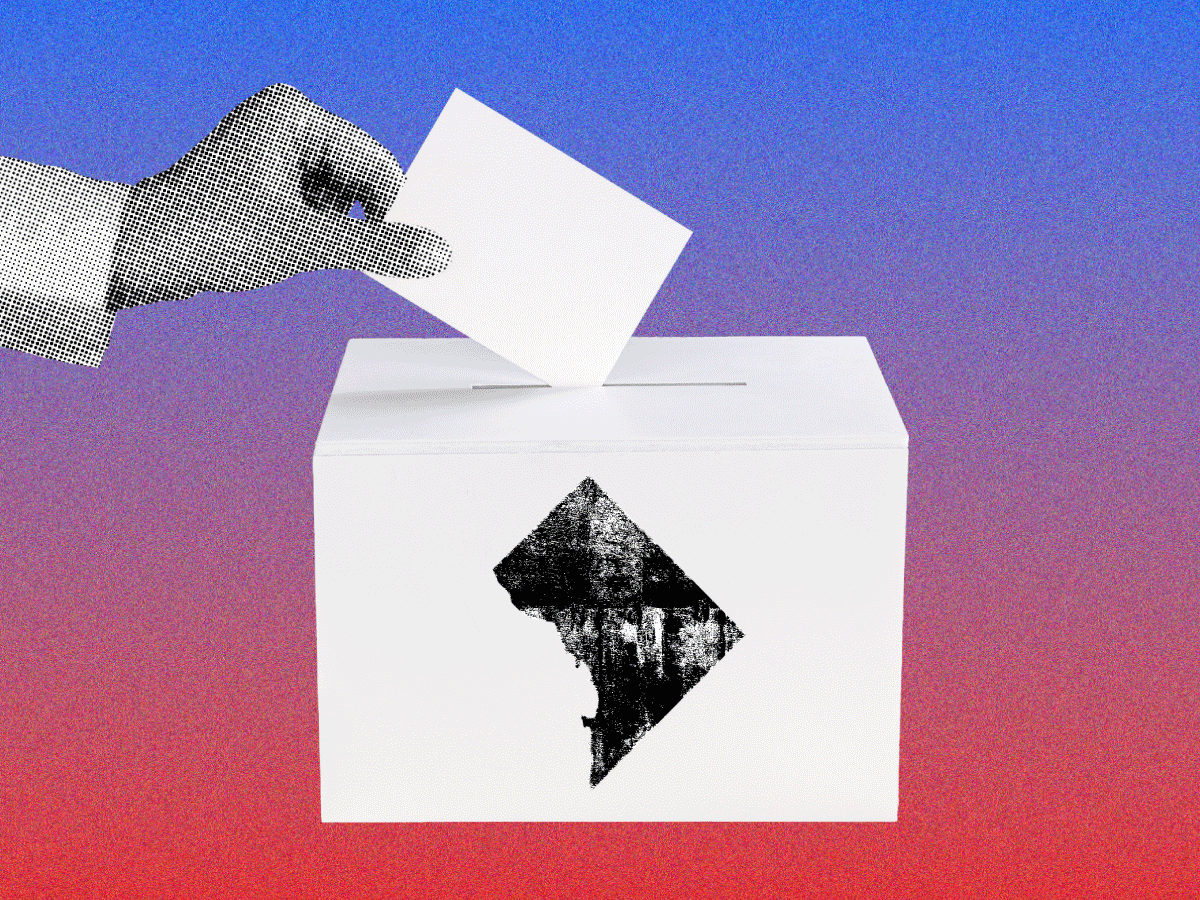
Ahead of DC’s primary election on June 16, candidates and grassroots organizations are rushing to educate voters on DC’s new ranked choice voting system.
Voters overwhelmingly approved Initiative 83 in the November 2024 election, which allowed for the city to conduct open primaries and use ranked choice voting, a system where voters can rank up to five candidates by preference instead of selecting one. However, last July the DC Council voted to fund only the implementation of ranked choice voting for the 2026 election cycle, failing to allocate funds for open primaries, so voters still need to be registered with a party to participate in next month’s elections.
DC will join cities including New York and San Francisco in implementing ranked choice voting in local elections, and while Initiative 83 passed with 72.9 percent of the vote, some District residents remain apprehensive about the change.
Here are five things DC voters should know about ranked choice voting.
How to actually vote
The essence of ranked choice voting is in the name: you rank your top choices. In races with up to five candidates, every candidate can be ranked. If there are more than five candidates, voters can rank their top five choices.
On the ballot, there will be a row for each candidate and a column for each number. Fill in the bubble for the ranking you’d like to give a candidate in their row, with first being your top choice and fifth being the last candidate you’d like to rank. To rank a write-in candidate, write the candidate’s name in the “write-in” line and then fill in whichever column you’d like to rank them in.
A common misconception is that voters should only rank their top candidates, or that you have to rank every single candidate. You can vote for just one.
“I would like to remind voters that they can rank as many candidates as they like, and there are no downsides to ranking more candidates,” says Deb Otis, senior director of research and policy at FairVote, a nonpartisan organization that advocates for election reforms. “It doesn’t hurt your first choice if you use your backup choices.”
While some voters have strategized ways to creatively help certain candidates and harm others via ranked choice, experts say that the best practice is to just rank candidates in order of preference.
How to avoid disqualification
While it’s unlikely that any one mistake will invalidate an entire ballot, some missteps can negate individual votes.
These include:
- Giving more than one candidate the same ranking.
If you “over-vote” (choosing multiple candidates in one column) in the first column, none of your votes in that race will count. If you over-vote in any of the following columns, that vote and any rankings after will not be counted.
- Ranking the same candidate more than once.
Only a candidate’s highest ranking will count. If you rank a candidate multiple times, any additional rankings are ignored.
- Skipping two consecutive rankings.
If you skip two rankings (i.e. jumping first to fourth or second to fifth) you risk your later rankings being invalidated.
If you do make a mistake (like over-voting or ranking a candidate twice), all votes in that race before the error will still count.
How your vote gets counted
Votes are tabulated differently than they are in other voting systems. Every voter’s first choice will be counted first—if no candidate receives 50 percent of first choice votes, then the candidate with the fewest votes will be eliminated. Those who ranked the eliminated candidate first will have their votes reallocated to their second-choice candidate. If, in a later round, your second-choice candidate is eliminated, your vote goes to your third choice, and so on. This process continues until there are only two candidates left, and the candidate with the most votes of the two is the winner. In the election for the At-Large seats in the DC Council, the top two vote-earners will win seats.
Kenyatta Smith, the Engagement and Outreach Director at Grow Democracy DC, a nonpartisan nonprofit aimed at providing election education to DC voters, says she recommends voters rank more than one candidate to make sure their vote counts even if their first choice loses.
“If your first choice loses, your vote moves to your next choice, so if you do not have any backup choices and your first choice is eliminated in the first round, your vote is no longer in that race,” Smith said.
This year, election night parties might be a little anticlimactic because of ranked choice. The DC Board of Elections announced in April that on election night, it will only post the number of first place rankings that every candidate in a race gets. Because DC has a 10-day window for mail-in ballots to arrive, the board won’t run ranked-choice voting tabulations until they feel certain that most of the ballots are in. In some races where one candidate does receive 50 percent of first-place votes, final victories may be clear on election night. However, it will likely be a few days after June 16 that the final ranked choice votes are tabulated.
In the mayoral race, rank choice voting will likely matter
Democratic mayoral frontrunners Ward 4 Councilmember Janeese Lewis George and former At-Large Councilmember Kenyan McDuffie appear to be neck-in-neck in the polls just three weeks before the June 16 primary. City Cast DC’s latest polling has Lewis George, a self-identified Democratic Socialist running on a platform of providing affordable housing and childcare to District residents, at 39 percent, and McDuffie, who has championed more modest proposals on supporting small businesses and decreasing utility costs, at 34 percent, meaning there’s a strong chance no candidate wins a majority in the first round of votes.
“It’s very likely that voters’ backup choices will be decisive in that election,” Otis said.
City Cast’s poll found that the new voting system could favor McDuffie, as the voters who did not rank Lewis George or McDuffie first were more likely to rank McDuffie second. Some 27 percent of voters who did not rank Lewis George or McDuffie first ranked McDuffie second, compared to 15 percent ranking Lewis George second.
The finding aligns with studies that have shown ranked choice voting is more likely to elect politically moderate candidates, as they often have broader electoral support.
Candidates have incorporated the new voting system in their campaigns
Candidates in races across the District are taking differing campaign strategies directing voters how to fill out their ranked-choice ballots.
One of the touted benefits of ranked choice voting is that it discourages candidates from attacking one another, since candidates are incentivized to compete for second-place votes among their opponents’ bases. In some DC races, this has proven effective, with US Shadow Rep. Oye Owolewa telling his supporters to rank his opponents in the Democratic race for At-large councilmember in a certain order. Similarly, Rashida Brown and Miguel Trindade Deramo—Democratic candidates in the Ward 1 Council race—have endorsed each other.
“Given the reality that most candidates won’t get 50 percent on the first try, it’s important for folks to know who you align with, who you trust, who you believe in to lead the city forward in the event that perhaps you or the candidate in question doesn’t win the election,” Owolewa told Washingtonian.
However, campaigns in other races have taken a different tactic. Lewis George at a recent candidate forum encouraged voters to not rank McDuffie due to his alleged acceptance of funds from donors who have also supported President Donald Trump. Posters have also popped up around the city encouraging voters not to rank McDuffie as a candidate.
Smith said ranked choice voting has changed the campaign dynamics in DC, as candidates have to work harder to reach a broader coalition of voters rather than relying only on their base, since ranked choice voting requires a candidate to garner a majority to win. She said this differs from many sitting DC elected officials, who won their races with a plurality of votes and have grown to solely rely on their core bases.
“With ranked choice voting, it kind of forces them to step outside of that everyday campaigning support so they can acquire more support because they have to win by the majority,” Smith said.
Election Day is on June 16, with early voting beginning June 8. Voters can register to vote in-person up until the day before the start of early voting, and same-day registration is available during early voting and on Election Day. Absentee ballot applications are due 15 days before Election Day, and ballots themselves should be postmarked on or before Election Day.