
hen the bad news broke, Will Lewis wasn’t around for it. As hundreds of Washington Post employees gathered in front of phones and laptops for a Zoom meeting in early February to learn their fates, the Post’s chief executive and publisher didn’t appear on their screens. Instead, the announcement that more than 350 journalists would lose their jobs was left to executive editor Matt Murray. Afterward, Lewis made no statements and granted no interviews. Murray said later that Lewis “had a lot of things to tend to today.”
The mass layoff—amounting to nearly half of the Post’s vaunted newsroom—translated into a broad disfiguring of the publication. The paper vaporized its sports and book sections, halved its network of foreign bureaus, and reduced its Metro section—where its history-making Watergate coverage had begun—to a skeleton. Every staff photographer was laid off. Among the casualties was Martin Weil, a beloved Metro reporter who’d worked at the paper since Lyndon Johnson was President. Weil was notified in a form letter delivered via email.
Past and present Post employees trained their anger and disappointment on the paper’s owner, Jeff Bezos, Amazon’s multibillionaire founder. Former executive editor Martin Baron blasted the world’s fifth-richest man for neglect, abandonment, and worse. Some of Bezos’s decisions, Baron wrote, were “gutless” and reflected “moral infirmity.” The paper had been losing money for several years, yes, but critics argued that Bezos could afford to lose money—literally for centuries—to maintain the paper’s newsgathering. He was now worth around $250 billion, ten times as much as he was when he bought the Post in 2013. Back then, he promised to provide “runway” (read: hard cash) for growth and experimentation. The new cuts would instead make the paper’s newsroom smaller than when Bezos first stepped in—smaller even than Politico, cofounded in 2007 by two former Post reporters.
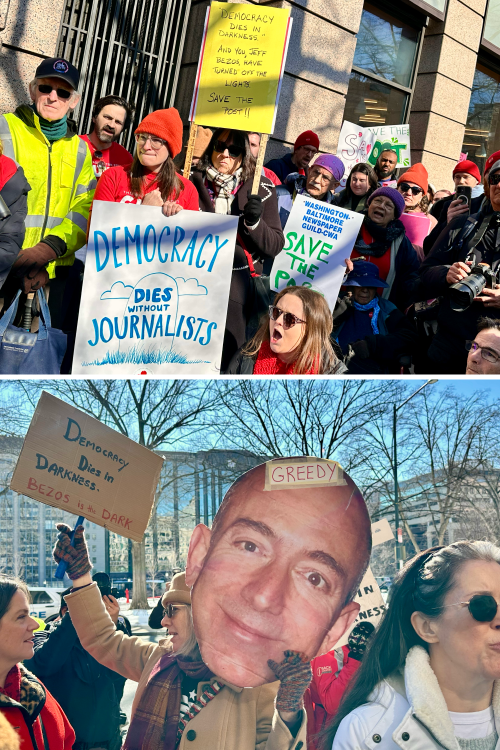
Lewis received his share of the rage and blame, too. Hired by Bezos in early 2024 to reverse declining readership and revenues, the 56-year-old newsman turned media executive had plainly failed. The Post lost a reported $100 million in 2024, Lewis’s first year, and even more in 2025. Lewis was unable to stanch the bleeding, despite previous buyouts and layoffs. Dozens more star journalists had left on their own, disappointed and disgusted by what they saw as his fecklessness.
Only a few months into his tenure, Lewis had retreated into a kind of sullen isolation. When Post reporters landed important scoops—such as the revelation in late November 2025 of the Pentagon’s “double tap” strike on a suspected drug-smuggling boat—he couldn’t muster up an attaboy or use it as a peg for collective encouragement, a tradition for the paper’s publishers. For a brief period, Lewis had even stopped talking to Murray, whom he’d handpicked to lead the news operation. “As far as the newsroom is concerned, he’s a nonentity,” a veteran reporter said in early January. “We haven’t seen him in months. He’s a ghost.”
Lewis, who hasn’t given an on-the-record interview in more than two years, didn’t respond to multiple requests for comment on this article. Nor did Murray or three of Lewis’s top business deputies. A Post spokesperson offered limited information in response to submitted questions.
The day after the Post’s bloodletting, Lewis was photographed—by a former Post sportswriter—walking the red carpet at a pre–Super Bowl event in San Francisco. More outrage ensued. Two days later, he was gone for good, announcing his departure in a terse email. Few mourned. “I’m glad Will Lewis has been fired,” Post reporter Katie Mettler told the New York Times. “I wish it had happened before he fired all my friends.”
Before Lewis left, newsroom morale had fallen so low that journalists had adopted a kind of rallying cry on an internal Slack channel: “Outlast the fuckery!” In the wake of his calamitous tenure, however, something one reporter had told Washingtonian in late January now sounded prophetic: “Looks like the fuckery is going to win after all.”
Broken Trust
Lewis arrived at the Post on a small wave of optimism and expectation. During his first meeting with staffers, in November 2023, he laid out his credentials, noting that he’d been a reporter and editor for 20 years before moving to the business side. He encouraged attendees to ask him hard questions and promised to “never buckle” when defending journalists. “We will always get the story done,” he declared. As a badge of his independence and integrity, he mentioned he’d been publisher of the Wall Street Journal in 2015 during its investigation of Theranos, a fraudulent medical startup that had received $125 million of investment from Journal principal owner Rupert Murdoch.
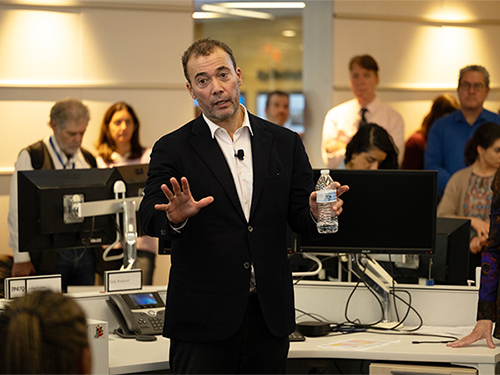
Lewis struck many as affable, witty, and energetic, as one might have expected of a man who’d captained his British university’s soccer team. The newsletter Semafor, in an early assessment, described him as “a relentlessly charming Brit whose uniform is sleek sweaters and expensive-looking sneakers.” Bezos paid his transatlantic hand handsomely: $3 million a year, according to records uncovered by former Post columnist Gene Weingarten.
Lewis was a dramatic change from his genteel predecessor, Fred Ryan, a former top staffer for President Reagan and Politico’s first president and CEO. Hired by Bezos in 2014, Ryan had overseen a period of increased readership and profitability during President Trump’s relentlessly newsmaking first term. But as that “Trump bump” turned into a broader media slump in 2021, Ryan seemed frozen, unable to adapt to a changing landscape of burned-out audiences and relative calm in the White House. Monthly visitors to the Post’s website plummeted from a pandemic-driven peak of 139 million in March 2020 to 58 million in December 2022. Digital subscriptions, which had grown to nearly 3 million by 2020, fell by nearly 500,000 as a sense of national crisis abated. When Ryan announced pending layoffs during a late-2022 town-hall meeting—and then walked away without taking questions—staffers were apoplectic. The next summer, he left the Post. The paper reportedly lost a total of $177 million in 2022 and 2023.
“Will embodies the tenacity, energy and vision needed for this role,” Bezos wrote in an email to Post staff in late 2023 announcing his hiring.
Bezos thought Lewis had the chops to turn things around. Born into a family of overachievers—his father and older brother had both received royal honors—Lewis began his career as a business reporter at the Mail on Sunday tabloid in 1991, advancing quickly to the more prestigious Financial Times, which sent him to New York in 1998 to cover Wall Street. A colleague from this period remembers Lewis as a driven reporter who developed an extensive network of sources, often courting them after hours: “He was out every night drinking with bankers. He was a charismatic force in the newsroom, very funny, fearless, and bold. He’d come in in the morning, shirttails out, pulling bar napkins with notes on them out of his pockets, and announce, ‘I’ve got a cracker here!’ ”
One of those crackers was a landmark scoop: news of a merger between Exxon and Mobil, then the largest industrial deal in history. Lewis soon began what a profile once described as a “vertiginous” rise through British media. After a stint as an editor at London’s Sunday Times, he joined the Daily Telegraph in 2005 as city editor. Just over a year later, he was promoted to editor in chief, at 37 the youngest in the newspaper’s 151-year history.
In early 2009, Lewis took a daring step, urging the Telegraph’s owners to pay an anonymous government whistleblower for an explosive piece of information—a secret database of files detailing lavish personal spending by members of Parliament and the prime minister’s cabinet, all at taxpayer expense. Paying for scoops isn’t uncommon for British tabloids, but it’s rare for more prestigious publications like the Telegraph. The paper ultimately spent about $165,000 on the files. Led by Lewis and a top reporter, Robert Winnett, the Telegraph mined the data for a series of bombshells. The reporting triggered national outrage and led to the resignations of dozens of officials. Seven more went to prison. Lewis was the toast of the British media, named “journalist of the year” at the 2010 British Press Awards.
Lewis also attempted to push the Telegraph further into digital-news delivery by starting something called the Euston Project, a $15 million, 50-person effort to develop new online revenues. During his run as publisher of the Wall Street Journal from 2014 to 2020, the paper added some 700,000 new subscribers, expanding to more than 2 million in total. Bezos was impressed. “Will embodies the tenacity, energy and vision needed for this role,” he wrote in an email to Post staff in late 2023 announcing his hiring. “He believes that together we will build the right future for the Post. I agree.”
Arriving in Washington, Lewis settled into a $7 million house in Georgetown and began a “listening tour.” He initially was a gregarious presence in the Post’s newsroom, roaming among the cubicles and booming out praise (“Great story!”). He was visible outside the paper, too. Lewis traveled Washington’s social circuit guided by Sally Quinn, the longtime Post writer and widow of legendary editor Ben Bradlee. At one party, Quinn introduced him to Chuck Schumer, the Senate minority leader. “Just don’t forget,” Schumer told Lewis with a smile, “I’m a big fucking deal around here!”
The Post’s own investigative reporting on Lewis’s past role in cleaning up a sprawling hacking scandal “raised serious questions about Will’s judgment and ethics.”
Within months, however, a bitter chill set in at the Post, rooted in a murky chapter of Lewis’s career. In 2010, Lewis left the Telegraph for a management job at News International, the British newspaper company controlled by Murdoch. The company soon became engulfed in a sprawling scandal in which its journalists were suspected of prying into the voicemails and emails of celebrities, politicians, and others in search of news. Assigned to clean up the mess, Lewis acted as a liaison between the company and criminal investigators.
Hacking victims—including Prince Harry and former prime minister Gordon Brown—later accused Lewis of covering up potentially incriminating evidence, specifically by overseeing the deletion of millions of company emails. Lewis has long denied wrongdoing and has never been charged with a crime, but the allegations remain under active investigation by Scotland Yard.
It’s unclear how the Post’s recruiters characterized all of this when they recommended Lewis as a candidate to replace Ryan. But it’s impossible to argue they were unaware. After his triumph on the expenses scandal, Lewis became a pariah among many British journalists for his “cleanup” work: Many suspected he’d steered investigators toward reporters and low-ranking editors, protecting Murdoch and his top executives. The even more damning claim—that Lewis had actively engaged in hiding evidence—formally surfaced in a lawsuit filed by more than 50 hacking victims in 2020 and was raised anew in lawsuits by Prince Harry and actor Hugh Grant in 2023. (Both later settled.)
Just before Lewis joined the Post, NPR reporter David Folkenflik approached Lewis for an interview. Lewis offered him an exclusive, on the condition that he not mention the hacking scandal. Folkenflik declined, wrote about the allegations, and later revealed Lewis’s offer. In response, Lewis called him an “activist, not a journalist.” When then–Post executive editor Sally Buzbee told Lewis in early 2024 that the paper intended to dig into the hacking story, the new publisher twice discouraged her. She launched the inquiry anyway, placing a senior editor, Matea Gold, in charge of a team that grew to eight reporters and other editors. They produced a series of stories that the Post boldly displayed on its front page. One of them revealed that Lewis and Winnett, his protégé at the Telegraph, had published articles years earlier based on information obtained through unsavory and possibly illegal means. The reporting, says a journalist who was involved in the Post’s investigation, “raised serious questions about Will’s judgment and ethics.” His attempts to suppress the story “violated a fundamental principle that news organizations must guard against conflicts of interest.”
Bezos stood by Lewis. But whatever trust the Post newsroom still had in the publisher vanished when Lewis sought to demote Buzbee as part of a proposed reorganization in mid-2024. She chose to resign instead, and Lewis tapped Winnett to replace her. The situation came to a head at a contentious staff meeting the day after Lewis announced Buzbee’s departure in a Sunday-night email. Peppered with skeptical questions, Lewis grew defensive, then churlish. When reporter Carol Leonnig, a multiple Pulitzer Prize winner, asked him about his “vision” for the paper, Lewis snapped at her: “We are going to turn this around, but let’s not sugarcoat it. It needs turning around,” adding, “People are not reading your stuff.”
The meeting was brief, and ended by Lewis. Winnett didn’t last long, either: The Post’s reporting prompted him to withdraw as top editor before he started the job.
Building Vaporware
Early in his tenure, Lewis summed up his strategy for reviving the Post with a mantra worthy of a Silicon Valley pitch deck: “Fix it, build it, scale it.” The motto had an appealing simplicity—and if Lewis had made good on any of those fronts, he might have mended his fractured relationship with the newsroom.
Only that’s not what happened. Lewis first promised to find more readers and subscribers via acquisitions, mimicking the New York Times’s successful strategy of buying Wordle, Wirecutter, and the Athletic. But outside of a brief, tire-kicking session with the owners of the Punchbowl political newsletter in 2024, the Post and Lewis never made any deals.
At the same time Lewis announced Buzbee’s departure, he proposed creating a “third newsroom”—a new entity on par with the paper’s news and opinion sections but centered on youth-centric news videos, lifestyle articles, and social-media-friendly posts. The idea echoed not one but two of Lewis’s old ideas: the Euston Project of 2009 and the News Movement, a British company he founded in 2020. Like the Euston Project, the Post’s “third newsroom”—renamed WP Ventures—was supposed to be, among other things, a laboratory for experimentation and innovation. A respected newsroom veteran, managing editor Krissah Thompson, and an experienced manager, Samantha Henig, were named to run it. The Post’s social-media, video, audio, newsletter, and health-reporting staffs were nominally assigned to the project, though people on those teams were expected to continue their daily responsibilities. Top management also decreed that the project would have to make do with existing resources—no new hires were anticipated.
Progress was halting. Ideas came and went—mostly the latter, according to people who were involved. Among the proposals that never made it off the drawing board: “expanded” horoscope listings, with in-depth details for every sign. Nothing out of WP Ventures produced meaningful new revenue. In July 2025—eight months after Murray formally announced the initiative and after thousands of man-hours of development—Thompson took a buyout. By the time Henig left the paper in October, WP Ventures had effectively collapsed. Lewis’s big idea was, in Silicon Valley–speak, vaporware. It mirrored the Euston Project, which closed less than a year after Lewis started it. “No one was ever sure what the third newsroom was going to be,” says a veteran reporter and editor who left during Lewis’s tenure. “It turned out to be nothing.”
Lewis’s would-be innovation efforts were doctored by a succession of British consultants, whom some in the newsroom referred to as “Will’s shadow team of Brits,” or simply “the blokes.” He also favored outsiders for senior positions: Of the 21 names on the Post’s masthead—its top business and news managers—at the start of this year, eight were British natives and/or people Lewis had previously worked with at Dow Jones and the Journal. “We heard a lot of British accents,” says a former editor and reporter, “and we wondered, ‘Who are these people? What do they know about the Post or Washington or even America?’ ”
Bezos, meanwhile, remained a remote figure who hadn’t visited the Post since early 2023. He did encourage the paper to think bigger and target people who had never considered subscribing. In response, management produced a PowerPoint presentation in early 2025 that included a “Big Hairy Audacious Goal” of reaching at least 200 million paying users—roughly 80 times its then–subscriber base—including “firefighters in Cleveland.” One person who saw the presentation tells Washingtonian it helped convince them to leave the Post: “My thought was that Lewis and Bezos didn’t know anything about firefighters in Cleveland or anywhere else.”
Vanishing Act
For all of Lewis’s misfires, it was Bezos who made arguably the two most injurious decisions during his tenure. The first came in October 2024, 11 days before the election, when Bezos decreed that the paper would end its practice of endorsing presidential candidates. Readers interpreted the move as a sop to Trump—the Post had planned to endorse Kamala Harris—and made their disappointment and anger known. Within ten days, some 250,000 people had canceled their subscriptions.
Lewis was initially the face of the fiasco, writing in a Post editorial that the decision was “a statement of support of our readers’ ability to make up their own minds.” But Bezos acknowledged a few days later that he’d made the call, writing that endorsements merely added to the public’s perception of media bias.
A few months later, Bezos announced that the Post would no longer offer a variety of opinions on its editorial page and instead would write only in defense of “personal liberties and free markets.” The decision, which struck many as another move to the right, led to the section editor’s resignation and a second cancellation frenzy that sheared another 100,000 subscribers off the books.
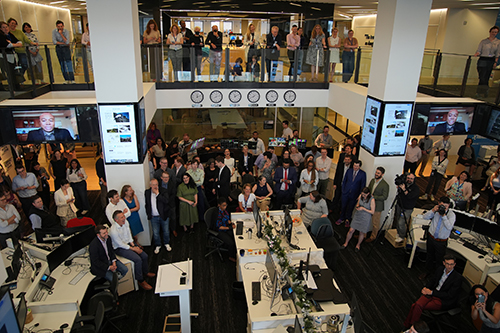
If ever there was a time for Lewis to stand up for his staff—to make good on his early promise to “never buckle”—this was it. There’s no indication he did. Instead, he receded further into ghost mode. In 2024, when the Post won three Pulitzer Prizes, Lewis didn’t show up to lead the newsroom celebration, the publisher’s traditional role. He was also missing last March when Warren Buffett hosted a screening of a documentary about legendary Post publisher Katharine Graham at the Kennedy Center. When he failed to show for another Pulitzer celebration again in 2025, Murray wanly explained that Lewis was traveling and would congratulate the winners on his return. Post journalists rolled their eyes—some likened it to a child being told that his perpetually absentee father would surely visit on their next birthday.
“As far as the newsroom is concerned, he’s a nonentity,” a Post reporter said of Lewis shortly before his departure. “We haven’t seen him in months. He’s a ghost.”
One of the events Lewis did preside over was a lavish brunch reception at the exclusive Ned’s Club following the White House Correspondents’ Dinner last spring. The party, which featured generous displays of caviar and a guest list of Washington insiders, cost $1 million, according to the New York Times. Reporters were livid. One noted that the sum represented “a not-insignificant” fraction of the Post’s losses for the year.
A few months earlier, more than 400 newsroom employees had signed an extraordinary letter to Bezos saying they were “deeply alarmed” by the Post’s growing problems. They urged him to come to the office and meet with employees. He never did. As the outrages and disappointments piled up, dozens of Post journalists left for jobs elsewhere. So many landed at the New York Times that the joke inside the Post was that the Times’s Washington bureau had become Lewis’s “third newsroom.”
The mood darkening, reporters began to gossip about whether Lewis’s fondness for after-hours drinking had affected his leadership. The satirical British magazine Private Eye had once nicknamed Lewis “Thirsty,” in reference to his frequent pub appearances. One former Post reporter told Washingtonian about an after-hours episode at a company-sponsored advertiser conference in Florida in 2024: Amid rounds of cocktails, Lewis made an embarrassing remark in front of clients. Several described an encounter between Lewis and the Post’s lobby security staff in which the new publisher talked about his hangover. Four former Post reporters told Washingtonian they brought up Lewis’s drinking in exit interviews with the company’s human-resources managers. One expressed concern that Lewis might embarrass the Post in public settings; another wondered if his “disheveled and hungover” appearance had a negative impact on business dealings. “It was clear to me that this wasn’t news” to the HR interviewer, one said. (The Post didn’t respond to direct inquiries about this topic.)
Another question puzzled the newsroom: Why did Bezos, surely as savvy a businessman as any alive, stick with Lewis for so long? People who know Lewis note that his career has advanced with the trust and approval of powerful men—Bezos, Murdoch, and Boris Johnson. The former London mayor and British prime minister, Johnson was a longtime correspondent and columnist for the Telegraph and an old colleague and friend of Lewis’s. Lewis served as one of Johnson’s political consultants after leaving the Journal in 2020, advising him in the aftermath of “Partygate,” a scandal involving social events held at 10 Downing Street while Britain was under strict pandemic lockdown orders. Johnson rewarded Lewis’s loyalty by submitting his name for a knighthood in honor of “political and public service” in 2022. Glenn Kessler, who wrote the Post’s Fact Checker column, says that Lewis—now officially Sir William—“is really good at managing up.” As for Bezos’s loyalty to him in the face of enduring failure, Kessler speculates: “No one wants to admit he made a mistake, especially a billionaire.”
It’s not clear whether Bezos pushed Lewis out or if he jumped ship of his own accord. But it’s apparent that the Post owner wasn’t sentimental about his departure. In a brief memo to staff, Bezos praised the paper’s continuing leadership and signaled “an exciting and thriving next chapter.” He didn’t mention Lewis at all.
Paying the Price
By almost every measure, Lewis left a legacy of ashes. The Post continues to produce important work, ranging from pieces on DOGE’s decimation of the federal workforce to coverage of Trump’s mauling of the Kennedy Center. But its stature and reach are in decline.
Among current and former employees, there’s a somewhat surprising theory: that Bezos isn’t actually displeased by the paper’s travails. In the treacherous, retaliatory atmosphere of Trump’s second term, a smaller, weaker, and less troublesome Post might pose fewer risks to the more prosperous parts of Bezos’s business empire—particularly Amazon and Blue Origin, his rocket company.
During Trump’s first term, the President periodically lashed out at Bezos and the Post, accusing the paper of being “the Amazon Washington Post.” Bezos is keenly aware that Trump’s hostility jeopardized Amazon’s delivery deals with the US Postal Service and complicated the company’s pursuit of a $10 billion Pentagon cloud-computing contract. (Amazon lost its bid for the project in 2019 but later sued, alleging Trump had applied “improper pressure” to influence the outcome. The project eventually was scrapped, and Amazon became one of four contractors on a revised contract.) Today Bezos also has to keep up with Elon Musk—owner of the spaceflight competitor SpaceX—who contributed nearly $300 million to Republican candidates, including Trump, in the 2024 election.
It’s not hard to squint and see the many pieces of a puzzle falling into place: Bezos’s spiking of the Post’s Harris endorsement; Amazon’s $1 million contribution to Trump’s inaugural committee; Bezos’s attendance at Trump’s inauguration; his abrupt decision to transform the Post’s opinion section into a more Trump-friendly environment; Amazon’s purchase of reruns of Trump’s The Apprentice reality show and its investment of $75 million in a Melania Trump–produced documentary; Amazon’s contribution to Trump’s White House ballroom project. Is it mere coincidence that Trump has refrained from criticizing Bezos, Amazon, and the Post in his second term, remaining silent even as the paper underwent its convulsive contraction in February? Possibly not.
“[Bezos’s] goal for the Post is to lose less money and for it to be something that isn’t a huge headache for his other businesses,” a former editor at the paper says. “Losing 250,000 subscribers is the price you pay for not antagonizing Trump. Amazon is the source of his wealth, Blue Origin is his passion. The Post is neither. On some level, I don’t blame him” for kowtowing to the President.
It took decades to build the Post into a jewel of journalism, a small but vital cog in the machinery of democracy. When Bezos bought the paper, he seemed to take that role seriously—until it became too costly, and perhaps too inconvenient. Lewis did little to change his mind. “If there’s an obit of the Post someday, the history books will say [Lewis] was the last captain on deck when the ship hit the iceberg,” says Kessler, who worked at the paper for 27 years. “But the ship was already headed toward the iceberg. Lewis just made the course worse.”
hen the bad news broke, Will Lewis wasn’t around for it. As hundreds of Washington Post employees gathered in front of phones and laptops for a Zoom meeting in early February to learn their fates, the Post’s chief executive and publisher didn’t appear on their screens. Instead, the announcement that more than 350 journalists would lose their jobs was left to executive editor Matt Murray. Afterward, Lewis made no statements and granted no interviews. Murray said later that Lewis “had a lot of things to tend to today.”
The mass layoff—amounting to nearly half of the Post’s vaunted newsroom—translated into a broad disfiguring of the publication. The paper vaporized its sports and book sections, halved its network of foreign bureaus, and reduced its Metro section—where its history-making Watergate coverage had begun—to a skeleton. Every staff photographer was laid off. Among the casualties was Martin Weil, a beloved Metro reporter who’d worked at the paper since Lyndon Johnson was President. Weil was notified in a form letter delivered via email.
Past and present Post employees trained their anger and disappointment on the paper’s owner, Jeff Bezos, Amazon’s multibillionaire founder. Former executive editor Martin Baron blasted the world’s fifth-richest man for neglect, abandonment, and worse. Some of Bezos’s decisions, Baron wrote, were “gutless” and reflected “moral infirmity.” The paper had been losing money for several years, yes, but critics argued that Bezos could afford to lose money—literally for centuries—to maintain the paper’s newsgathering. He was now worth around $250 billion, ten times as much as he was when he bought the Post in 2013. Back then, he promised to provide “runway” (read: hard cash) for growth and experimentation. The new cuts would instead make the paper’s newsroom smaller than when Bezos first stepped in—smaller even than Politico, cofounded in 2007 by two former Post reporters.
Lewis received his share of the rage and blame, too. Hired by Bezos in early 2024 to reverse declining readership and revenues, the 56-year-old newsman turned media executive had plainly failed. The Post lost a reported $100 million in 2024, Lewis’s first year, and even more in 2025. Lewis was unable to stanch the bleeding, despite previous buyouts and layoffs. Dozens more star journalists had left on their own, disappointed and disgusted by what they saw as his fecklessness.
Only a few months into his tenure, Lewis had retreated into a kind of sullen isolation. When Post reporters landed important scoops—such as the revelation in late November 2025 of the Pentagon’s “double tap” strike on a suspected drug-smuggling boat—he couldn’t muster up an attaboy or use it as a peg for collective encouragement, a tradition for the paper’s publishers. For a brief period, Lewis had even stopped talking to Murray, whom he’d handpicked to lead the news operation. “As far as the newsroom is concerned, he’s a nonentity,” a veteran reporter said in early January. “We haven’t seen him in months. He’s a ghost.”
Lewis, who hasn’t given an on-the-record interview in more than two years, didn’t respond to multiple requests for comment on this article. Nor did Murray or three of Lewis’s top business deputies. A Post spokesperson offered limited information in response to submitted questions.
The day after the Post’s bloodletting, Lewis was photographed—by a former Post sportswriter—walking the red carpet at a pre–Super Bowl event in San Francisco. More outrage ensued. Two days later, he was gone for good, announcing his departure in a terse email. Few mourned. “I’m glad Will Lewis has been fired,” Post reporter Katie Mettler told the New York Times. “I wish it had happened before he fired all my friends.”
Before Lewis left, newsroom morale had fallen so low that journalists had adopted a kind of rallying cry on an internal Slack channel: “Outlast the fuckery!” In the wake of his calamitous tenure, however, something one reporter had told Washingtonian in late January now sounded prophetic: “Looks like the fuckery is going to win after all.”
Broken Trust
Lewis arrived at the Post on a small wave of optimism and expectation. During his first meeting with staffers, in November 2023, he laid out his credentials, noting that he’d been a reporter and editor for 20 years before moving to the business side. He encouraged attendees to ask him hard questions and promised to “never buckle” when defending journalists. “We will always get the story done,” he declared. As a badge of his independence and integrity, he mentioned he’d been publisher of the Wall Street Journal in 2015 during its investigation of Theranos, a fraudulent medical startup that had received $125 million of investment from Journal principal owner Rupert Murdoch.
buckle” when defending journalists and to “always get the story done”–and
also to turn around the paper’s flagging business fortunes. Photograph by
Marvin Joseph/Washington Post via Getty Images.
Lewis struck many as affable, witty, and energetic, as one might have expected of a man who’d captained his British university’s soccer team. The newsletter Semafor, in an early assessment, described him as “a relentlessly charming Brit whose uniform is sleek sweaters and expensive-looking sneakers.” Bezos paid his transatlantic hand handsomely: $3 million a year, according to records uncovered by former Post columnist Gene Weingarten.
Lewis was a dramatic change from his genteel predecessor, Fred Ryan, a former top staffer for President Reagan and Politico’s first president and CEO. Hired by Bezos in 2014, Ryan had overseen a period of increased readership and profitability during President Trump’s relentlessly newsmaking first term. But as that “Trump bump” turned into a broader media slump in 2021, Ryan seemed frozen, unable to adapt to a changing landscape of burned-out audiences and relative calm in the White House. Monthly visitors to the Post’s website plummeted from a pandemic-driven peak of 139 million in March 2020 to 58 million in December 2022. Digital subscriptions, which had grown to nearly 3 million by 2020, fell by nearly 500,000 as a sense of national crisis abated. When Ryan announced pending layoffs during a late-2022 town-hall meeting—and then walked away without taking questions—staffers were apoplectic. The next summer, he left the Post. The paper reportedly lost a total of $177 million in 2022 and 2023.
“Will embodies the tenacity, energy and vision needed for this role,” Bezos wrote in an email to Post staff in late 2023 announcing his hiring.
Bezos thought Lewis had the chops to turn things around. Born into a family of overachievers—his father and older brother had both received royal honors—Lewis began his career as a business reporter at the Mail on Sunday tabloid in 1991, advancing quickly to the more prestigious Financial Times, which sent him to New York in 1998 to cover Wall Street. A colleague from this period remembers Lewis as a driven reporter who developed an extensive network of sources, often courting them after hours: “He was out every night drinking with bankers. He was a charismatic force in the newsroom, very funny, fearless, and bold. He’d come in in the morning, shirttails out, pulling bar napkins with notes on them out of his pockets, and announce, ‘I’ve got a cracker here!’ ”
One of those crackers was a landmark scoop: news of a merger between Exxon and Mobil, then the largest industrial deal in history. Lewis soon began what a profile once described as a “vertiginous” rise through British media. After a stint as an editor at London’s Sunday Times, he joined the Daily Telegraph in 2005 as city editor. Just over a year later, he was promoted to editor in chief, at 37 the youngest in the newspaper’s 151-year history.
In early 2009, Lewis took a daring step, urging the Telegraph’s owners to pay an anonymous government whistleblower for an explosive piece of information—a secret database of files detailing lavish personal spending by members of Parliament and the prime minister’s cabinet, all at taxpayer expense. Paying for scoops isn’t uncommon for British tabloids, but it’s rare for more prestigious publications like the Telegraph. The paper ultimately spent about $165,000 on the files. Led by Lewis and a top reporter, Robert Winnett, the Telegraph mined the data for a series of bombshells. The reporting triggered national outrage and led to the resignations of dozens of officials. Seven more went to prison. Lewis was the toast of the British media, named “journalist of the year” at the 2010 British Press Awards.
Lewis also attempted to push the Telegraph further into digital-news delivery by starting something called the Euston Project, a $15 million, 50-person effort to develop new online revenues. During his run as publisher of the Wall Street Journal from 2014 to 2020, the paper added some 700,000 new subscribers, expanding to more than 2 million in total. Bezos was impressed. “Will embodies the tenacity, energy and vision needed for this role,” he wrote in an email to Post staff in late 2023 announcing his hiring. “He believes that together we will build the right future for the Post. I agree.”
Arriving in Washington, Lewis settled into a $7 million house in Georgetown and began a “listening tour.” He initially was a gregarious presence in the Post’s newsroom, roaming among the cubicles and booming out praise (“Great story!”). He was visible outside the paper, too. Lewis traveled Washington’s social circuit guided by Sally Quinn, the longtime Post writer and widow of legendary editor Ben Bradlee. At one party, Quinn introduced him to Chuck Schumer, the Senate minority leader. “Just don’t forget,” Schumer told Lewis with a smile, “I’m a big fucking deal around here!”
The Post’s own investigative reporting on Lewis’s past role in cleaning up a sprawling hacking scandal “raised serious questions about Will’s judgment and ethics.”
Within months, however, a bitter chill set in at the Post, rooted in a murky chapter of Lewis’s career. In 2010, Lewis left the Telegraph for a management job at News International, the British newspaper company controlled by Murdoch. The company soon became engulfed in a sprawling scandal in which its journalists were suspected of prying into the voicemails and emails of celebrities, politicians, and others in search of news. Assigned to clean up the mess, Lewis acted as a liaison between the company and criminal investigators.
Hacking victims—including Prince Harry and former prime minister Gordon Brown—later accused Lewis of covering up potentially incriminating evidence, specifically by overseeing the deletion of millions of company emails. Lewis has long denied wrongdoing and has never been charged with a crime, but the allegations remain under active investigation by Scotland Yard.
It’s unclear how the Post’s recruiters characterized all of this when they recommended Lewis as a candidate to replace Ryan. But it’s impossible to argue they were unaware. After his triumph on the expenses scandal, Lewis became a pariah among many British journalists for his “cleanup” work: Many suspected he’d steered investigators toward reporters and low-ranking editors, protecting Murdoch and his top executives. The even more damning claim—that Lewis had actively engaged in hiding evidence—formally surfaced in a lawsuit filed by more than 50 hacking victims in 2020 and was raised anew in lawsuits by Prince Harry and actor Hugh Grant in 2023. (Both later settled.)
Just before Lewis joined the Post, NPR reporter David Folkenflik approached Lewis for an interview. Lewis offered him an exclusive, on the condition that he not mention the hacking scandal. Folkenflik declined, wrote about the allegations, and later revealed Lewis’s offer. In response, Lewis called him an “activist, not a journalist.” When then–Post executive editor Sally Buzbee told Lewis in early 2024 that the paper intended to dig into the hacking story, the new publisher twice discouraged her. She launched the inquiry anyway, placing a senior editor, Matea Gold, in charge of a team that grew to eight reporters and other editors. They produced a series of stories that the Post boldly displayed on its front page. One of them revealed that Lewis and Winnett, his protégé at the Telegraph, had published articles years earlier based on information obtained through unsavory and possibly illegal means. The reporting, says a journalist who was involved in the Post’s investigation, “raised serious questions about Will’s judgment and ethics.” His attempts to suppress the story “violated a fundamental principle that news organizations must guard against conflicts of interest.”
Bezos stood by Lewis. But whatever trust the Post newsroom still had in the publisher vanished when Lewis sought to demote Buzbee as part of a proposed reorganization in mid-2024. She chose to resign instead, and Lewis tapped Winnett to replace her. The situation came to a head at a contentious staff meeting the day after Lewis announced Buzbee’s departure in a Sunday-night email. Peppered with skeptical questions, Lewis grew defensive, then churlish. When reporter Carol Leonnig, a multiple Pulitzer Prize winner, asked him about his “vision” for the paper, Lewis snapped at her: “We are going to turn this around, but let’s not sugarcoat it. It needs turning around,” adding, “People are not reading your stuff.”
The meeting was brief, and ended by Lewis. Winnett didn’t last long, either: The Post’s reporting prompted him to withdraw as top editor before he started the job.
Building Vaporware
Early in his tenure, Lewis summed up his strategy for reviving the Post with a mantra worthy of a Silicon Valley pitch deck: “Fix it, build it, scale it.” The motto had an appealing simplicity—and if Lewis had made good on any of those fronts, he might have mended his fractured relationship with the newsroom.
Only that’s not what happened. Lewis first promised to find more readers and subscribers via acquisitions, mimicking the New York Times’s successful strategy of buying Wordle, Wirecutter, and the Athletic. But outside of a brief, tire-kicking session with the owners of the Punchbowl political newsletter in 2024, the Post and Lewis never made any deals.
At the same time Lewis announced Buzbee’s departure, he proposed creating a “third newsroom”—a new entity on par with the paper’s news and opinion sections but centered on youth-centric news videos, lifestyle articles, and social-media-friendly posts. The idea echoed not one but two of Lewis’s old ideas: the Euston Project of 2009 and the News Movement, a British company he founded in 2020. Like the Euston Project, the Post’s “third newsroom”—renamed WP Ventures—was supposed to be, among other things, a laboratory for experimentation and innovation. A respected newsroom veteran, managing editor Krissah Thompson, and an experienced manager, Samantha Henig, were named to run it. The Post’s social-media, video, audio, newsletter, and health-reporting staffs were nominally assigned to the project, though people on those teams were expected to continue their daily responsibilities. Top management also decreed that the project would have to make do with existing resources—no new hires were anticipated.
Progress was halting. Ideas came and went—mostly the latter, according to people who were involved. Among the proposals that never made it off the drawing board: “expanded” horoscope listings, with in-depth details for every sign. Nothing out of WP Ventures produced meaningful new revenue. In July 2025—eight months after Murray formally announced the initiative and after thousands of man-hours of development—Thompson took a buyout. By the time Henig left the paper in October, WP Ventures had effectively collapsed. Lewis’s big idea was, in Silicon Valley–speak, vaporware. It mirrored the Euston Project, which closed less than a year after Lewis started it. “No one was ever sure what the third newsroom was going to be,” says a veteran reporter and editor who left during Lewis’s tenure. “It turned out to be nothing.”
Lewis’s would-be innovation efforts were doctored by a succession of British consultants, whom some in the newsroom referred to as “Will’s shadow team of Brits,” or simply “the blokes.” He also favored outsiders for senior positions: Of the 21 names on the Post’s masthead—its top business and news managers—at the start of this year, eight were British natives and/or people Lewis had previously worked with at Dow Jones and the Journal. “We heard a lot of British accents,” says a former editor and reporter, “and we wondered, ‘Who are these people? What do they know about the Post or Washington or even America?’ ”
Bezos, meanwhile, remained a remote figure who hadn’t visited the Post since early 2023. He did encourage the paper to think bigger and target people who had never considered subscribing. In response, management produced a PowerPoint presentation in early 2025 that included a “Big Hairy Audacious Goal” of reaching at least 200 million paying users—roughly 80 times its then–subscriber base—including “firefighters in Cleveland.” One person who saw the presentation tells Washingtonian it helped convince them to leave the Post: “My thought was that Lewis and Bezos didn’t know anything about firefighters in Cleveland or anywhere else.”
Vanishing Act
For all of Lewis’s misfires, it was Bezos who made arguably the two most injurious decisions during his tenure. The first came in October 2024, 11 days before the election, when Bezos decreed that the paper would end its practice of endorsing presidential candidates. Readers interpreted the move as a sop to Trump—the Post had planned to endorse Kamala Harris—and made their disappointment and anger known. Within ten days, some 250,000 people had canceled their subscriptions.
Lewis was initially the face of the fiasco, writing in a Post editorial that the decision was “a statement of support of our readers’ ability to make up their own minds.” But Bezos acknowledged a few days later that he’d made the call, writing that endorsements merely added to the public’s perception of media bias.
A few months later, Bezos announced that the Post would no longer offer a variety of opinions on its editorial page and instead would write only in defense of “personal liberties and free markets.” The decision, which struck many as another move to the right, led to the section editor’s resignation and a second cancellation frenzy that sheared another 100,000 subscribers off the books.
If ever there was a time for Lewis to stand up for his staff—to make good on his early promise to “never buckle”—this was it. There’s no indication he did. Instead, he receded further into ghost mode. In 2024, when the Post won three Pulitzer Prizes, Lewis didn’t show up to lead the newsroom celebration, the publisher’s traditional role. He was also missing last March when Warren Buffett hosted a screening of a documentary about legendary Post publisher Katharine Graham at the Kennedy Center. When he failed to show for another Pulitzer celebration again in 2025, Murray wanly explained that Lewis was traveling and would congratulate the winners on his return. Post journalists rolled their eyes—some likened it to a child being told that his perpetually absentee father would surely visit on their next birthday.
“As far as the newsroom is concerned, he’s a nonentity,” a Post reporter said of Lewis shortly before his departure. “We haven’t seen him in months. He’s a ghost.”
One of the events Lewis did preside over was a lavish brunch reception at the exclusive Ned’s Club following the White House Correspondents’ Dinner last spring. The party, which featured generous displays of caviar and a guest list of Washington insiders, cost $1 million, according to the New York Times. Reporters were livid. One noted that the sum represented “a not-insignificant” fraction of the Post’s losses for the year.
A few months earlier, more than 400 newsroom employees had signed an extraordinary letter to Bezos saying they were “deeply alarmed” by the Post’s growing problems. They urged him to come to the office and meet with employees. He never did. As the outrages and disappointments piled up, dozens of Post journalists left for jobs elsewhere. So many landed at the New York Times that the joke inside the Post was that the Times’s Washington bureau had become Lewis’s “third newsroom.”
The mood darkening, reporters began to gossip about whether Lewis’s fondness for after-hours drinking had affected his leadership. The satirical British magazine Private Eye had once nicknamed Lewis “Thirsty,” in reference to his frequent pub appearances. One former Post reporter told Washingtonian about an after-hours episode at a company-sponsored advertiser conference in Florida in 2024: Amid rounds of cocktails, Lewis made an embarrassing remark in front of clients. Several described an encounter between Lewis and the Post’s lobby security staff in which the new publisher talked about his hangover. Four former Post reporters told Washingtonian they brought up Lewis’s drinking in exit interviews with the company’s human-resources managers. One expressed concern that Lewis might embarrass the Post in public settings; another wondered if his “disheveled and hungover” appearance had a negative impact on business dealings. “It was clear to me that this wasn’t news” to the HR interviewer, one said. (The Post didn’t respond to direct inquiries about this topic.)
Another question puzzled the newsroom: Why did Bezos, surely as savvy a businessman as any alive, stick with Lewis for so long? People who know Lewis note that his career has advanced with the trust and approval of powerful men—Bezos, Murdoch, and Boris Johnson. The former London mayor and British prime minister, Johnson was a longtime correspondent and columnist for the Telegraph and an old colleague and friend of Lewis’s. Lewis served as one of Johnson’s political consultants after leaving the Journal in 2020, advising him in the aftermath of “Partygate,” a scandal involving social events held at 10 Downing Street while Britain was under strict pandemic lockdown orders. Johnson rewarded Lewis’s loyalty by submitting his name for a knighthood in honor of “political and public service” in 2022. Glenn Kessler, who wrote the Post’s Fact Checker column, says that Lewis—now officially Sir William—“is really good at managing up.” As for Bezos’s loyalty to him in the face of enduring failure, Kessler speculates: “No one wants to admit he made a mistake, especially a billionaire.”
It’s not clear whether Bezos pushed Lewis out or if he jumped ship of his own accord. But it’s apparent that the Post owner wasn’t sentimental about his departure. In a brief memo to staff, Bezos praised the paper’s continuing leadership and signaled “an exciting and thriving next chapter.” He didn’t mention Lewis at all.
Paying the Price
By almost every measure, Lewis left a legacy of ashes. The Post continues to produce important work, ranging from pieces on DOGE’s decimation of the federal workforce to coverage of Trump’s mauling of the Kennedy Center. But its stature and reach are in decline.
Among current and former employees, there’s a somewhat surprising theory: that Bezos isn’t actually displeased by the paper’s travails. In the treacherous, retaliatory atmosphere of Trump’s second term, a smaller, weaker, and less troublesome Post might pose fewer risks to the more prosperous parts of Bezos’s business empire—particularly Amazon and Blue Origin, his rocket company.
During Trump’s first term, the President periodically lashed out at Bezos and the Post, accusing the paper of being “the Amazon Washington Post.” Bezos is keenly aware that Trump’s hostility jeopardized Amazon’s delivery deals with the US Postal Service and complicated the company’s pursuit of a $10 billion Pentagon cloud-computing contract. (Amazon lost its bid for the project in 2019 but later sued, alleging Trump had applied “improper pressure” to influence the outcome. The project eventually was scrapped, and Amazon became one of four contractors on a revised contract.) Today Bezos also has to keep up with Elon Musk—owner of the spaceflight competitor SpaceX—who contributed nearly $300 million to Republican candidates, including Trump, in the 2024 election.
It’s not hard to squint and see the many pieces of a puzzle falling into place: Bezos’s spiking of the Post’s Harris endorsement; Amazon’s $1 million contribution to Trump’s inaugural committee; Bezos’s attendance at Trump’s inauguration; his abrupt decision to transform the Post’s opinion section into a more Trump-friendly environment; Amazon’s purchase of reruns of Trump’s The Apprentice reality show and its investment of $75 million in a Melania Trump–produced documentary; Amazon’s contribution to Trump’s White House ballroom project. Is it mere coincidence that Trump has refrained from criticizing Bezos, Amazon, and the Post in his second term, remaining silent even as the paper underwent its convulsive contraction in February? Possibly not.
“[Bezos’s] goal for the Post is to lose less money and for it to be something that isn’t a huge headache for his other businesses,” a former editor at the paper says. “Losing 250,000 subscribers is the price you pay for not antagonizing Trump. Amazon is the source of his wealth, Blue Origin is his passion. The Post is neither. On some level, I don’t blame him” for kowtowing to the President.
It took decades to build the Post into a jewel of journalism, a small but vital cog in the machinery of democracy. When Bezos bought the paper, he seemed to take that role seriously—until it became too costly, and perhaps too inconvenient. Lewis did little to change his mind. “If there’s an obit of the Post someday, the history books will say [Lewis] was the last captain on deck when the ship hit the iceberg,” says Kessler, who worked at the paper for 27 years. “But the ship was already headed toward the iceberg. Lewis just made the course worse.”
This article appears in the April 2026 issue of Washingtonian.


