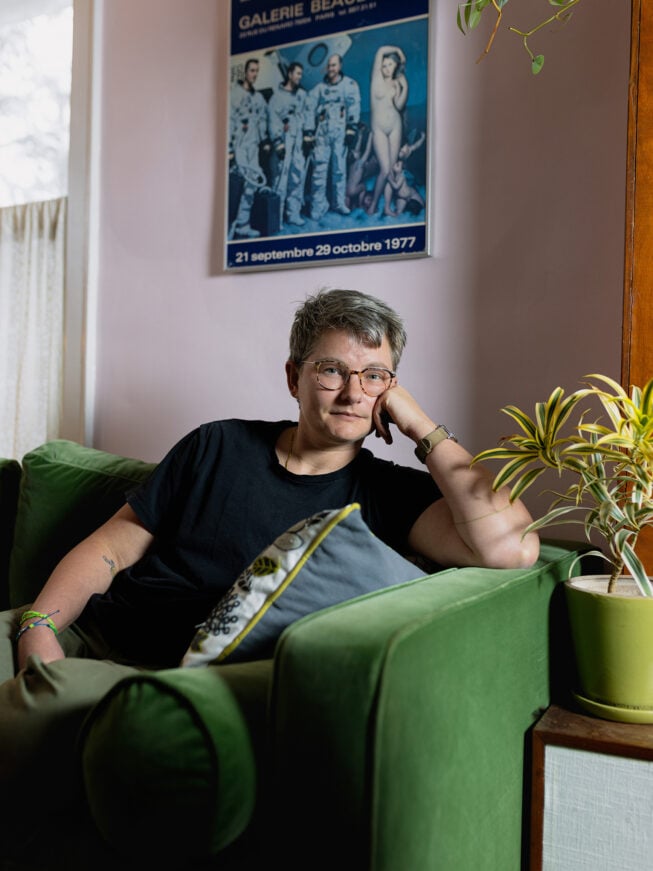
“A Botwin just got busted and another one’s hot, so I’m on high alert,” she said. Word had gotten out among the Botwins—the handful of DC-area women dealers who bring to mind the Weeds main character—that two people had been followed from a dealer’s Adams Morgan home. “One was followed all the way to Virginia,” Sara said.
As a result, Sara got a new cell phone, started rotating the cars she uses for deliveries, and began changing customers’ rendezvous points at the last minute. When we meet a few weeks later, though, the chatter among dealers seems to have calmed down.
From the high-powered attorney’s Mount Pleasant home, she drives to a popular bar, where a server spots Sara and places an order. Sara goes to her car, which is filled with unmarked paper bags, each containing individually wrapped brownies, turtles, cookies, and lollipops. She fills a goody bag, drops in a reminder that she’s available to make holiday treats, and seals it with one of her stickers.
Back in the bar, the server returns. “Here’s your bill,” he says, putting a receipt for a nonexistent drink on the counter. She hands over the bag—a typical order contains about a dozen treats—and takes the receipt and the envelope of cash beneath it. “I don’t have to pay for a drink anywhere in town,” she says.
She has two more deliveries and another bar drop-off scheduled for tonight. A customer who ordered brownies for a bachelorette party has rescheduled for the next morning. By tomorrow, Sara will have made $500 for her two days of work this week.
Sara charges $10 a cookie, which nets her about $2.50 profit. Each cookie contains approximately a quarter gram of cannabis. She doesn’t recommend eating more than half a cookie at a time, and she warns customers to “be home or somewhere safe” the first time they try her goods.
Sara lives mainly off her husband’s income. But she says her job is fun and that helping people is worth the risk. She tries not to focus on what would happen if she were busted: “What would they do, weigh the cookies? Test them to see how much is in them? How would they even decide what to do?”
Where There’s No Smoke, There’s Vapor
Marijuana may not be dangerous, but vaporizers reduce harm even further for users.
For marijuana smokers, the most important choice made after the brand of the bud is the equipment used to deliver the buzz. And vaporizers have become a delivery-method of choice. Vaporizers heat the marijuana to such a high temperature (ideally 350 degrees) that instead of smoke the weed turns to vapor.
According to Dale Gieringer, director of the California office of the National Organization to Reform Marijuana Laws (NORML), vaporizers first hit the market in the 1990s as a means to reduce harm to smokers. They appealed to users of medical marijuana, who typically might be ill, on chemotherapy, or elderly and not able to tolerate smoke in their lungs. Because they created a cleaner and some say “higher” high, vaporizers caught on with recreational users. “The smoke of marijuana, like the smoke of tobacco or any plant you burn, produces toxins,” Gieringer says, “making constant smokers susceptible to colds and bronchitis.” He says vaporizer sales took off in 2003, after his group did a study of the Volcano model of vaporizer: “It showed the toxins disappear when you vaporize.”
The devices are available in low-tech and high-tech models, with prices ranging from under $100 for a rudimentary version to many hundreds for a deluxe digital contraption, such as the Volcano. The Internet is packed with choices. Even Amazon has them. “The best are made in Germany,” Gieringer says.
“What I really like about the vaporizer is that it’s the least harsh,” says one daily marijuana smoker. “It’s for people who [use marijuana] on a regular basis. With no smoke it is easier on the lungs. It just releases the THC.”
By Carol Ross Joynt
What scares her more, she says, is the prospect of one of her customers getting arrested: “Imagine someone with Stage IV cancer, rotting away in jail because they bought a pot cookie trying to enjoy the last [days] of their lives.”
DC Department of Health director Mohammad Akhter says he isn’t worried that the dispensaries will clash with local or federal law enforcement.
“There is no other program in the country that is so tightly controlled,” he says. “We are very vigilant in terms of doing it right, so there will not be an opportunity for someone to come in and shut it down.”
DC’s health department is scheduled to announce in late March the applicants who are eligible to receive licenses to open the city’s ten cultivation centers, which will grow the medical marijuana. In May, the department plans to announce which applicants are eligible to register dispensaries for selling the medical marijuana.
This summer, the dispensaries should be able to open for business. DC residents who have specific illnesses, such as cancer, HIV/AIDS, or glaucoma, can then ask physicians for a medical-marijuana prescription. Unlike in some other parts of the country, easy-to-fake conditions such as headaches and back pain won’t qualify—at least not at first. Once patients register with the health department and receive an ID card, they can fill the prescription at a dispensary.
Launching a medical-marijuana program in the seat of the federal government brings additional challenges, among them the residents who are the same politicians who classify medical marijuana as illegal. Says Scott Hawkins: “I think the challenges that they’ll be facing in trying to execute and operationalize this program is a bit of a David-and-Goliath story.”
Another obstacle is space. The cultivation centers can’t open within 300 feet of preschools, primary or secondary schools, or recreation centers. Almost all of the applicants plan to set up shop in Ward 5, in Northeast DC.
Dispensary and cultivation-center applicant “Caldwell”—a “serial entrepreneur” who asks me to use his middle name because he’s concerned that speaking to the press might affect his application chances—says he hopes to get into the business for two reasons.
First, he says, “my mother died of complications with MS and my stepmother, whom I adored, died of pancreatic cancer. I would have done anything that would’ve made her able to eat better and kept her out of pain.” Second, Caldwell sees a business opportunity akin to “getting involved with alcohol at the end of Prohibition,” he says. “If you can be successful in Washington, you can be successful anywhere.” He envisions developing a model here that he can apply to a franchise in other states as they legalize medical marijuana.
Caldwell’s 300-page applications detail a meticulous approach. When a customer buys marijuana from his dispensary, the package will be labeled with the THC content and have tags that indicate the dispensary, the patient’s name, and the date of sale.
“Our database will be able to follow that back all the way to seed,” Caldwell says. “An ounce of good pot is going to cost you $400 to $600 on the street.” Medical marijuana will be priced similarly, he says, if not higher, “because you know exactly what you’re getting.”