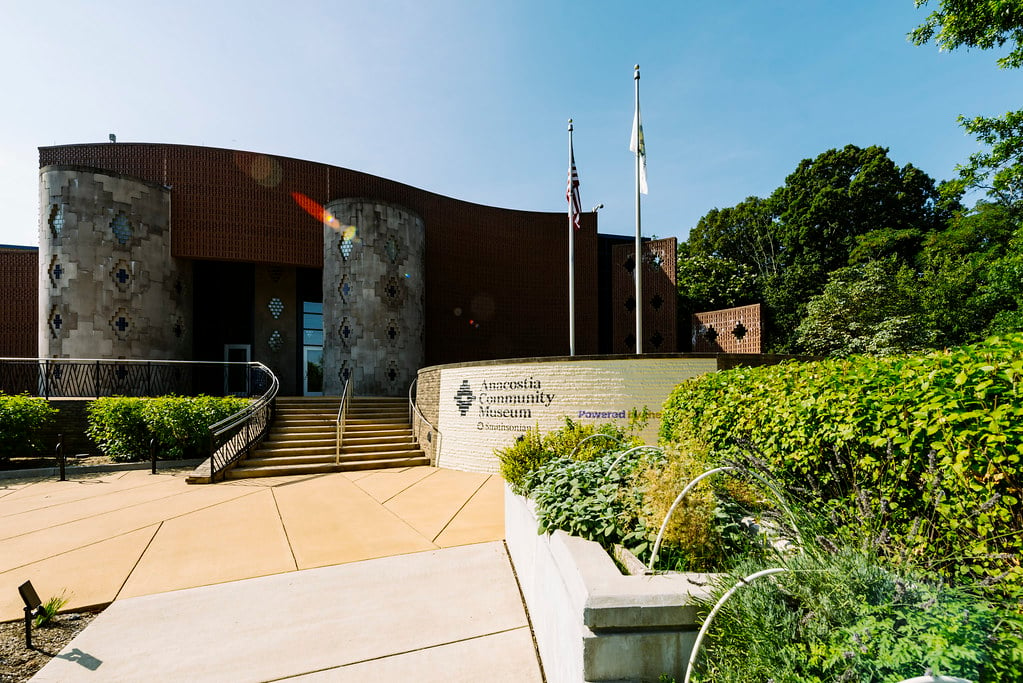
Timed to the country’s 250th anniversary, the Anacostia Community Museum is reopening on May 30 with a new exhibition, “We Make History,” that explores how communities create and preserve historical records. The museum has been closed since January 5 to install the new exhibit, which will be on view until January 2028.
“We Make History” gathers artifacts from the Anacostia Community Museum’s permanent collection, as well as other items on loan from partner institutions. The exhibition’s star attraction is a diary written by Adam Francis Plummer, an enslaved man who once lived in Prince George’s County. The exhibition opens on the 185th anniversary of the day that Plummer began the diary: May 30, 1841. “He faithfully kept that diary throughout his life, and after he passed in 1905, his daughter Nellie Arnold Plummer continued it,” says Jennifer Sieck, curator at the Anacostia Community Museum. “It’s likely the only example of a multi-generational diary by an enslaved person in the United States.”
Artifacts like the Plummer diary, the coat Marian Anderson wore at her 1939 Lincoln Memorial concert, and a hat sported by journalist Ethel L. Payne will demonstrate how ordinary people can preserve items that help tell extraordinary stories. The exhibition is divided into four sections that spotlight the ways individuals have made and kept history in the District, focusing on primary sources, historical locations, sports, and artistic contributions. Sieck describes the walk-through as a “workshop” that asks visitors to consider how they already practice record-keeping in their everyday lives.
In the interactive sections, attendees can make their own sports collectible card, pose for a selfie in front of a large image of the historic Howard Theater, write a history on a magnetic table, or use “bricks” to make a model of a place they’d like to preserve.
The exhibit also celebrates Anacostia Community Museum’s mission of community-driven museum work, with its run coinciding with the museum’s 50th anniversary in September 2027. Sieck hopes that “We Make History” will encourage the community to see how their family treasures and stories could belong in local libraries and museums. “Something all of us can do,” she says, “is to record our experiences and research our family history, interview our family members, and try to document what it’s like for us now.”

Dara T. Mathis is a journalist and nonfiction writer who joined Washingtonian in Fall 2025 as an Editorial Fellow. A 2024 recipient of the American Mosaic Journalism Prize, she resides in Prince George’s County, Maryland.